
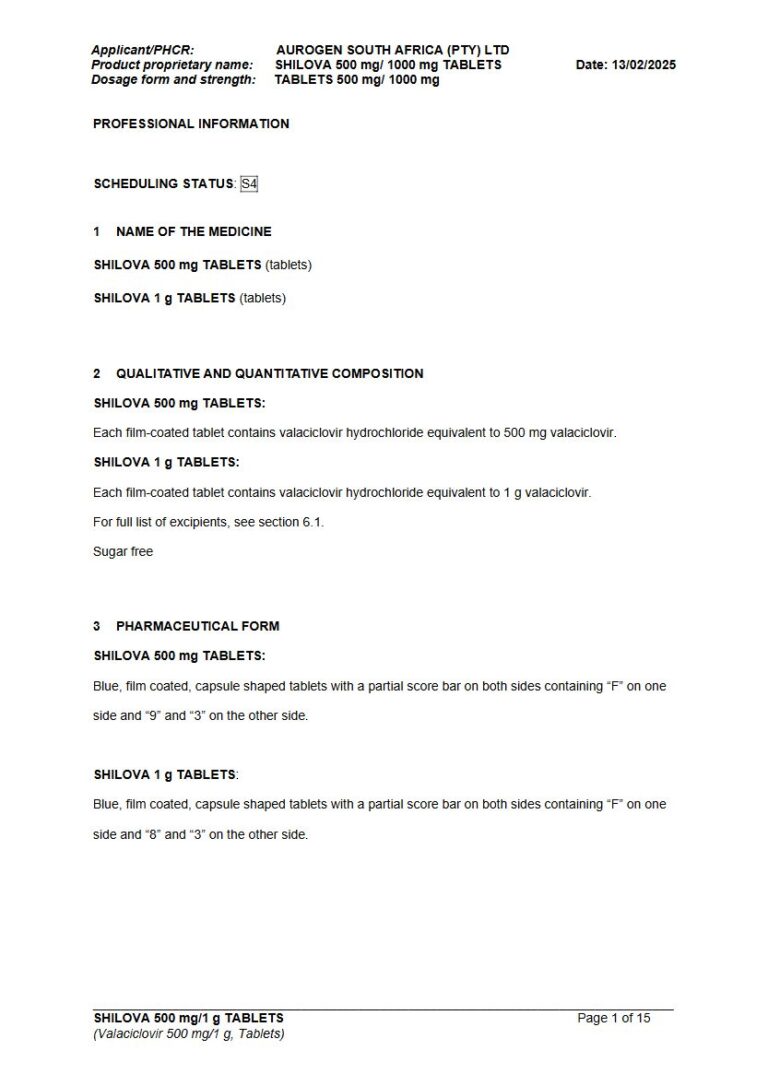
Shilova 500 mg/ 1000 mg TABLETS
PDF Leaflet Revision Date: 13 February 2025
Clinical Summary
Quick overview from the medicine insert
Indication
Treatment of herpes zoster and recurrent genital herpes.
Dosage (summary)
Herpes Zoster: 1000 mg TID for 7 days; Genital Herpes: 500 mg BID for 5 days.
Special Populations
- Elderly
- Renal impairment
- Hepatic impairment
Pregnancy & Breastfeeding
Safety not established; potential teratogenicity.
Key Drug Interactions
- Cimetidine
- Probenecid
- Nephrotoxic agents
Contraindications
- Hypersensitivity to valaciclovir or aciclovir
Common side effects
- Headache
- Nausea
- Dizziness
Counselling Points
- Avoid intercourse during outbreaks.
- Maintain adequate hydration.
- Monitor for severe skin reactions.
Serious warnings
- Risk of TTP/HUS
- CNS adverse reactions
- Severe skin reactions
Important Disclaimer
The Shilova 500 mg/ 1000 mg TABLETS professional information leaflet below is the property of Aurogen South Africa and is provided on Medinsert exactly as issued, with no.. alterations or editorial changes. We make every effort to keep content current by updating documents as soon as new versions become available. Medinsert serves as a trusted access point for healthcare professionals, but does not replace official sources or clinical judgement. For more details, please read our full disclaimer. read more>>
 Healthcare Professionals Only
This content is for registered healthcare professionals
Sign in or create a free account to read the full package insert.
Free for HPCSA-registered professionals. Powered by Medinsert.
Clinical Particulars
Section 4 of the official insert — extracted exactly as issued, no alterations
4.1 Therapeutic indication
SHILOVA TABLETS is indicated for the treatment of herpes zoster (shingles). SHILOVA TABLETS reduces the duration of zoster-associated pain, which includes acute and postherpetic neuralgia, thus accelerating resolution of pain. SHILOVA TABLETS also reduces the proportion of patients with zoster-associated pain. SHILOVA TABLETS is indicated for the episodic treatment of recurrent genital herpes in immunocompetent adult patients. SHILOVA TABLETS is indicated for the prevention (suppression) of recurrent herpes simplex infection of the skin and mucous membrane of the ano-genital area. SHILOVA TABLETS is indicated for the prophylaxis of cytomegalovirus (CMV) infection, CMV disease and other herpes virus infections following organ transplantation, where special risk exists.
4.2 Posology and method of administration
Posology
Dosage in adults: For the treatment of Herpes Zoster: 1000 mg of SHILOVA TABLETS to be taken three times per day for seven days. Recurrent genital herpes: The recommended dosage for the treatment of recurrent genital herpes is 500 mg twice daily for 5 days. Dosing should begin as early as possible. For recurrent episodes of herpes simplex, this should ideally be during the prodromal period or immediately the first signs or symptoms appear. There are no data on the effectiveness of SHILOVA TABLETS when initiated more than 24 hours after the onset of signs and symptoms. For the prevention (suppression) of recurrences of herpes simplex infection: Immunocompetent patients: 500 mg to be taken once daily. Some patients with very frequent recurrences (e.g. 10 or more per year) may gain additional benefit from the daily dose of 500 mg being taken as a divided dose (250 mg twice daily). Immunocompromised patients: 500 mg twice daily.
Prophylaxis of cytomegalovirus infection (CMV) and disease: Adults and adolescents (from 12 years of age): 2000 mg to be taken four times a day. Dosing should be initiated as early as possible post-transplant. This dose should be reduced according to creatinine clearance (See Dosage in renal impairment). The duration of treatment will usually be 90 days but may need to be extended in high-risk patients.
Paediatric population
No data are available.
Special populations
Dosage in the elderly: Dosage modification is not required unless renal function is impaired (see Dosage in renal impairment). Adequate hydration should be maintained.
Dosage in renal impairment: The dose of SHILOVA TABLETS should be modified as follows in patients with significantly impaired renal function: HERPES ZOSTER
Creatinine Clearance
SHILOVA TABLETS Dose
15 - 30 ml/min
1000 mg twice a day
< 15 ml/min
1000 mg once a day
RECURRENT GENITAL HERPES
Creatinine Clearance
SHILOVA TABLETS Dose
> 15 ml/min
500 mg twice daily
0 - 15 ml/min
500 mg once daily
PREVENTION OF RECURRENCE
Creatinine Clearance
SHILOVA TABLETS Dose
Immunocompetent
Immunocompromised
15 - 30 ml/min
No dosage adjustment required
No dosage adjustment required
< 15 ml/min
250 mg once a day
500 mg once daily
In patients on haemodialysis, the SHILOVA TABLETS dose recommended for patients with a creatinine clearance of less than 15 ml/min should be used, but the dose should be administered after the haemodialysis has been performed.
CMV PROPHYLAXIS: The dosage of SHILOVA TABLETS should be adjusted in patients with impaired renal function as shown in the table below:
Creatinine Clearance
SHILOVA TABLETS Dose
u2265 75 ml/min
2000 mg four times daily
50 to < 75 ml/min
1500 mg four times daily
25 to < 50 ml/min
1500 mg three times daily
10 to < 25 ml/min
1500 mg twice daily
< 10 ml/min or dialysis**
1500 mg once daily
** In patients on haemodialysis, the SHILOVA TABLETS dosage should be administered after the haemodialysis has been performed. The creatinine clearance should be monitored frequently, especially during periods when renal function is changing rapidly e.g. immediately after transplantation or engraftment. The SHILOVA TABLETS dosage should be adjusted accordingly.
Dosage in hepatic impairment: Dose modification is not required in patients with mild or moderate cirrhosis (hepatic synthetic function maintained). Pharmacokinetic data in patients with advanced cirrhosis (impaired hepatic synthetic function and evidence of portal-systemic shutting) do not indicate the need for dosage adjustment; however, clinical experience is limited.
Method of administration
To be taken orally.
4.3 Contraindications
SHILOVA TABLETS is contraindicated in patients known to be hypersensitive to valaciclovir, aciclovir or any component of their formulations. Safety in pregnancy and lactation has not been established. (See section 4.6).
4.4 Special warnings and precautions for use
Thrombotic, thrombocytopenic purpura/haemolytic uraemic syndrome (TTP / HUS): TTP / HUS in some cases resulted in death, has been reported in patients with advanced HIV disease and also in bone marrow transplant and renal transplant recipients. Cases of acute renal failure have been reported in:
u2022 Elderly patients with or without reduced renal function. Caution should be exercised when administering SHILOVA TABLETS to elderly patients, and dosage reduction is recommended for those with impaired renal function.
u2022 Patients with underlying renal disease who received higher than recommended doses of SHILOVA TABLETS for their level of renal function. Dosage reduction is recommended when administering SHILOVA TABLETS to patients with renal impairment.
u2022 Patients receiving other nephrotoxic medicines. Caution should be exercised when administering SHILOVA TABLETS to patients receiving potentially nephrotoxic medicines.
u2022 Patients without adequate hydration. Precipitation of aciclovir in renal tubules may occur when solubility (2,5 mg/ml) is exceeded in the intratubular fluid. Adequate hydration should be maintained for all patients. In the event of acute renal failure and anuria, the patient may benefit from haemodialysis until renal function is restored.
Central Nervous System (CNS)
CNS adverse reactions, including agitation, hallucinations, confusion, delirium, seizures, and encephalopathy, have been reported in both adult and paediatric patients with or without reduced renal function and in patients with underlying renal disease who received higher than recommended doses of SHILOVA TABLETS for their level of renal function. Elderly patients are more likely to have CNS adverse reactions. SHILOVA TABLETS should be discontinued if CNS adverse reactions occur.
Skin and appendage
Severe cutaneous adverse reactions (SCARS) including toxic epidermal necrolysis (TEN) Stevens Johnson Syndrome (SJS) and drug reaction with no eosinophilia and systemic symptoms (DRESS), which could be life-threatening or fatal, have been reported with SHILOVA TABLETS (see section 4.8).At the time of prescription, patients should be advised of the signs and symptoms of severe skin reactions and closely monitored. If signs and symptoms suggestive of these reactions appear, SHILOVA TABLETS should be discontinued immediately, and an alternative treatment should be considered. If the patient has developed a serious reaction such as SJS, TEN or DRESS with use of SHILOVA TABLETS, treatment with SHILOVA TABLETS must not be restarted in this patient at any time.
Use in genital herpes
Patients should be advised to avoid intercourse when symptoms are present even if treatment with an antiviral has been initiated. Continuous therapy with SHILOVA TABLETS in patients with recurrent genital herpes reduces the risk of transmitting genital herpes. It does not cure genital herpes or completely eliminate the risk of transmission. In addition to therapy with valaciclovir, it is recommended that patients use safer sex practices. As genital herpes is a sexually transmitted infection, patients should, in order to further reduce the risk of infecting partners, avoid contact with lesions, damaged skin/mucosa, and avoid intercourse when lesions and/or symptoms are present. Genital herpes is frequently transmitted in the absence of symptoms through asymptomatic viral shedding; therefore, patients should be counselled to use safer sex practices. The effect of SHILOVA TABLETS on transmission of sexually transmitted infections other than herpes (including HIV, gonorrhoea, syphilis and Chlamydia) is unknown. The efficacy of SHILOVA TABLETS for reducing transmission of genital herpes has not been established in individuals with multiple partners, non-heterosexual couples and couples not counselled to use safer sex practises.
4.5 Interaction with other medicines and other forms of interaction
No clinically significant interactions have been identified. Cimetidine and probenecid increase the area under the plasma concentration time curve of aciclovir by reducing its renal clearance: however, no dosage adjustment is necessary because of the wide therapeutic index of aciclovir. Other medicines which affect renal physiology could affect plasma levels of aciclovir. In patients receiving high-dose SHILOVA TABLETS (8 g/day) for CMV prophylaxis, caution is required during concurrent administration with medicines which compete with aciclovir for elimination, because of the potential for increased plasma levels of one or both medicines or their metabolites. Increases in plasma AUCs of aciclovir and of the inactive metabolite of mycophenolate mofetil, an immunosuppressant agent used in transplant patients, have been shown when the medicines are co-administered. Care is also required (with monitoring for changes in renal function) if administering high-dose SHILOVA TABLETS with medicines which affect other aspects of renal physiology (e.g. cyclosporin, tacrolimus).
4.6 Fertility, pregnancy and lactation
Safety in pregnancy and lactation has not been established (see section 4.3). Teratogenicity: Foetal abnormalities were observed in rats.
4.7 Effects on ability to drive and use machines
When driving vehicles or using machines it should be taken into account that dizziness or weariness or visual disturbances may occur.
4.8 Undesirable effects
MedDRA system organ class
Frequency
Adverse reactions
Blood and the lymphatic system disorders
Less frequent
Aplastic anaemia
Thrombocytopenia
Haemolytic anaemia, micro-angiopathic, neutropenia.
Leukocytoclastic vasculitis.
Immune system disorders
Less frequent
Acute hypersensitivity reactions and anaphylaxis and angioedema
Nervous system disorders
Frequent:
Headache
Less frequent
Decreased consciousness in patients with renal insufficiency
Dizziness, somnolence, convulsions Fatigue
Aggressive behaviour
Agitation
Ataxia, coma, confusion, dysarthria, encephalopathy, seizures and tremors
Psychiatric disorders:
Less frequent
Mania and psychosis, including auditory and visual hallucinations.
Eye disorders:
Less frequent
Visual abnormalities
Cardiac disorders:
Less frequent
Tachycardia
Vascular disorder:
Less frequent
Hypertension
Gastrointestinal disorders:
Frequent
Nausea.
Less frequent
Gastrointestinal disturbances such as constipation, diarrhoea, loss of appetite, stomach pain, vomiting.
Hepato-biliary disorders:
Less frequent
Hepatitis with liver function test abnormalities, jaundice.
Skin and subcutaneous tissue disorders:
Less frequent
Facial oedema.
Skin reactions such as erythema multiforme, photosensitivity, or rash (redness of the skin).
Alopecia, Stevens-Johnson syndrome, toxic epidermal necrolysis, urticaria, pruritus.
Unknown frequency
Acute generalised exanthematous pustulosis (AGEP), Drug reaction with eosinophilia and systemic symptoms (DRESS).
Musculoskeletal, connective tissue and bone disorders:
Less frequent
Arthralgia.
Renal and urinary disorders:
Less frequent
Renal insufficiency manifested by increased serum creatinine, acute renal failure
Reproductive system and breast disorders:
Less frequent
Dysmenorrhoea
Reporting of suspected adverse reactions
Reporting suspected adverse reactions after authorisation of the medicine is important. It allows continued monitoring of the benefit/risk balance of the medicine. Health care providers are requested to report any suspected adverse drug reactions to SAHPRA via the Med Safety APP (Medsafety X SAHPRA) and eReporting platform (who-umc.org) found on SAHPRA website.
4.9 Overdose
Symptoms and signs: There are at present no data available on overdose with SHILOVA TABLETS. In animal studies, large doses caused obstructive uropathy and crystalluria.
Management: In the event of asymptomatic SHILOVA TABLETS overdose occurring, aciclovir is removable by haemodialysis.
