
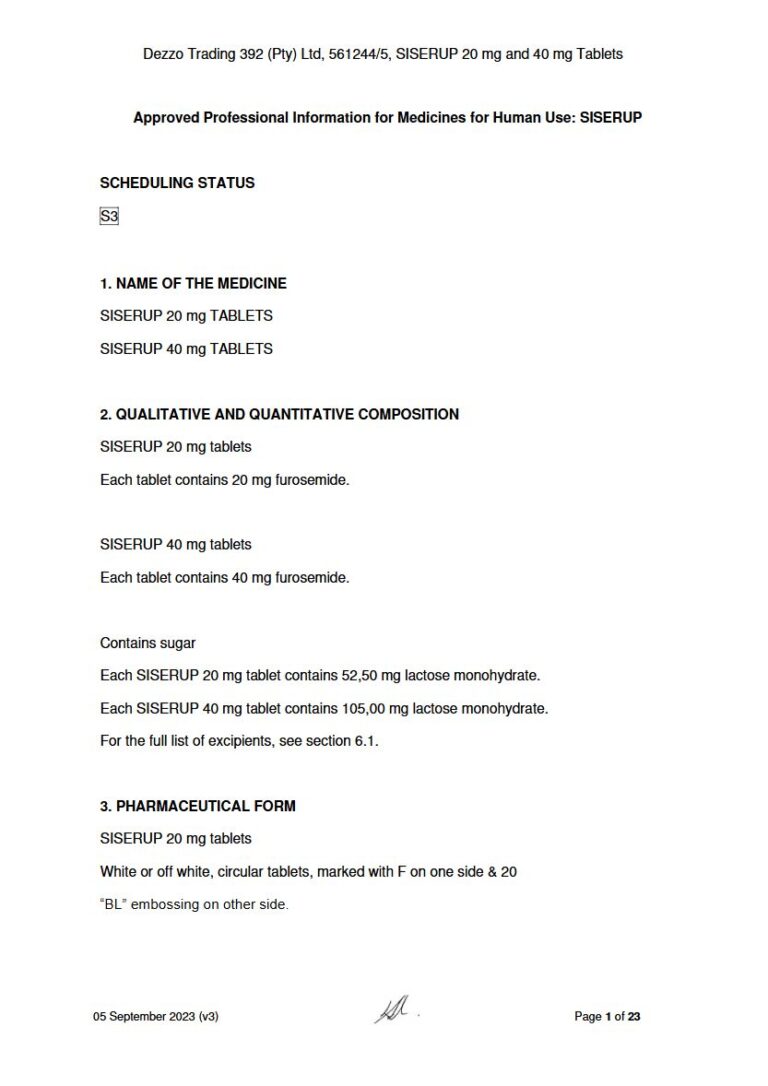
Siserup 40 Mg/20 mg Tablets
PDF Leaflet Revision Date: 05 September 2023
Clinical Summary
Quick overview from the medicine insert
Indication
Management of various forms of edema and hypertension.
Dosage (summary)
20 mg to 80 mg daily, may increase based on response.
Onset of Action / Duration
Onset: 30 mins, Duration: 4-5 hours
Special Populations
- Elderly
- Renal impairment
- Hepatic impairment
Pregnancy & Breastfeeding
Contraindicated in pregnancy and breastfeeding.
Key Drug Interactions
- ACE inhibitors
- NSAIDs
- Antipsychotics
- Lithium
Contraindications
- Hypersensitivity to furosemide
- Anuria
- Severe electrolyte disturbances
Common side effects
- Dehydration
- Hypokalaemia
- Dizziness
- Nausea
Counselling Points
- Take in the morning
- Monitor for dehydration
- Avoid potassium supplements without consulting
Serious warnings
- Risk of hypotension
- Ototoxicity
- Electrolyte imbalances
Important Disclaimer
The Siserup 40 Mg/20 mg Tablets professional information leaflet below is the property of Dezzo Trading 392 and is provided on Medinsert exactly as issued, with no.. alterations or editorial changes. We make every effort to keep content current by updating documents as soon as new versions become available. Medinsert serves as a trusted access point for healthcare professionals, but does not replace official sources or clinical judgement. For more details, please read our full disclaimer. read more>>
 Healthcare Professionals Only
This content is for registered healthcare professionals
Sign in or create a free account to read the full package insert.
Free for HPCSA-registered professionals. Powered by Medinsert.
Clinical Particulars
Section 4 of the official insert — extracted exactly as issued, no alterations
4.1 Therapeutic indications
Cardiac oedema: All forms of cardiac oedema in conjunction with adequate glycoside therapy.
Ascites due to cirrhosis of the liver, mechanical obstruction or cardiac failure.
Renal oedema in nephrotic syndrome.
Oedema occurring during the last three months of pregnancy - pre-eclamptic toxaemia and eclampsia.
As an adjunct in acute pulmonary oedema.
Cerebral oedema.
Hypertension of mild to moderate degree.
Barbiturate poisoning (using the principle of u201cforced diuresisu201d).
Burns: to reduce local oedema and to prevent oliguria from progressing to complete anuria.
4.2 Posology and method of administration
The usual dose of SISERUP is 20 mg to 80 mg per day given as a single dose, preferably in the morning. This dose may, however, be increased depending on the response of the patient.
Six hours after a 40 mg dose, 80 mg may be administered and, if necessary, after another six hours, 120 mg. After the oedema is controlled, maintenance therapy is continued at 20 mg to 40 mg daily. Daily doses exceeding 120 mg should preferably be distributed over two to three individual doses.
For the treatment of hypertension of mild or moderate degree, a daily dosage of 40 mg to 80 mg is taken orally. In combination with other hypotensive drugs, lower doses will often suffice.
Forced diuresis (e.g. management of barbiturate poisoning) 20 mg to 40 mg SISERUP is given in addition to infusion of electrolyte solution. Further treatment depends on the elimination of urine and must include substitution of the fluid and electrolyte losses. In poisoning with acid or basic substances the elimination rate can be further increased by alkalisation or acidification of the urine, respectively.
Infants and children under 15 years Children generally receive an oral dose of 2 mg/kg body mass per day in divided doses. This may be titrated to a maximum of 6 mg/kg.
Method of administration SISERUP is for oral administration.
4.3 Contraindications
- Hypersensitivity to furosemide or sulphonamides or to any of the excipients listed in section 6.1.
- SISERUP is contraindicated if increasing azotaemia and oliguria occur during treatment of severe progressive renal disease, anuria, hypokalaemia, hyponatraemia, hypovolaemia with or without hypotension. In hepatic coma and in states of electrolyte depletion, therapy with SISERUP should not be instituted until the basic condition is corrected or improved.
- Furosemide should not be given to lactating women (see section 4.6).
- Furosemide should not be administered during pregnancy (see section 4.6).
- Anuria and impaired renal function (creatinine clearance below 30 mL/min per 1,73 m2 body surface area) and renal failure resulting from poisoning by nephrotoxic and/or hepatotoxic medicines.
- Electrolyte disturbances (severe hyponatraemia: severe hypokalaemia, hypovolaemia), dehydration and/or hypotension (see section 4.4).
- Concomitant potassium supplements or potassium sparing diuretics (see section 4.5).
- Pre-coma/coma associated with hepatic cirrhosis or encephalopathy Addison's disease.
- Digitalis intoxication (see also section 4.5).
4.4 Special warnings and precautions for use
Hypotension and/or hypovolaemia (see also section 4.3) These and any acid-base disturbances should be corrected before furosemide is started. Symptomatic hypotension leading to dizziness, fainting or loss of consciousness can occur in patients treated with furosemide, particularly in the elderly, patients on other medications which can cause hypotension and patients with other medical conditions that are risks for hypotension.
Dose titration/adjustment (see section 4.2) u2022 Patients with hypoproteinaemia (such as that associated with the nephrotic syndrome) require careful dose titration (reduced furosemide effect: increased risk of ototoxicity).
u2022 In moderate liver congestion dosage adjustment may be needed.
Caution required: Caution needed in the following circumstances u2022 impaired hepatic function (see sections 4.2 & 4.3 and below u2013 monitoring required), u2022 impaired renal function and hepato-renal syndrome (see section 4.3 and below u2013 monitoring required), u2022 diabetes mellitus (latent diabetes may become overt: insulin requirements in established diabetes may increase), u2022 elderly patients, u2022 difficulty with micturition/potential obstruction in the urinary tract including prostatic hypertrophy (increased risk of acute retention), u2022 gout (increased risk of hyperuricaemia), u2022 patients at risk of pronounced falls in blood pressure.
Renal disorders SISERUP should be used with care in patients with prostatic hyperplasia or impairment of micturition since it can precipitate acute urinary retention.
Clinical monitoring requirements (see also section 4.8): Regular monitoring for u2022 blood dyscrasias. If these occur, stop furosemide immediately, u2022 liver damage, u2022 idiosyncratic reactions. In premature infants there is a risk of development of nephrocalcinosis /nephrolithiasis. Renal function must be monitored, and renal ultrasonography performed.
Laboratory monitoring requirements: u2022 frequent blood urea nitrogen (BUN) in first few months of treatment, periodically thereafter, u2022 serum electrolytes with replacement as appropriate.
Other alterations in lab values u2022 Serum creatinine and urea levels tend to rise during treatment. u2022 Serum cholesterol and triglycerides may rise but usually return to normal within 6 months of starting furosemide. u2022 Furosemide should be discontinued before a glucose tolerance test.
Excipient lactose This medicine contains lactose: Patients with rare hereditary problems of galactose intolerance, total lactase deficiency or glucose - galactose malabsorption should not take this medicine.
Excipient sodium SISERUP 20 mg contains less than 1 mmol sodium (23 mg) per tablet, that is to say essentially u2018sodium - freeu2019. SISERUP 40 mg contains less than 1 mmol sodium (23 mg) per tablet, that is to say essentially u2018sodium - freeu2019.
4.5 Interaction with other medicinal products and other forms of interaction
Angiotensin-converting enzyme (ACE) inhibitors Enhanced hypotensive effect when given with diuretics. A marked fall in blood pressure and deterioration in renal function may be seen when ACE inhibitors are added to furosemide therapy. The dose of furosemide should be reduced for at least three days, or the medicine stopped, before initiating the ACE inhibitor or increasing the dose of an ACE inhibitor.
Alpha-blockers Enhanced hypotensive effect when diuretics are given with alpha-blockers, also increased risk of first dose hypotension with post-synaptic alpha-blockers such as prazosin.
Antipsychotics Hypokalaemia caused by diuretics increase the risk of ventricular arrhythmias with amisulpiride or sertindole. An enhanced hypotensive effect may be seen when diuretics are given with phenothiazines. Hypokalaemia caused by diuretics increases risk of ventricular arrhythmias with pimozide (avoid concomitant use).
Antidepressants Possible increase of hypokalaemia when loop diuretics are given with reboxetine. There is an enhanced hypotensive effect when diuretics are given with Monoamine oxidase inhibitors (MAOIs). There is an increased risk of postural hypotension when diuretics are given with tricyclic antidepressants.
Anti-dysrhythmics Hypokalaemia caused by loop diuretics increases cardiac toxicity with amiodarone, disopyramide, flecainide, and antagonises the action of lidocaine and mexiletine.
Analgesics Diuretics can increase the risk of nephrotoxicity of non-steroidal anti-inflammatory drugs (NSAIDs), also antagonism of diuretic effect. Antagonism of diuretic effect (especially with indomethacin and ketorolac). Salicylic toxicity may be increased by furosemide.
Angiotensin u2013 II receptor antagonists Enhanced hypotensive effect when diuretics given with angiotensin-II receptor antagonists.
Antibacterials Avoid the use of diuretics in lymecycline treatment. There is an increased risk of ototoxicity when loop diuretics are given with aminoglycosides, polymyxins or vancomycin. Since this may lead to irreversible damage, these medicines must only be used with furosemide if there are compelling medical reasons. Impairment of renal function may develop in patients receiving concurrent treatment with furosemide and high doses of certain cephalosporins.
Antiepileptics There is an increased risk of hyponatraemia when diuretics are given with carbamazepine. The effects of furosemide are antagonised by phenytoin.
Antifungals There is an increased risk of hypokalaemia when loop diuretics are given with amphotericin.
Antivirals Plasma concentration of diuretics may be increased by nelfinavir, ritonavir or saquinavir.
Atomoxetine Hypokalaemia caused by diuretics increases the risk of ventricular dysrhythmias with atomoxetine.
Barbiturates Plasma concentrations of diuretics may be decreased. There may be an increased risk of osteomalacia when diuretics are taken in combination with phenobarbital.
Beta-blockers There is an enhanced hypotensive effect when diuretics are given with beta-blockers. Hypokalaemia caused by loop diuretics increases the risk of ventricular dysrhythmias with sotalol.
Cardiac glycosides Hypokalaemia caused by loop diuretics increases cardiac toxicity with cardiac glycosides.
Ciclosporin There is an increased risk of nephrotoxicity and possibly hypermagnesemia when diuretics are given with ciclosporin.
Cisplatin There is a risk of increased ototoxic effects if cisplatin and furosemide are given concomitantly. In addition, nephrotoxicity of cisplatin may be enhanced if furosemide is not given in low doses (e.g., 40 mg in patients with normal renal function) and with positive fluid balance when used to achieve forced diuresis during cisplatin treatment.
Corticosteroids The diuretic effect of diuretics is antagonized by corticosteroids. There is an increased risk of hypokalaemia when loop diuretics are given with corticosteroids.
Other diuretics There is an increased risk of hypokalaemia when loop diuretics are given with acetazolamide. Profound diuresis is possible when metolazone is given with furosemide. There is an increased risk of hypokalaemia when loop diuretics are given with thiazides and related diuretics.
Lithium Loop diuretics reduce the excretion of lithium, which may lead to increased plasma concentrations and a risk of toxicity. Therefore, it is recommended that lithium levels are carefully monitored and where necessary the lithium dosage is adjusted in patients receiving this combination.
Potassium salts There is an increased risk of hyperkalaemia when given with potassium salts.
Sucralfate Furosemide and sucralfate must not be taken within 2 hours of each other as sucralfate decreases the absorption of furosemide from the intestine and so reduces its effect.
Sympathomimetics, beta-2 There is an increased risk of hypokalaemia when loop diuretics are given with high doses of beta-2 sympathomimetics.
Tacrolimus There is an increased risk of hypokalaemia when given with tacrolimus.
Theophylline There is an increased risk of hypokalaemia when loop diuretics are given with theophylline.
Carbenoxolone, prolonged use of laxatives, liquorice May increase the risk of developing hypokalaemia.
Warfarin and clofibrate Warfarin and clofibrate compete with furosemide in the binding to serum albumin. This may have clinical significance in patients with low serum albumin levels (e.g., in nephrotic syndrome). Furosemide does not change the pharmacokinetics of warfarin to a significant extent, but a strong diuresis with associated dehydration may weaken the antithrombotic effect of warfarin.
Probenecid, methotrexate and other medicines which, like furosemide, undergo significant renal tubular secretion may reduce the effect of furosemide. Conversely, furosemide may decrease renal elimination of these medicines. In case of high-dose treatment (in particular, of both furosemide and the other medicines), this may lead to increased serum levels and an increased risk of adverse effects due to furosemide or the concomitant medication.
Risperidone When administering risperidone, caution should be exercised and the risks and benefits of the combination or co-treatment with furosemide or with other potent diuretics should be considered prior to the decision to use. See section 4.4 Special warnings and precautions for use regarding increased mortality in elderly patients with dementia concomitantly receiving risperidone.
Electrolyte imbalances Although administration of furosemide only rarely leads to hypokalaemia, a potassium rich diet is advisable. Treatment with potassium containing or potassium sparing preparations may be indicated.
4.6 Fertility, pregnancy and lactation
SISERUP should not be given during pregnancy only if strictly indicated, and then only for short periods of time (see section 4.3).
Breastfeeding Furosemide passes into breast milk and may inhibit lactation. Women must not breastfeed if they are treated with furosemide (see section 4.3).
Fertility No human data on the effect of furosemide on fertility are available.
4.7 Effects on ability to drive and use machines
Reduced mental alertness and rarely dizziness and blurred vision have been reported. Patients so affected should not drive or operate machinery.
4.8 Undesirable effects
a) Tabulated list of adverse reactions The table below shows all adverse drug reactions (ADRs) observed during clinical trials and post market spontaneous reports with furosemide.
System Organ Class Frequency Frequent Less Frequent Not known Blood and lymphatic system disorders Aplastic anaemia Bone marrow depression (necessitates withdrawal of treatment), eosinophilia, leukopenia. Haemolytic anaemia, agranulocytosis, thrombocytopenia, vasculitis.
Metabolism and nutritional disorders Dehydration, hyponatraemia, hypochloremic metabolic alkalosis, hypocalcaemia, hypomagnesemia (incidences of the last three are reduced by triamterene), nephrocalcinosis in infants. Hypovolaemia, hypochloraemia. Impaired glucose tolerance (by hypokalaemia) hyperuricaemia, gout, reduction of serum HDL- cholesterol, elevation of serum LDL-cholesterol, elevation of serum triglycerides, hyperglycaemia, tetany. aggravated pre-existing metabolic alkalosis (in decompensated cirrhosis of the liver), fluid and electrolyte disturbances, hyperglycaemia.
Psychiatric disorder Psychiatric disorder Nervous system disorders Paraesthesia, confusion, headache, dizziness, tetany. Eye disorders: Visual disturbance, blurred vision, yellow vision. Ear and labyrinth disorders Tinnitus and reversible or irreversible loss of hearing (although usually transitory, particularly in patients with renal failure, hypoproteinaemia (e.g. in nephritic syndrome).
Cardiac disorders Orthostatic intolerance, cardiac dysrhythmias, increased risk or persistence of patent ductus arteriosus in premature infants. Vascular disorders Decreased blood pressure, (which, if pronounced may cause signs and symptoms such as impairment of concentration and reactions, light-headedness, sensations of pressure in the head, headache, dizziness, drowsiness, weakness, disorders of vision, dry mouth, orthostatic intolerance).
Gastrointestinal disorders Dry mouth, thirst, nausea, bowel motility disturbances, vomiting, diarrhoea, constipation, acute pancreatitis (in long-term diuretic treatment, including furosemide).
Hepatobiliary disorders Pure intrahepatic cholestasis (jaundice), hepatic function abnormal.
Skin and subcutaneous tissue disorders Rash, pruritus, photosensitivity, toxic epidermal necrolysis. Urticaria, erythema multiforme, purpura, exfoliative dermatitis, itching, allergic reactions, such as skin rashes, various forms of dermatitis including urticaria, bullous lesions, when these occur treatment should be withdrawn.
Musculoskeletal and connective tissue disorders Muscle cramps, muscle weakness Renal and urinary disorders Reduced diuresis, urinary incontinence, urinary obstruction (in patients with hyperplasia of the prostate, bladder inability to empty, urethral stricture unspecified).
Nephrocalcinosis (in pre-term infants treated with furosemide), interstitial nephritis, acute renal failure. Congenital, familial and genetic disorders Patent ductus arteriosus General disorders and administration site conditions: Fatigue, malaise, fever, severe anaphylactoid or anaphylactic reactions (e.g. with shock).
Investigations Creatinine increased; blood urea increased Reporting of suspected adverse reactions Reporting suspected adverse reactions after authorisation of the medicine is important. It allows continued monitoring of the benefit/risk balance of the medicine. Healthcare professionals are asked to report any suspected adverse reactions to SAHPRA via the u201c6.04 Adverse Drug Reaction Reporting Formu201d, found online under SAHPRAu2019s publications: https://www.sahpra.org.za/Publications/Index/8
4.9 Overdose
Fluid, electrolyte depletion and dehydration are the most common symptoms in over dosage. The guiding principal of treatment is water and electrolyte replacement in accordance with urine output. If difficulty in micturition is proved or suspected, as in cases of prostatic hypertrophy or impairment of consciousness, care must be taken to ensure a free outflow of urine from the bladder. Other than the above, treatment is supportive and symptomatic.
