
Frusemide Fresenius 20 Mg/2 Ml Solution
PDF Leaflet Revision Date: 03 May 2022
Clinical Summary
Quick overview from the medicine insert
Indication
Management of edema associated with various conditions.
Dosage (summary)
20-40 mg IV, repeat after 2 hours if necessary; initial 40 mg for pulmonary edema.
Onset of Action / Duration
Onset: 5 mins, Duration: 3-6 hours
Special Populations
- Elderly
- Renal impairment
- Hepatic impairment
Pregnancy & Breastfeeding
Not recommended during pregnancy; contraindicated in breastfeeding.
Key Drug Interactions
- Aminoglycosides
- NSAIDs
- Digoxin
- Antidiabetics
Contraindications
- Hypersensitivity to furosemide
- Severe renal disease
- Anuria
- Hypovolaemia
Common side effects
- Hypokalaemia
- Dehydration
- Dizziness
- Tinnitus
Counselling Points
- Monitor fluid intake
- Report signs of dehydration
- Avoid alcohol
Serious warnings
- Ototoxicity with rapid infusion
- Risk of hypotension
- Electrolyte imbalances
Important Disclaimer
The Frusemide Fresenius 20 Mg/2 Ml Solution professional information leaflet below is the property of Fresenius Kabi Manufacturing Sa and is provided on Medinsert exactly as issued, with no.. alterations or editorial changes. We make every effort to keep content current by updating documents as soon as new versions become available. Medinsert serves as a trusted access point for healthcare professionals, but does not replace official sources or clinical judgement. For more details, please read our full disclaimer. read more>>
 Healthcare Professionals Only
This content is for registered healthcare professionals
Sign in or create a free account to read the full package insert.
Free for HPCSA-registered professionals. Powered by Medinsert.
Clinical Particulars
Section 4 of the official insert — extracted exactly as issued, no alterations
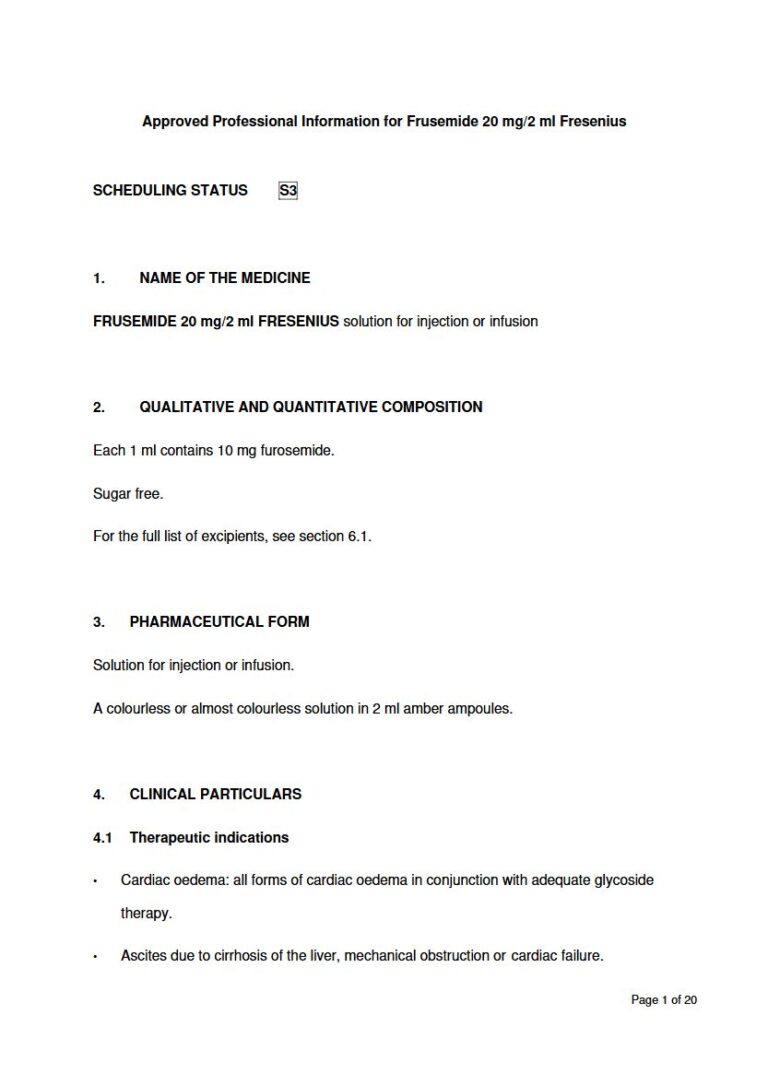
4.1 Therapeutic indications
u2022 Cardiac oedema: all forms of cardiac oedema in conjunction with adequate glycoside therapy.
u2022 Ascites due to cirrhosis of the liver, mechanical obstruction or cardiac failure.
u2022 Renal oedema (in nephrotic syndrome, usually in conjunction with ACTH or corticosteroids).
u2022 Pulmonary oedema.
u2022 Cerebral oedema.
u2022 Forced diuresis, e.g. management of barbiturate poisoning.
u2022 Burns: to reduce local oedema and to prevent oliguria from progressing to complete anuria.
4.2 Posology and method of administration
Posology
The recommended adult usual dose by this route is 20 u2013 40 mg, repeated if necessary after not less than 2 hours. Pulmonary oedema: Initial dose 40 mg intravenously. If necessary, the injection may be repeated after approximately 60 u2013 90 minutes. Forced diuresis (e.g. management of barbiturate poisoning): 20 mg to 40 mg FRUSEMIDE 20 mg/2 ml FRESENIUS is given in addition to infusion of electrolyte solution. Further treatment depends on the elimination of urine and must include substitution of the fluid and electrolyte losses. In poisoning with acid or basic substances the elimination rate can be further increased by alkalisation or acidification of the urine, respectively.
Special populations
Paediatric population (infants and children under 15 years): Parenteral administration (if necessary, continuous drip infusion) is indicated only in life-threatening conditions. In this case, infants/ children receive parenteral doses of 1 mg/kg body mass per day up to a maximum of 20 mg per day.
Method of administration
Intravenous or intramuscular administration of FRUSEMIDE 20 mg/2 ml FRESENIUS is indicated in all cases where intestinal absorption is impaired, prompt diuresis is required, or rapid fluid elimination is necessary. The rapid and powerful effect produced by intravenous injection may result in a transitory fall in plasma volume. Intravenously, FRUSEMIDE 20 mg/2 ml FRESENIUS should be injected slowly. The rate of injection of 4 mg per minute should not be exceeded. During long-term treatment, serum creatinine, urea and electrolytes (in particular potassium, calcium, chloride and bicarbonate) should be regularly checked.
4.3 Contraindications
u2022 Patients who are hypersensitive to furosemide, sulphonamides or to any other ingredient of FRUSEMIDE 20 mg/2 ml FRESENIUS (see section 4.3).
u2022 Increased uraemia, azotaemia and oliguria occurring during treatment of severe progressive renal disease.
u2022 Renal failure associated with hepatic coma, severe hypokalaemia, severe hyponatraemia and in pre-comatose and comatose states associated with hepatic encephalopathy.
u2022 In states of electrolyte depletion, hypovolaemia, dehydration and hypotension.
u2022 Anuria, or renal failure due to nephrotoxic or hepatotoxic medicines.
u2022 Pre-comatose states associated with hepatic cirrhosis.
u2022 Patients with Addisonu2019s disease or pre-existing hypercalcaemia.
u2022 Breastfeeding women.
4.4 Special warnings and precautions for use
Too vigorous diuresis may cause orthostatic hypotension or acute hypotensive episodes. Where indicated, steps should be taken to correct hypotension or hypovolaemia before commencing therapy. Regular monitoring of serum sodium, potassium and creatinine is generally recommended during furosemide, as in FRUSEMIDE 20 mg/2 ml FRESENIUS, therapy; particularly close monitoring is required in patients at high risk of developing electrolyte imbalances or in case of significant additional fluid loss. Hypovolaemia or dehydration as well as any significant electrolyte and acid-base disturbances must be corrected. This may require temporary discontinuation of FRUSEMIDE 20 mg/2 ml FRESENIUS. Urinary output must be secured. In patients with a partial obstruction of urinary outflow increased production of urine may provoke or aggravate complaints. These patients require careful monitoring. Patients with partial obstruction of urinary outflow, for example patients with prostatic hypertrophy or impairment of micturition have an increased risk of developing acute urinary retention and require careful monitoring.
In patients who are at high risk for radiocontrast nephropathy, FRUSEMIDE 20 mg/2 ml FRESENIUS is not recommended to be used for diuresis as part of the preventative measures against radiocontrast-induced nephropathy.
Ototoxicity
With parenteral use of FRUSEMIDE 20 mg/2 ml FRESENIUS in high doses, reversible deafness and tinnitus have been reported when the infusion is faster than 4 mg per minute. Permanent deafness may develop in patients with impaired renal function. Particularly careful monitoring is required in: u2022 patients with hypotension u2013 correct before use; u2022 patients who are at risk from a pronounced fall in blood pressure; u2022 patients with gout; u2022 patients with adrenal disease; u2022 patients with hypoproteinaemia, e.g. associated with nephrotic syndrome (the effect of furosemide may be weakened, and its ototoxicity potentiated). Cautious dose titration is required; u2022 elderly patients (see Electrolyte and fluid disturbances ); u2022 premature infants (possible development of nephrocalcinosis/ nephrolithiasis u2013 renal function must be monitored and renal ultrasonography performed); u2022 patients with impaired hepatic or renal function. Liver damage or dysfunction as well as renal failure have been reported (see also section 4.3).
Glucose tolerance and diabetes mellitus
Alterations in glucose tolerance tests with abnormalities of the fasting and 2-hour postprandial sugar levels have been observed and cases of precipitation of diabetes mellitus have been reported. Use with caution in patients with diabetes mellitus. The insulin requirements of diabetic patients may increase.
Electrolyte and fluid disturbances
A frequent side effect associated with FRUSEMIDE 20 mg/2 ml FRESENIUS therapy is fluid and electrolyte imbalance including hyponatraemia, hypokalaemia and hypochloraemic alkalosis, particularly after large doses or prolonged administration. Excessive diuresis may result in dehydration and reduction in blood volume, with circulatory collapse and with the possibility of vascular thrombosis and embolism, particularly in elderly patients. Because of the strong natriuretic effect of FRUSEMIDE 20 mg/2 ml FRESENIUS, the sodium levels could be reduced especially if the oedema is reduced quickly. Magnesium depletion may develop. FRUSEMIDE 20 mg/2 ml FRESENIUS increases urinary excretion of calcium, may lower serum calcium levels and cases of tetany have been reported. The risk of hypokalaemia is increased in patients with severe or congestive heart failure, hepatic cirrhosis or hyperaldosteronism. Excessive loss of potassium in patients receiving cardiac glycosides may precipitate digoxin toxicity. Care should also be taken in patients receiving potassium-depleting steroids.
Hypokalaemia may be counteracted with a potassium-rich diet. If a deficiency state exists u2013 especially in cirrhosis u2013 the serum potassium must first be restored by potassium supplementation, and if necessary, sodium and chloride. Caution should be observed in patients liable to electrolyte deficiency, such as the elderly. Regular monitoring of serum sodium, potassium and creatinine is generally recommended during FRUSEMIDE 20 mg/2 ml FRESENIUS therapy. Particularly close monitoring is required in patients at high risk of developing electrolyte imbalances or in case of significant additional fluid loss. Hypovolaemia or dehydration as well as any significant electrolyte and acid-base disturbances must be corrected. This may require temporary discontinuation of FRUSEMIDE 20 mg/2 ml FRESENIUS.
4.5 Interactions with other medicines
Cross-sensitivity may occur between furosemide, as in FRUSEMIDE 20 mg/2 ml FRESENIUS, and sulphonamides (see section 4.3). Interactions that may be expected with the concomitant administration of FRUSEMIDE 20 mg/2 ml FRESENIUS and the following medicines:
Antibiotics: Nephrotoxicity associated with cephalosporins and aminoglycosides and ototoxicity associated with aminoglycosides may be potentiated when FRUSEMIDE 20 mg/2 ml FRESENIUS is used in conjunction with these medicines. To avoid permanent damage, these medicines should not be used together.
Alcohol: Postural hypotension associated with FRUSEMIDE 20 mg/2 ml FRESENIUS may be enhanced by concomitant ingestion of alcohol.
Aldesleukin: Enhanced hypotensive effect.
Aliskiren: May decrease the furosemide concentration.
Anaesthetics: Enhanced hypotensive effects.
Anion-exchange resins: Colestyramine and colestipol markedly reduce the absorption of furosemide. Administer 2 u2013 3 hours apart.
Antidysrhythmic medicines: Toxicity of amiodarone, disopyramide, flecainide and quinidine is increased if hypokalaemia occurs. Action of lidocaine and mexiletine is antagonised by hypokalaemia. Hypokalaemia also increases the risk of ventricular dysrhythmias with a beta-blocker like sotalol.
Anticoagulants: FRUSEMIDE 20 mg/2 ml FRESENIUS may reduce the anticoagulant effect of warfarin.
Antidepressants: Increased risk of postural hypotension with tricyclic antidepressants. Enhanced hypotensive effect with monoamine oxidase inhibitors (MAOIs). There may be an increased risk of hypokalaemia when FRUSEMIDE 20 mg/2 ml FRESENIUS and reboxetine are used concomitantly.
Antidiabetics: FRUSEMIDE 20 mg/2 ml FRESENIUS may antagonise the hypoglycaemic effect of antidiabetic medicines.
Antiepileptics: Increased risk of hyponatraemia with concomitant administration of carbamazepine. The diuretic effect of furosemide has been shown to be substantially reduced by concomitant phenytoin therapy.
Antifungals: Increased risk of hypokalaemia with loop diuretics such as FRUSEMIDE 20 mg/2 ml FRESENIUS and amphotericin.
Anti-gout medicines: Probenecid reduces the renal clearance of furosemide and may increase, decrease or have no effect on the overall diuresis. Furosemide may reduce the renal clearance of probenecid. High-dose treatment with FRUSEMIDE 20 mg/2 ml FRESENIUS and probenecid may lead to increased serum levels and an increased risk of side effects.
Antihistamines: Hypokalaemia increases risk of ventricular dysrhythmias.
Antihypertensive medicines: FRUSEMIDE 20 mg/2 ml FRESENIUS may enhance the hypotensive effects of other antihypertensive medicines, including beta-blockers, calcium channel blockers, hydralazine, methyldopa and rauwolfia alkaloids. The dosage of concurrent antihypertensive medicines may require adjustment. Particular care should be taken with ACE inhibitors and angiotensin-II antagonists when initiating or increasing their dose in concomitant therapy with FRUSEMIDE 20 mg/2 ml FRESENIUS, since the combined treatment can result in marked reduction in blood pressure and deterioration in renal function.
Antipsychotics: Hypokalaemia increases risk of ventricular dysrhythmias with pimozide and sertindole. Concurrent use with FRUSEMIDE 20 mg/2 ml FRESENIUS should be avoided in hypokalaemic patients. Enhanced hypotensive effect with phenothiazines. Risperidone: Caution should be exercised (see section 4.4).
Concomitant administration of FRUSEMIDE 20 mg/2 ml FRESENIUS and lithium may lead to toxic blood concentrations of lithium. It is recommended that lithium levels are carefully monitored, and that the lithium dosage is adjusted where necessary.
Anxiolytics and hypnotics: Administration of chloral hydrate followed by intravenous FRUSEMIDE 20 mg/2 ml FRESENIUS may result in a syndrome of hot flushes, sweating, tachycardia and hypertension.
Barbiturates, narcotics: Postural hypotension associated with FRUSEMIDE 20 mg/2 ml FRESENIUS may be enhanced by concomitant ingestion of barbiturates or narcotics.
Ciclosporin: Concomitant use of ciclosporin and furosemide, as in FRUSEMIDE 20 mg/2 ml FRESENIUS, is associated with increased risk of gouty arthritis.
Corticosteroids: Increased risk of hypokalaemia and sodium retention with the naturally occurring corticosteroids. Fluid retention associated with corticosteroid use may cause antagonism of diuretic/antihypertensive effect.
Cytotoxics: Concomitant use of FRUSEMIDE 20 mg/2 ml FRESENIUS and cisplatin increases the risk of ototoxicity and nephrotoxicity.
Digoxin: Increased risk of toxicity if hypokalaemia or hypo-magnesaemia occurs. The digoxin dosage may require adjustment as a more pronounced fall in blood pressure must be anticipated if given concomitantly with FRUSEMIDE 20 mg/2 ml FRESENIUS.
Diuretics: Increased risk of hypokalaemia with other loop diuretics and other diuretics, including acetazolamide and thiazides. Severe electrolyte disturbances may occur in patients given metolazone concurrently with FRUSEMIDE 20 mg/2 ml FRESENIUS. The dosage of concurrently administered diuretics may require adjustment.
Dopaminergics: Enhanced hypotensive effect with levodopa.
Laxatives: Prolonged use may increase the risk of developing hypokalaemia.
Muscle relaxants: FRUSEMIDE 20 mg/2 ml FRESENIUS may enhance the neuromuscular blocking action of non-depolarising muscle relaxants, such as tubocurarine.
Nitrates: Enhanced hypotensive effect.
NSAIDs: Certain nonsteroidal anti-inflammatory drugs (e.g. indomethacin, ketorolac, acetylsalicylic acid (aspirin)) may attenuate the diuretic effect of furosemide and may cause acute renal failure in cases of pre-existing hypovolaemia or dehydration.
Prostaglandins: Hypotensive effect may be potentiated by alprostadil.
Sympathomimetics: There is an increased risk of hypokalaemia with high doses of u03b2 2 - sympathomimetics. Effects of pressor amines may be attenuated.
Theophylline: Risk of hypokalaemia may be increased; effects of theophylline may be potentiated.
Ulcer healing medicines: Carbenoxolone and liquorice may increase risk of hypokalaemia. Fluid retention associated with carbenoxolone may cause antagonism of diuretic/antihypertensive effect. Ranitidine causes a moderate increase in the bioavailability of furosemide, as in FRUSEMIDE 20 mg/2 ml FRESENIUS.
Medicines inducing QT prolongation syndrome: Electrolyte disturbances caused by FRUSEMIDE 20 mg/2 ml FRESENIUS may increase the toxicity of these medicines.
4.6 Fertility, pregnancy and lactation
Pregnancy: Safety in pregnancy has not been established. Animal data indicate that furosemide may cause fetal abnormalities. Furosemide crosses the placental barrier. As furosemide is a potent diuretic, reduction in maternal blood volume following administration could compromise placental perfusion. It should not be given during pregnancy unless there are compelling medical reasons. Treatment during pregnancy requires monitoring of fetal growth.
Lactation: Furosemide passes into breast milk and may inhibit lactation. Women must not breastfeed if they are treated with FRUSEMIDE 20 mg/2 ml FRESENIUS (see section 4.3).
4.7 Effects on ability to drive and use machines
Some side effects (e.g. an undesirable pronounced fall in blood pressure) may impair the patient's ability to concentrate and react and therefore constitute a risk in situations where these abilities are of special importance (e.g. operating a vehicle or machinery).
4.8 Undesirable effects
Infections and infestations
Frequency not known: Pancreatitis.
Blood and lymphatic system disorders
Less frequently: Bone marrow depression, anaemia, leukopenia, agranulocytosis, aplastic anaemia, haemolytic anaemia and thrombocytopenia (with purpura), eosinophilia.
Immune system disorders
Frequency not known: Hypersensitivity reactions, anaphylaxis, anaphylactoid reactions.
Metabolism and nutrition disorders
Frequent: Fluid and electrolyte imbalance, including hyponatraemia, hypokalaemia and hypochloraemic alkalosis, particularly after large doses or prolonged use, metabolic alkalosis.
Less frequent: Hyperglycaemia, glycosuria, hyperuricaemia, gout, increased urinary excretion of calcium, lowering of serum calcium levels, tetany, hypocalcaemia (may lead to decreased bone mineral content, rickets, fractures and renal calcification or nephrolithiasis in preterm infants). Hypovolaemia, dehydration (particularly in elderly). Latent diabetes mellitus may become manifest.
Nervous system disorders
Less frequently: Dizziness, headache, paraesthesia, syncope, orthostatic hypotension.
Eye disorders
Frequency not known: Blurred vision, yellow vision.
Ear disorders
Frequency not known: Deafness (see section 4.4), tinnitus.
Cardiac disorders
Frequency not known: Dysrhythmia due to electrolyte imbalance.
Vascular disorders
Frequency not known: Hypotension, persistence of patent ductus arteriosus in premature babies, vasculitis.
Skin and subcutaneous tissue disorders
Less frequently: Rashes, urticaria, exfoliative dermatitis, pruritus, purpura, photosensitivity, erythema multiforme, bullous lesion, acute generalised exanthematous pustulosis (AGEP) and drug rash with eosinophilia syndrome.
Musculoskeletal and connective tissue disorders
Frequency not known: Muscle spasm, cramps.
Renal and urinary disorders
Frequency not known: Interstitial nephritis, urine retention (e.g. in patients with bladder emptying disorders, prostatic hyperplasia or narrowing of the urethra), increases in blood creatinine and urea levels, nephrocalcinosis/nephrolithiasis in premature babies.
Gastrointestinal disorders
Frequency not known: Nausea, vomiting, diarrhoea.
Hepatobiliary disorders
Frequency not known: Cholestatic jaundice, liver dysfunction, reversible liver failure, hepatic coma in patients with cirrhosis, intrahepatic cholestasis, increased liver transaminases, hepatic encephalopathy.
General disorders and administration site conditions
Frequency not known: Fever, pain at the injection site.
Investigations
Frequency unknown: Thiamine deficiency, raised serum cholesterol and triglyceride levels.
Reporting of suspected adverse reactions
Health care providers are asked to report any suspected Adverse Drug Reactions to the Holder of the Certificate of Registration at the following email address: [email protected] and to the relevant medicineu2019s regulatory authority in the country where the product is marketed.
Reporting suspected adverse reactions after authorisation of FRUSEMIDE 20 mg/2 ml FRESENIUS is important. It allows continued monitoring of the benefit/risk balance of FRUSEMIDE 20 mg/2 ml FRESENIUS. Health care providers are asked to report any suspected adverse reactions via the Adverse Drug Reaction Reporting Form , found online under SAHPRAu2019s publications: https://www.sahpra.org.za/Publications/Index/8 .
4.9 Overdose
The clinical picture in acute or chronic overdose depends primarily on the extent and consequences of electrolyte and fluid loss, e.g. hypovolaemia, dehydration, haemoconcentration, cardiac dysrhythmias due to excessive diuresis. Symptoms of these disturbances include severe hypotension (progressing to shock), acute renal failure, thrombosis, delirious states, flaccid paralysis, apathy and confusion. The guiding principle of treatment is water and electrolyte replacement in accordance with urine output (with monitoring of carbohydrate metabolism if necessary). If difficulty in micturition is proved or suspected, as in cases of prostatic hypertrophy or impairment of consciousness, care must be taken to ensure a free outflow of urine from the bladder. Treatment is symptomatic and supportive. No specific antidote to furosemide is known. If ingestion has only just taken place, attempts may be made to limit further systemic absorption of the active ingredient by measures such as gastric lavage or those designated to reduce absorption (e.g. activated charcoal).
