
Lasix 20 mg/40 mg/80 mg/2 ml Tablets
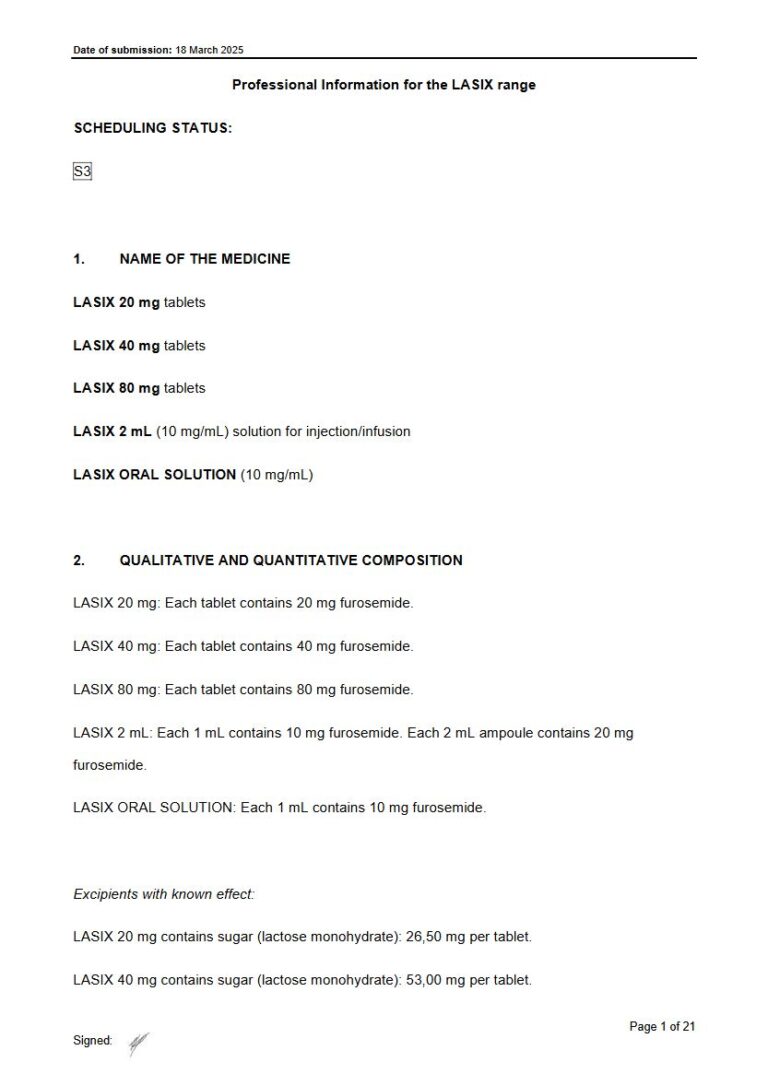
PDF Leaflet Revision Date: 18 March 2025
Clinical Summary
Quick overview from the medicine insert
Indication
Fluid retention and hypertension.
Dosage (summary)
Adults: 20-80 mg orally daily; max 1500 mg. IV for rapid effect.
Onset of Action / Duration
Onset: 30 mins, Duration: 6-8 hours
Special Populations
- Renal impairment
- Hepatic impairment
- Elderly
Pregnancy & Breastfeeding
Contraindicated in pregnancy and breastfeeding.
Key Drug Interactions
- Aminoglycosides
- NSAIDs
- Lithium
- ACE inhibitors
Contraindications
- Hypersensitivity to furosemide
- Anuric renal failure
- Severe hypokalaemia
Common side effects
- Hypotension
- Electrolyte disturbances
- Dehydration
Counselling Points
- Take in the morning
- Monitor weight
- Report signs of dehydration
Serious warnings
- Monitor electrolytes
- Risk of ototoxicity
- Caution in diabetes
Important Disclaimer
The Lasix 20 mg/40 mg/80 mg/2 ml Tablets professional information leaflet below is the property of Sanofi-Aventis South Africa and is provided on Medinsert exactly as issued, with no.. alterations or editorial changes. We make every effort to keep content current by updating documents as soon as new versions become available. Medinsert serves as a trusted access point for healthcare professionals, but does not replace official sources or clinical judgement. For more details, please read our full disclaimer. read more>>
 Healthcare Professionals Only
This content is for registered healthcare professionals
Sign in or create a free account to read the full package insert.
Free for HPCSA-registered professionals. Powered by Medinsert.
Clinical Particulars
Section 4 of the official insert — extracted exactly as issued, no alterations
4.1 Therapeutic indications
- Fluid retention associated with congestive cardiac failure.
- Fluid retention associated with chronic renal failure.
- Maintenance of fluid excretion in acute renal failure.
- Fluid retention associated with nephritic syndrome (if diuretic treatment is required).
- Fluid retention or ascites associated with liver disease.
- Hypertension.
- Hypertensive crisis (as a supportive measure).
- Support of forced diuresis.
- As an adjunct in acute pulmonary oedema.
- Support measures in cerebral oedema.
4.2 Posology and method of administration
The dose used must be the lowest that is sufficient to achieve the desired effect. LASIX is given intravenously only when oral administration is not feasible or is ineffective or if a rapid effect is required. If intravenous therapy is used, it is recommended that transfer to oral therapy be carried out as soon as possible.
To achieve optimum efficacy and suppress counter-regulation, a continuous furosemide infusion is generally to be preferred to repeated bolus injections. Where continuous furosemide infusion is not feasible for follow-up treatment after one or several acute bolus doses, a follow-up regimen with low doses given at short intervals (approximately 4 hours) is to be preferred to a regimen with higher bolus doses at longer intervals.
In adults, the recommended maximum daily dose of LASIX for both oral and intravenous administration is 1 500 mg. The duration of treatment depends on the indication and is determined on an individual basis by the doctor or other health care provider.
Adults: The usual oral dose of LASIX is 20 mg to 80 mg per day given as a single dose, preferably in the morning. This dose may, however, be increased depending on the response of the patient. Six hours after a 40 mg dose, 80 mg may be administered and, if necessary, after another six hours, 120 mg. After oedema is controlled, maintenance therapy is continued at 20 mg to 40 mg daily. Daily dose exceeding 120 mg should preferably be distributed over two to three individual doses.
For the treatment of hypertension of mild to moderate degree, a daily dosage of 40 mg to 80 mg is taken orally. In combination with other hypotensive medicines, lower doses will often suffice.
Intravenous and intramuscular administration of LASIX is indicated in all cases where intestinal absorption is impaired or prompt diuresis required. The rapid and powerful effect produced by intravenous injection may result in a transitory fall in plasma volume.
Pulmonary oedema: The initial dose is 40 mg intravenously. If necessary, the injection may be repeated after approximately 20 minutes.
Forced diuresis (e.g. management of barbiturate poisoning): 20 mg to 40 mg LASIX is given in addition to infusion of electrolyte solution. Further treatment depends on the elimination of urine and must include substitution of the fluid and electrolyte losses. In poisoning with acid or basic substances the elimination rate can be further increased by alkalisation or acidification of the urine, respectively.
Infants and children under 15 years: Children generally receive an oral dose of 2 mg/kg body mass per day in divided doses up to a maximum daily dose of 40 mg. This may be titrated to a maximum of 6 mg/kg/day. Parenteral administration (if necessary, continuous drip infusion) is indicated only in life-threatening conditions. In this case, infants/children receive parenteral doses of 1 mg/kg body mass per day up to a maximum of 20 mg per day.
Method of administration: Oral formulations: It is recommended that LASIX be taken on an empty stomach. Tablets are to be swallowed whole without chewing and with sufficient amounts of liquid. Intravenous injection/infusion: Intravenous LASIX must be injected or infused slowly; a rate of 4 mg per minute must not be exceeded. In patients with severe impairment of renal function (serum creatinine > 5 mg/dL), it is recommended that an infusion rate of 2,5 mg per minute is not exceeded. Intramuscular injection: Intramuscular administration must be restricted to exceptional cases where either oral or intravenous administration is not feasible. It must be noted that intramuscular injection is not suitable for the treatment of acute conditions such as pulmonary oedema. During long-term treatment, serum creatinine, urea and also electrolytes, in particular potassium, calcium, chloride and bicarbonate, should be regularly checked.
4.3 Contraindications
LASIX is contraindicated:
- in patients with hypersensitivity to furosemide or any of the excipients of LASIX (see section 6.1). Patients allergic to sulfonamides may show cross-sensitivity to furosemide,
- in patients with hypovolaemia or dehydration,
- in patients with anuric renal failure,
- in patients with severe hypokalaemia,
- in patients with severe hyponatraemia,
- in patients with pre-comatose and comatose states associated with hepatic encephalopathy,
- in breastfeeding women,
- if increasing uraemia and oliguria occur during treatment of severe progressive renal disease.
4.4 Special warnings and precautions for use
Urinary outflow must be secured. In patients with a partial obstruction of urinary outflow, increased production of urine may provoke or aggravate complaints. Thus, these patients require careful monitoring. Treatment with LASIX necessitates regular medical supervision.
Particularly careful monitoring is necessary:
- in patients with hypotension,
- in patients who would be at particular risk from a pronounced fall in blood pressure,
- in patients with latent or manifest diabetes mellitus,
- in patients with gout,
- in patients with hepatorenal syndrome,
- in patients with hypoproteinaemia (cautious dose titration is required),
- in premature infants (renal function must be monitored and renal ultrasonography performed).
Regular monitoring of serum sodium, potassium and creatinine is recommended during furosemide therapy; particularly close monitoring is required in patients at high risk of developing electrolyte imbalances or in case of significant additional fluid loss due to vomiting, diarrhoea or intense sweating. Hypovolaemia or dehydration as well as any significant electrolyte and acid-base disturbances must be corrected.
Concomitant use with risperidone: In risperidone placebo-controlled trials in elderly patients with dementia, a higher incidence of mortality was observed in patients treated with furosemide plus risperidone when compared to patients treated with risperidone alone. Caution should be exercised and the risks and benefits of this combination or co-treatment should be considered prior to the decision to use. Dehydration should be avoided.
The possibility exists of exacerbation or activation of systemic lupus erythematosus.
4.5 Interaction with other medicines and other forms of interaction
- Intravenous administration of LASIX within 24 hours of taking chloral hydrate may lead to flushing, sweating attacks, restlessness, nausea, increase in blood pressure and tachycardia. Use of LASIX concomitantly with chloral hydrate is, therefore, not recommended.
- LASIX may potentiate the ototoxicity of aminoglycosides and other ototoxic medicines. Since this may lead to irreversible damage these medicines must only be used with LASIX if there are compelling medical reasons.
- There is a risk of ototoxic effects if cisplatin and furosemide are given concomitantly. In addition, nephrotoxicity of cisplatin may be enhanced by a high dose of LASIX. LASIX should be given in low doses and with positive fluid balance when used to achieve forced diuresis during cisplatin treatment.
- Oral LASIX and sucralfate must not be taken within 2 hours of each other because sucralfate decreases the absorption of LASIX from the intestine and so reduces its effect.
- LASIX decreases the excretion of lithium salts and may cause increased risk of lithium toxicity, including increased risk of cardiotoxic and neurotoxic effects of lithium. It is recommended that lithium levels are carefully monitored in patients receiving this combination.
- Patients who are receiving diuretics, such as LASIX, may suffer severe hypotension and deterioration in renal function, including renal failure, especially when an angiotensin-converting enzyme inhibitor (ACE) or angiotensin II receptor antagonist is given for the first time or for the first time in an increased dose. Consideration must be given to interrupting the administration of LASIX temporarily or at least reducing the dose of LASIX for three days before starting treatment with, or increasing the dose of, an ACE inhibitor or angiotensin II receptor antagonist.
- Risperidone: Caution should be exercised and the risks and benefits of the combination or co-treatment with LASIX should be considered prior to the decision to use (see section 4.4).
- Concomitant administration of nonsteroidal anti-inflammatory drugs (NSAIDs) including aspirin (acetylsalicylic acid) may reduce the effect of LASIX. In patients with dehydration or hypovolaemia, NSAIDs may cause acute renal failure. Salicylate toxicity may be increased by LASIX.
- Attenuation of the effect of LASIX may occur following concurrent administration of phenytoin.
- Aliskiren reduces plasma concentration of furosemide given orally. In patients treated with both aliskiren and oral LASIX, it is recommended to monitor for reduced diuretic effect and adjust the dose accordingly.
- Corticosteroids, carbenoxolone, liquorice in large amounts, and prolonged use of laxatives may increase the risk of developing hypokalaemia.
- Some electrolyte disturbances (e.g. hypokalaemia, hypomagnesaemia) may increase the toxicity of certain other medicines (e.g. digoxin and medicines inducing QT interval prolongation syndrome).
- If antihypertensive medicines, diuretics or other medicines with blood pressure-lowering potential are given concomitantly with LASIX, a more pronounced fall in blood pressure must be anticipated.
- Probenecid, methotrexate and other medicines which, like LASIX, undergo significant renal tubular secretion may reduce the effect of LASIX.
- The effects of antidiabetic medicines and blood pressure-increasing sympathomimetics may be reduced. The effects of curare-type muscle relaxants or of theophylline may be increased.
- Impairment of renal function may develop in patients receiving concurrent treatment with LASIX and high doses of certain cephalosporins.
- Concomitant use of ciclosporin and LASIX is associated with increased risk of gouty arthritis secondary to LASIX-induced hyperuricaemia and ciclosporin impairment of renal urate excretion.
- Patients who were at high risk for radiocontrast nephropathy treated with LASIX experienced a higher incidence of deterioration in renal function after receiving radiocontrast, compared to high-risk patients who received only intravenous hydration prior to receiving radiocontrast.
- The harmful effects of nephrotoxic medicines on the kidney may be increased.
- When digoxin is administered concurrently it should be remembered that potassium deficiency increases the sensitivity of the myocardium to digoxin.
- Levothyroxine: LASIX may inhibit binding of thyroid hormones to carrier proteins and thereby lead to an initial transient increase in free thyroid hormones, followed by an overall decrease in total hormone levels. Thyroid levels should be monitored.
4.6 Fertility, pregnancy and lactation
Furosemide crosses the placental barrier.
Pregnancy: LASIX must not be given during pregnancy. Treatment during pregnancy requires monitoring of foetal growth.
Breastfeeding: Furosemide passes into breast milk and may inhibit lactation. Women must not breastfeed their infant while they are treated with LASIX.
4.7 Effects on ability to drive and use machines
Taking LASIX may inhibit the patientu2019s ability to concentrate, drive or operate machinery (see section 4.8). Caution is advised before driving a vehicle or operating machinery until the effects of LASIX are known.
4.8 Undesirable effects
Blood and lymphatic system disorders:
- Frequent: haemoconcentration
- Less frequent: thrombocytopenia, leukopenia, agranulocytosis, aplastic or haemolytic anaemia, eosinophilia
- Frequency unknown: blood coagulation disorders
Immune system disorders:
- Less frequent: severe anaphylactic or anaphylactoid reactions (e.g. shock)
- Frequency unknown: exacerbation or activation of systemic lupus erythematosus
Metabolism and nutrition disorders:
- Frequent: symptomatic electrolyte disturbances, dehydration, hypovolaemia, blood creatinine increased, increase in cholesterol and triglyceride serum levels, increase in uric acid serum levels and attacks of gout. Hyponatraemia, hypochloraemia, hypokalaemia
- Less frequent: impaired glucose tolerance, dryness of mouth, diabetes mellitus (latent becoming manifest; and aggravation of manifest)
- Frequency unknown: hypocalcaemia, hypomagnesaemia, increased blood urea, metabolic alkalosis, pseudo-Bartteru2019s syndrome
Nervous system disorders:
- Frequent: hepatic encephalopathy in patients with hepatocellular insufficiency
- Less frequent: paraesthesia
- Frequency unknown: dizziness, fainting or loss of consciousness, headache
Ear and labyrinth disorders:
- Less frequent: hearing disorders, tinnitus, deafness, sometimes irreversible
Vascular disorders:
- Frequent: hypotension including orthostatic hypotension
- Less frequent: vasculitis
- Frequency unknown: tendency for thromboses, circulatory collapse, circulatory disorders (vertigo, feeling pressure in head, visual impairment), embolism
Gastrointestinal disorders:
- Less frequent: nausea, vomiting, diarrhoea, acute pancreatitis
Hepatobiliary disorders:
- Less frequent: intrahepatic cholestasis, increase in liver transaminases
Skin and subcutaneous tissue disorders:
- Less frequent: pruritus, urticaria, other rashes or bullous lesions; erythema multiforme, bullous pemphigoid, photosensitivity, purpura
- Frequency unknown: Stevens-Johnson syndrome, toxic epidermal necrolysis, exfoliative dermatitis, vesicular cutaneous eruptions, AGEP (acute generalised exanthematous pustulosis) and DRESS (drug rash with eosinophilia and systemic symptoms), lichenoid reactions
Musculoskeletal, connective tissue and bone disorders:
- Frequency unknown: tetany, cases of rhabdomyolysis often in the context of hypokalaemia
Renal and urinary disorders:
- Frequent: increased urine volume
- Less frequent: tubulointerstitial nephritis
- Frequency unknown: acute retention of urine in patients with a partial obstruction of urinary outflow, nephrocalcinosis/nephrolithiasis in premature infants, renal failure, increased urine sodium, increased urine chloride
Congenital familial and genetic disorders:
- Frequency unknown: increased risk of persistence of patent ductus arteriosus when furosemide is administered to premature infants during the first weeks of life
General disorders and administration site conditions:
- Less frequent: fever
- Frequency unknown: following intramuscular infection, local reactions such as pain.
Reporting of suspected adverse reactions: Reporting suspected adverse reactions after authorisation of LASIX is important. It allows continued monitoring of the benefit/risk balance of the medicine. Health care providers are requested to report any suspected adverse reactions to:
- The Pharmacovigilance Unit at Sanofi: [email protected] (email), https://ae.reporting.sanofi/ (web portal) or +27 11 256 3700 (tel), or
- SAHPRA via the Med Safety App (Medsafety X SAHPRA) and eReporting platform (who- umc.org) found on SAHPRAu2019s website.
4.9 Overdose
The clinical picture in acute or chronic overdose depends primarily on the extent and consequences of electrolyte and fluid loss, e.g. hypovolaemia, dehydration, haemoconcentration, cardiac dysrhythmias (including AV-block and ventricular fibrillation). Symptoms of these disturbances include severe hypotension (progressing to shock), acute renal failure, thrombosis, delirious states, flaccid paralysis, apathy and confusion.
No specific antidote to furosemide is known. If oral ingestion has taken place, attempts may be made to limit further systemic absorption of furosemide by measures such as those designed to reduce absorption (e.g. activated charcoal). Clinically relevant disturbances in electrolyte and fluid balance must be corrected. Together with the prevention and treatment of serious complications resulting from such disturbances and of other effects on the body, this may necessitate general and specific intensive medical monitoring and therapeutic measures.
