
Sodium Chloride 0,9 %/10 ml Injection
PDF Leaflet Revision Date: 10 February 2025
Clinical Summary
Quick overview from the medicine insert
Indication
Diluent for reconstitution of compatible medicinal products.
Dosage (summary)
Use as needed for reconstitution; method: IV, IM, or SC.
Special Populations
- Elderly
- Children
- Newborns
Pregnancy & Breastfeeding
Use with caution during pregnancy and lactation; safety not established.
Key Drug Interactions
- Lithium carbonate
- Alcohol
Contraindications
- Hypernatraemia
- Hypertonia
- Cardiac insufficiency
- Oedematous states
- Severe hypertension
- Metabolic acidosis
Common side effects
- Convulsions
- Nausea
- Vomiting
- Headache
Counselling Points
- Use immediately after opening.
- Check compatibility before use.
- Do not use if solution is not clear.
Serious warnings
- Use cautiously in patients with hypertension, cardiac failure, renal impairment.
Important Disclaimer
The Sodium Chloride 0,9 %/10 ml Injection professional information leaflet below is the property of Fresenius Kabi South Africa and is provided on Medinsert exactly as issued, with no.. alterations or editorial changes. We make every effort to keep content current by updating documents as soon as new versions become available. Medinsert serves as a trusted access point for healthcare professionals, but does not replace official sources or clinical judgement. For more details, please read our full disclaimer. read more>>
 Healthcare Professionals Only
This content is for registered healthcare professionals
Sign in or create a free account to read the full package insert.
Free for HPCSA-registered professionals. Powered by Medinsert.
Clinical Particulars
Section 4 of the official insert — extracted exactly as issued, no alterations
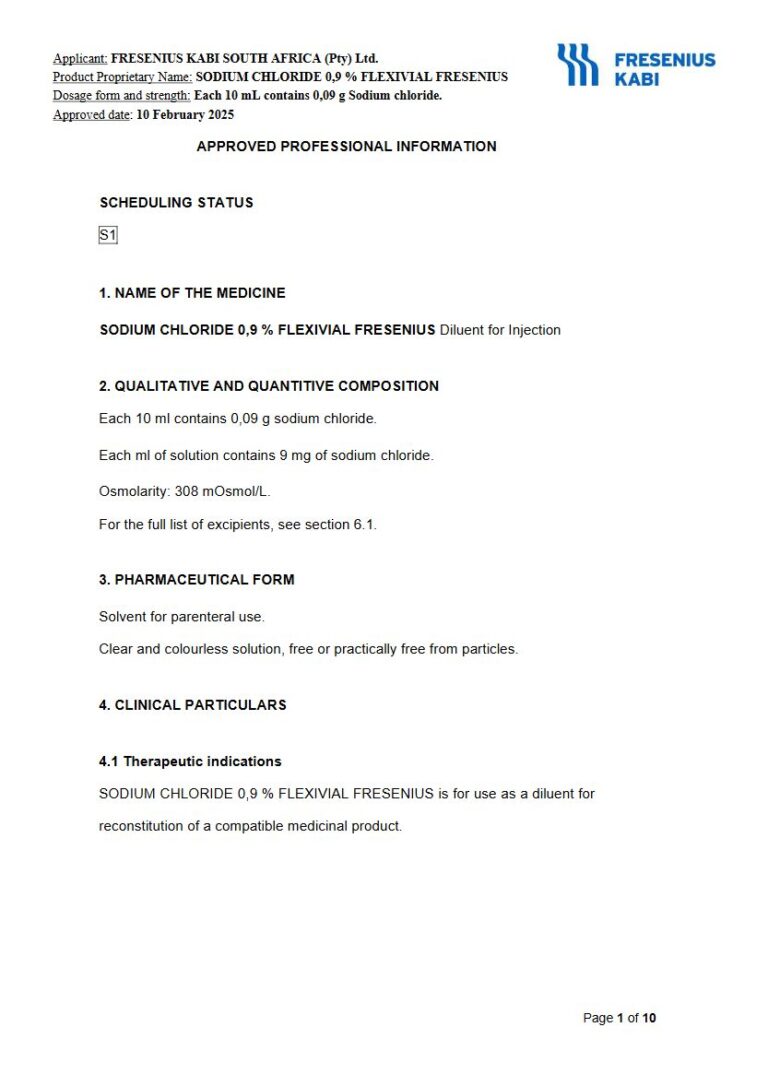
4.1 Therapeutic indications
SODIUM CHLORIDE 0,9 % FLEXIVIAL FRESENIUS is for use as a diluent for reconstitution of a compatible medicinal product.
4.2 Posology and method of administration
Posology
SODIUM CHLORIDE 0,9 % FLEXIVIAL FRESENIUS is intended for use as a diluent for reconstitution of a compatible medicinal product. The amount to be used will depend on the concentration wanted for the administration of the medicine to be dissolved.
Method of administration
Intravenous, intramuscular or subcutaneous use.
4.3 Contraindications
Intravenously, SODIUM CHLORIDE 0,9 % FLEXIVIAL FRESENIUS should be administered cautiously to young children and elderly patients. Due to the indications of the product, contraindications depend on the medicine to be dissolved. In general, the administration of this product is contraindicated in the following situations:
- Hypernatraemia
- Hypertonia
- Cardiac insufficiency
- Oedematous states in patients with cardiac, hepatic or renal disorders
- Severe hypertension
- Metabolic acidosis
4.4 Special warnings and precautions for use
See section 4.3. Once the container is opened the solution should be used immediately. In case of subcutaneous administration, no supplement should be added, since isotonicity would change. Do not use the solution if it is not clear or have visible precipitates. Before adding the medicine to the SODIUM CHLORIDE 0,9 % FLEXIVIAL FRESENIUS ampoule compatibility between the substance to be administered and sodium chloride should be checked. Sodium chloride should be used with precaution in patients with hypertension, cardiac failure, pulmonary or peripheral oedema, renal impairment, pre-eclampsia, hyperaldosteronism, cirrhosis and other disorders of liver, hypervolaemia, urinary tract obstruction, hypoproteinaemia and other sicknesses and treatments (e.g., corticosteroids) associated to sodium retention.
Paediatric population
Newborns, whether premature or not, can present too high sodium levels due to immaturity of renal function. Therefore, in newborns, whether premature or not, repeated injections of sodium chloride can only be administered after sodium levels in the blood have been determined.
4.5 Interaction with other medicines and other forms of interactions
Interactions depend on the medicine to be dissolved. Sodium chloride is incompatible with lithium carbonate, whose renal excretion is directly proportional to the sodium levels in the body. Administration of sodium chloride accelerates renal excretion of lithium, causing a decrease of its therapeutical action. The addition of alcohol to sodium chloride solutions should be avoided.
4.6 Fertility, pregnancy and lactation
Women of childbearing potential/ Contraception in males and females
No information available.
Pregnancy
Safety in pregnancy has not been established; therefore, it is recommended to be used with precaution if it is administered during pregnancy.
Breastfeeding
Safety in lactation has not been established; therefore, it is recommended to be used with precaution if it is administered during lactation.
4.7 Effects on ability to drive and use machines
Not relevant.
4.8 Undesirable effects
Convulsions may result from iatrogenically induced hypernatraemia. General disorders and administration site conditions may be provoked. Inadequate or excessive administration of physiologic saline solution may produce hyperhydration, hypernatraemia, hyperchloraemia and related signs such as metabolic acidosis because of decrease of bicarbonate concentration and oedema formation. An excess of sodium chloride may produce nausea, vomiting and headache.
As SODIUM CHLORIDE 0,9 % FLEXIVIAL FRESENIUS solvent for parenteral use is used as a diluent of injectable preparations, the nature of the product added determine the probability of appearance of undesirable effects. In case of adverse reactions due to the associated medicine, infusion should be immediately discontinued, the patient should be evaluated, suitable corrective measures should be established, and the solution should be kept for a later analysis should it become necessary.
Reporting of suspected adverse reactions
Reporting suspected adverse reactions after authorisation of the medicine is important. It allows continued monitoring of the benefit/risk balance of the medicine. Healthcare providers are asked to report any suspected adverse reactions to SAHPRA via the Med Safety APP (Medsafety X SAHPRA) and eReporting platform (who-umc.org) found on SAHPRA website. Healthcare providers are asked to report any suspected adverse drug reactions to the Holder of the Certificate of Registration at the following email address: [email protected] and to the relevant medicineu2019s regulatory authority in the country where the product is marketed.
4.9 Overdose
In cases of patients unable to retain the sodium selectively, the treatment must be discontinued. An excess of sodium chloride, in its most acute form, produces dehydration of internal organs, nausea, vomiting, diarrhoea, abdominal cramps, thirst, decrease of salivation, water, sweat, fever, hypotension, tachycardia, renal failure, pulmonary oedema, acidosis, respiratory insufficiency, headache, vertigo, irritability, muscle spasms, rigidity, coma and death. Due to the nature of the product, if its indication and administration are correct and controlled there is no risk of intoxication.
