
Soflax 13,5 mg TABLETS
PDF Leaflet Revision Date: 03 August 2023
Clinical Summary
Quick overview from the medicine insert
Indication
Relief of occasional constipation.
Dosage (summary)
Adults: 1-2 tablets once daily; children >6 years: half the adult dose.
Onset of Action / Duration
Onset: 6-12 hours
Special Populations
- Renal impairment
- Hepatic impairment
Pregnancy & Breastfeeding
Not recommended during pregnancy or breastfeeding due to insufficient data.
Key Drug Interactions
- Potentiates digoxin
- Interactions with anti-dysrhythmic medicines
- Enhances electrolyte imbalance with diuretics
Contraindications
- Hypersensitivity to Sennosides
- Intestinal obstruction
- Acute gastrointestinal complaints
- Severe dehydration
- Concomitant use with other laxatives
Common side effects
- Abdominal pain
- Diarrhoea
- Hypokalaemia
Counselling Points
- Start with the lowest dose
- Consult a doctor if no bowel action after 3 days
- Investigate cause of constipation if needed daily
Serious warnings
- Risk of dependence on laxatives
- Use not recommended for longer than one week
- Potential for dehydration
Important Disclaimer
The Soflax 13,5 mg TABLETS professional information leaflet below is the property of Cipla Medpro and is provided on Medinsert exactly as issued, with no.. alterations or editorial changes. We make every effort to keep content current by updating documents as soon as new versions become available. Medinsert serves as a trusted access point for healthcare professionals, but does not replace official sources or clinical judgement. For more details, please read our full disclaimer. read more>>
 Healthcare Professionals Only
This content is for registered healthcare professionals
Sign in or create a free account to read the full package insert.
Free for HPCSA-registered professionals. Powered by Medinsert.
Clinical Particulars
Section 4 of the official insert — extracted exactly as issued, no alterations
4.1 Therapeutic indications
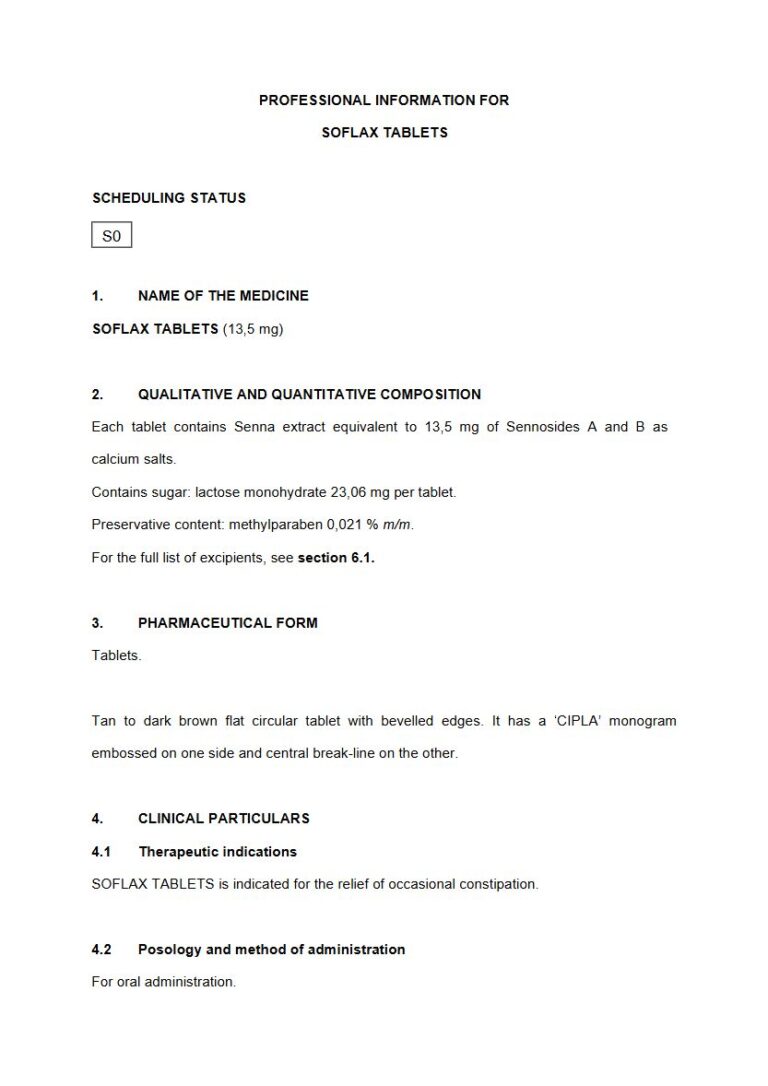
SOFLAX TABLETS is indicated for the relief of occasional constipation.
4.2 Posology and method of administration
For oral administration. The dosage should be the lowest required to produce a comfortable, soft-formed motion. This varies between individuals. The recommended dosage for adults is one to two tablets once daily. It is suggested that the lowest dose is started with and increased daily until a comfortable motion is produced. If no bowel action has occurred after three days of increased dosage, the medication should be stopped, and a doctor consulted. Children over 6 years of age can be given half the adult dosage. Paediatric population Not recommended for use in children under the age of 6 years.
4.3 Contraindications
SOFLAX TABLETS is contraindicated:
- in patients with hypersensitivity to Sennosides A and B or to any other excipients of SOFLAX TABLETS (see section 6.1).
- in patients with intestinal obstruction or undiagnosed abdominal symptoms, acute or persistent gastrointestinal complaints, and stenosis, atony, appendicitis, inflammatory bowel diseases (e.g., Crohnu2019s disease, ulcerative colitis), abdominal pain of unknown origin, severe dehydration state with water or electrolyte depletion, nausea and vomiting, rectal bleeding and congestive heart failure.
- when used concomitantly with other laxatives.
4.4 Special warnings and precautions for use
Prolonged or frequent use of SOFLAX TABLETS may result in dependence on laxatives and loss of normal bowel function. SOFLAX TABLETS should not be used by patients suffering from faecal impaction and undiagnosed, acute or persistent gastrointestinal complaints, e.g. abdominal pain, nausea or vomiting unless advised by a doctor, because these symptoms can be signs of potential or existing intestinal blockage (ileus). SOFLAX TABLETS should not be used for a period longer than one week, unless directed by a doctor. If you have noticed a sudden change in bowel habits that has persisted for a period longer than 2 weeks, consult a doctor before using SOFLAX TABLETS. Rectal bleeding or failure to have a bowel movement after use of a laxative may indicate a serious condition. Discontinue use and consult a doctor. If SOFLAX TABLETS is needed every day the cause of the constipation should be investigated. Senna pods preparations, such as SOFLAX TABLETS, should only be used if a therapeutic effect cannot be achieved by a chance of diet or the administration of bulk forming medicines. Prolonged and excessive use of SOFLAX TABLETS may lead to diarrhoea with excessive loss of water and electrolytes, particularly potassium leading to hypokalaemia. There is also the possibility of developing an atonic non-functioning colon. Intestinal loss of fluids may promote dehydration. Symptoms may include thirst and oliguria. Care should be taken in patients with inflammatory bowel disease. Patients with kidney disorders should be aware of possible electrolyte imbalance. SOFLAX TABLETS contains lactose monohydrate. Patients with rare hereditary problems of galactose intolerance, total lactase deficiency or glucose-galactose malabsorption should not take SOFLAX TABLETS.
4.5 Interaction with other medicines and other forms of interaction
Hypokalaemia (resulting from long-term laxative abuse) potentiates the action of digoxin and interacts with anti-dysrhythmic medicines with which include reversion to sinus rhythm (e.g., quinidine) and with medicines inducing QT prolongation. Concomitant use with other medicines inducing hypokalaemia (e.g., diuretics, adrenocorticosteroids and liquorice root) may enhance electrolyte imbalance.
4.6 Fertility, pregnancy and lactation
Pregnancy There are no reports of undesirable or damaging effects during pregnancy and on the foetus when used at the recommended dosage schedule. However, as a consequence of experimental data concerning a genotoxic risk of several anthranoids such as SOFLAX TABLETS, e.g., emodin and aloe-emodin, use is not recommended during pregnancy. Breastfeeding Use during breastfeeding is not recommended as there are insufficient data on the excretion of metabolites in breast milk. Small amounts of active metabolites (rhein) are excreted in breast milk.
4.7 Effects on ability to drive and use machines
No known effects.
4.8 Undesirable effects
The following adverse reactions have been classified according to the following categories, frequent, less frequent and frequency unknown.
MedDRA system organ Class Frequency Side effects
Immune system disorders Frequency unknown Hypersensitivity, urticarial and hypogammaglobulinaemia.
Metabolism and nutrition disorders Frequency unknown Hypokalaemia and cachexia.
Respiratory, thoracic and mediastinal disorders Frequency unknown Asthma.
Gastrointestinal disorders Frequency unknown Abdominal pain such as cramps and colic, diarrhoea and gastrointestinal tract mucosal pigmentation.
Skin and subcutaneous tissue disorders Frequency unknown Pruritus and exanthema generalised.
Musculoskeletal and connective tissue disorders Frequency unknown Finger clubbing, tetany and hypertrophic osteoarthropathy.
Renal and urinary disorders Frequency unknown Chromaturia (discontinuation of urine may occur and may interfere with diagnostic tests).
Reporting of suspected adverse reactions Reporting suspected adverse reactions after authorisation of the medicine is important. It allows continued monitoring of the benefit/risk balance of the medicine. Health care providers are asked to report any suspected adverse reactions to SAHPRA via the u201c6.04 Adverse Drug Reactions Reporting Formu201d, found online under SAHPRAu2019s publications: https://www.sahpra.org.za/Publications/Index/8 and to Cipla Medpro (Pty) Ltd at [email protected] or telephone 080 222 6662 (toll free).
4.9 Overdose
Symptoms of overdose The major symptoms of overdose are griping pain and severe diarrhoea with consequent losses of fluid and electrolytes.
Treatment of overdose Treatment is symptomatic and supportive with generous amounts of fluid. Electrolytes, especially potassium, should be monitored.
