
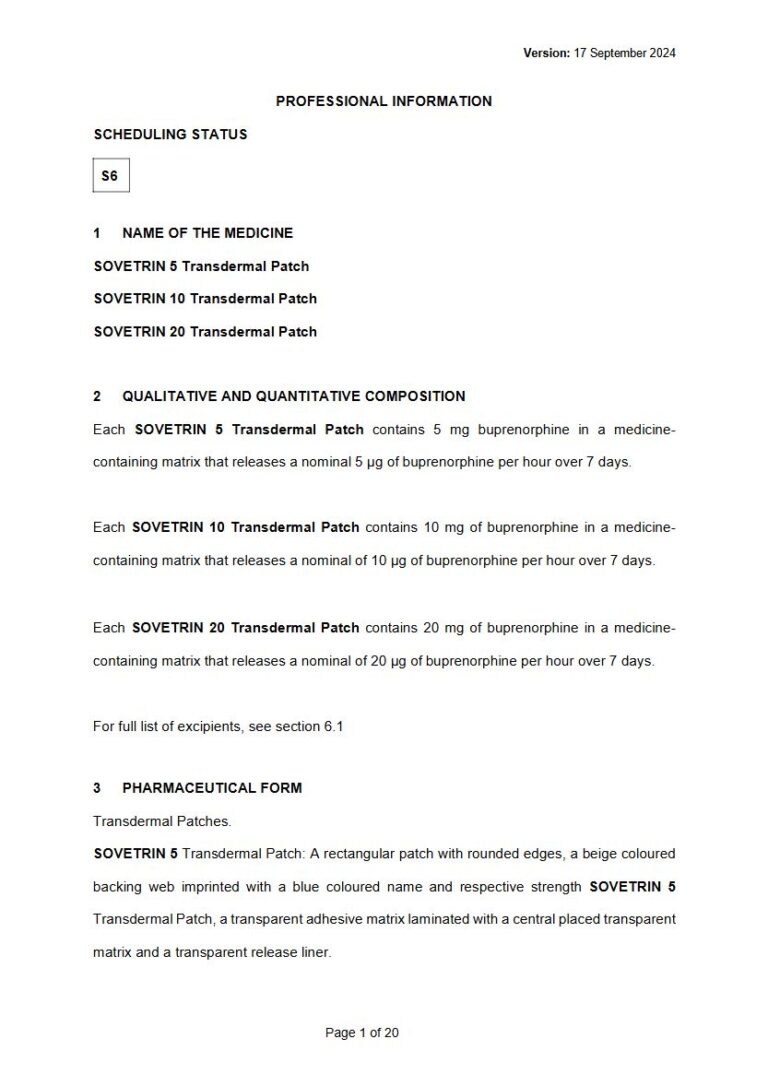
Sovetrin 5 , 10, 20 5 mg, 10 mg, 20 mg Transdermal Patch
PDF Leaflet Revision Date: 8 July 2024
Clinical Summary
Quick overview from the medicine insert
Indication
Chronic musculoskeletal pain of moderate to severe intensity.
Dosage (summary)
Initial dose: SOVETRIN 5 patch (5 u03bcg/h), titrate every 3-7 days as needed.
Onset of Action / Duration
Onset: 17 hours, Duration: 7 days
Special Populations
- Renal impairment
- Hepatic impairment
Pregnancy & Breastfeeding
Contraindicated in pregnancy and lactation; may cause neonatal withdrawal.
Key Drug Interactions
- CNS depressants
- MAO inhibitors
- CYP3A4 inhibitors
Contraindications
- Hypersensitivity to buprenorphine
- Severe hepatic impairment
- Myasthenia gravis
- Opioid dependence
Common side effects
- Dizziness
- Constipation
- Nausea
- Application site reactions
Counselling Points
- Avoid direct heat on patch
- Rotate application sites
- Monitor for sedation and respiratory depression
Serious warnings
- Respiratory depression risk
- Serotonin syndrome risk
- Potential for abuse and dependence
Important Disclaimer
The Sovetrin 5 , 10, 20 5 mg, 10 mg, 20 mg Transdermal Patch professional information leaflet below is the property of Trinity Pharma and is provided on Medinsert exactly as issued, with no.. alterations or editorial changes. We make every effort to keep content current by updating documents as soon as new versions become available. Medinsert serves as a trusted access point for healthcare professionals, but does not replace official sources or clinical judgement. For more details, please read our full disclaimer. read more>>
 Healthcare Professionals Only
This content is for registered healthcare professionals
Sign in or create a free account to read the full package insert.
Free for HPCSA-registered professionals. Powered by Medinsert.
Clinical Particulars
Section 4 of the official insert — extracted exactly as issued, no alterations
4.1 Therapeutic indications
SOVETRIN is indicated for the treatment of chronic musculoskeletal pain of the joints and the lower back when that pain is of moderate to severe intensity sufficient to require an opioid to obtain adequate analgesia.
4.2 Posology and method of administration
Posology
SOVETRIN should be worn continuously for 7 days. Patients aged 18 years and over: The lowest SOVETRIN dose available, SOVETRIN 5 (5 u03bcg/h) should be used as the initial dose in all patients.
Titration
During initiation, titration, and treatment with SOVETRIN, patients may continue their existing NSAID or paracetamol regimen as needed. The dose of SOVETRIN should not be increased at less than 3-day intervals when steady state levels are attained. Changes in SOVETRIN dosage may be individually titrated based on the need for supplemental analgesia and the patientu2019s analgesic response to SOVETRIN.
To increase the dose, a larger patch should replace the patch that is currently being worn, or a combination of patches should be applied in different places to achieve the desired dose. It is recommended that no more than two patches be applied at the same time, regardless of patch strength. Titration should continue every 3 - 7 days until adequate analgesia is achieved. If adequate pain control cannot be achieved with SOVETRIN, therapy with SOVETRIN should be discontinued and the patient converted to an appropriate analgesic regimen as determined by a physician.
Special populations
Renal impairment: No special dose adjustment of buprenorphine is necessary in patients with renal impairment. Hepatic impairment: There is no need for dosage adjustment when using SOVETRIN in patients with mild to moderate hepatic impairment. Patients with severe hepatic impairment may accumulate buprenorphine during SOVETRIN treatment. SOVETRIN should not be used in such patients (see section 4.3). Paediatric population: The safety and efficacy of SOVETRIN in patients under 18 years of age has not been established.
Method of administration
In order to minimise the potential of skin reactions (see section 4.4) SOVETRIN should be applied to non-irritated, intact skin of the upper outer arm, upper chest, upper back or the side of the chest. SOVETRIN should be applied to a relatively hairless or nearly hairless skin site. If none are available, the hair at the site should be clipped, not shaven. Application sites should be rotated whenever a transdermal patch is replaced or added. Application sites should be re-used at no less than 3-week intervals. If the application site must be cleaned, it should be done with clear water only. Soaps, alcohol, oils, lotions, or abrasive devices should not be used. The skin must be dry before the transdermal patch is applied. SOVETRIN should be pressed firmly in place at the application site, making sure contact is complete, especially around the edges. If the edges of the begin to peel off, the edges may be taped down with suitable skin tape. If a transdermal patch falls off, a new one should be applied. Bathing, showering, or swimming should not affect the system. While wearing SOVETRIN, patients should be advised to avoid exposing the SOVETRIN site to direct external heat sources such as heating pads, electric blankets, heat lamps, hot water bottles, etc., as an increase in absorption of buprenorphine may occur. The effects of the use of SOVETRIN in hot tubs and saunas have not been studied.
Application directions
Open the pouch just before applying the patch. Take off the thin cover sheet. Attach the patch to the upper arm, upper chest, upper back, or sides of the chest. Press the patch with the hand for approximately 30 seconds and check that it is properly attached. The patch should not be used if the seal is broken. Discontinuation: After removal of SOVETRIN, plasma concentrations decrease gradually. This should be considered when therapy with SOVETRIN is to be followed by other opioids. As a general rule, a subsequent opioid should not be administered within 24 hours after removal of SOVETRIN.
4.3 Contraindications
SOVETRIN is contraindicated in:
u2022 patients with known hypersensitivity to buprenorphine or to any of the excipients;
u2022 patients suffering from delirium tremens;
u2022 patients with severe hepatic impairment;
u2022 patients suffering from myasthenia gravis;
u2022 opioid dependent patients and for narcotic withdrawal treatment;
u2022 conditions in which the respiratory centre and function are severely impaired or may become so;
u2022 patients who are receiving MAO inhibitors or have taken them within the last two weeks.
SOVETRIN should not be used in patients with head injury, intracranial lesions or increased intracranial pressure, shock or a reduced level of consciousness of uncertain origin.
4.4 Special warnings and precautions for use
SOVETRIN should not be used in patients with impaired respiratory function and in patients concurrently receiving monoamine oxidase inhibitors (MAOls) or who have received MAOls within the previous two weeks (see sections 4.3 and 4.5). SOVETRIN should be used with particular caution in patients with acute alcohol intoxication, head injury, shock, a reduced level of consciousness of uncertain origin, intracranial lesions or increased intracranial pressure. SOVETRIN is contraindicated in patients with severe hepatic impairment (see section 4.3). Severe febrile illness may increase the rate of buprenorphine absorption from SOVETRIN. SOVETRIN should be used with caution in patients with constipation. Caution should be exercised in patients suffering from sleep apnoea.
SOVETRIN may lower the seizure threshold in patients with a history of seizure disorder. Since CYP3A4 inhibitors may increase concentrations of buprenorphine (see Section 4.5), patients already treated with CYP3A4 inhibitors should have their dose of SOVETRIN carefully titrated since a reduced dosage might be sufficient in these patients. SOVETRIN is not recommended for analgesia in the immediate post-operative period or in other situations characterised by rapidly varying analgesic requirement.
Respiratory depression
Respiratory depression is the primary risk of opioid excess. Opioids may cause sleep-related breathing disorders including sleep-related hypoxemia and central sleep apnoea (CSA). CSA risk may be increased in a dose-dependent manner with opioid use in some patients. In patients who present with CSA, consider decreasing the total opioid dosage. Pre-existing sleep apnoea may be made worse with opioids (see section 4.8). In patients who present with CSA, consider decreasing the total opioid dosage.
CNS depressants co-administration
Concomitant use of sedative medicines such as benzodiazepines or related medicines and buprenorphine may result in sedation, coma, respiratory depression and death. Therefore, concomitant prescribing with these sedative medicines should be reserved for patients for whom alternative treatment options are not possible. The lowest effective dose should be used if a decision is made to prescribe opioids concomitantly with sedative medicines. The duration of treatment should be as short as possible. It is unknown if such severity can be expected from transdermal formulation of buprenorphine. The patients should be followed closely for signs and symptoms of. It is strongly recommended to inform patients and their caregivers to be aware of the symptoms of sedation and respiratory depression (see section 4.5).
4.5 Interactions with other medicines
SOVETRIN must not be used concomitantly with MAOIs or in patients who have received MAOIs within the previous two weeks (see sections 4.3 and 4.4). SOVETRIN should be used with caution in patients who are concurrently taking other central nervous system (CNS) depressants or other medicines that may cause hypotension, respiratory depression, profound sedation or potentially result in coma and death. Such medicines include other opioid analgesics, sedatives or hypnotics, general anaesthetics, phenothiazines, alcohol, centrally acting anti-emetics and benzodiazepines. Buprenorphine should be used cautiously when co-administered with serotonergic medicinal products, such as SSRIs, SNRIs, MAOIs or tricyclic antidepressants as the risk of serotonin syndrome, a potentially life-threatening condition, is increased (see section 4.4). Effect of other active substance on the pharmacokinetics of buprenorphine: Reduction in hepatic blood flow induced by some general anaesthetics (e.g., halothane) and other medicines may result in a decreased rate of hepatic elimination of the medicine buprenorphine. Buprenorphine as in SOVETRIN is mainly metabolised by glucuronidation and to a lesser extent (about 30 %) by CYP3A4. Concomitant treatment with CYP3A4 inhibitors may lead to increased plasma concentrations with exaggerated efficacy of buprenorphine. Interaction with the CYP3A4 inhibitor ketoconazole will have no clinically relevant increases in mean maximum (Cmax) or total (AUC) buprenorphine exposure following SOVETRIN with ketoconazole as compared to SOVETRIN alone. The interaction between CYP3A4 enzyme inducers and buprenorphine has not been studied. Co-administration of buprenorphine and enzyme inducers (e.g., phenobarbital, carbamazepine, phenytoin and rifampin) may lead to increased clearance which might result in reduced efficacy.
4.6 Fertility, pregnancy and lactation
Women of childbearing potential /Contraception in males and females
SOVETRIN should not be used in women of childbearing potential who are not using effective contraception.
Pregnancy
SOVETRIN should not be used during pregnancy. There are no or limited data available for the use of buprenorphine in pregnant woman. It has been shown, towards the end of pregnancy, high doses of buprenorphine may induce respiratory depression in the neonate, even after a brief period of administration. Prolonged use of SOVETRIN during pregnancy, may result in neonatal withdrawal. Buprenorphine has been shown to cross the placenta in humans. Buprenorphine has been detected in newborn blood, urine and meconium and also in motheru2019s milk at low concentrations.
Breastfeeding
SOVETRIN Transdermal Patch should not be used during lactation. As buprenorphine is excreted in human milk.
Fertility
No human data on the effect of buprenorphine on fertility are available.
4.7 Effects on ability to drive and use machines
SOVETRIN Transdermal Patch may impair the ability to drive and use machines. This pertains particularly in the beginning of treatment and in conjunction with other centrally acting substances including alcohol, sedatives, tranquillisers and hypnotics. In cases where a stable dose is used, a general restriction is not necessary. For patients who experience and are affected by side effects such as dizziness drowsiness and or blurred vision during treatment initiation or titration to a higher dose should not drive or use machines, for at least 24 hours after the patch has been removed. SOVETRIN Transdermal Patch can also impair cognitive function and can affect a patient's ability to drive safely.
4.8 Undesirable effects
The following side effects have been reported during the use of buprenorphine: The table lists adverse reactions reported from 9 completed studies with buprenorphine. The reactions are listed as MeDRA preferred term by system organ class and absolute frequency. In general, included adverse events are those with a relation to medicine use, and excluded adverse events are minor events, those that are too imprecise to be meaningful, and events that may be commonly observed in the absence of medicine therapy.
4.9 Overdose
The manifestations of SOVETRIN overdose is an extension of its pharmacological actions. Respiratory depression has been absent in some cases of buprenorphine overdose. Respiratory depression including apnoea may occur in other overdose situations. Additional symptoms include sedation, drowsiness, nausea, vomiting, cardiovascular collapse and marked miosis. Remove any SOVETRIN in contact with the patientu2019s skin and dispose of it properly. Establish and maintain a clear airway, assist and control respiration as indicated, and maintain adequate body temperature and fluid balance. Oxygen, intravenous fluids, vasopressors, and other supportive measures should be employed as indicated. A specific opioid antagonist such as naloxone may reverse the effects of buprenorphine, although naloxone may be less effective in reversing the effects of buprenorphine than other u03bc-opioid agonists. Treatment with continuous intravenous naloxone should begin with the usual doses but high doses may be required. Maintenance of adequate ventilation is essential when managing a SOVETRIN overdose and more important than specific antidote treatment with a narcotic antagonist such as naloxone.
