
Staquis 20 mg Ointment (for topical use).
PDF Leaflet Revision Date: 03 September 2025
Clinical Summary
Quick overview from the medicine insert
Indication
Topical treatment of mild to moderate atopic dermatitis.
Dosage (summary)
Apply a thin layer twice daily to affected skin areas.
Special Populations
- Elderly
- Paediatric patients < 3 months
Pregnancy & Breastfeeding
Safety in pregnancy and breastfeeding not established.
Key Drug Interactions
- Warfarin (no interaction potential)
Contraindications
- Hypersensitivity to crisaborole or excipients
Common side effects
- Application site reactions
- Burning
- Stinging
Counselling Points
- Apply only to affected areas
- Discontinue if severe reactions occur
Serious warnings
- Hypersensitivity reactions may occur.
Important Disclaimer
The Staquis 20 mg Ointment (for topical use). professional information leaflet below is the property of Pfizer Laboratories and is provided on Medinsert exactly as issued, with no.. alterations or editorial changes. We make every effort to keep content current by updating documents as soon as new versions become available. Medinsert serves as a trusted access point for healthcare professionals, but does not replace official sources or clinical judgement. For more details, please read our full disclaimer. read more>>
 Healthcare Professionals Only
This content is for registered healthcare professionals
Sign in or create a free account to read the full package insert.
Free for HPCSA-registered professionals. Powered by Medinsert.
Clinical Particulars
Section 4 of the official insert — extracted exactly as issued, no alterations
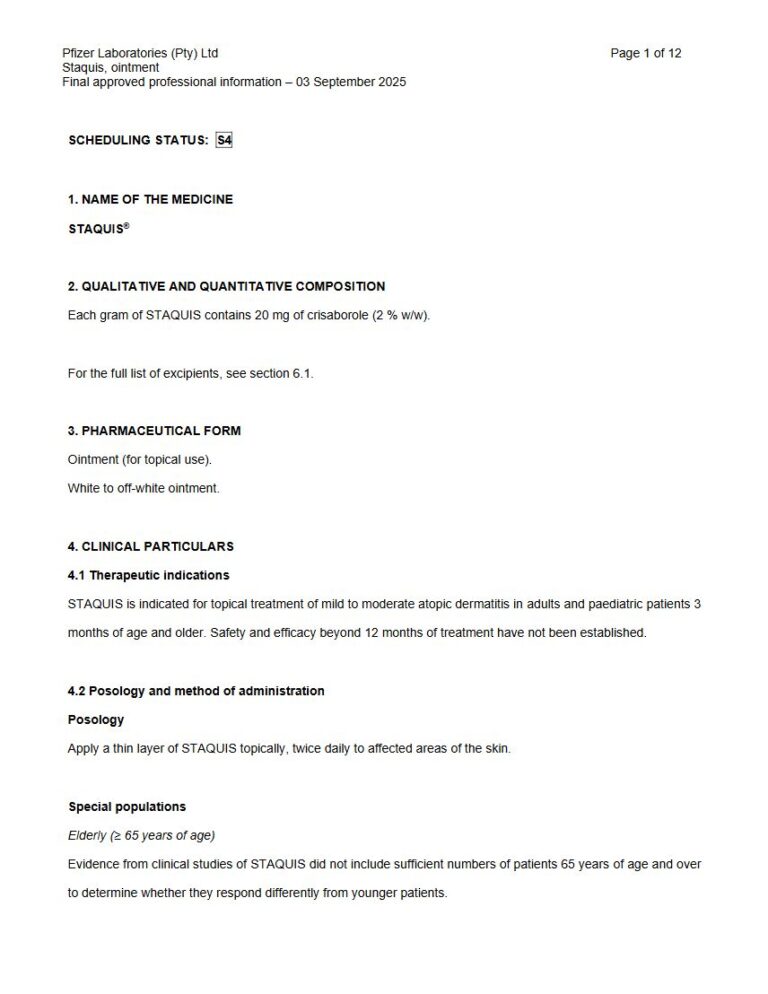
4.1 Therapeutic indications
STAQUIS is indicated for topical treatment of mild to moderate atopic dermatitis in adults and paediatric patients 3 months of age and older. Safety and efficacy beyond 12 months of treatment have not been established.
4.2 Posology and method of administration
Posology
Apply a thin layer of STAQUIS topically, twice daily to affected areas of the skin.
Special populations
Elderly (u2265 65 years of age)
Evidence from clinical studies of STAQUIS did not include sufficient numbers of patients 65 years of age and over to determine whether they respond differently from younger patients.
Paediatric population
The safety and efficacy of STAQUIS in paediatric patients below the age of 3 months have not been established.
Method of administration
STAQUIS is for topical use only and not for oral, ophthalmic, intranasal, or intravaginal use. STAQUIS should be applied topically twice daily to all affected areas of skin.
4.3 Contraindications
STAQUIS is contraindicated in patients who are hypersensitive to crisaborole or to any of the excipients of STAQUIS listed in section 6.1.
4.4 Special warnings and precautions for use
Hypersensitivity
Hypersensitivity reactions, including contact urticaria, have occurred in patients treated with STAQUIS. Hypersensitivity should be suspected in the event of severe pruritus, swelling and erythema at the application site or at a distant site. If signs and symptoms of hypersensitivity occur, discontinue STAQUIS immediately and initiate appropriate therapy.
4.5 Interaction with other medicines and other forms of interaction
In vitro studies using human liver microsomes indicated that under the conditions of clinical use, STAQUIS and metabolite 1 are not expected to inhibit cytochrome P450 (CYP) 1A2, 2B6, 2C8, 2C9, 2C19, 2D6, and 3A4. In vitro studies using human liver microsomes for metabolite 2 showed that it did not inhibit activities of CYP2C19, 2D6, and 3A4; was a weak inhibitor of CYP1A2 and 2B6; and a moderate inhibitor of CYP2C8 and 2C9. In vitro studies in human hepatocytes showed that under the conditions of clinical use, STAQUIS and metabolites 1 and 2 are not expected to induce CYP enzymes.
Interactions
The most sensitive enzyme, CYP2C9, was further investigated in a clinical trial with coadministration of STAQUIS with warfarin, a CYP2C9 substrate. The results of this study showed no medicine interaction potential.
Abnormal laboratory findings: Haematologic, clinical chemistry and other quantitative data
Results for clinical laboratory testing have not identified clinically important changes from baseline to the end of study in mean or median values for any haematology or biochemistry parameters in any of the clinical studies in patients with atopic dermatitis.
4.6 Fertility, pregnancy and lactation
Pregnancy
Safe use during pregnancy has not been established. There is no available data with STAQUIS in pregnant women to inform the medicine-associated risk for major birth defects and miscarriage. In animal reproduction studies, there were no adverse developmental effects observed with oral administration of crisaborole in pregnant rats and rabbits during organogenesis at doses up to 3 and 2 times, respectively, the maximum recommended human dose (MRHD).
Breastfeeding
STAQUIS is systemically absorbed following topical application, however it is unknown if STAQUIS is excreted in human milk. Safe use during breastfeeding has not been established.
Fertility
Reproduction studies in male or female rats using oral administration of STAQUIS revelated no effects on fertility (see section 5.3).
4.7 Effects on ability to drive and use machines
No studies with STAQUIS on the effect of the ability to drive or use machines have been performed, therefore STAQUIS has no known influence on the ability to drive or use machines.
4.8 Undesirable effects
Summary of the safety profile
The most common medicine-related adverse events reported in clinical trials among patients with mild to moderate atopic dermatitis 2 years of age and older have been application site reactions.
Tabulated summary of adverse reactions
In two randomised, double-blind, parallel-group, vehicle-controlled Phase 3 clinical trials (studies AN2728-AD-301 and AN2728-AD-302), 1 012 patients 2 to 79 years of age with mild to moderate atopic dermatitis were treated with STAQUIS twice daily for 4 weeks. The adverse reaction reported by u2265 1 % of STAQUIS-treated patients is listed in Table 1.
Table 1: Adverse reaction occurring in u2265 1 % of patients in atopic dermatitis trials through week 4 a Refers to skin sensations such as burning or stinging.
Summary of adverse reactions
Less common clinical trial adverse reactions
Less common (< 1 %) adverse reactions in patients treated with STAQUIS included application site reactions (including contact dermatitis and pruritus) and flare of atopic dermatitis. In an open-label, single arm, long-term safety study, 517 patients 2 to 72 years of age (including 454 patients 2 to 17 years of age), who had completed one of the Phase 3 studies without safety issues that precluded further treatment, were treated with STAQUIS twice daily intermittently for up to 48 weeks in 28 day on-treatment or off-treatment cycles. A total of 9 (2 %) patients discontinued the therapy due to adverse events. The most frequently reported adverse events included atopic dermatitis, application site pain, and application site infection.
Paediatric population
See clinical trial adverse reactions. In a multi-centre, open-label, uncontrolled trial, 137 paediatric patients 3 months to < 2 years of age were treated with STAQUIS twice daily for 4 weeks. Overall, the safety profile of STAQUIS in this age group was consistent with that of studies AN2728-AD-301 and AN2728-AD-302 in patients 2 years of age and older.
Reporting of suspected adverse reactions
Reporting suspected adverse reactions after authorisation of the medicine is important. It allows continued monitoring of the benefit/risk balance of the medicine. Health care providers are requested to report any suspected adverse medicine reactions to SAHPRA via the Med Safety APP (Medsafety X SAHPRA) and eReporting platform (who-umc.org) found on SAHPRA website. Report any suspected adverse drug reactions associated with the use of the medicine directly to Pfizer via [email protected]
4.9 Overdose
There are no data from clinical trials regarding signs and symptoms of overdose of STAQUIS. If surplus STAQUIS has been applied, the excess should be thoroughly wiped off. In cases of accidental oral mucosal, ophthalmic, intranasal or intravaginal exposure, the ointment should be thoroughly washed off and the area cleansed with water.
