
Syntometrine 1 ml Injection
PDF Leaflet Revision Date: 15 December 2022
Clinical Summary
Quick overview from the medicine insert
Indication
Active management of third stage of labour and prevention/treatment of postpartum haemorrhage.
Dosage (summary)
1 ml intramuscularly after delivery of the shoulder or immediately after delivery of the child.
Onset of Action / Duration
Onset: 7 mins, Duration: Not specified
Special Populations
- Renal impairment
- Hepatic impairment
Pregnancy & Breastfeeding
Contraindicated during pregnancy and first two stages of labour; excreted in breast milk, may suppress lactation.
Key Drug Interactions
- CYP3A4 inhibitors
- Vasoconstrictors
- Prostaglandins
Contraindications
- Hypersensitivity
- Pregnancy
- Uterine inertia
- Severe toxaemia
- Hypertension
- Cardiac disease
Common side effects
- Hypertension
- Dizziness
- Nausea
- Vomiting
- Headache
Counselling Points
- Avoid driving or operating machinery
- Monitor for dizziness and hypotension
- Report any adverse reactions
Serious warnings
- Anaphylaxis in latex allergy
- Potentially arrhythmogenic
- Caution in coronary artery disease
Important Disclaimer
The Syntometrine 1 ml Injection professional information leaflet below is the property of Adcock Ingram Critical Care and is provided on Medinsert exactly as issued, with no.. alterations or editorial changes. We make every effort to keep content current by updating documents as soon as new versions become available. Medinsert serves as a trusted access point for healthcare professionals, but does not replace official sources or clinical judgement. For more details, please read our full disclaimer. read more>>
 Healthcare Professionals Only
This content is for registered healthcare professionals
Sign in or create a free account to read the full package insert.
Free for HPCSA-registered professionals. Powered by Medinsert.
Clinical Particulars
Section 4 of the official insert — extracted exactly as issued, no alterations
4.1 Therapeutic Indications
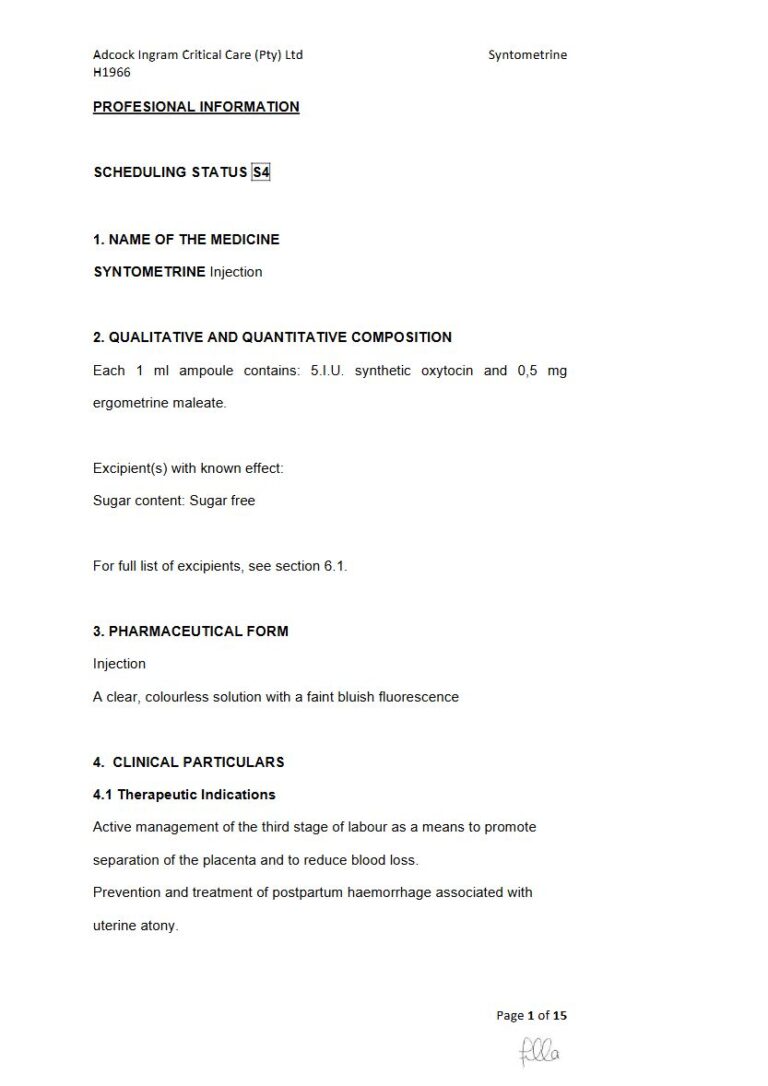
Active management of the third stage of labour as a means to promote separation of the placenta and to reduce blood loss. Prevention and treatment of postpartum haemorrhage associated with uterine atony.
4.2 Posology and method of administration
Active management of third stage of labour 1 ml SYNTOMETRINE should be injected intramuscularly (but not intravenously), after delivery of the shoulder, or at the latest, immediately after delivery of the child. Expulsion of the placenta, which is normally separated by the first strong uterine contraction, should be assisted by controlled cord traction.
Prevention and treatment of postpartum haemorrhage Following expulsion of the placenta, 1 ml intramuscularly, or intravenously if bleeding is heavy. Intravenous injections should be given slowly.
4.3 Contraindications
Hypersensitivity to the active substances or to any of the excipients listed in section 6.1; Pregnancy and labour (induction of labour, first stage of labour, second stage of labour prior to the delivery of the anterior shoulder) due to the risk of uterine hypertonus and associated foetal complications (see section 4.6 Fertility, pregnancy and lactation); Primary or secondary uterine inertia; Predisposition to uterine rupture as in patients of high parity or with a uterine scar from previous caesarean section; Impaired renal or hepatic function; Severe toxaemia of Human Reproduction; Placenta praevia, mechanical obstruction to delivery, malposition of the foetus, or obvious foetal distress; Pre-eclampsia, eclampsia; Porphyria; Occlusive vascular disease, including Raynaudu2019s phenomenon; Sepsis; Hypertension; Cardiac disease.
4.4 Special warnings and precautions for use
Active management of the third stage of labour requires expert obstetric supervision. SYNTOMETRINE should not be given in breech presentation until after delivery of the child, and in multiple births, not until the last child has been delivered. In postpartum haemorrhage, if bleeding is not arrested by the injection of SYNTOMETRINE, the possibility of retained placental fragments should be excluded before a further injection is given. Ergometrine derivatives are excreted in breast milk. It can also suppress lactation, so repeated use should be avoided (see 4.6 Fertility, Pregnancy and Lactation).
Anaphylaxis in women with latex allergy There have been reports of anaphylaxis following administration of oxytocin in women with a known latex allergy. Due to the existing structural homology between oxytocin and latex, latex allergy/intolerance may be an important predisposing risk factor for anaphylaxis following oxytocin administration.
Ergometrine can cause vasoconstriction and should therefore be used with caution in patients with occlusive vascular diseases, such as Raynaudu2019s phenomenon. Treatment should be stopped if signs of vasoconstriction develops. Patients with coronary artery disease may be more susceptible to myocardial ischaemia and infarction caused by ergometrine-induced vasospasm. Oxytocin should be considered as potentially arrhythmogenic. Caution is required when using SYNTOMETRINE in patients with other risk factors for torsades de pointes such as medicines which prolong the QT interval or in patients with a history of long QT syndrome (see section 4.5).
Ergometrine is a substrate of CYP3A4. The concomitant use of SYNTOMETRINE with strong CYP3A4 inhibitors such as macrolide antibiotics (e.g. troleandomycin, erythromycin, clarithromycin), HIV protease or reverse transcriptase inhibitors (e.g. ritonavir, indinavir, nelfinavir, delavirdine), or azole antifungals (e.g. ketoconazole, itraconazole, voriconazole) should be avoided, since this can result in an elevated exposure to methylergometrine and ergot toxicity (vasospasm and ischaemia of the extremities and other tissues). Caution should be exercised when SYNTOMETRINE is used concurrently with other vasoconstrictors or other ergot alkaloids. Concurrent use of vasoconstrictors and SYNTOMETRINE after delivery during anaesthesia may lead to severe postpartum hypertension. Methylergometrine may enhance the vasoconstrictor/vasopressor effects of other medicines such as triptans (5HT1B/1D receptor agonists), sympathomimetics (including those in local anaesthetics), beta-blockers or other ergot alkaloids (see section 4.5). Caution is required when using SYNTOMETRINE alone or in combination with prostaglandins and their analogues in the treatment of postpartum atonic uterine haemorrhage (see section 4.5). SYNTOMETRINE should only be given under full obstetric observation. Intravenous injections should be given slowly to prevent bolus formation and hypertension.
4.5 Interactions with other medicines and other forms of interaction
Interactions related to both oxytocin and ergometrine administration. Interactions resulting in concomitant use not recommended (see section 4.4) Vasoconstrictors/Sympathomimetics SYNTOMETRINE may enhance the vasopressor effects of vasoconstrictors and sympathomimetics, including those contained in local anaesthetics. Prostaglandins and their analogues Prostaglandins and their analogues facilitate contraction of the myometrium hence SYNTOMETRINE can potentiate the uterine action of prostaglandins and analogues and vice versa. Inhalation anaesthetics Inhalation anaesthetics (e.g. halothane, sevoflurane, desflurane, isoflurane) have a relaxing effect on uterus and produce a notable inhibition of uterine tone and thereby, may diminish the uterotonic effect of SYNTOMETRINE.
Interactions related to oxytocin administration Interactions resulting in concomitant use not recommended (see section 4.4). Medicines prolonging the QT interval Oxytocin should be considered as potentially dysrhythmogenic, particularly in patients with other risk factors for torsades de pointes such as medicines which prolong the QT interval or in patients with history of long QT syndrome.
Interactions related to ergometrine administration Interactions resulting in concomitant use not recommended (see section 4.4). CYP3A4 inhibitors Strong CYP3A4 inhibitors such as protease inhibitors, macrolide antibiotics (e.g. troleandomycin, erythromycin, clarithromycin), HIV protease or reverse transcriptase inhibitors (e.g. ritonavir, indinavir, nelfinavir, delavirdine), azole antifungals (e.g. ketoconazole, itraconazole, voriconazole), quinolones raise the levels of ergot derivatives including SYNTOMETRINE, which may lead to ergotism. Combined use with SYNTOMETRINE should be avoided. Other weaker CYP3A4 inhibitors (e.g. cimetidine, delavirdine, grapefruit juice, quinupristin, dalfopristin) may interact similarly. Ergot alkaloids/ergot derivatives Concurrent use of other ergot alkaloids (e.g. methysergide) and other ergot derivatives can increase the risk of severe and persistent spasm of major arteries. Triptans Additive vasoconstriction may occur when ergometrine is concomitantly given with triptans (e.g. sumatriptan, zolmitriptan, rizatriptan, almotriptan, eletriptan). Beta-blockers Concomitant administration with beta-blockers may enhance the vasoconstrictive action of SYNTOMETRINE. Glyceryl trinitrate and other antianginal drugs Ergometrine produces vasoconstriction and can be expected to reduce the effect of glyceryl trinitrate and other antianginal medicines. CYP3A4 inducers CYP3A4 inducers (e.g. nevirapine, rifampicin) may reduce the clinical effect of ergometrine.
4.6 Fertility, pregnancy and lactation
Pregnancy Ergometrine has potent uterotonic activity. Therefore SYNTOMETRINE is contraindicated during pregnancy, first stage of labour and second stage labour prior to the delivery of the shoulder (see section 4.3). SYNTOMETRINE should not be given in breech presentation until after delivery of the child, and in multiple births, not until the last child has been delivered.
Breastfeeding Ergometrine derivatives are excreted in breast milk. Ergometrine can inhibit prolactin secretion and in turn can suppress lactation, so its repeated use should be avoided.
4.7 Effects on ability to drive and use machines
Taking SYNTOMETRINE can start labour. Women with contractions should not drive or use machines. Patients should be warned of the possibility of dizziness and hypotension (see section 4.8 Undesirable effects).
4.8 Undesirable effects
a. Summary of the safety profile The following side-effects have been reported during post-approval use of SYNTOMETRINE via spontaneous case reports and literature cases. Because these reactions are reported voluntarily from a population of uncertain size and subject to confounding factors, it is not possible to reliably estimate their frequency which is therefore quoted as not known. Adverse drug reactions are listed according to system organ classes in MedDRA. Within each system class organ class, side effects are presented in order of decreasing seriousness.
b. Tabulated summary of adverse reactions
c. Description of selected adverse reactions There are reports of neonatal jaundice and retinal haemorrhage associated with the use of oxytocin in the management of labour. SYNTOMETRINE should be given under full obstetric observation. Intravenous injections should be given slowly to prevent bolus formation and hypertension. Reporting of suspected adverse reactions System organ class Adverse drug reaction Immune system disorders Anaphylactic reaction Hypersensitivity reaction Cardiac disorders Myocardial infarction, Coronary arteriospasm, Cardiac dysrhythmias Vascular disorders Hypertension Respiratory, thoracic and mediastinal disorders Bronchospasm Gastrointestinal disorders Vomiting, Nausea, Abdominal pain Skin and subcutaneous tissue disorders Angioedema Reproductive system and breast disorders Pelvic haematomas Nervous system disorders headache, dizziness
4.9 Overdose
Overdosage may give rise to uterine hypertonicity, tetanic contraction, uterine rupture, extensive laceration of soft tissue, severe hypertension, water retention and intoxication with convulsions and coma, foetal bradycardia, foetal dysrhythmia, foetal asphyxia, foetal and also maternal death. Subarachnoid haemorrhage has occurred. Overdosage of ergometrine maleate may give rise to gastro-intestinal disturbances, hyper- or hypotension, respiratory depression, hypothermia and coma. The patient should be kept under close surveillance and fluid intake and output, and electrolytes should be monitored. In cases of oral ingestion, although the benefit of gastric decontamination is uncertain, activated charcoal may be given to patients who present within 1 hour of ingesting a toxic dose (more than 125 micrograms/kg in adults) or any amount in a child or in adults with peripheral vascular disease, ischaemic heart disease, severe infection, or hepatic or renal impairment. In severe arterial vasospasm vasodilators have been recommended; heparin and dextran 40 have also been advocated to minimise the risk of thrombosis. Analgesics may be required for severe ischaemic pain. Accidental administration to the newborn infant has been reported. In these accidental neonatal overdosage cases, symptoms such as respiratory depression, convulsions, cyanosis, oliguria, hypertonia, and dysrhythmia have been reported. Treatment should be symptomatic; in most cases respiratory and cardiovascular support has been required. Fatal cases have been reported in the absence of adequate treatment.
