
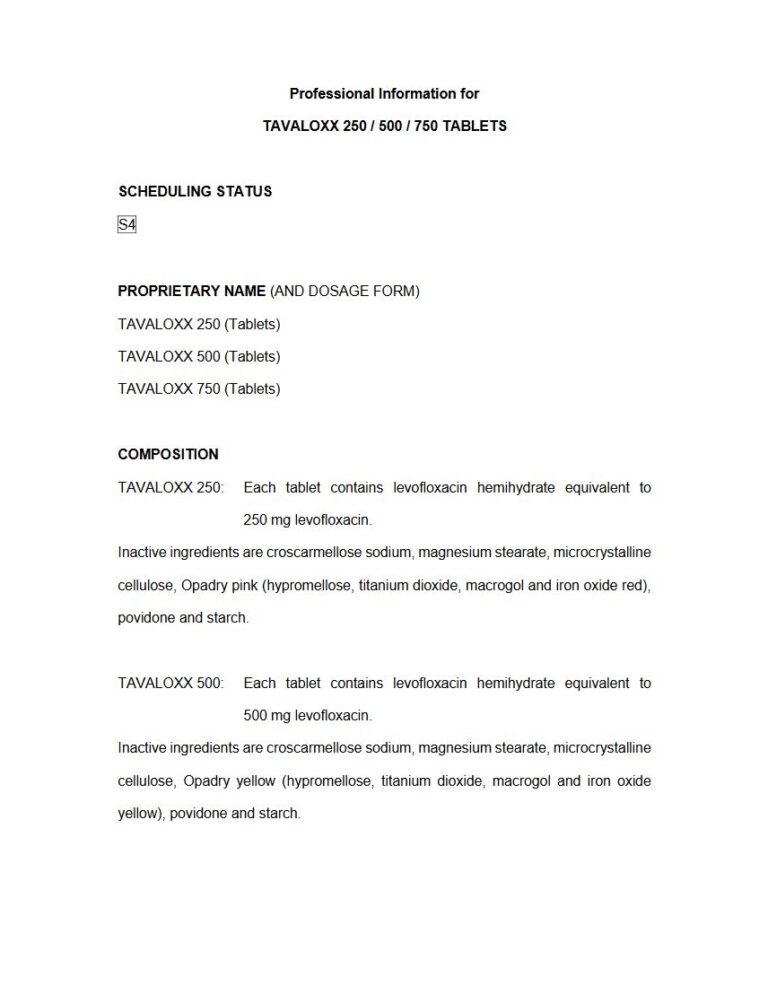
Tavaloxx 250mg / 500mg / 750mg Tablets
PDF Leaflet Revision Date: 16 August 2020
Clinical Summary
Quick overview from the medicine insert
Indication
Treatment of various bacterial infections in adults.
Dosage (summary)
500 mg once daily for bronchitis; 750 mg once daily for pneumonia.
Onset of Action / Duration
Onset: 1 hour, Duration: 6-8 hours
Special Populations
- Renal impairment
- Elderly
Pregnancy & Breastfeeding
Contraindicated in pregnancy and lactation.
Key Drug Interactions
- Iron salts
- Antacids
- Sucralfate
- Theophylline
- Warfarin
Contraindications
- Hypersensitivity to levofloxacin
- Epilepsy
- Tendon disorders
- Children under 18
- Pregnancy
- Moderate to severe renal impairment
Common side effects
- Nausea
- Diarrhoea
- Headache
- Dizziness
- Insomnia
Counselling Points
- Take with plenty of fluids
- Avoid antacids 2 hours before/after
- Monitor for signs of tendon pain
- Report severe diarrhoea immediately
Serious warnings
- Risk of tendon rupture
- QT-interval prolongation
- Pseudomembranous colitis
- Severe hypersensitivity reactions
Important Disclaimer
The Tavaloxx 250mg / 500mg / 750mg Tablets professional information leaflet below is the property of Cipla Medpro and is provided on Medinsert exactly as issued, with no.. alterations or editorial changes. We make every effort to keep content current by updating documents as soon as new versions become available. Medinsert serves as a trusted access point for healthcare professionals, but does not replace official sources or clinical judgement. For more details, please read our full disclaimer. read more>>
 Healthcare Professionals Only
This content is for registered healthcare professionals
Sign in or create a free account to read the full package insert.
Free for HPCSA-registered professionals. Powered by Medinsert.
Clinical Particulars
Section 4 of the official insert — extracted exactly as issued, no alterations
4.1 Therapeutic indications
TAVALOXX can be used in adults, in the treatment of the following bacterial infections:
- Acute exacerbations of chronic bronchitis: caused by H. influenzae, K. pneumoniae, S. aureus, M. catarrhalis, E. coli, H. parainfluenzae or S. pneumoniae.
- Pneumonia (community-acquired): caused by H. influenzae, S. pneumoniae, S. aureus, M. catarrhalis, H. parainfluenzae, K. pneumoniae, E. coli, Mycoplasma pneumoniae, Chlamydia pneumoniae or Legionella pneumophila.
- Sinusitis: caused by H. influenzae, S. pneumoniae, S. aureus, M. catarrhalis or H. parainfluenzae.
- Urinary tract infections (complicated) and acute pyelonephritis: caused by E. coli, K. pneumoniae, S. faecalis, P. mirabilis, Enterobacter cloacae and P. aeruginosa.
- Uncomplicated urinary tract infections in women: caused by E. coli, K. pneumoniae.
- Skin and soft tissue infections (uncomplicated): caused by S. aureus, S. pyogenes, Acinetobacter calcoaceticus, E. cloacae, P. mirabilis, P. aeruginosa, E. coli, K. pneumoniae or S. faecalis.
- Skin and soft tissue infections (complicated): caused by S. aureus, S. pyogenes, P. mirabilis, E. coli, K. pneumoniae, S. faecalis, E. cloacae, K. oxytoca.
- Intra-abdominal infections: caused by E. coli and anaerobic micro-organisms.
- TAVALOXX 750: Hospital acquired pneumonia: due to H. influenzae, S. pneumoniae and methicillin-sensitive S. aureus.
4.2 Posology and method of administration
TAVALOXX tablets should be swallowed whole, without crushing. TAVALOXX tablets may be taken on an empty stomach or with meals. TAVALOXX is to be taken once or twice daily.
The dosage will depend on the type of pathogen and the severity of the infection. The use of TAVALOXX should be continued for a minimum of 48 to 72 hours after it has become evident that the patient has a bacterial infection. The duration of therapy varies according to the course of the disease. The following daily dose is recommended for TAVALOXX:
Daily dosage recommended in patients with normal renal function:
- Bronchitis, bacterial exacerbations: 500 mg once daily for 5 u2013 10 days. Alternatively, 750 mg once daily for 3 to 5 days if caused by H. influenzae, methicillin-sensitive S. aureus, M. catarrhalis, H. parainfluenzae or S. pneumoniae.
- Pneumonia, community acquired: 500 mg once or twice daily for 10 u2013 14 days (the higher dosage should be chosen in the presence of complicating factors e.g. co-morbidity, advanced age). Alternatively, 750 mg once daily for 5 days if caused by H. influenzae, S. pneumoniae, H. parainfluenzae, M. pneumoniae, C. pneumoniae or L. pneumophila.
- Sinusitis: 500 mg once daily for 10 to 14 days. Alternatively, 750 mg once daily for 5 days.
- Urinary tract infections (complicated) and acute pyelonephritis: 250 mg once daily for 10 days.
- Urinary tract infections (uncomplicated) in women: 250 mg once daily for 3 days.
- Uncomplicated skin and soft tissue infections: 250 to 500 mg once daily for 7 u2013 10 days.
- Complicated skin and soft tissue infections: 500 mg once daily for 10 u2013 14 days.
- Intra-abdominal infections: 500 mg once daily in combination with an antibiotic with anaerobic coverage for 10 - 14 days.
- Above infections when bacteraemia or septicaemia is present: 500 mg twice daily for 10 u2013 14 days.
- Hospital acquired pneumonia: 750 mg once daily for 10 to 14 days if caused by H. influenzae, S. pneumoniae and methicillin-sensitive S. aureus.
Daily dosage recommended in patients with impaired renal function:
Dosage must be adjusted in patients with impaired renal function according to the degree of impairment (creatinine clearance u2264 50 mL/min):
- Patients with a creatinine clearance between 20 and 50 mL/min: Patients to be taking 250 or 500 mg once daily: a normal single dose should be given initially and then reduced by half this dose once daily. Patients to be taking 500 mg twice daily: the initial dose should be 500 mg and then 250 mg should be taken twelve hourly. In patients meant to be taking 750 mg once daily: a normal single dose should be given initially, and then 750 mg should be administered every 48 hours.
- Patients with a creatinine clearance between 10 and 19 mL/min: Patients to be taking 250 mg once daily: a normal single dose should be given initially and then reduced to 125 mg every 48 hours. Patients to be taking 500 mg once daily: should be given a normal single dose initially and then this dose should be reduced to 125 mg every 24 hours. Patients to be taking 500 mg twice daily: should be given 500 mg initially and then this dose should be reduced to 125 mg every 12 hours. In patients meant to be taking 750 mg once daily: a normal single dose should be given initially, and then reduced to 500 mg administered every 48 hours.
- Patients with a creatinine clearance of less than 10 mL/min or in patients on haemodialysis or CAPD (Continuous Ambulatory Peritoneal Dialysis): In patients where the prescribed dosage is 250 mg once daily: a normal single dose should be given initially and then this dose should be reduced to 125 mg every 48 hours. Patients to be taking 500 mg once daily: should be given a normal single dose initially and then this dose should be reduced to 125 mg every 24 hours. Patients to be taking 500 mg twice daily: should be given 500 mg initially and then this dose should be reduced to 125 mg every 24 hours. In patients meant to be taking 750 mg once daily: a normal single dose should be given initially, and then reduced to 500 mg administered every 48 hours.
No adjustment of dosage is required in the elderly or in patients with impaired liver function.
4.3 Contraindications
The use of TAVALOXX is contraindicated in:
- Previous hypersensitivity reaction to levofloxacin, other quinolones, or any other ingredient.
- Epilepsy.
- Patients with history of tendon disorders associated with fluoroquinolone administration.
- Children or adolescents (under 18 years of age).
- Pregnancy and lactation.
- Patients with moderate to severe renal impairment who are using ACE inhibitors or renin-angiotensin blockers concomitantly.
- Patients with confirmed mitral valve and/or aortic valve regurgitation unless no safer appropriate alternative antibiotic is available, has failed or is not well tolerated.
4.4 Special warnings and precautions for use
TAVALOXX SHOULD NOT BE GIVEN TO PATIENTS UNDER 18 YEARS OF AGE.
Caution should be exercised when using TAVALOXX in patients:
- Prone to seizures, such as patients with pre-existing central nervous system lesions.
- Being treated with fenbufen or non-steroidal anti-inflammatory medicines.
- Using medicines which lower the cerebral seizure threshold, such as theophylline.
- Driving or operating machinery, as the use of TAVALOXX may alter the ability to drive or to operate machinery.
- Being tested for tuberculosis as TAVALOXX inhibits the growth of Mycobacterium tuberculosis and therefore may give false-negative results in the bacteriological diagnosis of tuberculosis.
- Exposed to ultraviolet light such as sunlight through window glass or longer wavelength ultraviolet (UVA) from sunbeds, in order to prevent photosensitisation.
Disturbances in blood glucose, including both hyperglycaemia and hypoglycaemia have been reported, usually in diabetic patients receiving concomitant treatment with an oral hypoglycaemic medicine or with insulin. Cases of hypoglycaemic coma have been reported. In diabetic patients, careful monitoring of blood glucose is recommended (see SIDE EFFECTS).
Pseudomembranous colitis: Diarrhoea, particularly if severe, persistent and/or bloody, during or after treatment with TAVALOXX, may be symptomatic of pseudomembranous colitis due to Clostridium difficile. If pseudomembranous colitis is suspected, TAVALOXX must be stopped immediately (see SIDE EFFECTS).
Tendinitis: Tendinitis, which is observed with the use of quinolones, such as TAVALOXX, may occasionally lead to tendon rupture involving the Achilles tendon in particular. This effect may occur within 48 hours of starting treatment and may be bilateral. Elderly patients are more prone to tendinitis. The risk of tendon rupture may be increased by co-administration of corticosteroids. If tendonitis is suspected, treatment with TAVALOXX must be stopped immediately. Tendonitis/rupture may occur after several weeks after discontinuation of TAVALOXX (see SIDE EFFECTS).
Patients with renal impairment: Since TAVALOXX is excreted mainly by the kidneys, the dose of TAVALOXX should be adjusted in patients with renal impairment (see DOSAGE AND DIRECTIONS FOR USE). Concomitant use of fluoroquinolones, such as TAVALOXX and ACE inhibitors/renin-angiotensin receptor blockers may precipitate acute kidney injury in patients, especially those with moderate to severe renal impairment and elderly patients (see CONTRAINDICATIONS and SIDE EFFECTS). Renal function should be assessed before initiating treatment, with fluoroquinolones or ACE inhibitors/renin-angiotensin receptor blockers.
QT-interval prolongation: Caution should be taken when using fluoroquinolones, including TAVALOXX, in patients with known risk factors for prolongation of the QT-interval such as:
- The elderly.
- Uncorrected electrolyte imbalance (e.g. hypokalaemia, hypomagnesaemia).
- Congenital long QT syndrome.
- Cardiac disease (e.g. heart failure, myocardial infarction, bradycardia).
- Concomitant use of medicines that are known to prolong the QT-interval [e.g. Class IA and III antidysrhythmics, tricyclic antidepressants, macrolides, antipsychotics] (see INTERACTIONS).
Women and the elderly may be more sensitive to QTc-prolonging medicines. Therefore, caution should be taken when fluoroquinolones, including TAVALOXX, are administered in these populations.
Cardiac disorders: There is some evidence, although inconclusive, of a possible association between oral fluoroquinolone use, such as TAVALOXX, and mitral valve and/or aortic valve regurgitation. A thorough cardiovascular examination including an echocardiogram, should be performed before oral fluoroquinolones are prescribed. Fluoroquinolones, including TAVALOXX, should not be prescribed to patients with mitral valve and/or aortic valve regurgitation (see CONTRAINDICATIONS).
Glucose-6-phosphate dehydrogenase deficiency: Patients with latent or actual defects in glucose-6-phosphate dehydrogenase activity may be prone to haemolytic reactions when treated with quinolones, such as TAVALOXX. The potential occurrence of haemolysis should be monitored.
Peripheral neuropathy: Sensory or sensorimotor peripheral neuropathy has been reported in patients receiving fluoroquinolones, including TAVALOXX, which can be rapid in its onset. TAVALOXX should be discontinued if the patient experiences symptoms of neuropathy. This would minimise the possible risk of developing an irreversible condition (see SIDE EFFECTS).
In patients treated with TAVALOXX, determination of opiates in urine may give a false-positive result. Methicillin resistant S. aureus (MRSA) is very likely to possess co-resistance to fluoroquinolones, including levofloxacin. Levofloxacin is not recommended for the treatment of known or suspected MRSA infections unless laboratory results have confirmed susceptibility of the organism to levofloxacin (and commonly recommended antibacterial agents for the treatment of MRSA-infections are not considered appropriate). Resistance to fluoroquinolones of E. coli u2013 the most common pathogen involved in urinary tract infections u2013 varies. Prescribers are advised to consider the local prevalence of resistance in E. coli to fluoroquinolones.
Hypersensitivity reactions: Levofloxacin may cause serious, potentially fatal hypersensitivity reactions (e.g. angio-oedema up to anaphylactic shock), occasionally following the initial dose. Patients should discontinue treatment immediately and contact their doctor who will initiate appropriate emergency measures (see SIDE EFFECTS).
Severe bullous reactions: Severe bullous skin reactions such as Stevens-Johnson syndrome or toxic epidermal necrolysis have been reported with levofloxacin. Patients should be advised to contact their doctor immediately before continuing treatment if skin and/or mucosal reactions occur.
Psychotic reactions: Psychotic reactions have been reported in patients receiving quinolones, including levofloxacin. In very rare cases these have progressed to suicidal thoughts and self-endangering behaviour u2013 sometimes after a single dose of levofloxacin. Levofloxacin should then be discontinued and appropriate measures instituted. Caution is therefore recommended if levofloxacin is indicated in psychotic patients or in patients with a history of psychiatric disease (see SIDE EFFECTS).
Hepatobiliary disorders: Hepatic necrosis up to fatal hepatic failure has been reported with levofloxacin, primarily in patients with severe underlying diseases, e.g. sepsis. Treatment should be stopped and patients should contact their doctor if signs and symptoms of hepatic disease develop such as anorexia, jaundice, dark urine, pruritus or tender abdomen.
Exacerbation of myasthenia gravis: Fluoroquinolones, such as levofloxacin, have neuromuscular blocking activity and may exacerbate muscle weakness in patients with myasthenia gravis.
Vision disorders: If vision becomes impaired or any effects on the eyes are experienced, an eye specialist should be consulted immediately.
Superinfection: The use of levofloxacin, as in TAVALOXX, especially if prolonged, may result in overgrowth of non-susceptible organisms. If superinfection occurs during therapy, appropriate measures should be taken.
Effect on ability to drive and use machines: TAVALOXX may alter reactivity to such an extent that the ability to drive or to operate machinery may be impaired.
4.5 Interactions with other medicines
The absorption of TAVALOXX is significantly reduced when administered with iron salts, antacids and sucralfate. It is recommended that preparations containing iron salts, sucralfate, magnesium- or aluminium-containing antacids should not be taken 2 hours before or after TAVALOXX tablet administration.
TAVALOXX is known to inhibit hepatic drug metabolism and may interfere with the clearance of medicines, such as theophylline, fenbufen or similar non-steroidal anti-inflammatory medicines that lower the seizure threshold. Concomitant use of fluoroquinolones, such as TAVALOXX and ACE inhibitors/renin-angiotensin receptor blockers may precipitate acute kidney injury (see CONTRAINDICATIONS). Careful consideration should be given to age, renal function, hydration status and concomitant prescribing of diuretics or NSAIDs, and to monitoring of changes in renal function throughout treatment. Caution should be exercised when TAVALOXX is co-administered with medicines that affect tubular renal secretion, such as probenecid and cimetidine, especially in renally impaired patients. Increased coagulation tests (PT/INR) and/or bleeding which may be severe, have been reported in patients treated with TAVALOXX in combination with a vitamin K antagonist (e.g. warfarin). Coagulation tests should be monitored in patients treated with vitamin K antagonists. TAVALOXX should be used with caution in patients receiving medicines known to prolong the QT-interval [e.g. Class IA and III antidysrhythmics, tricyclic antidepressants, macrolides] (see WARNINGS AND SPECIAL PRECAUTIONS).
4.6 Fertility, pregnancy and lactation
The use of TAVALOXX during pregnancy and lactation is contraindicated (see CONTRAINDICATIONS).
4.7 Effects on ability to drive and use machines
TAVALOXX may alter reactivity to such an extent that the ability to drive or to operate machinery may be impaired.
4.8 Undesirable effects
The following side effects have been reported:
Infections and infestations: Less frequent: Fungal infection, pathogen resistance, fungal overgrowth and proliferation of other resistant micro-organisms.
Blood and the lymphatic system disorders: Less frequent: Leukopenia, eosinophilia, neutropenia, thrombocytopenia. Frequency unknown: Pancytopenia, agranulocytosis, haemolytic anaemia.
Immune system disorders: Less frequent: Angio-oedema, allergic manifestations, hypersensitivity, pruritus, rash, urticaria, vasculitis reactions. Frequency unknown: Anaphylactic shock, anaphylactoid shock.
Metabolism and nutrition disorders: Less frequent: Hypoglycaemia, particularly in diabetic patients (see WARNINGS AND SPECIAL PRECAUTIONS), anorexia. Frequency unknown: Hyperglycaemia, hypoglycaemic coma.
Psychiatric disorders: Frequent: Insomnia. Less frequent: Anxiety, confusional state, psychotic disorder (with e.g. hallucination) depression, agitation, nervousness, abnormal dreams, nightmares. Frequency unknown: Psychotic disorders with self-endangering behaviour including suicidal ideation or suicide attempt.
Nervous system disorders: Frequent: Headache, dizziness. Less frequent: Somnolence, tremor, dysgeusia, paraesthesia, convulsion. Frequency unknown: Peripheral sensory neuropathy, peripheral sensory motor neuropathy, parosmia including anosmia, dyskinesia, extrapyramidal disorder, ageusia, syncope, benign intracranial hypertension. In the event of such adverse reactions, TAVALOXX must be discontinued immediately and the medical practitioner informed.
Eye disorders: Less frequent: Visual disturbances (such as blurred vision). Frequency unknown: Transient vision loss, uveitis.
Ear and labyrinth disorders: Less frequent: Vertigo, tinnitus. Frequency unknown: Hearing impaired, hearing loss.
Cardiac disorders: Less frequent: Tachycardia, palpitation. Frequency unknown: Ventricular tachycardia, which may result in cardiac arrest, ventricular arrhythmia and torsade de pointes (predominantly in patients with risk factors for QT prolongation, electrocardiogram QT prolonged.
Vascular disorders: Less frequent: Hypotension.
Respiratory, thoracic and mediastinal disorders: Less frequent: Dyspnoea, allergic pneumonitis. Frequency unknown: Bronchospasm.
Gastrointestinal disorders: Frequent: Nausea, diarrhoea, vomiting. Less frequent: Gastrointestinal symptoms may occur (gastric or abdominal symptoms, loss of appetite, abdominal pain, dyspepsia, flatulence, constipation). The onset of diarrhoea, particularly if severe, persistent and/or bloody, during or after treatment with TAVALOXX, may indicate the appearance of pseudomembranous colitis. Suspicion of pseudomembranous colitis requires immediate cessation of treatment with appropriate specific antibiotic therapy.
Hepatobiliary disorders: Frequent: Hepatic enzyme increased (ALT/AST, alkaline phosphatase, GGT). Less frequent: Blood bilirubin increased. Frequency unknown: Jaundice and severe liver injury, including cases with fatal acute liver failure, primarily in patients with severe underlying diseases.
Skin and subcutaneous tissue disorders: Less frequent: Rash, pruritus, urticaria, hyperhidrosis. Frequency unknown: Toxic epidermal necrolysis, Stevens-Johnson syndrome, erythema multiforme, photosensitivity reaction, leukocytoclastic vasculitis, stomatitis.
Musculoskeletal, connective tissue and bone disorders: Less frequent: Arthralgia, myalgia, tendon disorder including tendinitis (e.g. Achilles tendon), muscular weakness which may be of special importance in patients with myasthenia gravis. Frequency unknown: Rhabdomyolysis, tendon rupture (e.g. Achilles tendon, ligament rupture, muscle rupture, arthritis.
Renal and urinary disorders: Less frequent: Blood creatinine increased, renal failure acute (e.g. due to interstitial nephritis.
General disorders and administrative site conditions: Less frequent: Asthenia, pyrexia (fever), disturbances of taste and smell, fungal overgrowth and proliferation of other resistant micro-organisms. Frequency unknown: Pain (including pain in back, chest and extremities). TAVALOXX is known to possibly trigger attacks of porphyria in patients suffering from porphyria.
Post-marketing: Metabolism and nutrition disorders: Frequency unknown: Hyperglycaemia, hypoglycaemic coma (see WARNINGS AND SPECIAL PRECAUTIONS).
Cardiac disorders: Frequency unknown: Cases of mitral valve and/or aortic valve regurgitation were reported in patients treated with oral fluoroquinolones, such as TAVALOXX. Due to insufficient post-marketing information in the reported cases, it is unknown whether fluoroquinolone use was the causative factor, or a contributory factor or played no role in the reported cases where mitral and/or aortic regurgitation cases was diagnosed.
4.9 Overdose
According to studies in animals, the most important signs to be expected following acute overdosage of TAVALOXX are central nervous system symptoms such as confusion, dizziness, impairment of consciousness and convulsive seizures, increases in QT-interval as well as gastro-intestinal reactions such as nausea and mucosal erosions. The treatment of an overdosage is only symptomatic and supportive. TAVALOXX is not effectively removed by haemodialysis or peritoneal dialysis. In the event of overdose the patient should be carefully observed (including ECG monitoring) and symptomatic treatment should be implemented. In case of acute oral overdosage, gastric lavage should also be considered and antacids may be used for protection of gastric mucosa.
