
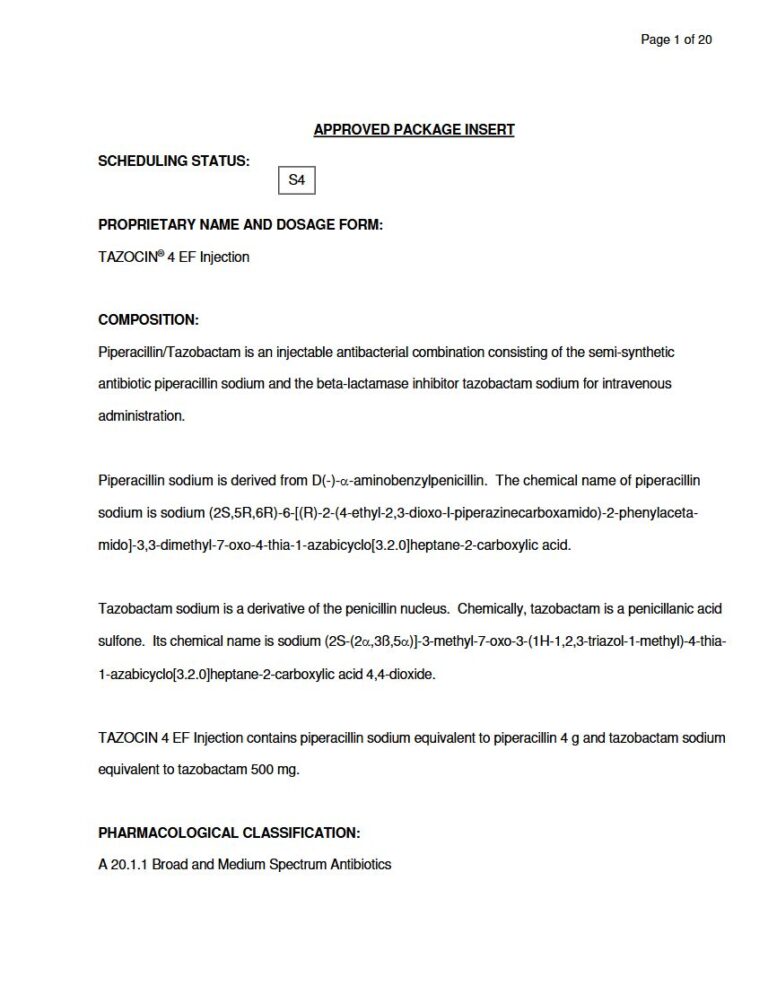
Tazocin 4g-500mg Injection
PDF Leaflet Revision Date: 02 May 2002
Clinical Summary
Quick overview from the medicine insert
Indication
Treatment of systemic and local bacterial infections.
Dosage (summary)
Adults: 4 g/0.5 g every 8 hours; adjust for renal impairment.
Special Populations
- Renal impairment
- Elderly
Pregnancy & Breastfeeding
Use only if benefits outweigh risks; crosses placenta and low levels in breast milk.
Key Drug Interactions
- Probenecid
- Aminoglycosides
- Methotrexate
Contraindications
- History of allergic reactions to penicillins or cephalosporins
Common side effects
- Diarrhoea
- Nausea
- Rash
- Hypersensitivity reactions
Counselling Points
- Report any allergic reactions
- Monitor for severe diarrhoea
- Avoid mixing with other antibiotics in IV solutions
Serious warnings
- Serious hypersensitivity reactions
- Pseudomembranous colitis
Important Disclaimer
The Tazocin 4g-500mg Injection professional information leaflet below is the property of Pfizer and is provided on Medinsert exactly as issued, with no.. alterations or editorial changes. We make every effort to keep content current by updating documents as soon as new versions become available. Medinsert serves as a trusted access point for healthcare professionals, but does not replace official sources or clinical judgement. For more details, please read our full disclaimer. read more>>
 Healthcare Professionals Only
This content is for registered healthcare professionals
Sign in or create a free account to read the full package insert.
Free for HPCSA-registered professionals. Powered by Medinsert.
Clinical Particulars
Section 4 of the official insert — extracted exactly as issued, no alterations
4.1 Therapeutic indications
Piperacillin/tazobactam is indicated for the treatment of the following systemic and/or local bacterial infections in which susceptible organisms have been detected or are suspected:
Adults:
- Community acquired pneumonia due to Haemophilus influenzae.
- Intra-abdominal Infections caused by piperacillin resistant beta-lactamase producing strains of Escherichia coli and Bacteroides fragilis.
- Skin and Skin Structure Infections caused by piperacillin resistant beta-lactamase producing strains of Staphylococcus aureus.
- Gynaecologic Infections including endometritis caused by piperacillin resistant beta-lactamase producing strains of E coli.
- Piperacillin/tazobactam plus an aminoglycoside is indicated for Bacterial infections in Neutropenic patients.
Children:
CHILDREN UNDER THE AGE OF 12 YEARS: Piperacillin/tazobactam plus an aminoglycoside is indicated for bacterial infections in neutropenic patients.
CHILDREN 2 - 12 YEARS: In hospitalised children aged 2 to 12 years, piperacillin/tazobactam is indicated for the treatment of serious intra-abdominal infections, caused by E. coli or Bacteroides species. It has not been evaluated in this indication for paediatric patients below the age of 2 years.
While piperacillin/tazobactam is indicated only for the conditions listed above, infections caused by piperacillin susceptible organisms are also amenable to piperacillin/tazobactam treatment due to its piperacillin content. Therefore, the treatment of mixed infections caused by piperacillin susceptible organisms and u00df-lactamase producing organisms susceptible to piperacillin/tazobactam should not require the addition of another antibiotic.
4.3 Contraindications
The use of piperacillin/tazobactam is contraindicated in patients with a history of allergic reactions to any of the penicillins and/or cephalosporins or u00df-lactamase inhibitors, or any of the constituents.
4.4 Special warnings and precautions for use
Serious and occasionally fatal hypersensitivity (anaphylactic/anaphylactoid including shock) reactions have been reported in patients receiving therapy with penicillins. These reactions are more apt to occur in persons with a history of penicillin hypersensitivity or sensitivity to multiple allergens. There have been reports of patients with a history of penicillin hypersensitivity that have experienced severe hypersensitivity reactions when treated with a cephalosporin. Before initiating therapy with piperacillin/tazobactam, careful inquiry should be made concerning previous hypersensitivity reactions to penicillins, cephalosporins, and other allergens. If an allergic reaction occurs during therapy with piperacillin/tazobactam, the antibiotic should be discontinued. Serious hypersensitivity reactions require immediate emergency measures, with adrenaline, corticosteroids and antihistamines. An open airway must be maintained.
Pseudomembranous colitis has been reported with nearly all antibacterial agents, including piperacillin. Antibiotic-induced pseudomembranous colitis may be manifested by severe, persistent diarrhoea which may be life-threatening. The onset of pseudomembranous colitis may occur during or after antibacterial treatment. Therefore it is important to consider this diagnosis in patients who present with diarrhoea subsequent to the administration of antibacterial agents. After the diagnosis of pseudomembranous colitis has been established, therapeutic measures should be initiated. Mild cases of pseudomembranous colitis usually respond to drug discontinuation alone. In moderate to severe cases, consideration should be given to management with fluids and electrolytes, protein supplementation and treatment with an oral antibacterial drug effective against C. difficile.
While piperacillin/tazobactam possesses the characteristic low toxicity of the penicillin group of antibiotics, periodic assessment of organ system functions including renal and hepatic during prolonged therapy is advisable. Leukopenia and neutropenia may occur, especially during prolonged therapy. Therefore, periodic assessment of haematopoietic function should be performed. Bleeding manifestations have occurred in some patients receiving u00df-lactam antibiotics. These reactions have sometimes been associated with abnormalities of coagulation tests such as clotting time, platelet aggregation and prothrombin time and are more likely to occur in patients with renal failure. If bleeding manifestations occur, the antibiotic should be discontinued and appropriate therapy instituted.
The possibility of the emergence of resistant organisms, which might cause superinfections, should be kept in mind, particularly during prolonged treatment. If this occurs, appropriate measures should be taken.
As with other penicillins, patients may experience neuromuscular excitability or convulsions if higher than recommended doses are given intravenously. This product contains 2,79 mEq (64 mg) of sodium per gram of piperacillin which may increase a patientu2019s overall sodium intake. Periodic electrolyte determinations should be made in patients with low potassium reserves, and the possibility of hypokalaemia should be kept in mind with patients who have potentially low potassium reserves and who are receiving cytotoxic therapy or diuretics. Modest elevation of indices of liver function may be observed. In patients with renal insufficiency or haemodialysis patients, the intravenous dose should be adjusted to the degree of renal function impairment. Patients over 65 years are not at an increased risk of developing adverse effects solely because of age. However, dosage should be adjusted in the presence of renal insufficiency.
4.5 Interactions with other medicines
Concurrent administration of probenecid and piperacillin/tazobactam produced a longer half-life and lower renal clearance for both piperacillin and tazobactam; however, peak plasma concentrations of either medicine are unaffected. No interaction is found between piperacillin/tazobactam and vancomycin.
Piperacillin either alone or with tazobactam did not significantly alter the pharmacokinetics of tobramycin in subjects with normal renal function and with mild or moderate renal impairment. The pharmacokinetics of piperacillin, tazobactam, and the M1 metabolite were also not significantly altered by tobramycin administration. Whenever piperacillin/tazobactam is used concurrently with another antibiotic, especially an aminoglycoside, the drugs must not be mixed in intravenous solutions or administered concurrently due to physical incompatibility.
During simultaneous administration of high doses of heparin, oral anticoagulants and other drugs that may affect the blood coagulation system and/or the thrombocyte function, the coagulation parameters should be tested more frequently and monitored regularly. Piperacillin, when given concomitantly with vecuronium has been implicated in the prolongation of the neuromuscular blockage of vecuronium. Due to their similar mechanism of action, it is expected that the neuromuscular blockade produced by any of the non-depolarizing muscle relaxants could be prolonged in the presence of piperacillin. Piperacillin may reduce the excretion of methotrexate; therefore, serum levels of methotrexate should be monitored in patients to avoid drug toxicity.
Pharmaceutical incompatibilities: Piperacillin/tazobactam should not be mixed with other medicines in a syringe or infusion bottle since compatibility has not been established.
The mixing of beta-lactam antibiotics with aminoglycosides in vitro can result in substantial inactivation of the aminoglycoside. However, amikacin and gentamicin were determined to be compatible with piperacillin/tazobactam in vitro in certain diluents at specific concentrations (see DOSAGE AND DIRECTIONS FOR USE). Because of chemical instability, piperacillin/tazobactam should not be used with solutions containing only sodium bicarbonate. Lactated Ringeru2019s solution is only compatible with TAZOCIN 4 EF formulation. Piperacillin/tazobactam should not be added to blood products or albumin hydrolysates.
Laboratory tests: The administration of piperacillin/tazobactam may result in a false-positive reaction for glucose in the urine using a copper-reduction method. It is recommended that glucose tests based on enzymatic glucose oxidase reactions be used. There have been reports of positive test results using the Bio-Rad Laboratories Platelia Aspergillus EIA test in patients receiving piperacillin/tazobactam injection who were subsequently found to be free of Aspergillus infection. Cross-reactions with non-Aspergillus polysaccharides and polyfuranoses with Bio-Rad Laboratories Platelia Aspergillus EIA test have been reported. Therefore, positive test results in patients receiving piperacillin/tazobactam should be interpreted cautiously and confirmed by other diagnostic methods.
4.6 Fertility, pregnancy and lactation
Adequate studies on the use of piperacillin/tazobactam during pregnancy and the period of breast feeding are not yet available. Piperacillin/tazobactam did not affect fertility in rats and was not teratogenic in mice or rats. Piperacillin and tazobactam cross the placenta. Piperacillin is excreted in low concentrations in human milk; tazobactam concentrations in human milk have not been studied. Until further experience is available, however, pregnant or nursing women should be treated only if the therapeutic benefit outweighs the risk to the patient and the foetus.
4.7 Effects on ability to drive and use machines
Not stated in the provided text.
4.8 Undesirable effects
Adverse reactions are listed in the Table in CIOMS frequency categories:
Very Common u2265 10 %
Common u2265 1 % and < 10 %
Uncommon u2265 0,1 % and < 1%
Rare u2265 0,01 % and < 0,1 %
Very rare < 0,01 %
Infections and infestations:
Uncommon: Candidal superinfections
Blood and lymphatic system:
Uncommon: Leukopenia, neutropenia, thrombocytopenia
Rare: Anaemia, bleeding manifestations (including purpura, epistaxis, bleeding time prolonged), eosinophilia, haemolytic anaemia
Very rare: Agranulocytosis, Coombs direct test positive, pancytopenia, prolonged partial thromboplastin time, prothrombin time prolonged, thrombocytosis
Immune system disorders:
Uncommon: Hypersensitivity reaction
Rare: Anaphylactic/anaphylactoid reaction (including shock)
Metabolism and nutritional disorders:
Very rare: Blood albumin decreased, blood glucose decreased, blood total protein decreased, hypokalaemia
Nervous system disorders:
Uncommon: Headache, insomnia
Vascular disorders:
Uncommon: Hypotension, phlebitis, thrombophlebitis
Rare: Flushing
Gastro-intestinal:
Common: Diarrhoea, nausea, vomiting
Uncommon: Constipation, dyspepsia, jaundice, stomatitis
Rare: Abdominal pain, pseudomembranous colitis
Hepatobiliary system:
Uncommon: Alanine aminotransferase increased, aspartate aminotransferase increased
Rare: Bilirubin increased, blood alkaline phosphatase increased, gamma-glutamyltransferase increased, hepatitis
Skin and subcutaneous tissue disorders:
Common: Rash
Uncommon: Pruritus, urticaria
Rare: Bullous dermatitis, erythema multiforme
Very rare: Stevens-Johnson Syndrome, toxic epidermal necrolysis
Musculoskeletal, connective tissue and bone disorders:
Rare: Arthralgia
Renal and urinary disorders:
Uncommon: Blood creatinine increased
Rare: Interstitial nephritis, renal failure
Very rare: Blood urea nitrogen increased
General disorders and administration site conditions:
Uncommon: Fever, injection site reaction
Rare: Rigors
Piperacillin therapy has been associated with an increased incidence of fever and rash in cystic fibrosis patients.
4.9 Overdose
See SIDE EFFECTS. The majority of events experienced during overdosage including nausea, vomiting and diarrhoea have also been reported with the usual recommended dosages. Patients may experience neuromuscular excitability or convulsions if higher than recommended doses are given intravenously (particularly in the presence of renal failure). Treatment should be supportive and symptomatic according to the patientu2019s clinical presentation. No specific antidote is known. Excessive serum concentrations of either piperacillin or tazobactam may be reduced by haemodialysis. In the event of an emergency, all required intensive medical measures are indicated as in the case of piperacillin. In case of motor excitability or convulsions, anticonvulsive agents (e.g. diazepam or barbiturates) may be indicated. In case of severe, hyperallergic (anaphylactic) reactions, the usual countermeasures are to be initiated (antihistamines, corticosteroids, sympathicomimetic drugs and, if required, oxygen and airway management). In case of severe, persistent diarrhoea, the possibility of antibiotic-induced life-threatening pseudomembranous colitis must be taken into consideration. Therefore, piperacillin/tazobactam must be discontinued immediately in such cases and suitable therapy be initiated (e.g. oral teicoplanin or oral vancomycin). Preparations, which inhibit peristalsis, are contraindicated.
