
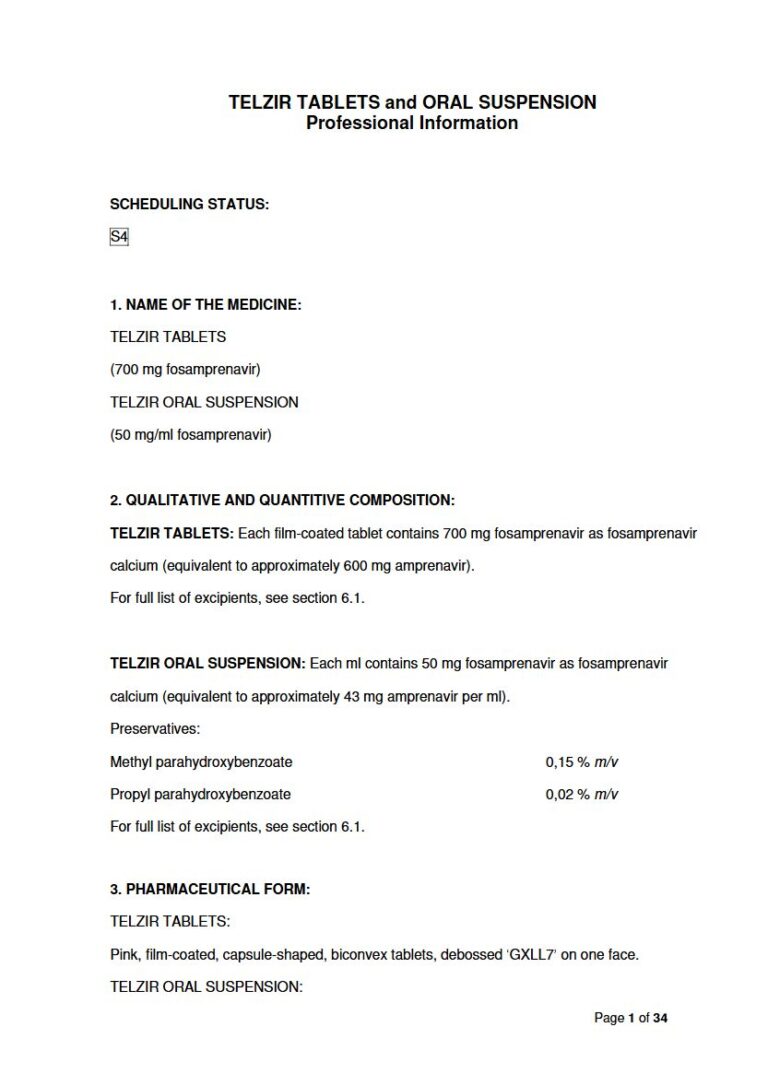
Telzir 700 mg/ 50 mg TABLETS. ORAL SUSPENSION
PDF Leaflet Revision Date: 11 March 2022
Clinical Summary
Quick overview from the medicine insert
Indication
Treatment of HIV in combination with other antiretroviral medicines.
Dosage (summary)
Adults: 1400 mg once daily or 700 mg twice daily with ritonavir.
Special Populations
- Elderly
- Renal impairment
- Hepatic impairment
Pregnancy & Breastfeeding
Not recommended during pregnancy or breastfeeding due to lack of safety data.
Key Drug Interactions
- CYP3A4 inhibitors
- Rifampicin
- St John's Wort
- PDE5 inhibitors
Contraindications
- Severe hepatic impairment
- Hypersensitivity to components
- Concomitant use with ketoconazole
Common side effects
- Diarrhea
- Headache
- Rash
- Hypertriglyceridemia
Counselling Points
- Take with food for children
- Monitor for signs of hypersensitivity
- Regular viral load monitoring required
Serious warnings
- Risk of opportunistic infections
- Hypersensitivity reactions
- Increased bleeding in hemophiliacs
Important Disclaimer
The Telzir 700 mg/ 50 mg TABLETS. ORAL SUSPENSION professional information leaflet below is the property of Glaxosmithkline South Africa and is provided on Medinsert exactly as issued, with no.. alterations or editorial changes. We make every effort to keep content current by updating documents as soon as new versions become available. Medinsert serves as a trusted access point for healthcare professionals, but does not replace official sources or clinical judgement. For more details, please read our full disclaimer. read more>>
 Healthcare Professionals Only
This content is for registered healthcare professionals
Sign in or create a free account to read the full package insert.
Free for HPCSA-registered professionals. Powered by Medinsert.
Clinical Particulars
Section 4 of the official insert — extracted exactly as issued, no alterations
4.1 Therapeutic indications
TELZIR in combination with low dose ritonavir is indicated for the treatment of Human Immunodeficiency Virus (HIV) infected patients for use in combination with other antiretroviral medicines.
4.2 Posology and method of administration
Therapy should be initiated by a medical practitioner experienced in the management of HIV infection. TELZIR is not recommended for use as monotherapy, due to the rapid emergence of resistant virus. All regimens must be administered in combination with other antiretroviral medicines. The importance of complying with the full recommended dosing regimen should be stressed to all patients. Do not exceed the recommended dose. Higher than approved dose combinations of TELZIR with ritonavir are not recommended for use (see section 4.4). Once daily administration of TELZIR with ritonavir is not recommended in protease inhibitor (PI) experienced patients.
Adults (greater than or equal to 18 years of age): Tablets: TELZIR tablets in combination with ritonavir can be taken with or without food. In addition to tablets, TELZIR is also available as an oral suspension for use in adults unable to swallow tablets.
Therapy nau00efve patients: The recommended dose is 1 400 mg TELZIR (2 tablets) once daily with 200 mg ritonavir once daily or 700 mg TELZIR (1 tablet) twice daily with 100 mg ritonavir twice daily.
PI-experienced patients: The recommended dose 700 mg TELZIR (1 tablet) twice daily with 100 mg ritonavir twice daily.
Oral suspension: TELZIR oral suspension in combination with ritonavir should be taken without food and on empty stomach. Shake the bottle vigorously for 20 seconds before first dose is removed. Shake bottle before subsequent doses are removed. Do not mix with other medicines.
Therapy nau00efve patients: The recommended dose is 1 400 mg TELZIR (28 ml) once daily with 200 mg ritonavir once daily or 700 mg TELZIR (14 ml) twice daily with 100 mg ritonavir twice daily. Both regimens must be administered in combination with other antiretroviral medicines.
PI-experienced patients: The recommended dose is 700 mg TELZIR (14 ml) twice daily with 100 mg ritonavir twice daily.
Children and Adolescent Patients (2 to 17 years of age): Tablets: The TELZIR oral suspension is the recommended formulation for the most accurate dosing in children based on body weight. The adult tablet regimens of TELZIR 700 mg twice daily plus 100 mg ritonavir twice daily (for protease inhibitor nau00efve or experienced patients) may be used in children and adolescents if they weigh at least 39 kg and can swallow the tablets whole. Ritonavir 100 mg capsules may be used in children and adolescents taking the TELZIR oral suspension if they weigh at least 33 kg and can swallow the capsules whole. The tablet can be taken with or without food.
Oral suspension: The TELZIR oral suspension is the recommended formulation for the most accurate dosing in children based on body weight. The oral suspension should be taken with food by children and adolescents. Shake the bottle before use. The recommended doses of TELZIR oral suspension with ritonavir are as follows:
Table 2: Dosage Recommendations for paediatric patients
Children less than 2 years of age: The safety and efficacy of TELZIR in combination with ritonavir has not yet been established in this patient population.
Patient Population Age TELZIR/Ritonavir * Dosage regimen - Twice daily 2-5 years TELZIR 20 mg/kg Ritonavir 3 mg/kg u2265 6 years TELZIR 18 mg/kg Ritonavir 3 mg/kg PI naive 2-5 years TELZIR 20 mg/kg Ritonavir 3 mg/kg u2265 6 years TELZIR 18 mg/kg Ritonavir 3 mg/kg PI experienced 2-5 years TELZIR 20 mg/kg Ritonavir 3 mg/kg u2265 6 years TELZIR 18 mg/kg Ritonavir 3 mg/kg * Maximum dose not to exceed the recommended adult dose. The adult tablet regimen of TELZIR with ritonavir twice daily may be prescribed to children and adolescents weighing at least 39 kg and able to swallow tablets whole. Ritonavir 100 mg capsules may be prescribed to children and adolescents taking the TELZIR oral suspension if they weigh at least 33 kg and can swallow the capsules whole.
Elderly: The pharmacokinetics of fosamprenavir in combination with ritonavir has not been studied in patients over 65 years of age (see section 5.2). When treating elderly patients, consideration should be given to potential hepatic, renal or cardiac dysfunction, concomitant disease or other medicinal therapy.
Renal impairment: No initial dose adjustment is considered necessary in patients with renal impairment (see section 5.2).
Hepatic impairment: Fosamprenavir is converted in man to amprenavir. The principal route of amprenavir and ritonavir elimination is hepatic metabolism. For adults with mild hepatic impairment (Child-Pugh score: 5-6): TELZIR should be used with caution and at a reduced dose of 700 mg TELZIR twice daily with 100 mg ritonavir once daily. TELZIR is contra-indicated in patients with severe hepatic impairment. For adults with moderate hepatic impairment (Child-Pugh score: 7-9): TELZIR should be used with caution and at a reduced dose 450 mg TELZIR twice daily with 100 mg ritonavir once daily. As it is not possible to achieve this latter TELZIR dose using the tablet formulation, these patients should be treated with TELZIR oral suspension.
4.3 Contraindications
Known hypersensitivity to fosamprenavir, amprenavir, ritonavir or to any of the excipients of these medicines. Patients with severe hepatic impairment. Concomitant treatment with ketoconazole. TELZIR in combination with ritonavir must not be administered concurrently with medicines with narrow therapeutic windows that are substrates of cytochrome P450 3A4 (CYP 3A4). Co-administration may result in competitive inhibition of the metabolism of these medicines and create the potential for elevated plasma concentrations, leading to serious and life-threatening adverse events such as cardiac dysrrhythmia (e.g. cisapride, pimozide), hypotension (for example, the alpha blocker alfuzosin), prolonged sedation or respiratory depression (e.g. triazolam, midazolam, quetiapine) or peripheral vasospasm or ischaemia (e.g. ergot derivatives) or rhabdomyolysis (e.g. lovastatin and simvastatin) (see section 4.5). TELZIR/ritonavir must not be administered concomitantly with the antipsychotic medicinal product lurasidone. Please refer to the full prescribing information for ritonavir for other potential interactions (see section 4.5). TELZIR/ritonavir must not be administered concomitantly with sildenafil when used for the treatment of pulmonary arterial hypertension (for use of sildenafil in patients with erectile dysfunction, see section 4.4 and section 4.5). There is increased potential for sildenafil-associated serious adverse events. Ritonavir also inhibits CYP2D6 in vitro and in vivo but to a lesser extent than CYP3A4. TELZIR in combination with ritonavir should not be co-administered with medicines that are highly dependent on CYP2D6 metabolism and for which elevated plasma concentrations are associated with serious and/or life-threatening results. These medicinal products include flecainide and propafenone (please refer to the full prescribing information for ritonavir for further details) (see section 4.5). TELZIR in combination with ritonavir must not be administered concurrently with rifampicin due to expected large decreases in plasma concentrations of amprenavir (see section 4.5). Herbal preparations containing St Johnu2019s Wort (Hypericum perforatum) must not be used while taking TELZIR in combination with ritonavir due to the risk of decreased plasma concentrations and reduced clinical effects of amprenavir (see section 4.5). The pharmacokinetics, safety and efficacy of the TELZIR/ritonavir combination in children below 2 years of age have not yet been established.
4.4 Special warnings and precautions for use
Opportunistic infections: Patients should be advised that treatment with the TELZIR/ritonavir combination, or any other current antiretroviral therapy, does not cure HIV and that they may still develop opportunistic infections and other complications of HIV infection, and therefore they should remain under close observation by healthcare professionals experienced in the treatment of patients with associated HIV disease. Regular monitoring of viral load and CD4 counts needs to be done.
The risk of HIV transmission to others: Patients should be advised that current antiretroviral therapies, including TELZIR/ritonavir combinations, do not prevent the risk of transmission of HIV to others through sexual contact or blood contamination. Appropriate precautions should continue to be taken.
Hypersensitivity: Fosamprenavir contains a sulphonamide moiety. There is a potential for cross sensitivity between medicines in the sulphonamide class and TELZIR. TELZIR in combination with ritonavir should be used with caution in patients with a known sulphonamide allergy. The TELZIR oral suspension contains propyl and methyl parahydroxybenzoate. These substances may cause an allergic reaction. This reaction may be delayed.
In antiretroviral nau00efve patients receiving TELZIR/ritonavir in combination with abacavir and lamivudine, medicine hypersensitivity was commonly reported. All cases were reported as possibly related to abacavir. In cases of reported medicine hypersensitivity, abacavir was discontinued and an alternative antiretroviral medicine substituted. Few patients withdrew from the study due to these events.
Haemophiliac patients: There have been reports of increased bleeding including spontaneous skin haematomas and haemarthroses in haemophiliac patients type A and B treated with protease inhibitors. In some patients, administration of factor VIII was necessary. In more than half of the reported cases, treatment with protease inhibitors was continued, or re-introduced if treatment had been discontinued. A causal relationship has been evoked, although the mechanism of action has not been elucidated. Haemophiliac patients should therefore be informed of the possibility of increased bleeding.
Hyperglycaemia: New onset of diabetes mellitus, hyperglycaemia or exacerbation of existing diabetes mellitus have been reported in patients receiving antiretroviral therapy, including TELZIR. In some of these, the hyperglycaemia was severe and, in some cases also associated with ketoacidosis. Many of the patients had confounding medical conditions, some of which required therapy with medicines that have been associated with the development of diabetes mellitus or hyperglycaemia.
Hepatic/Renal dysfunction: Amprenavir and ritonavir are both principally metabolised by the liver. TELZIR with ritonavir should be used with caution and at reduced doses in adults with mild and moderate hepatic impairment (see section 4.2) and should not be used in patients with severe hepatic impairment (see section 4.3). Patients with underlying hepatitis B or C and elevations in transaminases prior to treatment may be at increased risk of developing transaminase elevations. Appropriate laboratory testing should be conducted prior to initiating therapy and at periodic intervals during treatment.
Since the renal clearance of amprenavir and ritonavir is negligible, increased plasma concentrations are not expected in patients with renal impairment. Because amprenavir and ritonavir are highly protein bound, it is unlikely that haemodialysis or peritoneal dialysis will significantly remove them.
Increase in body fat: Combination anti-retroviral therapy, including regimens containing a protease inhibitor, may be associated with increased body fat in some patients. Clinical examination should include evaluation for physical signs of increase in body fat. Patients with evidence of increase in body fat should have a thorough cardiovascular risk assessment.
Lipid elevations: Treatment with TELZIR plus ritonavir has resulted in increases in the concentration of triglycerides and cholesterol. Triglyceride and cholesterol testing should be performed prior to initiating therapy with fosamprenavir and at periodic intervals during therapy. Lipid disorders should be managed as clinically appropriate.
Immune Reconstitution Syndrome: In HIV-infected patients with severe immune deficiency at the time of initiation of antiretroviral therapy (ART), an inflammatory reaction to asymptomatic or residual opportunistic infections may arise and cause serious clinical conditions, or aggravation of symptoms. Typically, such reactions have been observed within the first few weeks or months of initiation of ART. Relevant examples are tuberculosis, cytomegalovirus retinitis, generalised and/or focal mycobacterial infections and Pneumocystis jiroveci (P. carinii) pneumonia. Any inflammatory symptoms must be evaluated without delay and treatment initiated when necessary. Auto-immune disorders (such as Gravesu2019 disease, polymyositis and Guillain-Barre syndrome) have also been reported to occur in the setting of immune reconstitution, however, the time to onset is more variable, and can occur many months after initiation of treatment and sometimes can be an atypical presentation.
Osteonecrosis: Although the aetiology is considered to be multifactorial (including corticosteroid use, alcohol consumption, severe immunosuppression, higher body mass index), cases of osteonecrosis have been reported, particularly with advanced HIV-disease and/or long-term exposure to combination antiretroviral therapy (cART). Patients should be advised to seek medical advice if they experience joint aches and pains, joint stiffness or difficulty in movement.
Interactions: Interactions with other medicines have been identified (see section 4.5 and section 4.3). Caution is advised with the concomitant use of TELZIR and rifabutin, anti-dysrhythmics, anticonvulsants, immunosuppressants, tricyclic antidepressants, oral anticoagulants, and herbal medicines (see section 4.5). Concomitant use of TELZIR with ritonavir and fluticasone propionate or other glucocorticoids that are metabolised by CYP3A4 is not recommended unless the potential benefit of treatment outweighs the risk of systemic corticosteroid effects, including Cushing's syndrome and adrenal suppression (see section 4.5). Because there may be an increased risk with co-administration of TELZIR, ritonavir and oral contraceptives, alternative non-hormonal methods of contraception are recommended for women of childbearing potential (see section 4.5).
No data are available on the co-administration of TELZIR and ritonavir with oestrogens and/or progestogens when used as hormonal replacement therapies. The efficacy and safety of these therapies with TELZIR and ritonavir has not been established.
Co-administration of TELZIR/ritonavir with other antineoplastics metabolised by CYP3A (for example dasatinib, nilotinib, ibrutinib, vinblastine and everolimus) may increase concentrations of these medicinal products, potentially increasing the risk of adverse events usually associated with these medicines. Please refer to the relevant product information for these medications (see section 4.5).
Concomitant use of PDE5 inhibitors (e.g. sildenafil) for the treatment of erectile dysfunction in patients receiving the fosamprenavir/ritonavir combination is not recommended. Concomitant use of fosamprenavir and ritonavir with PDE5 inhibitors is expected to substantially increase PDE5 inhibitor concentrations and may result in PDE5 inhibitor associated adverse events, including hypotension, syncope, visual changes and priapism (see section 4.5).
Hepatitis C virus (HCV) Direct-Acting Antivirals: When hepatitis C virus direct-acting antiviral (DAA) medicines, which are metabolised by CYP3A4 or are inducers/inhibitors of CYP3A4, are co-administered with TELZIR/ritonavir, altered plasma concentrations of medicines are expected due to inhibition or induction of CYP3A4 enzyme activity. These interactions may lead to:
- Clinically significant adverse reactions from greater exposures of fosamprenavir/ritonavir or concomitant medicines.
- Loss of therapeutic effect of fosamprenavir/ritonavir or concomitant medicines and possible development of resistance.
Therefore, co-administration of TELZIR/ritonavir is not recommended with HCV DAA medicines, which are metabolised by CYP3A4 or are inducers/inhibitors of CYP3A4, because of the potential for an interaction (for example telaprevir, boceprevir, simeprevir, paritaprevir). In case of concomitant HCV DAA therapy for hepatitis C, please refer to the relevant product information for these medicines.
Rhabdomyolysis: An increase in CPK, myalgia, myositis, and rarely, rhabdomyolysis, have been reported with protease inhibitors, more specifically in association with nucleoside analogues. Clinical chemistry abnormalities: Severe clinical laboratory abnormalities (Grade 3 or 4) potentially related to treatment with TELZIR in combination with ritonavir and reported in greater than or equal to 2 % of subjects, included: increased ALT (5-8 %); AST (4-6 %); serum lipase (4-6 %) and triglycerides (6 %). Total cholesterol elevations were observed in less than 1 % of subjects. Use of TELZIR with ritonavir at higher than approved dosages has resulted in elevated transaminase levels in some subjects and are not recommended for use.
4.5 Interaction with other medicines and other forms of interaction
When fosamprenavir and ritonavir are co-administered, the ritonavir metabolic medicine interaction profile may predominate because ritonavir is a more potent CYP3A4 inhibitor. The full prescribing information for ritonavir must therefore be consulted prior to initiation of therapy with TELZIR and ritonavir. Interaction studies have only been performed in adults. Ritonavir is a potent inhibitor of the cytochrome P450 isoform CYP3A. Ritonavir also inhibits CYP2D6 and induces CYP3A4, CYP1A2, CYP2C9 and glucuronosyl transferase. Amprenavir, the active metabolite of fosamprenavir, is a less potent CYP3A4 inhibitor than ritonavir. Interactions involving CYP3A4: Amprenavir, the active metabolite of fosamprenavir, and ritonavir are primarily metabolised in the liver by CYP3A4. Therefore, medicines that either share this metabolic pathway or modify CYP3A4 activity may modify the pharmacokinetics of amprenavir and ritonavir. Similarly, administration of fosamprenavir in combination with ritonavir may modify the pharmacokinetics of other medicines that share this metabolic pathway (see section 4.3 and section 4.4). The medicines listed below include examples of substrates, inhibitors, or inducers of CYP3A4 that could interact with TELZIR in combination with ritonavir when used concomitantly. This list is not exhaustive. In some cases, the clinical significance of these potential interactions is unknown and has not been studied. Patients should therefore be monitored for toxicities associated with such medicines when they are used in combination with TELZIR and ritonavir.
Interactions involving CYP2D6: Ritonavir is an inhibitor of CYP2D6. Therefore, the combination of ritonavir with fosamprenavir may result in increased plasma concentrations of medicines that are primarily metabolised by CYP2D6 (see section 4.3).
Associations contraindicated (see section 4.3): TELZIR in combination with ritonavir must not be administered concurrently with medicines with narrow therapeutic windows that are substrates of cytochrome P450 3A4 (CYP3A4). Co-administration may result in competitive inhibition of the metabolism of these medicines and create the potential for serious and/or life-threatening adverse events such as cardiac dysrhythmia (e.g. cisapride, pimozide, ketoconazole, itraconazole), hypotension (for example, the alpha blocker alfuzosin), prolonged sedation or respiratory depression (e.g. triazolam, midazolam, quetiapine) or peripheral vasospasm or ischaemia (e.g. ergot derivatives) or rhabdomyolysis (e.g. lovastatin and simvastatin) (see section 4.3). TELZIR/ritonavir must not be administered concomitantly with sildenafil when used for the treatment of pulmonary arterial hypertension. There is increased potential for sildenafil-associated serious adverse events (see section 4.3). TELZIR in combination with ritonavir should not be co-administered with medicines that are highly dependent on CYP2D6 metabolism and for which elevated plasma concentrations are associated with serious and/or life-threatening results. These medicines include flecainide and propafenone (see section 4.3). Rifampicin reduces the amprenavir plasma AUC by approximately 82 %. Based on information for other protease inhibitors, it is expected that co-administration of TELZIR and ritonavir with rifampicin will also result in large decreases in plasma concentrations of amprenavir. Accordingly, TELZIR in combination with ritonavir should not be co-administered with rifampicin (see section 4.3). Serum levels of amprenavir and ritonavir can be reduced by concomitant use of the herbal preparation St Johnu2019s Wort (Hypericum perforatum). This is due to metabolising enzymes being induced by St Johnu2019s Wort. Herbal preparations containing St Johnu2019s Wort should therefore not be combined with TELZIR and ritonavir. If a patient is already taking St Johnu2019s Wort, it should be stopped. Amprenavir and ritonavir levels may increase on stopping St Johnu2019s Wort. The inducing effect may persist for at least 2 weeks after cessation of treatment with St Johnu2019s Wort (see section 4.3). There is no information on interaction with other herbal preparations, including spirulina, African potato and garlic. These products should therefore be avoided. Ketoconazole/Itraconazole: amprenavir and ritonavir both significantly increase plasma concentrations of ketoconazole and are expected to increase itraconazole concentrations. Ketoconazole and itraconazole (> 200 mg/day) should not be used concomitantly with TELZIR and ritonavir (see section 4.3). Rifampicin: rifampicin is a potent inducer of CYP3A4. Concomitant administration with amprenavir resulted in a reduction of amprenavir plasma C min and AUC by 92 % and 82 %, respectively. Rifampicin must not be used concomitantly with the TELZIR/ritonavir combination (see section 4.3). Additional associations, precautions for use: Antiretroviral medicines: Non-nucleoside reverse transcriptase inhibitors: Efavirenz: concurrent administration of efavirenz (600 mg once daily) with the fosamprenavir and ritonavir once daily regimen (fosamprenavir 1 400 mg once daily and ritonavir 200 mg once daily) decreased plasma amprenavir AUC by 13 % and C min by 36 %. An increase in the ritonavir dose to 300 mg once daily is recommended in order to maintain plasma amprenavir concentrations. When efavirenz (600 mg once daily) was co-administered with the fosamprenavir and ritonavir twice daily regimen (fosamprenavir 700 mg twice daily and ritonavir 100 mg twice daily) plasma amprenavir concentrations were not significantly changed. Nevirapine: The AUC, C max and C min of nevirapine were increased by 14 %, 13 % and 22 % respectively. Therefore, if nevirapine is given in combination with TELZIR (700 mg twice daily) plus ritonavir (100 mg twice daily), no dose adjustment is necessary. The TELZIR with ritonavir once daily regimen has not been studied. Delavirdine: no dose recommendations can be given for the co-administration of the TELZIR/ritonavir combination and delavirdine. If these medicines are used concomitantly care is advised, as delavirdine may be less effective due to decreased and potentially sub-therapeutic plasma concentrations. Nucleoside/Nucleotide reverse transcriptase inhibitors: No dose adjustment is considered necessary when the following antiretroviral medicines are co-administered with fosamprenavir and ritonavir: zidovudine, didanosine, stavudine, lamivudine, abacavir and tenofovir. Protease Inhibitors: No dose recommendation can be given for the use of fosamprenavir and ritonavir in combination with other protease inhibitors. Available interaction data are presented in the following sections. Appropriate doses of these combinations with respect to safety and efficacy have not been established. Lopinavir/ritonavir: the C max, AUC and C min of lopinavir were increased by 30 %, 37 % and 52 % respectively when the lopinavir/ritonavir combination (400 mg/100 mg twice daily for 2 weeks) was given with fosamprenavir/ritonavir (700 mg/100 mg twice daily for two weeks). The C max, AUC and C min of amprenavir were decreased by 58 %, 63 % and 65 % respectively. The C max, AUC and C min of lopinavir were unchanged (compared with values observed when lopinavir/ritonavir 400 mg/100 mg was administered twice daily for two weeks) when the lopinavir/ritonavir combination (533 mg/133 mg twice daily for 2 weeks) was given with fosamprenavir (1 400 mg twice daily for two weeks). The C max, AUC and C min of amprenavir were decreased by 13 %, 26 % and 42 % respectively compared to values obtained with fosamprenavir/ritonavir, 700/100 mg twice daily dosing for two weeks. Indinavir: amprenavir (750 or 800 mg three times daily) was administered for 2 weeks to patients receiving concomitant indinavir (800 mg three times daily, fasted). Amprenavir steady state C max, AUC, and C min were significantly increased by 18 %, 33 %, and 25 %, respectively. Compared to historic data, indinavir steady state C max, AUC, and C min were decreased by 22 %, 38 %, and 27 %, respectively. Saquinavir: amprenavir (750 or 800 mg three times daily) was administered for 2 weeks to patients receiving concomitant saquinavir (800 mg three times daily, fed state). Amprenavir steady state C max, AUC and C min were significantly decreased by 37 %, 32 % and 14 % respectively. Compared to historic data, the saquinavir steady state C max, AUC, and C min were significantly increased by 21 %, decreased 19 % and decreased 48 % respectively. Nelfinavir: amprenavir (750 or 800 mg three times daily) was administered for 2 weeks to patients receiving concomitant nelfinavir (750 mg three times daily) fed state. Amprenavir steady state C max, and C min were significantly decreased by 14 % and increased 189 % respectively. Compared to historic data, the nelfinavir steady state C max, AUC, and C min were increased by 12 %, 15 %, and 14 %, respectively. Atazanavir: Co-administration of fosamprenavir (700 mg twice daily) plus ritonavir (100 mg twice daily) with atazanavir (300 mg once daily) for 10 days had no effect on steady state plasma amprenavir pharmacokinetics. Atazanavir plasma AUC(0-u03c4) decreased by 22 %, C max by 24 % and C u03c4 remained unchanged relative to values obtained from atazanavir (300 mg once daily) plus ritonavir (100 mg once daily).
4.6 Fertility, pregnancy and lactation
The safety of TELZIR in pregnancy has not been established. TELZIR should not be used during pregnancy as there is no information on the use of TELZIR in pregnancy.
Pregnancy: In pregnant rats and rabbits there were no major effects on embryo-foetal development. However systemic plasma exposures (AUC) to amprenavir in these studies were similar (rats) or lower (rabbits) than exposure in patients in clinical studies with TELZIR. In view of the low exposure in rabbits, the potential developmental toxicity of TELZIR has not been fully determined.
Breastfeeding: The safety of TELZIR in breastfeeding has not been established. Due to the possibility of transfer of the HIV virus in maternal milk, breastfeeding of infants is not recommended.
Fertility: No human data on the effect of fosamprenavir on fertility are available. In rats, there was no major effect on fertility or reproductive performance with fosamprenavir (see section 5.3).
4.7 Effects on ability to drive and use machines
TELZIR can cause dizziness which may affect the ability to drive and use machines.
4.8 Undesirable effects
Adverse reactions are listed by MedDRA system organ class and absolute frequency. Frequencies are defined as very common (u2265 1/10), common (u2265 1/100, <1/10), uncommon (u2265 1/1 000, <100) and rare (u2265 1/10 000, <1/1 000). Frequency categories for the events listed below have been based on clinical trials data. Most the adverse events below come from two large clinical studies in adults. The most frequent clinical adverse event related to study medicine, of at least moderate intensity (Grade 2 or more) and occurring in at least 2 % of patients are included.
Metabolism and nutrition disorders: Common: hypertriglyceridaemia (see section 4.4)
Nervous system disorders: Common: headache
Gastrointestinal disorders: Very common: diarrhoea Common: loose stools, nausea, vomiting, abdominal pain
Skin and subcutaneous tissue disorders: Common: rash Rare: Stevens-Johnson Syndrome Erythematous or maculopapular cutaneous eruptions, with or without pruritus, may occur during therapy. The rash most generally will resolve spontaneously without the necessity of discontinuing of treatment with the TELZIR/ritonavir combination. TELZIR/ritonavir combination therapy should be definitively stopped in case of severe rash or in case of rash of slight or moderate intensity associated with systemic or mucosal signs (see section 4.4)
Renal and urinary disorders: Uncommon: renal stones.
General disorders and administration site conditions: Common: fatigue
Investigations: Very common: blood cholesterol increased Common: Blood triglycerides increased, alanine aminotransferase increased, aspartate aminotransferase increased, lipase increased. Post-Marketing: In addition to adverse reactions reported from clinical trials, the following reactions have been reported post-approval use of TELZIR. The frequencies of the following adverse events are unknown.
Cardiac disorders: myocardial infarction
Immune system disorders: angioedema
Metabolism and nutritional disorders: hypercholesterolaemia (see section 4.4)
Nervous system disorders: dizziness, oral paraesthesia.
Reporting of side effects: If you get side effects, talk to your doctor or pharmacist or nurse. You can also report side effects to SAHPRA via the u201c6.04 Adverse Drug Reaction Reporting Formu201d, found online under SAHPRAu2019s publications: https://www.sahpra.org.za/Publications/Index/8. By reporting side effects, you can help provide more information on the safety of TELZIR.
4.9 Overdose
There is no known antidote for TELZIR. It is not known whether amprenavir can be removed by peritoneal dialysis or haemodialysis. If overdosage occurs, the patient should be monitored for evidence of toxicity (see section 4.8) and standard supportive treatment applied as necessary.
