
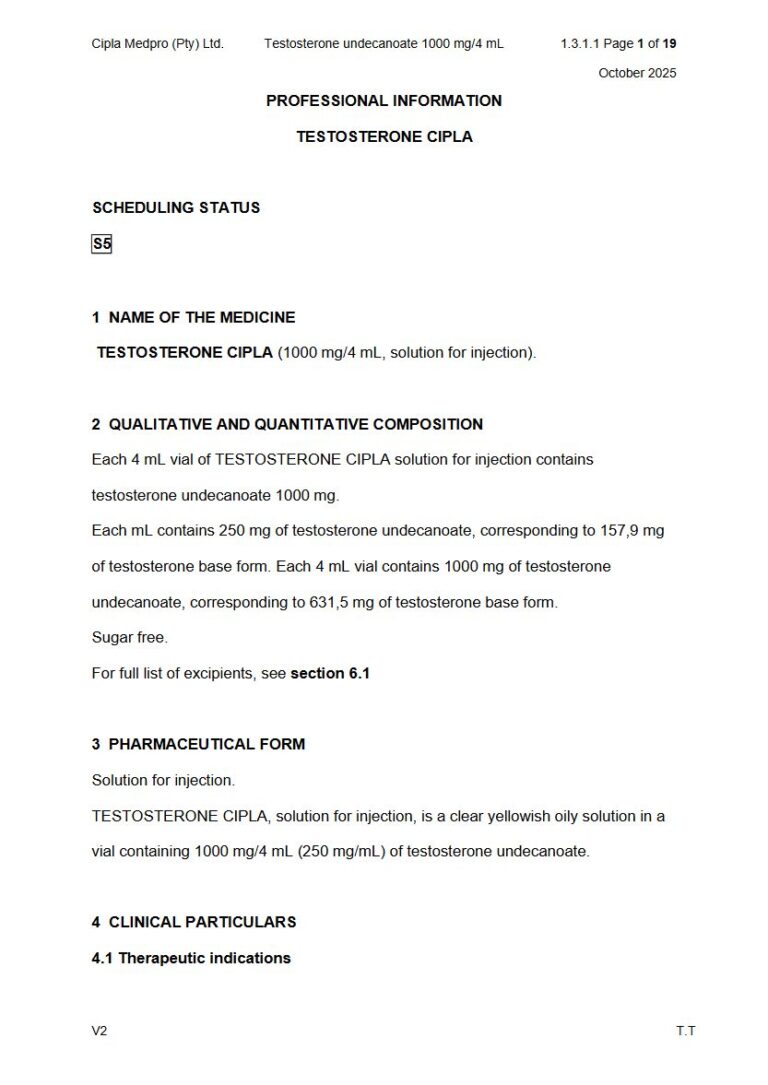
Testosterone Cipla 1000 mg Solution for injection
PDF Leaflet Revision Date: October 2025
Clinical Summary
Quick overview from the medicine insert
Indication
Testosterone replacement therapy in male hypogonadism.
Dosage (summary)
1000 mg every 10 to 14 weeks; may start at 6 weeks for loading dose.
Onset of Action / Duration
Onset: 1 day, Duration: 10-14 weeks
Special Populations
- Elderly patients
- Hepatic impairment
- Renal impairment
Pregnancy & Breastfeeding
Not indicated for use in women, including pregnant or breastfeeding women.
Key Drug Interactions
- Increased activity of oral anticoagulants
- Enhanced oedema with corticosteroids
- May affect insulin dosage
Contraindications
- Hypersensitivity to testosterone
- Androgen-dependent carcinoma
- Hypercalcaemia
- Liver tumours
Common side effects
- Acne
- Injection site pain
- Polycythaemia
Counselling Points
- Inject intramuscularly and slowly
- Monitor testosterone levels
- Report any severe side effects
Serious warnings
- Risk of prostatic hyperplasia
- Potential for thrombotic events
- Monitor for polycythaemia
Important Disclaimer
The Testosterone Cipla 1000 mg Solution for injection professional information leaflet below is the property of Cipla Medpro and is provided on Medinsert exactly as issued, with no.. alterations or editorial changes. We make every effort to keep content current by updating documents as soon as new versions become available. Medinsert serves as a trusted access point for healthcare professionals, but does not replace official sources or clinical judgement. For more details, please read our full disclaimer. read more>>
 Healthcare Professionals Only
This content is for registered healthcare professionals
Sign in or create a free account to read the full package insert.
Free for HPCSA-registered professionals. Powered by Medinsert.
Clinical Particulars
Section 4 of the official insert — extracted exactly as issued, no alterations
4.1 Therapeutic indications
TESTOSTERONE CIPLA is indicated for testosterone replacement therapy in primary and secondary male hypogonadism.
4.2 Posology and method of administration
Posology
TESTOSTERONE CIPLA (1 vial corresponding to 1000 mg testosterone undecanoate) is injected every 10 to 14 weeks. Injections with this frequency are capable of maintaining sufficient testosterone levels and do not lead to accumulation.
Start of treatment
Serum testosterone levels should be measured before the start of treatment. The first injection interval may be reduced to a minimum of 6 weeks. With this loading dose, steady-state levels will be reached quickly.
Individualisation of treatment
It is advisable to occasionally measure testosterone serum levels at the end of an injection interval. Serum levels below normal range would indicate the need for a shorter injection interval. In the case of high serum levels, an extension of the injection interval may be considered. The injection interval should remain within the recommended range of 10 to 14 weeks.
Special populations
Paediatric population
TESTOSTERONE CIPLA is not indicated for use in children and adolescents. It has not been clinically evaluated in males below the age of 18 years (see section 4.4).
Elderly patients
Limited data do not suggest the need for a dosage adjustment in elderly patients (see section 4.4).
Patients with hepatic impairment
No formal studies have been performed in patients with hepatic impairment. The use of TESTOSTERONE CIPLA in men with past or present liver tumours (see section 4.3).
Patients with renal impairment
No formal studies have been performed in patients with renal impairment.
Method of administration
TESTOSTERONE CIPLA is strictly for intramuscular injection. Special care must be given to avoid intravasal injection. The injections must be administered very slowly (over 2 minutes). To avoid injury when opening, the contents of the vial are to be injected intramuscularly immediately after opening (see section 6.6.).
4.3 Contraindications
TESTOSTERONE CIPLA should not be used in:
u2022 Patients with known hypersensitivity to testosterone or to any of the excipients in TESTOSTERONE CIPLA (see section 6.1).
u2022 Androgen-dependent carcinoma of the prostate or of the male mammary gland.
u2022 Hypercalcaemia accompanying malignant tumours.
u2022 Past or present liver tumours.
The use of TESTOSTERONE CIPLA in women is contraindicated.
4.4 Special warnings and precautions for use
Children and adolescents
Clinical trials with TESTOSTERONE CIPLA in children or adolescents under the age of 18 have not been conducted. In children, besides masculinisation, TESTOSTERONE CIPLA can cause accelerated growth and bone maturation and premature epiphyseal closure, thereby reducing final height.
Elderly population
Older patients treated with TESTOSTERONE CIPLA may be at an increased risk for the development of prostatic hyperplasia. Although there are no clear indications that TESTOSTERONE CIPLA actually generates prostatic carcinoma, it can enhance the growth of any existing prostatic carcinoma. Therefore, carcinoma of the prostate has to be excluded before starting therapy with TESTOSTERONE CIPLA. As a precaution, regular examinations of the prostate are recommended in men.
Laboratory tests
Haemoglobin and haematocrit should be checked periodically in patients on long-term testosterone therapy to detect cases of polycythaemia (see section 4.8).
Tumours
Cases of benign and malignant liver tumours have been reported in users of hormonal substances such as androgen compounds. If severe upper abdominal complaints, liver enlargement or signs of intra-abdominal haemorrhage occur in men using TESTOSTERONE CIPLA, a liver tumour should be included in the differential-diagnostic considerations.
Cardiac, hepatic or renal insufficiency
Caution should be exercised in patients predisposed to oedema, e.g., in cases of severe cardiac, hepatic or renal insufficiency or ischaemic heart disease, as treatment with androgens may result in increased retention of sodium and water. In cases of severe complications characterised by oedema with or without congestive heart failure, treatment must be stopped immediately (see section 4.8). Testosterone may cause a rise in blood pressure and TESTOSTERONE CIPLA should be used with caution in men with hypertension.
Clotting disorders
Testosterone should be used with caution in patients with thrombophilia or risk factors for venous thromboembolism (VTE), as there have been post-marketing studies and reports of thrombotic events (e.g., deep vein thrombosis, pulmonary embolism, ocular thrombosis) in these patients during testosterone therapy. In thrombophilic patients, VTE cases have been reported even under anticoagulation treatment, therefore continuing testosterone treatment after first thrombotic event should be carefully evaluated. In case of treatment continuation, further measures should be taken to minimise the individual VTE risk.
Other conditions
Pre-existing sleep apnoea may be potentiated.
Drug abuse and dependence
Testosterone has been subject to abuse, typically at doses higher than recommended for the approved indication(s) and in combination with other anabolic androgenic steroids. Abuse of testosterone and other anabolic androgenic steroids can lead to serious adverse reactions including cardiovascular (with fatal outcomes in some cases), hepatic and/or psychiatric events. Testosterone abuse may result in dependence and withdrawal symptoms upon significant dose reduction or abrupt discontinuation of use.
Application
TESTOSTERONE CIPLA must be injected strictly intramuscularly and very slowly (over two minutes). Pulmonary microembolism of oily solutions can in rare cases lead to signs and symptoms such as cough, dyspnoea, malaise, hyperhidrosis, chest pain, dizziness, paraesthesia, or syncope. These reactions may occur during or immediately after the injection and are reversible. Treatment is usually supportive, e.g., by administration of supplemental oxygen. Suspected anaphylactic reactions after TESTOSTERONE CIPLA injection have been reported.
4.5 Interaction with other medicines and other forms of interactions
Oral anti-coagulants
Testosterone and derivatives have been reported to increase the activity of coumarin derived oral anti-coagulants. Patients receiving oral anti-coagulants require close monitoring, especially at the beginning or end of androgen therapy. Increased monitoring of the prothrombin time, and international normalised ratio (INR) determinations, are recommended.
Other interactions
The concurrent administration of testosterone with adrenocorticotropic hormone (ACTH) or corticosteroids may enhance oedema formation, thus these active substances should be administered cautiously, particularly in patients with cardiac or hepatic disease or in patients predisposed to oedema.
Laboratory test interactions: Androgens may decrease levels of thyroxin-binding globulin resulting in decreased total T4 serum levels and increased resin uptake of T3 and T4. Free thyroid hormone levels remain unchanged, however, and there is no clinical evidence of thyroid dysfunction. TESTOSTERONE CIPLA may enhance the blood-sugar reducing effects of insulin. The dosage of the hypoglycaemic medicine may need to be lowered. Interactions can occur with medicines that induce microsomal enzymes, which can result in increased clearance of TESTOSTERONE CIPLA e.g., barbiturates. TESTOSTERONE CIPLA may interfere with the metabolism of other medicines. Accordingly, plasma and tissue concentrations may be affected e.g., increased oxyphenbutazone serum levels have been reported. Moreover, testosterone and derivatives have been reported to increase the activity of oral anticoagulants, possibly requiring dose adjustment. Independently of this finding, as a general rule, the limitations of using intramuscular injections in patients which acquired or inherited blood clotting irregularities always have to be observed.
4.6 Fertility, pregnancy and lactation
Pregnancy
TESTOSTERONE CIPLA is not indicated for use in women and must not be used in pregnant women.
Breastfeeding
TESTOSTERONE CIPLA is not indicated for use in women and must not be used in breastfeeding women.
Fertility
TESTOSTERONE CIPLA may reversibly reduce spermatogenesis (see section 4.8).
4.7 Effects on ability to drive and use machines
Dizziness has been reported as less frequent side effect (see section 4.8). Patients experiencing dizziness should avoid driving and use of machines.
4.8 Undesirable effects
a. Summary of the safety profile
The most frequently reported undesirable effects during treatment with TESTOSTERONE CIPLA are acne and injection site pain. Pulmonary microembolism of oily solution can in rare cases lead to signs and symptoms such as cough, dyspnoea, malaise, hyperhidrosis, chest pain, dizziness, paraesthesia, or syncope. These reactions may occur during or immediately after the injection and are reversible. Suspected anaphylactic reactions after TESTOSTERONE CIPLA injection have been reported. Androgens may accelerate the progression of sub-clinical prostatic cancer and benign prostatic hyperplasia.
b. List of adverse reactions
Blood and lymphatic system disorders:
Frequent: Polycythaemia
Less frequent: Haematocrit increased, Red blood cell count increased, Haemoglobin increased
Immune system disorders:
Less frequent: Hypersensitivity
Metabolism and nutrition disorders:
Frequent: Weight increased
Less frequent: Increased appetite, Glycosylated haemoglobin increased, Hypercholesterolaemia, Blood triglycerides increased, Blood cholesterol increased
Psychiatric disorders:
Less frequent: Depression, Emotional disorder, Insomnia, Restlessness, Aggression, Irritability
Nervous system disorders:
Less frequent: Headache, Migraine, Tremor
Vascular disorders:
Frequent: Hot flush.
Less frequent: Cardiovascular disorder, Hypertension, Dizziness
Respiratory, thoracic and mediastinal disorders:
Less frequent: Bronchitis, Sinusitis, Cough, Dyspnoea, Snoring, Dysphonia
Gastrointestinal disorders:
Less frequent: Diarrhoea, Nausea
Hepatobiliary disorders:
Less frequent: Liver function test abnormalities, Aspartate aminotransferase increased
Skin and subcutaneous tissue disorders:
Frequent: Acne.
Less frequent: Alopecia, Erythema, Rash, Papular rash, Pruritis, Dry skin
Musculoskeletal and connective tissue disorders:
Less frequent: Arthralgia, Pain in extremity, Muscle spasm, Muscle strain, Musculoskeletal stiffness
Renal and urinary disorders:
Less frequent: Urine flow decreased, Urinary retention, Urinary tract disorder, Nocturia, Dysuria
Reproductive system and breast disorders:
Frequent: Prostate specific antigen increased, Prostate examination abnormal, Benign prostate hyperplasia
Less frequent: Prostatic intraepithelial neoplasia, Prostate induration, Prostatitis, Prostatic disorder, Decreased libido, Increased libido, Testicular pain, Breast induration, Breast pain, Gynaecomastia, Increased estradiol, Testosterone increased
Frequency unknown: Increased frequency of erections, Interruption or reduction in spermatogenesis, Testicle size reduction, Painful erections.
General disorders and administration site conditions:
Frequent: Injection site pain, Injection site discomfort, Injection site pruritus, Injection site erythema, Injection site haematoma, Injection site irritation, Injection site reaction
Less frequent: Fatigue, Asthenia, Hyperhidrosis, Night sweats
Frequency unknown: Water retention and oedema.
Injury, poisoning and procedural complications:
Frequency unknown: Pulmonary oil microembolism.
c. Description of selected adverse reactions
Pulmonary microembolism of oily solutions can in rare cases lead to signs and symptoms such as cough, dyspnoea, malaise, hyperhidrosis, chest pain, dizziness, paraesthesia, or syncope. These reactions may occur during or immediately after the injections and are reversible. In addition to the above, mentioned adverse reactions, nervousness, hostility, sleep apnoea, various skin reactions including seborrhoea, increased hair growth, increased frequency of erections and in very rare cases jaundice have been reported under treatment with testosterone containing preparations. Therapy with high doses of testosterone preparations commonly reversibly interrupts or reduces spermatogenesis, thereby reducing the size of the testicles; testosterone replacement therapy of hypogonadism can in rare cases cause persistent, painful erections (priapism). High-dosed or long-term administration of testosterone occasionally increases the occurrences of water retention and oedema.
Reporting of suspected adverse reactions
Reporting suspected adverse reactions after authorisation of the medicine is important. It allows continued monitoring of the benefit/risk balance of the medicine. Health care providers are requested to report any suspected adverse drug reactions to SAHPRA via the Med Safety APP (Medsafety X SAHPRA) and eReporting platform (who-umc.org) found on the SAHPRA website, or to Cipla Medpro (Pty) Ltd. by email: [email protected] or telephone: 080 222 6662 (toll free).
4.9 Overdose
No special therapeutic measure apart from termination of therapy with the medicine or dose reduction is necessary after overdose.
