
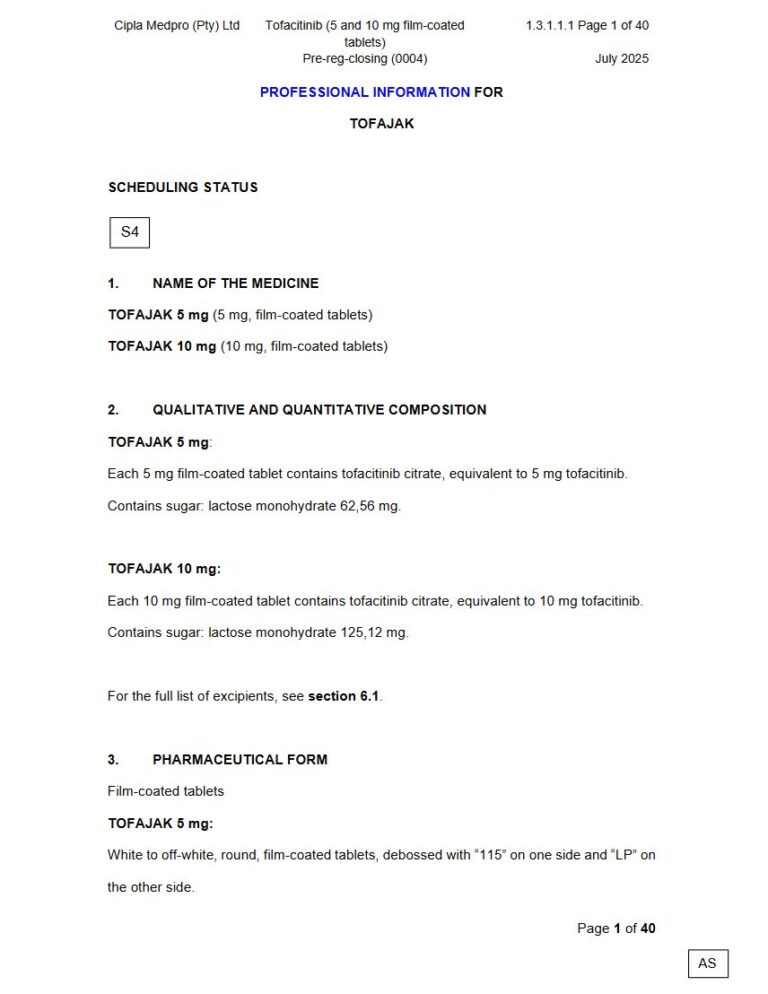
Tofajak 5/10 5 mg / 10 mg FC tablet
PDF Leaflet Revision Date: July 2025
Clinical Summary
Quick overview from the medicine insert
Indication
Moderate to severe active rheumatoid arthritis, psoriatic arthritis, and ulcerative colitis.
Dosage (summary)
RA/PsA: 5 mg twice daily; UC: 10 mg twice daily for 8 weeks, then 5 mg twice daily for maintenance.
Special Populations
- Elderly
- Hepatic impairment
- Renal impairment
Pregnancy & Breastfeeding
Contraindicated in pregnancy and breastfeeding.
Key Drug Interactions
- CYP3A4 inhibitors (e.g., ketoconazole)
- CYP inducers (e.g., rifampicin)
Contraindications
- Hypersensitivity to tofacitinib
- Untreated tuberculosis
- Severe hepatic impairment
- Active infections
Common side effects
- Headache
- Hypertension
- Nausea
- Diarrhoea
- Infections
Counselling Points
- Monitor for signs of infection.
- Use effective contraception during treatment.
- Avoid live vaccines during treatment.
Serious warnings
- Serious infections risk
- Malignancy risk
- Gastrointestinal perforation risk
Important Disclaimer
The Tofajak 5/10 5 mg / 10 mg FC tablet professional information leaflet below is the property of Cipla Medpro and is provided on Medinsert exactly as issued, with no.. alterations or editorial changes. We make every effort to keep content current by updating documents as soon as new versions become available. Medinsert serves as a trusted access point for healthcare professionals, but does not replace official sources or clinical judgement. For more details, please read our full disclaimer. read more>>
 Healthcare Professionals Only
This content is for registered healthcare professionals
Sign in or create a free account to read the full package insert.
Free for HPCSA-registered professionals. Powered by Medinsert.
Clinical Particulars
Section 4 of the official insert — extracted exactly as issued, no alterations
4.1 Therapeutic indications
Rheumatoid arthritis
TOFAJAK in combination with methotrexate (MTX) is indicated for the treatment of moderate to severe active rheumatoid arthritis (RA) in adult patients who have responded inadequately to, or who are intolerant to one or more disease-modifying antirheumatic medicines. TOFAJAK can be given as monotherapy in case of intolerance to MTX or when treatment MTX is inappropriate (see sections 4.4 and 4.5).
Psoriatic arthritis
TOFAJAK in combination with MTX is indicated for the treatment of active psoriatic arthritis (PsA) in adult patients who have had an inadequate response or who have been intolerant to a prior disease modifying antirheumatic drug (DMARD) therapy (see section 5.1).
Ulcerative colitis
TOFAJAK is indicated for the treatment of adult patients with moderately to severely active ulcerative colitis (UC) who have had an inadequate response, lost response, or were intolerant to either conventional therapy or a biologic medicine (see section 5.1).
4.2 Posology and method of administration
Treatment should be initiated and supervised by medical practitioners experienced in the diagnosis and treatment of conditions for which TOFAJAK is indicated.
Posology
Rheumatoid arthritis and psoriatic arthritis
The recommended dose is 5 mg administered twice daily.
Dose adjustment
No dose adjustment is required when used in combination with MTX.
Ulcerative colitis
The recommended dose is 10 mg given orally twice daily for induction for 8 weeks and 5 mg given twice daily for maintenance. For patients who do not achieve adequate therapeutic benefit by week 8, the induction dose of 10 mg twice daily can be extended for an additional 8 weeks (16 weeks total), followed by 5 mg twice daily for maintenance. TOFAJAK induction therapy should be discontinued in any patient who shows no evidence of therapeutic benefit by week 16. For some patients, such as those who have failed prior tumour necrosis factor (TNF) antagonist therapy, consideration should be given to continuation of the 10 mg twice daily dose for maintenance in order to maintain therapeutic benefit (see section 5.1).
Patients who experience a decrease in response on TOFAJAK 5 mg twice daily maintenance therapy may benefit from an increase to TOFAJAK 10 mg administered twice daily.
In patients who have responded to treatment with TOFAJAK, corticosteroids may be reduced and/or discontinued in accordance with standard of care.
Retreatment in UC
If therapy is interrupted, restarting treatment with TOFAJAK can be considered. If there has been a loss of response, reinduction with TOFAJAK 10 mg twice daily may be considered. The treatment interruption period in clinical studies extended up to 1 year. Efficacy may be regained by 8 weeks of 10 mg twice daily therapy (see section 5.1).
Dose interruption and discontinuation
TOFAJAK treatment should be interrupted if a patient develops a serious infection until the infection is controlled. Interruption of dosing may be needed for management of dose-related laboratory abnormalities including lymphopenia, neutropenia, and anaemia. As described in Tables 1, 2 and 3 below, recommendations for temporary dose interruption or permanent discontinuation of treatment are made according to the severity of laboratory abnormalities (see section 4.4). It is also recommended not to initiate dosing in patients with an absolute lymphocyte count (ALC) less than 750 cells/mm3.
4.3 Contraindications
TOFAJAK is contraindicated in:
- Hypersensitivity to the tofacitinib or to any of the excipients in TOFAJAK (see section 6.1)
- Untreated pulmonary tuberculosis (active and latent) or untreated extra pulmonary tuberculosis, serious infections such as sepsis, or opportunistic infections (see section 4.4)
- Severe hepatic impairment (see section 4.2)
- Pregnancy and breastfeeding (see section 4.6)
- Patients with treatment nau00efve / experienced HIV infections.
TOFAJAK 10 mg twice daily is contraindicated in patients who have one or more of the following conditions:
- Use of combined hormonal contraceptives or hormone replacement therapy
- Heart failure
- Previous venous thromboembolism, either deep venous thromboembolism or pulmonary embolism
- Inherited coagulation disorder
- Malignancy
- Patients undergoing major surgery.
4.4 Special warnings and precautions for use
Combination with other therapies
Tofacitinib has not been studied and its use should be avoided in combination with biologics such as TNF antagonists, interleukin (IL)-1R antagonists, IL-6R antagonists, anti-CD20 monoclonal antibodies, IL-17 antagonists, IL-12/IL-23 antagonists, anti-integrins, selective co-stimulation modulators and potent immunosuppressants such as azathioprine, 6-mercaptopurine, ciclosporin and tacrolimus because of the possibility of increased immunosuppression and increased risk of infection.
It has been reported that there was a higher incidence of adverse events for the combination of tofacitinib with MTX versus tofacitinib as monotherapy in RA clinical studies. The use of tofacitinib in combination with phosphodiesterase 4 inhibitors has not been studied in tofacitinib clinical studies.
Serious Infections
Serious and sometimes fatal infections due to bacterial, mycobacterial, invasive fungal, viral, or other opportunistic pathogens have been reported in patients receiving tofacitinib. Rheumatoid arthritis patients taking corticosteroids may be predisposed to infection. Tofacitinib as in TOFAJAK should not be initiated in patients with active infections, including localised infections. The risks and benefits of treatment should be considered prior to initiating tofacitinib as in TOFAJAK in patients:
- with recurrent infections
- with a history of a serious or an opportunistic infection
- who have resided or travelled in areas of endemic mycoses
- who have underlying conditions that may predispose them to infection.
Patients should be closely monitored for the development of signs and symptoms of infection during and after treatment with TOFAJAK. Treatment should be interrupted if a patient develops a serious infection, an opportunistic infection, or sepsis. A patient who develops a new infection during treatment with TOFAJAK should undergo prompt and complete diagnostic testing appropriate for an immunocompromised patient, appropriate antimicrobial therapy should be initiated, and the patient should be closely monitored. As there is a higher incidence of infections in the elderly and in the diabetic populations in general, caution should be used when treating the elderly and patients with diabetes (see section 4.8).
Risk of infection may be higher with increasing degrees of lymphopenia and consideration should be given to lymphocyte counts when assessing individual patient risk of infection. Discontinuation and monitoring criteria for lymphopenia are discussed in section 4.2.
Tuberculosis
The risks and benefits of treatment should be considered prior to initiating tofacitinib as in TOFAJAK in patients:
- who have been exposed to TB
- who have resided or travelled in areas of endemic TB.
Patients should be evaluated and tested for latent or active infection prior to and per applicable guidelines during administration of TOFAJAK. Patients with latent TB, who test positive, should be treated with standard antimycobacterial therapy before administering TOFAJAK. Anti-tuberculosis therapy should also be considered prior to administration of TOFAJAK in patients who test negative for TB but who have a past history of latent or active TB and where an adequate course of treatment cannot be confirmed; or those who test negative but who have risk factors for TB infection. Consultation with a healthcare professional with expertise in the treatment of TB is recommended to aid in the decision about whether initiating anti-tuberculosis therapy is appropriate for an individual patient. Patients should be closely monitored for the development of signs and symptoms of TB, including patients who tested negative for latent TB infection prior to initiating therapy.
Viral reactivation
Viral reactivation and cases of herpes virus reactivation (e.g. herpes zoster) were observed in clinical studies with tofacitinib. In patients treated with tofacitinib, the incidence of herpes zoster appears to be increased in:
- Patients with an ALC less than 1 000 cells/mm3 (see section 4.2)
- Patients with long standing RA who have previously received two or more biological disease modifying antirheumatic drugs (DMARDs)
- Patients treated with 10 mg twice daily.
The impact of tofacitinib on chronic viral hepatitis reactivation is unknown. Patients screened positive for hepatitis B or C were excluded from clinical trials. Screening for viral hepatitis should be performed in accordance with clinical guidelines before starting therapy with tofacitinib as in TOFAJAK.
Malignancy and lymphoproliferative disorder
The risks and benefits of tofacitinib as in TOFAJAK treatment should be considered prior to initiating therapy in patients with current or a history of malignancy other than a successfully treated non-melanoma skin cancer (NMSC), or when considering continuing tofacitinib as in TOFAJAK in patients who develop a malignancy. The possibility exists for tofacitinib as in TOFAJAK to affect host defences against malignancies. Lymphomas have been observed in patients treated with tofacitinib. Patients with RA, particularly those with highly active disease may be at a higher risk (up to several-fold) than the general population for the development of lymphoma. The effect of tofacitinib on the development of lymphoma is uncertain.
Other malignancies were observed in clinical studies and the post-marketing setting, including, but not limited to, lung cancer, breast cancer, melanoma, prostate cancer, and pancreatic cancer. The effect of tofacitinib on the development and course of malignancies is not known.
Non-melanoma skin cancer
NMSCs have been reported in patients treated with tofacitinib. The risk of NMSC may be higher in patients treated with tofacitinib 10 mg twice daily than in patients treated with 5 mg twice daily. Periodic skin examination is recommended for patients who are at increased risk for skin cancer.
Pulmonary embolism
Pulmonary embolism (PE) has been observed in patients taking tofacitinib in clinical trials and post-marketing reports. TOFAJAK 10 mg twice daily is contraindicated in patients who are at high risk for pulmonary embolism (see also section 4.3). Additional risk factors that should be considered in determining the patientu2019s risk for PE are older age, obesity, smoking status, and immobilisation.
Interstitial lung disease
Caution is also recommended in patients with a history of chronic lung disease as they may be more prone to infections. Events of interstitial lung disease (some of which had a fatal outcome) have been reported in patients treated with tofacitinib in RA clinical trials and in the post-marketing setting although the role of Janus kinase (JAK) inhibition in these events is not known.
Gastrointestinal perforations
Events of gastrointestinal perforation have been reported in clinical trials although the role of JAK inhibition in these events is not known. TOFAJAK should be used with caution in patients who may be at increased risk for gastrointestinal perforation (e.g., patients with a history of diverticulitis, patients with concomitant use of corticosteroids and/or non-steroidal anti-inflammatory drugs (NSAIDs)). Patients presenting with new onset abdominal signs and symptoms should be evaluated promptly for early identification of gastrointestinal perforation.
Cardiovascular risk
RA and PsA patients have an increased risk for cardiovascular disorders. Patients treated with TOFAJAK should have risk factors (e.g., hypertension, hyperlipidaemia) managed as part of usual standard of care.
Liver enzymes
In reported studies treatment with tofacitinib was associated with an increased incidence of liver enzyme elevation in some patients (see section 4.8 liver enzyme tests). Caution should be exercised when considering initiation of TOFAJAK treatment in patients with elevated alanine aminotransferase (ALT) or aspartate aminotransferase (AST), particularly when initiated in combination with potentially hepatotoxic medicines such as MTX. Following initiation, routine monitoring of liver tests and prompt investigation of the causes of any observed liver enzyme elevations are recommended to identify potential cases of drug-induced liver injury. If drug-induced liver injury is suspected, the administration of TOFAJAK should be interrupted until this diagnosis has been excluded.
4.5 Interactions with other medicines
TOFAJAK total daily dose should be reduced by half in patients receiving potent inhibitors of cytochrome P450 (CYP) 3A4 (e.g., ketoconazole) and in patients receiving 1 or more concomitant medicines that result in both moderate inhibition of CYP3A4 as well as potent inhibition of CYP2C19 (e.g., fluconazole) (see sections 4.4 and 4.5) as follows:
- TOFAJAK dose should be reduced to 5 mg once daily in patients receiving 5 mg twice daily.
- TOFAJAK dose should be reduced to 5 mg twice daily in patients receiving 10 mg twice daily.
Special populations
Elderly
No dose adjustment is required in patients aged 65 years and older. There are limited data in patients aged 75 years and older. A higher incidence and severity of adverse events in the elderly (> 65 yrs) is an important potential risk.
Hepatic impairment
Table 4: Dose adjustment for hepatic impairment
Hepatic Impairment Classification Dose adjustment
- Mild Child Pugh A No dose adjustment required.
- Moderate Child Pugh B Dose should be reduced to 5 mg once daily when the indicated dose in the presence of normal hepatic function is 5 mg twice daily.
- Dose should be reduced to 5 mg twice daily when the indicated dose in the presence of normal hepatic function is 10 mg twice daily (see section 5.2).
- Severe Child Pugh C TOFAJAK should not be used in patients with severe hepatic impairment (see section 4.3).
Renal impairment
Table 5: Dose adjustment for renal impairment
Renal impairment Creatinine clearance Dose adjustment
- Mild 50 to 80 mL/min No dose adjustment required.
- Moderate 30 to 49 mL/min No dose adjustment required.
- Severe < 30 mL/min Dose should be reduced to 5 mg once daily when the indicated dose in the presence of normal renal function is 5 mg twice daily.
- Dose should be reduced to 5 mg twice daily when the indicated dose in the presence of normal renal function is 10 mg twice daily. Patients with severe renal impairment should remain on a reduced dose even after haemodialysis (see section 5.2).
Paediatric population
The safety and efficacy of TOFAJAK in children 0 to less than 18 years have not yet been established.
Method of administration
TOFAJAK is given orally with or without food. For patients who have difficulties swallowing, TOFAJAK tablets may be crushed and taken with water.
4.6 Fertility, pregnancy and lactation
Women of childbearing potential / contraception in females
Women of childbearing potential should be advised to use effective contraception during treatment with tofacitinib as in TOFAJAK and for at least 4 weeks after the last dose.
Pregnancy
There are no adequate and well-controlled studies on the use of tofacitinib in pregnant women. Tofacitinib has been shown to be teratogenic in rats and rabbits, and to affect parturition and peri/postnatal development. As a precautionary measure, the use of TOFAJAK during pregnancy is contraindicated (see section 4.3).
Breastfeeding
It is not known whether tofacitinib is secreted in human milk. A risk to the breastfed child cannot be excluded. Tofacitinib was secreted in the milk of lactating rats. As a precautionary measure, the use of TOFAJAK during breastfeeding is contraindicated (see section 4.3).
Fertility
Formal studies of the potential effect on human fertility have not been conducted. Tofacitinib impaired female fertility but not male fertility in rats.
4.7 Effects on ability to drive and use machines
Tofacitinib as in TOFAJAK has no or negligible influence on the ability to drive and use machines.
4.8 Undesirable effects
a. Summary of the safety profile
Rheumatoid arthritis
The most frequent serious adverse reactions were serious infections (see section 4.4). The most frequent serious infections reported with tofacitinib were pneumonia, herpes zoster, urinary tract infection, cellulitis, diverticulitis, and appendicitis. Among opportunistic infections, TB and other mycobacterial infections, cryptococcus, histoplasmosis, oesophageal candidiasis, multidermatomal herpes zoster, cytomegalovirus, BK virus infections and listeriosis were reported with tofacitinib. Some patients have presented with disseminated rather than localised disease. Other serious infections that were not reported in clinical studies may also occur (e.g., coccidioidomycosis).
The most frequently reported adverse reactions during the first 3 months in clinical trials were headache, upper respiratory tract infections, nasopharyngitis, diarrhoea, nausea and hypertension (see Tabulated list of adverse reactions). The proportion of patients who discontinued treatment due to adverse reactions during the first 3 months of the studies was 3,8 % for patients taking tofacitinib. The most frequent infections resulting in discontinuation of therapy were herpes zoster and pneumonia.
Psoriatic arthritis
Overall, the safety profile observed in patients with active PsA treated with tofacitinib was consistent with the safety profile observed in patients with RA treated with tofacitinib.
Ulcerative colitis
The most frequently reported adverse reactions in patients receiving tofacitinib 10 mg twice daily in the induction studies were headache, nasopharyngitis, nausea, and arthralgia. In the induction and maintenance studies, across tofacitinib and placebo treatment groups, the most frequent categories of serious adverse reactions were gastrointestinal disorders and infections, and the most frequent serious adverse reaction was worsening of UC. Overall, the safety profile observed in patients with UC treated with tofacitinib was consistent with the safety profile of tofacitinib in the RA indication.
b. Tabulated list of adverse reactions
4.9 Overdose
In case of an overdose, it is recommended that the patient be monitored for signs and symptoms of adverse reactions. There is no specific antidote for overdose with TOFAJAK. Treatment should be symptomatic and supportive. Pharmacokinetic data up to and including a single dose of 100 mg in healthy volunteers indicate that more than 95 % of the administered dose is expected to be eliminated within 24 hours.
