
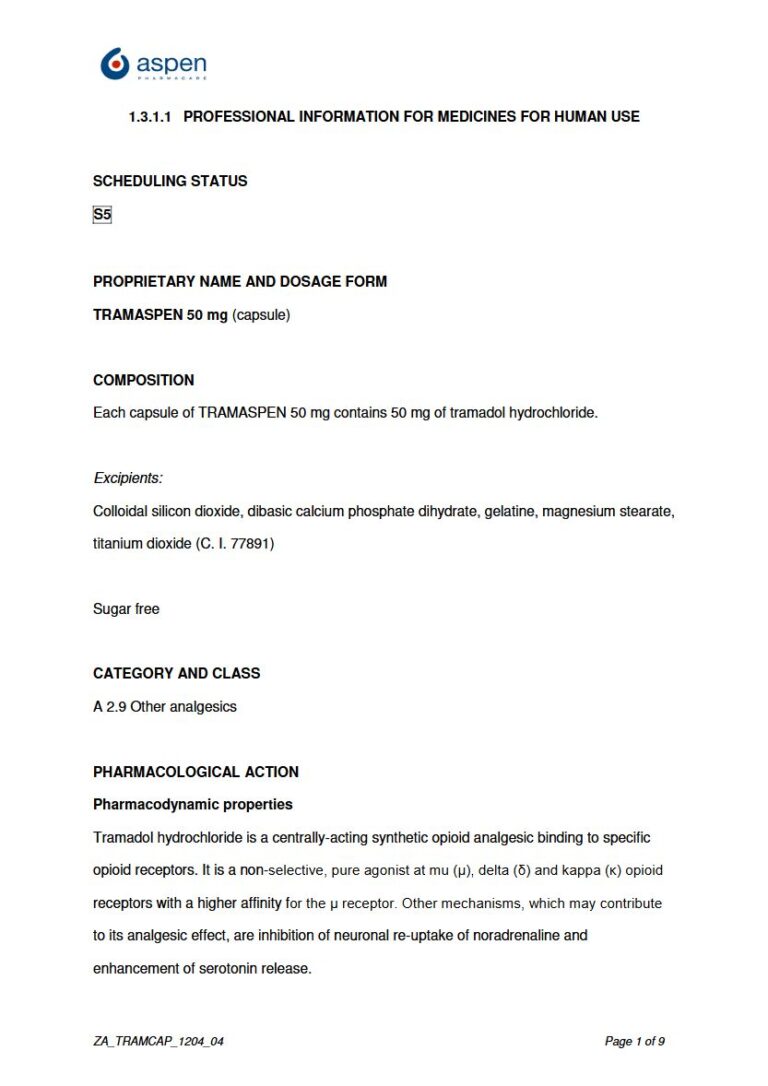
Tramaspen 50mg Capsule
PDF Leaflet Revision Date: 20 April 2012
Clinical Summary
Quick overview from the medicine insert
Indication
Management of moderate to moderately severe pain.
Dosage (summary)
Initial 50 mg, then 100 mg twice daily; max 200 mg twice daily.
Onset of Action / Duration
Onset: 1 hour, Duration: ~6 hours
Special Populations
- Elderly
- Renal impairment
- Hepatic impairment
Pregnancy & Breastfeeding
Not established; contraindicated in pregnancy and lactation.
Key Drug Interactions
- MAO inhibitors
- CNS depressants
- Carbamazepine
Contraindications
- Hypersensitivity to tramadol
- Acute intoxication with CNS depressants
- Narcotic withdrawal treatment
- Respiratory depression
- Increased intracranial pressure
Common side effects
- Drowsiness
- Dizziness
- Nausea
- Constipation
Counselling Points
- Avoid operating machinery
- Do not exceed recommended dose
- Monitor for signs of dependence
Serious warnings
- Risk of addiction and dependence
- Caution in epilepsy
- Risk of respiratory depression
Important Disclaimer
The Tramaspen 50mg Capsule professional information leaflet below is the property of Pharmacare and is provided on Medinsert exactly as issued, with no.. alterations or editorial changes. We make every effort to keep content current by updating documents as soon as new versions become available. Medinsert serves as a trusted access point for healthcare professionals, but does not replace official sources or clinical judgement. For more details, please read our full disclaimer. read more>>
 Healthcare Professionals Only
This content is for registered healthcare professionals
Sign in or create a free account to read the full package insert.
Free for HPCSA-registered professionals. Powered by Medinsert.
Clinical Particulars
Section 4 of the official insert — extracted exactly as issued, no alterations
4.1 Therapeutic indications
TRAMASPEN 50 mg is indicated for:
- the management of moderate to moderately severe pain.
4.2 Posology and method of administration
The dosage should be adjusted to the intensity of pain and the individualu2019s response to the analgesic action of TRAMASPEN 50 mg. TRAMASPEN 50 mg should not be used for the treatment of minor pain.
Adults and children over the age of 14 years
Initial dose of 50 mg, followed by 100 mg twice daily. The dose may be increased to 150 mg or 200 mg twice daily.
Elderly
The usual doses may be used except in patients 75 years of age and over. A downward adjustment of the dose and/or prolongation of the interval between doses are recommended.
Renal impairment
The elimination of TRAMASPEN 50 mg may be prolonged. The usual initial dose should be used, but for patients with creatinine clearance < 30 ml/min, the dosage interval should be increased to 12 hours.
Hepatic impairment
The elimination of TRAMASPEN 50 mg may be prolonged. The usual initial dose should be used but in severe hepatic impairment, the dosage interval should be increased to 12 hours.
Duration of treatment
Under no circumstances should TRAMASPEN 50 mg be given for longer than absolutely necessary. If the nature and severity of the disease require long-term pain treatment with TRAMASPEN 50 mg, evaluation should be carried out initially and at regular intervals to assess efficacy, adverse events, and the need for further treatment.
4.3 Contraindications
TRAMASPEN 50 mg is contraindicated in:
- Hypersensitivity to tramadol hydrochloride or opioids.
- Acute intoxication with alcohol, hypnotics, analgesic opioids or psychotropic medicines (due to the risk of respiratory depression).
- Patients taking monoamine oxidase (MAO) inhibitors or within two weeks of their discontinuation (see INTERACTIONS).
- Narcotic withdrawal treatment.
- Respiratory depression especially in the presence of cyanosis and excessive bronchial secretions.
- Increased intracranial pressure or central nervous depression due to head injury or cerebral disease.
- Pregnancy and lactation.
4.4 Special warnings and precautions for use
- Avoid the use of TRAMASPEN 50 mg in patients with a history of addiction, as physical dependence of the morphine-type may develop. Reinstatement of physical dependence in patients that have previously been dependent, may occur with TRAMASPEN 50 mg.
- Use with caution in patients with a history of epilepsy or those susceptible to seizures (e.g. patients taking neuroleptics and other medicines that reduce the seizure threshold).
- Use with caution in patients with renal or hepatic impairment and avoid if severe.
- The possibility of respiratory depression cannot be excluded if the recommended dose is exceeded or other centrally depressant medicines are given concomitantly.
- TRAMASPEN 50 mg should not be used for the treatment of minor pain.
4.5 Interactions with other medicines
Monoamine oxidase inhibitors (MAOIs)
Because of its inhibitory effect on serotonin uptake, TRAMASPEN 50 mg should not be used concomitantly with MAOIs or within 14 days after discontinuing such treatment (see CONTRAINDICATIONS).
Central nervous system (CNS) depression-producing medications, including alcohol and anaesthetics
Caution is recommended because concurrent use may potentiate the CNS depressant effects. The duration of anaesthesia may be prolonged when TRAMASPEN 50 mg is combined with barbiturates.
Carbamazepine
Serum concentrations of TRAMASPEN 50 mg are reduced by carbamazepine, resulting in diminished analgesic activity of TRAMASPEN 50 mg. Inhibitors of CYP3A4 such as ketoconazole and erythromycin may inhibit the metabolism of TRAMASPEN 50 mg.
4.6 Fertility, pregnancy and lactation
The safety of TRAMASPEN 50 mg in pregnancy and lactation has not been established (see CONTRAINDICATIONS).
4.7 Effects on ability to drive and use machines
The administration of TRAMASPEN 50 mg concurrently with other central nervous system medicines is likely to intensify and prolong CNS effects (see INTERACTIONS). Patients should be warned not to operate machinery or drive a car while using TRAMASPEN 50 mg.
4.8 Undesirable effects
Immune system disorders
Less frequent: anaphylaxis and anaphylactoid reactions. These reactions may occur after the first dose.
Frequency not known: angioedema, bronchospasm. These reactions may occur after the first dose. Toxic Epidermal Necrolysis and Stevens-Johnson Syndrome have been reported.
Nervous system disorders
Frequent: drowsiness, dizziness, headache.
Less frequent: confusion, hallucinations, seizures (see WARNINGS AND SPECIAL PRECAUTIONS), amnesia, paraesthesia, syncope.
Frequency not known: fatigue, sedation.
Eye disorders
Less frequent: blurred vision.
Cardiac disorders
Less frequent: flushing, syncope, tachycardia, postural hypotension.
Frequency not known: bradycardia, cardiovascular collapse.
Gastrointestinal disorders
Frequent: nausea, vomiting, dry mouth, dyspepsia, constipation, diarrhoea, anorexia, abdominal pain.
Hepato-biliary disorders
Frequency not known: increase in liver enzymes.
Skin and subcutaneous tissue disorders
Frequent: skin rashes, pruritus, sweating (especially when IV administration is too rapid).
Less frequent: vesicles, urticaria.
Renal and urinary disorders
Less frequent: urinary retention, urinary frequency.
4.9 Overdose
Symptoms
Symptoms of overdosage are typical of opioids, and include pinpoint pupils, slow heartbeat, slow or troubled breathing, weakness, seizures, cold, clammy skin (see SIDE EFFECTS).
Treatment
Supportive measures such as maintaining the patency of the airway and maintaining cardiovascular function should be instituted. Treatment of restlessness is symptomatic and supportive. Naloxone should be used to reverse some, but not all, symptoms caused by overdosage with TRAMASPEN 50 mg. Administration of naloxone should be done with caution because it may precipitate seizures. Diazepam has been found to be effective in treating convulsions caused by TRAMASPEN 50 mg toxicity. Haemodialysis is not recommended in overdose, since it removes less than 7 % of the administered dose of TRAMASPEN 50 mg in a 4-hour dialysis period.
