
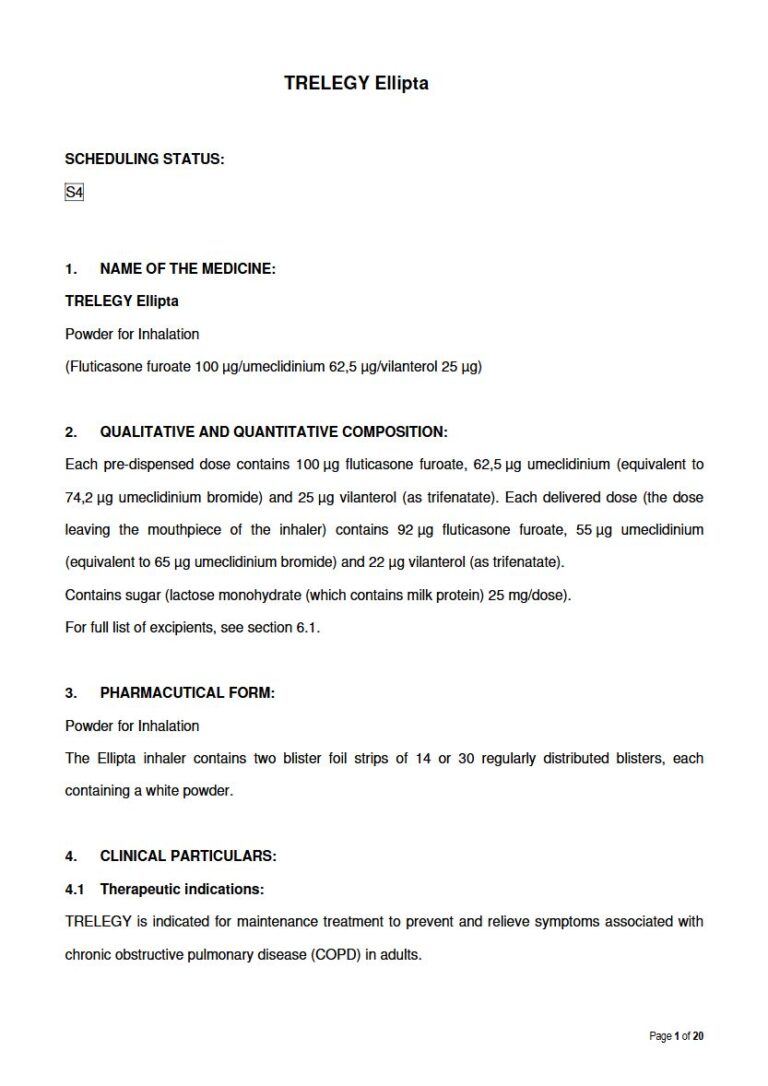
Trelegy Ellipta 100 μg/ 62,5 μg/ 25 μg Powder for Inhalation
PDF Leaflet Revision Date: 11 April 2024
Clinical Summary
Quick overview from the medicine insert
Indication
Maintenance treatment for COPD in adults.
Dosage (summary)
One inhalation once daily for adults; no adjustment for elderly or renal/hepatic impairment.
Special Populations
- Elderly
- Renal impairment
- Hepatic impairment
Pregnancy & Breastfeeding
Safety not established; potential risks in pregnancy and breastfeeding.
Key Drug Interactions
- Beta-blockers may reduce effectiveness
- CYP3A4 inhibitors may increase exposure
Contraindications
- Severe milk-protein allergy
- Hypersensitivity to components
Common side effects
- Pneumonia
- Upper respiratory tract infection
- Headache
- Cough
Counselling Points
- Rinse mouth after use
- Do not exceed recommended dose
- Monitor for pneumonia symptoms
Serious warnings
- Not for acute symptom relief
- Paradoxical bronchospasm
- Cardiovascular effects
Important Disclaimer
The Trelegy Ellipta 100 μg/ 62,5 μg/ 25 μg Powder for Inhalation professional information leaflet below is the property of Glaxosmithkline South Africa and is provided on Medinsert exactly as issued, with no.. alterations or editorial changes. We make every effort to keep content current by updating documents as soon as new versions become available. Medinsert serves as a trusted access point for healthcare professionals, but does not replace official sources or clinical judgement. For more details, please read our full disclaimer. read more>>
 Healthcare Professionals Only
This content is for registered healthcare professionals
Sign in or create a free account to read the full package insert.
Free for HPCSA-registered professionals. Powered by Medinsert.
Clinical Particulars
Section 4 of the official insert — extracted exactly as issued, no alterations
4.1 Therapeutic indications
TRELEGY is indicated for maintenance treatment to prevent and relieve symptoms associated with chronic obstructive pulmonary disease (COPD) in adults.
4.2 Posology and method of administration
TRELEGY is for oral inhalation only. After inhalation, the patient should rinse their mouth with water without swallowing.
Adults: The recommended and maximum dose is one inhalation of TRELEGY once daily, at the same time each day.
Children and adolescents: Use in patients less than 18 years of age is not relevant given the indication for TRELEGY.
Elderly: No dosage adjustment is required in patients over 65 years (see section 5.2).
Renal impairment: No dosage adjustment is required for patients with renal impairment (see section 5.2).
Hepatic Impairment: No dosage adjustment is required in patients with hepatic impairment. Umeclidinium has not been studied in patients with severe hepatic impairment (see section 4.4 and section 5.2).
4.3 Contraindications
TRELEGY is contraindicated in patients with severe milk-protein allergy or who have demonstrated hypersensitivity to fluticasone furoate, umeclidinium, vilanterol or any of the excipients.
4.4 Special warnings and precautions for use
The use of TRELEGY has not been studied in patients with asthma and is not recommended in this patient population.
Exacerbations: TRELEGY is intended for the maintenance treatment of COPD. It should not be used for the relief of acute symptoms, i.e. as rescue therapy for the treatment of acute episodes of bronchospasm. Acute symptoms should be treated with an inhaled short-acting bronchodilator.
Increasing use of short-acting bronchodilators to relieve symptoms indicates deterioration of control and patients should be reviewed by a medical practitioner.
Patients should not stop therapy with TRELEGY without medical practitioner supervision since symptoms may recur after discontinuation.
Paradoxical bronchospasm: Paradoxical bronchospasm may occur with an immediate increase in wheezing after dosing and may be life-threatening. Treatment with TRELEGY should be discontinued immediately, the patient assessed and alternative therapy instituted if necessary.
Cardiovascular effects: Cardiovascular effects, such as cardiac dysrhythmias e.g. atrial fibrillation and tachycardia, may be seen after the administration of muscarinic receptor antagonists or sympathomimetic agents, including umeclidinium or vilanterol, respectively. Therefore, TRELEGY should be used with caution in patients with unstable or life-threatening cardiovascular disease, or heart rhythm abnormalities, hypothyroidism or uncorrected hypokalaemia. Hypokalaemia may occur. Overdosages may cause cardiac effects. High dosages may increase the risk of serious side effects, including cardiac dysrhythmias. This risk is further aggravated if TRELEGY is administered concomitantly with other medicines that cause hypokalaemia and cardiac dysrhythmias, or in the presence of hypoxia and acidosis. The maximum dosage should not be exceeded.
Patients with hepatic impairment: Patients with moderate to severe hepatic impairment receiving TRELEGY should be monitored for systemic corticosteroid-related adverse reactions (see section 5.2).
Systemic corticosteroid effects: Systemic effects may occur with any inhaled corticosteroid, particularly at high doses prescribed for maintenance treatment. Possible systemic effects include hypothalamic u2010 pituitary u2010 adrenal (HPA) suppression, decrease in bone mineral density, cataract, glaucoma and central serous chorioretinopathy (CSCR).
TRELEGY should be administered with caution in patients with pulmonary tuberculosis or in patients with chronic or untreated infections.
Antimuscarinic activity: Consistent with its antimuscarinic activity, TRELEGY should be used with caution in patients with narrow-angle glaucoma or urinary retention.
Pneumonia: In line with the known class effect of inhaled corticosteroids, pneumonia events (including pneumonias resulting in hospitalisation) were observed in patients with COPD receiving TRELEGY. In some instances, fatal events of pneumonia have been reported with use of inhaled corticosteroid fluticasone furoate-containing medicines, including TRELEGY (see section 4.8). Medical practitioners should remain vigilant for the possible development of pneumonia in patients with COPD, as the clinical features of such infections overlap with the symptoms of COPD exacerbations. Risk factors for pneumonia in patients with COPD receiving inhaled corticosteroid-containing medicines include current smokers, patients with a history of prior pneumonia, patients with low body mass index and patients with severe COPD. These factors should be considered when TRELEGY is prescribed and treatment should be re-evaluated if pneumonia occurs.
Diabetic patients: There have been reports of increases in blood sugar levels in diabetic patients and this should be considered when prescribing TRELEGY to patients with a history of diabetes mellitus.
TRELEGY contains lactose: Patients with rare hereditary problems of galactose intolerance e.g. galactosaemia, Lapp lactase deficiency or glucose-galactose malabsorption or fructose intolerance should not use TRELEGY (see section 1).
4.5 Interactions with other medicines and other forms of interaction
Clinically significant interactions mediated by fluticasone furoate, umeclidinium or vilanterol at clinical doses are considered unlikely due to the low plasma concentrations achieved after inhaled dosing.
Interaction with beta-blockers: Beta-adrenergic blockers may weaken or antagonise the effect of beta 2 -adrenergic agonists, such as vilanterol. If beta-blockers are required, cardioselective beta-blockers should be considered; however, caution should be exercised during concurrent use of both non-selective and selective beta-blockers.
Interaction with CYP3A4 inhibitors: Fluticasone furoate and vilanterol, both components of TRELEGY, are rapidly cleared by extensive first-pass metabolism mediated by the enzyme CYP3A4. Care is advised when co-administering with strong CYP3A4 inhibitors (e.g. ketoconazole, ritonavir) as there is potential for an increased systemic exposure to both fluticasone furoate and vilanterol, which could lead to an increase in the potential for adverse reactions (see section 5.2).
Other long acting antimuscarinics and long acting beta 2 -adrenergic agonists: Co-administration of TRELEGY with other long-acting muscarinic antagonists or long-acting beta 2 -adrenergic agonists has not been studied and is not recommended as it may potentiate the adverse reactions (see section 4.8 and section 4.9).
4.6 Fertility, pregnancy and lactation
Safety in pregnancy and lactation is not established.
Pregnancy: There are insufficient data from the use of TRELEGY in pregnant women. Animal studies have shown reproductive toxicity after administration of beta 2 -agonists or corticosteroids.
Lactation: It is unknown whether fluticasone furoate, umeclidinium, vilanterol or their metabolites are excreted in human milk. However, other corticosteroids, muscarinic antagonists and beta 2 -agonists are detected in human milk. A risk to breastfed newborns/infants cannot be excluded. A decision must be made whether to discontinue breastfeeding or to discontinue TRELEGY therapy taking into account the benefit of breastfeeding for the child and the benefit of therapy for the woman.
4.7 Effects on the ability to drive and use machines
There have been no studies to investigate the effect of TRELEGY on the ability to perform tasks that require judgement, motor or cognitive skills. A detrimental effect on such activities would not be anticipated from the pharmacology of fluticasone furoate, umeclidinium or vilanterol at clinical doses.
4.8 Undesirable effects
Clinical trial data: Adverse reactions are listed below by MedDRA system organ class and by frequency. The following convention has been used for the classification of adverse reactions: Very common: u2265 1/10 Common: u2265 1/100 to < 1/10 Uncommon: u2265 1/1 000 to < 1/100 Rare: u2265 1/10 000 to < 1/1 000 Very rare: < 1/10 000.
Table 1 Adverse Reactions
System organ class Adverse reaction(s) Frequency
Infections and infestations Pneumonia * Upper respiratory tract infection Bronchitis Pharyngitis Rhinitis Sinusitis Influenza Nasopharyngitis Candidiasis of mouth and throat Urinary tract infection Common Viral respiratory tract infection Uncommon
Nervous system disorders Headache Common Dysgeusia Uncommon
Eye disorders Vision blurred (see section 4.4) Uncommon Glaucoma Eye pain
Cardiac disorders Supraventricular tachyarrhythmia Tachycardia Atrial fibrillation Uncommon
Respiratory, thoracic & mediastinal disorders Cough Oropharyngeal pain Common Dysphonia Uncommon
Gastrointestinal disorders Constipation Common Dry mouth Uncommon
Musculoskeletal and connective tissue disorders Arthralgia Back pain Common Fractures Uncommon
Description of selected adverse reactions: *Pneumonia (see section 4.4): In a total of 1 810 patients with advanced COPD (mean post bronchodilatory screening FEV1 45 % of predicted, SD 11 %), 65 % of which had experienced a moderate/severe COPD exacerbation in the year prior to study entry, there was a higher incidence of pneumonia events reported up to 24 weeks in patients receiving TRELEGY (20 patients, 2 %) than in patients receiving budesonide/formoterol (7 patients, < 1 %). Pneumonia which required hospitalisation occurred in 1 % of patients receiving TRELEGY and < 1 % of patients receiving budesonide/formoterol up to 24 weeks. One fatal case of pneumonia was reported in a patient who received TRELEGY. In the subset of 430 subjects treated for up to 52 weeks, the incidence of pneumonia events reported in both TRELEGY and budesonide/formoterol arms was equal at 2 %. The incidence of pneumonia events with TRELEGY is comparable with that observed in the FF/VI 100/25 arm of FF/VI clinical studies in COPD.
Post-marketing data: System organ class Adverse reaction(s) Frequency
Immune system disorders Hypersensitivity reactions, including anaphylaxis, angioedema, urticaria, and rash Less Frequent
Metabolism and nutrition disorders Hyperglycaemia Less Frequent
Psychiatric disorders Anxiety Less Frequent
Nervous system disorders Tremor Less Frequent
Eye disorders Intraocular Pressure Increased Less Frequent
Cardiac disorders Palpitations Less Frequent
Musculoskeletal and Connective tissue disorders Muscle spasms Less Frequent
Renal and urinary disorders Urinary retention Dysuria Less Frequent
Reporting of adverse reactions: Reporting suspected adverse reactions after authorisation of the medicine is important. It allows continued monitoring of the benefit/risk balance of the medicine. Healthcare providers are asked to report any suspected adverse reactions to SAHPRA via the u20186.04 Adverse Drug Reactions Reporting Formu2019, found online under SAHPRAu2019s publications: https://www.sahpra.org.za/Publications/Index/8.
4.9 Overdose
No data from clinical studies are available regarding overdose of TRELEGY.
Signs and Symptoms: An overdose of TRELEGY may produce signs, symptoms or adverse effects associated with the individual componentsu2019 pharmacological actions (see section 4.4 and section 5.1).
Treatment: There is no specific treatment for an overdose with TRELEGY. If overdose occurs, the patient should be treated supportively with appropriate monitoring as necessary. Cardioselective beta-blockade should only be considered for profound vilanterol overdose effects that are clinically concerning and unresponsive to supportive measures. Cardioselective beta-blocking medicines should be used with caution in patients with a history of bronchospasm. Further management should be as clinically indicated or as recommended by the national poisons centre, where available.
