
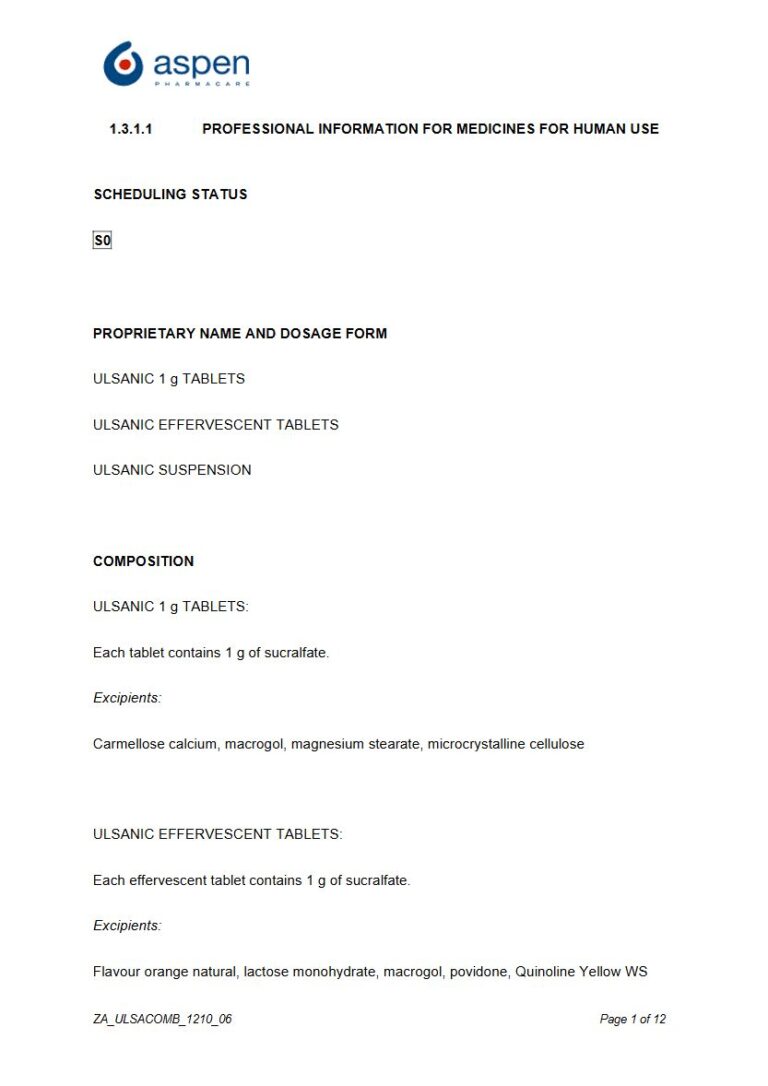
Ulsanic 1g Tablet / Efferverscent / Supension
PDF Leaflet Revision Date: 26 October 2012
Clinical Summary
Quick overview from the medicine insert
Indication
Treatment of gastric and duodenal ulcers, chronic gastritis, and reflux oesophagitis.
Dosage (summary)
1 g three to four times daily between meals; maintenance: 1 g twice daily.
Special Populations
- Renal impairment
- Elderly
Pregnancy & Breastfeeding
Safety not established in pregnancy; unknown if excreted in breast milk.
Key Drug Interactions
- Cimetidine
- Ranitidine
- Digoxin
- Ketoconazole
- Phenytoin
- Fluoroquinolone antibacterials
- Tetracycline
- Levothyroxine
- Quinidine
- Theophylline
- Warfarin
Contraindications
- Hypersensitivity to sucralfate or excipients
Common side effects
- Constipation
- Dizziness
- Drowsiness
- Skin rashes
- Pruritus
Counselling Points
- Take between meals
- Dissolve effervescent tablets in water
- Monitor for dizziness or drowsiness
Serious warnings
- Caution in renal impairment due to aluminium absorption
- Risk of bezoar formation
Important Disclaimer
The Ulsanic 1g Tablet / Efferverscent / Supension professional information leaflet below is the property of Aspen Pharmacare and is provided on Medinsert exactly as issued, with no.. alterations or editorial changes. We make every effort to keep content current by updating documents as soon as new versions become available. Medinsert serves as a trusted access point for healthcare professionals, but does not replace official sources or clinical judgement. For more details, please read our full disclaimer. read more>>
 Healthcare Professionals Only
This content is for registered healthcare professionals
Sign in or create a free account to read the full package insert.
Free for HPCSA-registered professionals. Powered by Medinsert.
Clinical Particulars
Section 4 of the official insert — extracted exactly as issued, no alterations
4.1 Indications
u2022 Gastric ulcer, duodenal ulcer, chronic gastritis and reflux oesophagitis.
u2022 ULSANIC produces relief of subjective symptoms of peptic ulceration e.g. epigastric pain, hyperchlorhydria, vomiting.
u2022 Maintenance treatment after successful endoscopically proven, recently healed duodenal ulcer.
4.2 Posology and method of administration
The usual adult dosage is one tablet or one effervescent tablet or 5 ml (one medicine measure) of suspension three or four times a day between meals and at bedtime. The effervescent tablet should be dissolved in a glass of water. A dosage regime of 2 g twice daily (i.e. 2 tablets, or 2 effervescent tablets or 10 ml suspension, mornings and evenings) has also been shown to be effective for the treatment of duodenal ulcer.
Reflux oesophagitis: One tablet mixed with water or one effervescent tablet dissolved in water or 5 ml (one medicine measure) of suspension four times a day between meals and at bedtime.
Maintenance treatment after successful healing of duodenal ulcer: One tablet or one effervescent tablet twice daily i.e. one tablet half an hour before breakfast and one tablet half an hour before supper on an empty stomach. Treatment should be continued for 12 months.
Relief is usually experienced by peptic ulcer patients following the administration of ULSANIC alone, although a short-term regime with additional analgesic and spasmolytic medicines may be of greater benefit in some patients with incipient clinical manifestations, especially severe pain in the epigastrium.
4.3 Contraindications
Hypersensitivity to sucralfate or to any of the excipients found in ULSANIC (see COMPOSITION).
4.4 Special warnings and precautions for use
ULSANIC should be administered with caution in patients with renal impairment or on dialysis, due to the possibility of increased aluminium absorption. In patients with renal failure, absorption of aluminium may cause adverse effects. Aluminium accumulation and toxicity (aluminium osteodystrophy, osteomalacia, encephalopathy) have been described in patients with renal impairment. Blood levels of aluminium, phosphate, calcium, alkaline phosphatase, should be periodically measured in these patients.
Caution is advised when ULSANIC is administered in patients with phosphate deficiencies as aluminium binds to phosphate in the gastrointestinal tract, inhibiting its absorption.
Occasional cases of bezoar (an insoluble mass formed within the gastric lumen) have been reported in patients taking ULSANIC. Bezoars have been described in patients after administration of ULSANIC in severely ill patients in Intensive Care Units, and especially in premature infants in whom the use of ULSANIC is not recommended, and should be used with caution in patients with delayed gastric emptying or receiving concomitant enteral feeds.
Since the elderly often have reduced physiological function, the dosage should be adjusted with care. The safety and efficacy of the maintenance treatment exceeding a period of 12 months have not been established.
4.5 Interactions with other medicines
Sucralfate may interfere with the absorption of other medicines and it has been suggested that there should be an interval of 2 hours between the administration of ULSANIC and other concurrent non-antacid medication. Some of the medicines reported to be affected by ULSANIC include cimetidine, ranitidine, digoxin, ketoconazole, phenytoin, fluoroquinolone antibacterials, tetracycline, levothyroxine, quinidine, theophylline and possibly warfarin.
The recommended interval between ULSANIC administration and other antacids is 30 minutes.
Cases of bezoar formation has been reported when ULSANIC has been administered concomitantly with enteral feeds. An interval of one hour should separate ULSANIC administration and enteral feeding (see SIDE EFFECTS).
4.6 Fertility, pregnancy and lactation
Safety in pregnant and lactating women has not been established.
Lactation: It is not known whether ULSANIC is excreted in human breast milk.
4.7 Effects on ability to drive and use machines
ULSANIC may cause dizziness and drowsiness. Patients should be cautioned about operating hazardous machinery including motor vehicles until they are reasonably certain that ULSANIC therapy does not affect them adversely.
4.8 Undesirable effects
Nervous system disorders
- Less frequent: Dizziness, drowsiness
- Frequency unknown: Vertigo
Skin and subcutaneous tissue disorders
- Less frequent: Skin rashes, pruritus
Gastrointestinal disorders
- Frequent: Constipation
- Less frequent: Diarrhoea, nausea, dry mouth, gastric discomfort. A few cases of bezoar have been reported in patients with the administration of ULSANIC SUSPENSION and enteral feeds by nasogastric tube (see INTERACTIONS)
General disorders and administrative site conditions
- Frequency unknown: Back pain
4.9 Overdose
Treatment should be symptomatic and supportive.
