
Uricid 0.5 Mg Tablets
PDF Leaflet Revision Date: 28 February 2023
Clinical Summary
Quick overview from the medicine insert
Indication
Relief of acute attacks of gout.
Dosage (summary)
Initial dose 0.5-1 mg, then 0.5 mg every 2 hours until relief or GI symptoms occur. Max 6 mg in 3 days.
Special Populations
- Elderly
- Paediatric populations
Pregnancy & Breastfeeding
Contraindicated in pregnancy; use caution in breastfeeding.
Key Drug Interactions
- P-glycoprotein inhibitors
- Strong CYP3A4 inhibitors
- Macrolide antibiotics
- Oral anticoagulants
Contraindications
- Hypersensitivity to colchicine
- Severe renal impairment
- Severe hepatic impairment
- Blood dyscrasias
Common side effects
- Nausea
- Vomiting
- Diarrhoea
- Abdominal pain
Counselling Points
- Take with water
- Avoid alcohol
- Report muscle pain or weakness
- Use effective contraception if of childbearing potential
Serious warnings
- Fatal overdoses possible
- Narrow therapeutic window
- Monitor for blood dyscrasias
Important Disclaimer
The Uricid 0.5 Mg Tablets professional information leaflet below is the property of Trinity Pharma and is provided on Medinsert exactly as issued, with no.. alterations or editorial changes. We make every effort to keep content current by updating documents as soon as new versions become available. Medinsert serves as a trusted access point for healthcare professionals, but does not replace official sources or clinical judgement. For more details, please read our full disclaimer. read more>>
 Healthcare Professionals Only
This content is for registered healthcare professionals
Sign in or create a free account to read the full package insert.
Free for HPCSA-registered professionals. Powered by Medinsert.
Clinical Particulars
Section 4 of the official insert — extracted exactly as issued, no alterations
4.1 Therapeutic indications
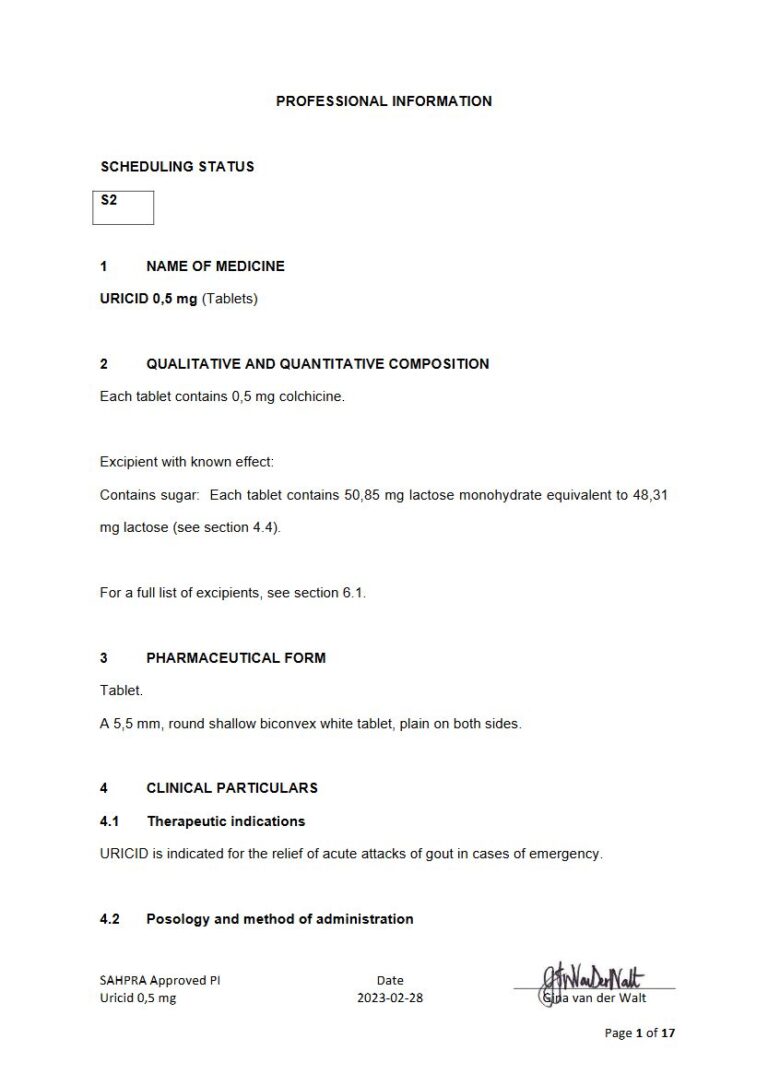
URICID is indicated for the relief of acute attacks of gout in cases of emergency.
4.2 Posology and method of administration
Posology
Adults
In acute gout the initial dose is 0,5 mg to 1 mg (i.e., 1 to 2 tablets) by mouth immediately, followed by 0,5 mg (1 tablet) every 2 hours until pain relief is obtained or gastrointestinal symptoms such as vomiting, or diarrhoea occur. A maximum total treatment course of 6 mg must not be exceeded. The course should not be repeated within 3 days, but preferably 7 days should elapse between courses of gout treatment with URICID to avoid cumulative toxicity. URICID is not an analgesic medicine and should not be used to treat pain from other causes.
Special populations
Elderly
URICID should be used with caution in the elderly.
Paediatric populations
Safety and efficacy of URICID have not been established in paediatric populations.
Method of administration
Oral route. Tablet should be swallowed with a glass of water.
4.3 Contraindications
URICID is contraindicated in:
- Patients with hypersensitivity to colchicine or to any of the excipients (see section 6.1);
- Pregnancy and lactation (see section 4.6);
- Patients with serious gastrointestinal, renal, hepatic or cardiac disorders (see section 4.4);
- Patients with blood dyscrasias: myelosuppression, leukopenia, granulocytopenia, thrombocytopenia and aplastic anaemia (see section 4.4).
- Women of childbearing potential unless they are using effective contraceptive measures.
- Patients with severe renal impairment (creatinine clearance < 30 mL/min).
- Patients with severe hepatic impairment.
- Patients undergoing haemodialysis since it cannot be removed by dialysis or exchange transfusion.
- Patients with renal or hepatic impairment who are taking a P-glycoprotein (P-gp) inhibitor or a strong CYP3A4 inhibitor (see section 4.5). In these patients, life-threatening and fatal colchicine toxicity has been reported with URICID in therapeutic doses.
- Combination with macrolide antibiotics and pristinamycin.
4.4 Special warnings and precautions for use
Fatal overdoses
URICID is potentially toxic so it is important not to exceed the recommended dose as prescribed by a healthcare provider with the necessary knowledge and experience (see section 4.2). Colchicine, as contained in URICID, has a narrow therapeutic window. The administration should be discontinued if toxic symptoms such as nausea, vomiting, abdominal pain, diarrhoea occur (see sections 4.2 and 4.8). URICID should be withdrawn or the dose reduced if adverse gastrointestinal effects occur. Fatal overdoses have been reported with colchicine, as contained in URICID, in adults and children. Keep URICID away from children. URICID should be given with great care to elderly or debilitated patients who may be particularly susceptible to cumulative toxicity and to those patients with cardiovascular, hepatic, renal or gastrointestinal disease. Patients with liver or renal impairment should be carefully monitored for adverse effects of colchicine.
Blood dyscrasias
Colchicine, as contained in URICID, may cause severe bone marrow depression (agranulocytosis, aplastic anaemia, thrombocytopenia). The change in blood counts may be gradual or very sudden. Aplastic anaemia in particular has a high mortality rate. Periodic checks of the blood picture are essential (see section 4.3). If patients develop signs or symptoms that could indicate a blood cell dyscrasia, such as fever, stomatitis, sore throat, prolonged bleeding, bruising or skin disorders, treatment with URICID should be immediately discontinued and a full haematological investigation should be conducted straight away.
Hepatic and renal impairment
Patients with liver or renal impairment should be carefully monitored for adverse effects of URICID (see sections 4.2, 4.3 and 4.8). Co-administration with P-gp inhibitors and/or moderate or strong CYP3A4 inhibitors will increase the exposure to colchicine, as contained in URICID, which may lead to colchicine induced toxicity including fatalities. If treatment with a P-gp inhibitor or a moderate or strong CYP3A4 inhibitor is required in patients with normal renal and hepatic function, a reduction in URICID dosage or interruption of URICID treatment is recommended (see sections 4.3 and 4.5).
Elderly population
URICID should be given with care to old and debilitated patients and to those with cardiac, hepatic, renal or gastrointestinal disease.
Co-administration with P-gp inhibitors and/or moderate or strong CYP3A4 inhibitors
Co-administration with P-gp inhibitors and/or moderate or strong CYP3A4 inhibitors will increase the exposure to URICID, which may lead to URICID induced toxicity including fatalities. If treatment with a P-gp inhibitor or a moderate or strong CYP3A4 inhibitor is required in patients with normal renal and hepatic function, a reduction in URICID dosage or interruption of URICID treatment is recommended (see sections 4.3 and 4.8).
Paediatric population
Safety and efficacy of URICID have not been established in paediatric populations.
Excipients
URICID contains lactose monohydrate. Patients with rare hereditary problems of galactose intolerance, total lactase deficiency or glucose-galactose malabsorption should not take URICID.
4.5 Interaction with other medicines and other forms of interaction
URICID is contraindicated in patients with renal or hepatic impairment who are taking a P-gp inhibitor (e.g., ciclosporin, verapamil or quinidine) or a strong CYP3A4 inhibitor (e.g., ritonavir, atazanavir, indinavir, clarithromycin, telithromycin, itraconazole or ketoconazole) (see section 4.3). Colchicine, as contained in URICID, is a substrate for both CYP3A4 and the transport protein P-gp. In the presence of CYP3A4 or P-gp inhibitors, the concentrations of colchicine in the blood increase. Toxicity, including fatal cases, have been reported during concurrent use of CYP3A4 or P-gp inhibitors such as macrolides (clarithromycin, telithromycin and erythromycin), ciclosporin, ketoconazole, itraconazole, voriconazole, HIV protease inhibitors (ritonavir, atazanavir), calcium channel blockers (verapamil and diltiazem) and disulfiram (see sections 4.3 and 4.4). A reduction in URICID dosage or an interruption of treatment is recommended in patients with normal renal or hepatic function if treatment with a P-gp inhibitor or strong CYP3A4 inhibitor is required. A 4-fold reduction in colchicine dosage is recommended when co-administered with a P-gp inhibitor (e.g., ciclosporin) and/or a strong CYP3A4 inhibitor (e.g., clarithromycin, ketoconazole, ritonavir). A 2-fold reduction in colchicine, as contained in URICID dosage is recommended when co-administered with a moderate CYP3A4 inhibitor (e.g., verapamil, diltiazem, grapefruit juice (see sections 4.3 and 4.4). Such combinations should be avoided in patients with renal and hepatic impairment (see sections 4.3 and 4.4). Given the nature of the side effects, caution is advised with concomitant administration of medicine that can affect the blood count or have a negative effect on hepatic and/or renal function.
Pristinamycin
Concomitant administration of pristinamycin and URICID can increase the undesirable effects of colchicine with potentially fatal consequences (see section 4.3).
Oral anticoagulants
Concomitant administration of URICID and oral anticoagulants may increase the effect of the oral anticoagulant and increase the risk of haemorrhage. More frequent INR checks are required. Possible modification of the dosage of the oral anticoagulant during treatment with URICID and for 8 days after its cessation may be required.
Thiazide diuretics
May increase serum uric levels and interfere with the activity of URICID.
Cimetidine and tolbutamide
Reduce metabolism of colchicine and thus plasma levels of URICID increase.
Grapefruit juice
May increase plasma levels of URICID as grapefruit juice is a moderate inhibitor of CYP3A4. Grapefruit juice should therefore not be taken together with URICID.
Vitamin B12 (cyanocobalamin)
Reversible malabsorption of cyanocobalamin (vitamin B12) may be induced by an altered function of the intestinal mucosa.
Statins (HMG-CoA reductase inhibitors), fibrates, ciclosporin, digoxin
The risk of myopathy and rhabdomyolysis is increased by a combination of colchicine with statins, fibrates, ciclosporin or digoxin. Cases of myopathy, including rhabdomyolysis, have been reported with HMG-CoA reductase inhibitors and co-administration with URICID, and caution should be exercised when given concomitantly. There may be an increased risk if renal function is impaired. Patients should be advised to report muscle pain or weakness.
Alcohol
Concomitant use of URICID increases the risk of gastrointestinal disorders. Alcohol increases blood uric acid concentrations.
Non-steroidal anti-inflammatory drugs (NSAIDs)
Concomitant use may increase the risk of gastrointestinal symptoms.
Antineoplastic medicines
Cytolytic medicines may increase the serum uric acid concentrations.
Bone marrow depressants or radiation therapy
Additive bone marrow depression may occur and dosage reduction of URICID may be required.
Medicines affecting the blood count, hepatic function or renal function
Given the nature of the side effects, caution is advised with concomitant administration of medicines that can affect the blood count or have a negative effect on hepatic and/or renal function.
4.6 Fertility, pregnancy and lactation
Women of childbearing potential
Women of childbearing potential must use effective contraception during treatment with URICID.
Pregnancy
URICID should not be used during pregnancy.
Breastfeeding
Colchicine may be excreted in breast milk.
Fertility
No data is available.
4.7 Effects on ability to drive and use machines
URICID is not expected to have an influence; however, patients should not drive, use machinery or perform any tasks that require concentration until they are certain that URICID do not adversely affect their ability to do so safely (see section 4.8).
4.8 Undesirable effects
a. Tabulated summary of adverse reactions
System Organ Class Frequency Undesirable effect
Blood and lymphatic system disorders Frequency Unknown Bone marrow depression with agranulocytosis, aplastic anaemia, leukopenia, thrombocytopenia, aplastic anaemia, leukopenia, neutropenia*
Nervous system disorders Frequency Unknown Peripheral neuritis, peripheral neuropathy
Vascular disorders Frequency Unknown General vascular damage, hypotension (with large doses)
Immune system disorders Frequency Unknown Hypersensitivity reactions
Gastrointestinal system disorders Frequent Abdominal pain, nausea, vomiting and diarrhoea**
Less Frequent Burning of the throat Frequency Unknown Gastrointestinal haemorrhage, profuse diarrhoea
Hepatobiliary disorders Frequency Unknown Hepatotoxicity, hepatic damage
Skin and subcutaneous tissue disorders Less Frequent Urticaria, morbilliform eruptions Frequency Unknown Alopecia, skin rashes, vesicular dermatitis, purpura and dermatoses, burning of the skin
Musculoskeletal and connective tissue disorders Frequency Unknown Myopathy, joint pain, rhabdomyolysis
Renal and urinary disorders Frequency Unknown Renal damage, anuria, haematuria, oliguria, dehydration
Reproductive system and breast disorders Frequency Unknown Amenorrhoea, dysmenorrhoea, oligospermia, reversible azoospermia
b. Description of selected adverse reactions
* Larger doses may cause profuse diarrhoea, gastrointestinal haemorrhage, skin rashes and renal damage. Bone marrow depression with agranulocytosis, thrombocytopenia and aplastic anaemia have occurred on prolonged treatment, as well as peripheral neuritis, myopathy, rashes and alopecia.
** URICID should be withdrawn or the dose reduced if gastrointestinal side effects occur.
c. Reporting of suspected adverse reactions
Reporting suspected adverse reactions after authorisation of the medicine is important. It allows continued monitoring of the benefit/risk balance of the medicine. Health care providers are asked to report any suspected adverse reactions to SAHPRA via the u201c6.04 Adverse Drug Reactions Reporting Formu201d, found online under SAHPRAu2019s publications: https://www.sahpra.org.za/Publications/Index/8
4.9 Overdose
Symptoms
Colchicine, as contained in URICID, has a narrow therapeutic window and is extremely toxic in overdose, it has been associated with serious and fatal toxicity. Patients at particular risk of toxicity are those with renal or hepatic impairment, gastrointestinal or cardiac disease, and patients at extremes of age (very young and very old). Following colchicine overdose, all patients, even in the absence of early symptoms, should be referred for immediate medical assessment (see section 4.4).
Clinical
There is often a delay of up to 6 hours before toxicity is apparent; some features may be delayed up to 1 week or longer. Early symptoms of acute overdosage may be delayed (which occur up to 1 day after ingestion but 3 hours on average): nausea, vomiting, abdominal pain, hemorrhagic gastroenteritis, volume depletion, electrolyte abnormalities, diarrhoea, electrolyte disturbances, hypovolaemic shock, leukocytosis, hypotension in severe cases.
The second phase with life threatening complications develops 24 to 72 hours (7 days or longer) after medicine administration: hepatic impairment, hyperpyrexia, bone marrow depression with leukopenia followed by rebound leukocytosis, multisystem organ dysfunction, acute renal failure, confusion, coma, ascending peripheral motor and sensory neuropathy, myocardial depression (decreased cardiac output), pancytopenia, cardiac dysrhythmias, respiratory failure (respiratory distress), consumption coagulopathy. A toxic epidermal necrolysis-like reaction has also been reported. These can progress in severe cases to multiple organ damage with bone marrow aplasia, convulsions, coma, delirium, rhabdomyolysis, neuropathy, hepatocellular damage and ascending paralysis of the central nervous system, disseminated intravascular coagulation and death. Death is usually a result of respiratory depression and cardiovascular collapse. If the patient survives, recovery may be accompanied by rebound leukocytosis and reversible alopecia starting about one week after the initial ingestion. The lethal dose varies widely (7 mg to 65 mg single dose) for adults but is generally about 20 mg.
Treatment
No antidote is available. Gastric lavage may be an alternative in adults who present within 1 hour of a potentially, acute life-threatening overdose. In acute overdosage, the value of gut decontamination is uncertain. Consider oral activated charcoal 50 g in adults who have ingested more than 0,1 mg/kg bodyweight within 1 hour of presentation and children who have ingested any amount of URICID within 1 hour may be given activated charcoal 1 g/kg. Doses may be repeated every 4 hours in both adults and children, for those who have ingested more than 300 u03bcg/kg, provided they are not vomiting. Haemodialysis and haemoperfusion has no efficacy (high apparent distribution volume) as they do not enhance URICID elimination; blood and urine concentrations are of no use diagnostically (see section 4.3). Close clinical and biological monitoring in hospital environment. Management is mainly symptomatic and supportive, with attention given to respiration, pulse, blood pressure and circulation, and cardiac rhythm; fluid and electrolyte imbalances should be corrected. In cases of overdosage or acute poisoning patients should be carefully monitored. Patients are monitored for at least 6 hours after ingestion, or 12 hours if they have taken more than 300 u03bcg/kg. Asymptomatic patients may then be discharged, with advice to return if gastrointestinal symptoms appear.
