
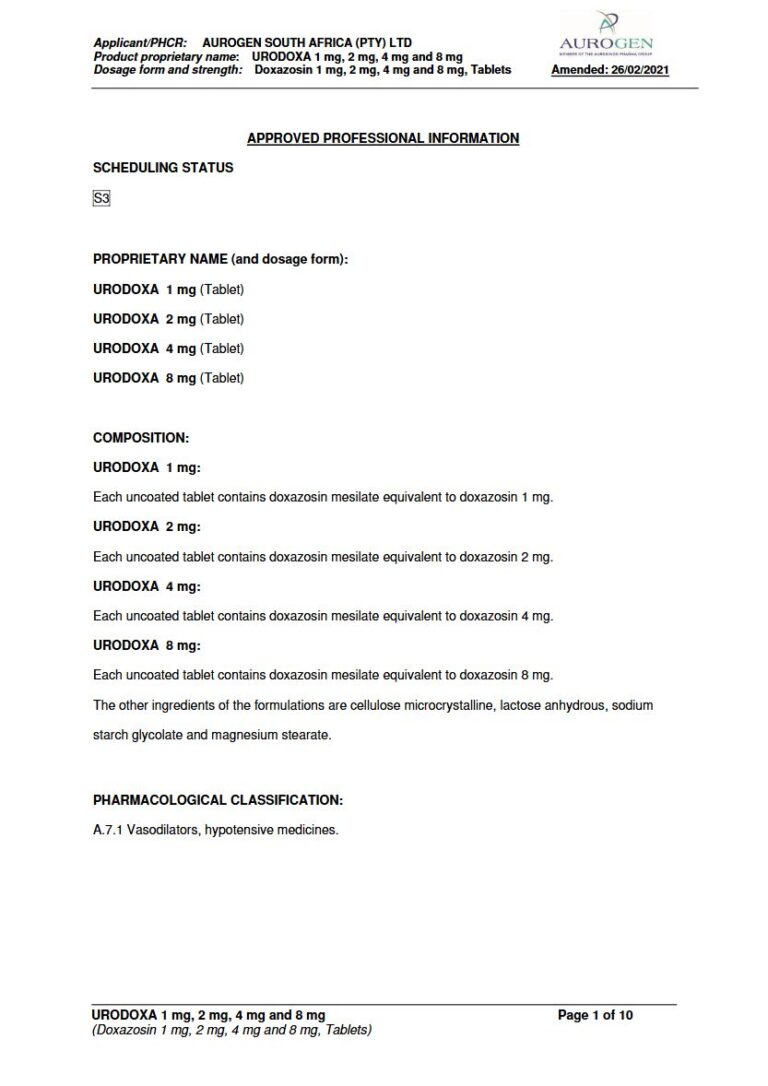
Urodoxa 1 mg, 2 mg, 4 mg and 8 mg Tablets
PDF Leaflet Revision Date: 26 February 2021
Clinical Summary
Quick overview from the medicine insert
Indication
Treatment of mild to moderate hypertension and benign prostatic hyperplasia.
Dosage (summary)
Initial dose 1 mg daily, may increase to 2-4 mg; max 8 mg.
Onset of Action / Duration
Onset: 2 hours, Duration: 24 hours
Special Populations
- Elderly
- Hepatic impairment
- Renal impairment
Pregnancy & Breastfeeding
Contraindicated in pregnancy and lactation.
Key Drug Interactions
- Additive hypotension with PDE-5 inhibitors
- Enhanced hypotensive effects with diuretics
Contraindications
- Hypersensitivity to quinazolines
- History of orthostatic hypotension
- Severe urinary tract obstruction
Common side effects
- Dizziness
- Headache
- Hypotension
- Fatigue
Counselling Points
- Avoid driving if drowsy
- Monitor blood pressure regularly
- Take initial dose at bedtime
Serious warnings
- Risk of first-dose hypotension
- Caution in patients with angina
Important Disclaimer
The Urodoxa 1 mg, 2 mg, 4 mg and 8 mg Tablets professional information leaflet below is the property of Aurogen South Africa and is provided on Medinsert exactly as issued, with no.. alterations or editorial changes. We make every effort to keep content current by updating documents as soon as new versions become available. Medinsert serves as a trusted access point for healthcare professionals, but does not replace official sources or clinical judgement. For more details, please read our full disclaimer. read more>>
 Healthcare Professionals Only
This content is for registered healthcare professionals
Sign in or create a free account to read the full package insert.
Free for HPCSA-registered professionals. Powered by Medinsert.
Clinical Particulars
Section 4 of the official insert — extracted exactly as issued, no alterations
4.1 Therapeutic indications
Hypertension: URODOXA is indicated for the treatment of mild to moderate hypertension.
Benign Prostatic Hyperplasia: URODOXA is also indicated for the treatment of the urinary outflow obstruction and symptoms associated with benign prostatic hyperplasia (BPH). URODOXA may be used in BPH patients who are either hypertensive or normotensive.
4.2 Posology and method of administration
Benign Prostatic Hyperplasia: The initial dosage of URODOXA is 1 mg given once daily. Depending on the individual patient's urodynamics and BPH symptomatology, dosage may then be increased to 2 mg and thereafter to 4 mg and up to the maximum recommended dose of 8 mg. The recommended titration interval is 1 - 2 weeks. The usual recommended dose is 2 - 4 mg once daily. Blood pressure should be evaluated routinely in these patients.
4.3 Contraindications
URODOXA is contraindicated in patients with a known hypersensitivity to quinazolines or any of the ingredients of URODOXA .
- Pregnancy and lactation (see u201cPREGNANCY AND LACTATIONu201d ).
- Patients with a history of orthostatic hypotension.
- Patients with benign prostatic hyperplasia and concomitant congestion of upper urinary tract, chronic urinary tract infection of bladder stones.
- As monotherapy in patients either overflow bladder or anuria or without progressive renal insufficiency.
4.4 Special warnings and precautions for use
URODOXA is not recommended for the treatment of heart failure caused by mechanical obstruction, for example aortic or mitral valve stenosis, pulmonary embolism, and restrictive pericardial disease. It should be used with caution is patients with angina pectoris. Treatment with URODOXA should be introduced with caution due to the risk of sudden collapse after the initial dose. Extra caution is necessary in patients with hepatic or renal impairment and in the elderly. There is no experience with the use of URODOXA in children.
Patients undergoing cataract surgery: Intraoperative Floppy Iris Syndrome (IFIS) has been observed during cataract surgery in some patients on or previously treated with alpha1 blockers. This variant of small pupil syndrome is characterised by the combination of a flaccid iris that billows in response to intraoperative irrigation currents, progressive intraoperative miosis despite preoperative dilation with standard mydriatic medicines, and potential prolapse of the iris toward the phacoemulsification incisions. The patientu2019s surgeon should be prepared for possible modifications to their surgical technique, such as the utilisation of iris hooks, iris dilator rings, or viscoelastic substances. This does not appear to be a benefit of stopping alpha1 blocker therapy prior to cataract surgery.
Patients taking PDE-5 Inhibitors: Concomitant administration of URODOXA with a PDE-5 inhibitor can result in additive blood pressure lowering effects and symptomatic hypotension. Postural hypotension with or without symptoms (e.g. dizziness) may develop within a few hours following administration of URODOXA . However, infrequently, symptomatic postural hypotension has also been reported later than a few hours after dosing. As with other alpha-blockers, there is a potential for syncope, especially after the initial dose or after an increase in dosage strength. Patients should be warned of the possible occurrence of such events and should avoid situations where injury could result should syncope occur. Care should be taken when URODOXA is administered to patients with symptomatic hypotension or patients who have had a hypotensive response to other medications. URODOXA contains lactose and should not be given to patients with rare hereditary problems or a history of galactose intolerance, Lapp lactase deficiency or glucose-galactose malabsorption.
4.5 Interactions with other medicines
No adverse medicine interaction has been noted in clinical experience with thiazide diuretics, furosemide, beta-blocking agents, oral hypoglycaemic medicines, antibiotics, uricosuric agents or anticoagulants. However the hypotensive effects of URODOXA may be enhanced by use with diuretics and other anti-hypertensives, and by alcohol and other medicines that cause hypotension. The risk of first-dose hypotension may be particularly increased in patients receiving beta-blockers or calcium channel blockers. Concomitant administration of URODOXA with a PDE-5 inhibitor can result in additive blood pressure lowering effects and symptomatic hypotension; therefore, PDE-5 inhibitor therapy should be initiated at the lowest dose in patients taking URODOXA .
4.6 Fertility, pregnancy and lactation
The safety of URODOXA in pregnancy or lactation has not yet been established (see u201cCONTRA - INDICATIONS u201d ).
4.7 Effects on ability to drive and use machines
The ability to engage in activities such as driving a motor vehicle or operating machinery may be impaired, especially when initiating therapy. URODOXA may cause drowsiness or dizziness therefore patients affected should not drive or operate machinery.
4.8 Undesirable effects
Blood and the lymphatic system disorders: The following side effects have been reported and frequencies are unknown: Thrombocytopenia, leukopenia.
Immune system disorders: The following side effects have been reported and frequencies are unknown: Allergic medicine reactions.
Psychiatric disorders: Less frequent: Nervousness. The following side effects have been reported and frequencies are unknown: Depression, insomnia, agitation.
Nervous system disorders: Frequent: Dizziness, vertigo, headache. Less frequent: Somnolence. The following side effects have been reported and frequencies are unknown: Tremor, paraesthesia, postural dizziness.
Eye disorders: The following side effects have been reported and frequencies are unknown: Blurred vision, abnormal vision.
Cardiac disorders: Less frequent: Cardiac dysrhythmias, palpitations, tachycardia. The following side effects have been reported and frequencies are unknown: Myocardial infarction, angina pectoris.
Vascular disorders: Less frequent: Hypotension. The following side effects have been reported and frequencies are unknown: Cerebrovascular accidents.
Respiratory, thoracic and mediastinal disorders: Less frequent: Dyspnoea, rhinitis. The following side effects have been reported and frequencies are unknown: Epistaxis.
Gastrointestinal disorders: Less frequent: Nausea, abdominal pain. The following side effects have been reported and frequencies are unknown: Diarrhoea, dry mouth, vomiting.
Hepato-biliary disorders: The following side effects have been reported and frequencies are unknown: Jaundice, hepatitis, cholestasis.
Skin and subcutaneous tissue disorders: The following side effects have been reported and frequencies are unknown: Skin rashes, pruritus, purpura.
Renal and urinary disorders: The following side effects have been reported and frequencies are unknown: Haematuria. Cases of urinary incontinence were reported; this effect may be related to the pharmacological action of URODOXA .
Reproductive system and breast disorders: Less frequent: Priapism. The following side effects have been reported and frequencies are unknown: Sexual dysfunction, and impotence.
General disorders and administrative site conditions: Frequent: Asthenia. The following side effects have been reported and frequencies are unknown: Fatigue, malaise, chest pain, oedema.
Investigations: The following side effects have been reported and frequencies are unknown: Abnormal liver function tests.
4.9 Overdose
See u201cSIDE EFFECTSu201d . Dialysis is not indicated, since URODOXA is highly protein bound. Treatment is symptomatic and supportive.
