
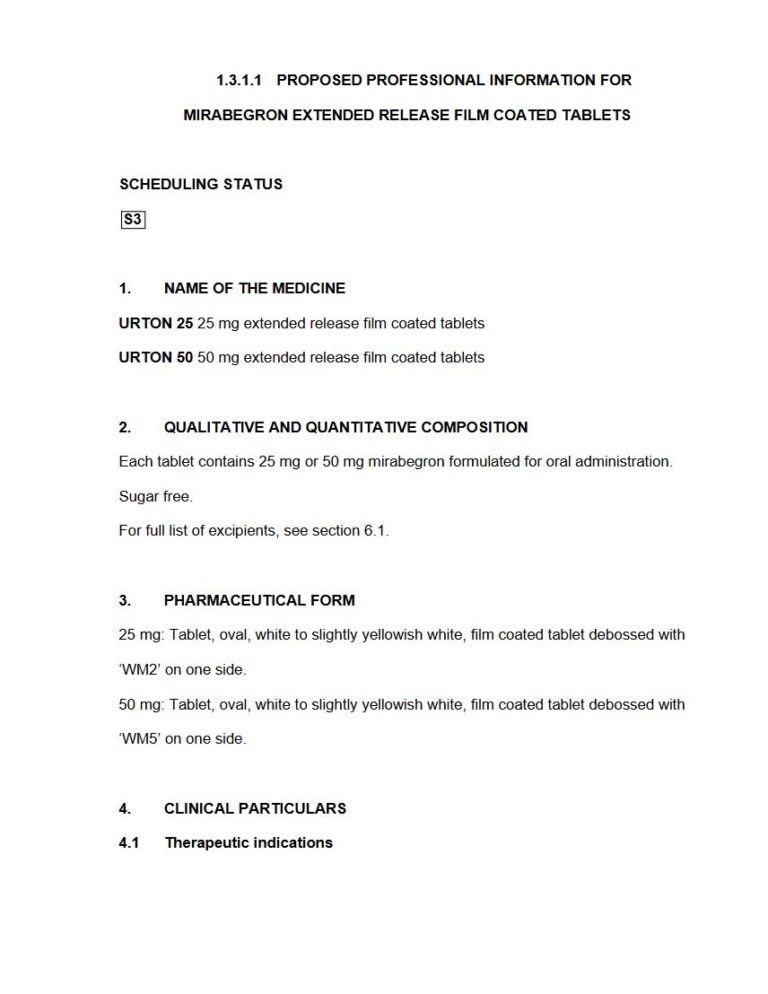
Urton 25 mg/50 mg Tablets
PDF Leaflet Revision Date: 01 November 2022
Clinical Summary
Quick overview from the medicine insert
Indication
Symptomatic treatment of overactive bladder (OAB) syndrome.
Dosage (summary)
50 mg once daily; 25 mg for severe renal/hepatic impairment.
Special Populations
- Renal impairment
- Hepatic impairment
Pregnancy & Breastfeeding
Avoid in pregnancy; not recommended during breastfeeding.
Key Drug Interactions
- CYP2D6 substrates
- Strong CYP3A inhibitors
Contraindications
- Hypersensitivity
- Severe renal impairment
- Severe hepatic impairment
- Uncontrolled hypertension
Common side effects
- Urinary tract infection
- Tachycardia
- Dizziness
Counselling Points
- Take once daily with liquids
- Monitor blood pressure
- Avoid in pregnancy and breastfeeding
Serious warnings
- May increase blood pressure
- Caution in QT prolongation
Important Disclaimer
The Urton 25 mg/50 mg Tablets professional information leaflet below is the property of Cipla Medpro and is provided on Medinsert exactly as issued, with no.. alterations or editorial changes. We make every effort to keep content current by updating documents as soon as new versions become available. Medinsert serves as a trusted access point for healthcare professionals, but does not replace official sources or clinical judgement. For more details, please read our full disclaimer. read more>>
 Healthcare Professionals Only
This content is for registered healthcare professionals
Sign in or create a free account to read the full package insert.
Free for HPCSA-registered professionals. Powered by Medinsert.
Clinical Particulars
Section 4 of the official insert — extracted exactly as issued, no alterations
4.1 Therapeutic indications
Symptomatic treatment urinary urgency, increased micturition frequency and/or urgency incontinence as experienced in adult patients with overactive bladder (OAB) syndrome.
4.2 Posology and method of administration
Posology
Adults (including elderly patients)
The recommended dose of URTON is 50 mg once daily with or without food.
Special populations
Patients with Renal impairment
No dose adjustment is necessary for patients with mild and moderate renal impairment (eGFR 30 to 89 mL/min/1.73 mu00b2 as estimated by MDRD). In patients with severe renal impairment (eGFR 15 to 29 mL/min/1.73 mu00b2), the recommended dose of URTON is 25 mg once daily with or without food. URTON has not been studied in patients with End Stage Renal Disease (eGFR <15 mL/min/1.73 mu00b2 or patients requiring haemodialysis) (see section 4.3).
Patients with Hepatic Impairment
No dose adjustment is necessary in patients with mild hepatic impairment (Child-Pugh Class A). In patients with moderate hepatic impairment (Child-Pugh Class B) the recommended dose of URTON is 25 mg once daily with or without food. URTON has not been studied in patients with severe hepatic impairment (Child-Pugh Class C). (see section 4.3)
Paediatric population
The safety and efficacy of URTON in children below 18 years of age have not been established. Therefore, use in this age group is not recommended.
Method of administration
URTON is to be taken once daily, with liquids, swallowed whole and is not chewed, divided or crushed.
4.3 Contraindications
- Hypersensitivity to the active substance or to any of the excipients of URTON.
- Severe end stage renal impairments (eGFR < 15 mL/min/1.73 mu00b2).
- Severe hepatic impairment (Child-Pugh Class C).
- Severe uncontrolled hypertension defined as systolic blood pressure u2265 180 mm Hg and/or diastolic blood pressure u2265 110 mm Hg.
4.4 Special warnings and precautions for use
Renal impairment
URTON has not been studied in patients with End Stage Renal Disease (eGFR < 15 mL/min/1.73 mu00b2 or patient requiring haemodialysis) and, therefore, it is not recommended for use in this patient population. In patients with severe renal impairment (GFR 15 - 29 mL/min/1.73 mu00b2), dosage reduction is recommended. URTON is not recommended for use in patients with severe renal impairment (GFR 15 - 29 mL/min/1.73 mu00b2) concomitantly receiving strong CYP3A inhibitors.
Hepatic Impairment
URTON has not been studied in patients with severe hepatic impairment (Child-Pugh Class C) and, therefore, it is not recommended for use in this patient population. URTON is not recommended in patients with moderate hepatic impairment (Child-Pugh Class B) concomitantly receiving strong CYP3A inhibitors.
Hypertension
URTON can increase blood pressure. Blood pressure should be measured at baseline and periodically during treatment with URTON, especially in hypertension patients. Data are limited in patients with Stage 2 Hypertension (systolic blood pressure u2265 160 mm Hg or diastolic blood pressure u2265 100 mm Hg).
Patients with bladder outlet obstruction and patients taking anti-muscarinic medicines
Urinary retention has been reported in patients with bladder outlet obstruction and patients taking anti-muscarinic medicines for the treatment of overactive bladder concurrently taking mirabegron. Caution should be observed when URTON is administered to patients with clinically significant BOO and patients taking anti-muscarinic medicines for the treatment of OAB.
4.5 Interactions with other medicines
Clinically relevant medicine interactions between mirabegron and medicinal products that inhibit, induce or are a substrate for one of the cytochrome P450 (CYP) isozymes or transporters are not expected, except for the inhibitory effect of mirabegron on the metabolism CYP2D6 substrates. Mirabegron, as in URTON, is transported and metabolised through multiple pathways. Mirabegron is a substrate for CYP3A4, CYP2D6, butyrylcholinesterase, uridine diphospho-glucuronosyltransferases (UGT), the efflux transporter P-glycoprotein (P-gp) and the influx organic cation transporters (OCT) OCT1, OCT2 and OCT3.
Sulfonylurea hypoglycaemic medicines, glibenclamide (a CYP3A substrate), gliclazide (a CYP2C9 and CYP3A4 substrate) and tolbutamide (a CYP3A4 substrate) may not affect the in vitro metabolism of mirabegron. Mirabegron may not affect the metabolism of glibenclamide or tolbutamide. Studies of URTON using human liver microsomes and recombinant human CYP enzymes showed that mirabegron is a moderate and time-dependent inhibitor of CYP2D6 and a weak inhibitor of CYP3A. URTON is unlikely to inhibit the metabolism of co-administered medicines metabolised by following cytochrome P450 enzymes: CYP1A2, CYP2B6, CYP2C8, CYP2C9, CYP2C19 and CYP2E1. URTON did not induce CYP1A2 or CYP3A. URTON inhibited P-gp-mediated medicines transport at high concentrations. URTON may not cause clinically relevant inhibition of OCT-mediated drug transport.
Effect of enzyme inhibitors
Mirabegron exposure was increased 1.8-fold in healthy volunteers, also taking ketoconazole, a strong inhibitor of CYP3A/P-gp. Administration of mirabegron is inadvisable in patients with moderate hepatic impairment (Child-Pugh Class B) simultaneously receiving strong CYP3A inhibitors. URTON is not recommended in patients with severe renal impairment or patients with moderate hepatic impairment (Child-Pugh Class B) concomitantly receiving strong CYP3A inhibitors (see section 4.4).
Effect of enzyme inducers
Dose adjustment is not required for URTON when administered concomitantly with therapeutic doses of rifampicin or other CYP3A or P-gp inducers.
Effect of URTON on CYP2D6 substrates
Caution is advised if URTON is co-administered with medicines that are significantly metabolised by CYP2D6 and have a narrow therapeutic index such as haloperidol, risperidone, thioridazine and Type 1C antiarrhythmics (e.g. flecainide, propafenone, clomipramine). Caution should also be taken if URTON is co-administered with CYP2D6 substrates that are individually dose titrated.
Effect of URTON on transporters
The lowest dose of digoxin should be prescribed initially, for patients who are commencing a combination of URTON and digoxin. Serum digoxin concentrations should be closely observed and utilized for the titration of digoxin dose to attain the desired clinical effect. The inhibition potential of P-gp by mirabegron should be considered when URTON is combined with sensitive P-gp substrates such as dabigatran.
4.6 Fertility, pregnancy and lactation
Pregnancy
Safety in pregnancy has not been established. It is recommended that URTON be avoided during pregnancy.
Breastfeeding
Mirabegron may be present in human milk. URTON should not be administered to mothers who are breastfeeding their infants.
4.7 Effects on ability to drive and use machines
URTON may cause dizziness, somnolence and blurred vision which may have an influence on the ability to drive and use machines. See section 4.8 below.
4.8 Undesirable effects
Infections and Infestations
Frequent: Urinary tract infection
Less frequent: Vaginal infection, cystitis
Immune system disorders
Less frequent: angioedema
Psychiatric disorders
Frequency unknown: Insomnia
Nervous system disorders
Less frequent: Dizziness, somnolence, blurred vision
Frequency unknown: Headache
Eye disorders
Less frequent: Eyelid oedema
Cardiac disorder
Frequent: Tachycardia
Less frequent: Palpitations, atrial fibrillation
Vascular disorders
Frequency unknown: Hypertensive crisis
Gastrointestinal disorders
Less frequent: Dyspepsia, gastritis and lip oedema
Frequency unknown: Nausea, constipation, diarrhoea
Skin and subcutaneous tissue disorders
Less frequent: Urticarial rash, macular rash, popular rash, pruritus, angioedema pruritus, leukocytoclastic vasculitis and purpura
Musculoskeletal and connective tissue disorder
Less frequent: Joint swelling
Reproductive system and breast disorder
Less frequent: Vulvovaginal pruritus
Investigations
Less frequent: Increased blood pressure, increase GGT, increase AST, increase ALT
Renal and urinary disorders:
Frequency unknown: Urinary retention
Post-Marketing
Immune system Disorders:
Less frequent: Angioedema
Nervous System disorders:
Frequent: Headache, dizziness
Psychiatric Disorders:
Frequency unknown: Insomnia
Vascular Disorders:
Less frequent: Hypertensive crisis
Gastrointestinal Disorders:
Frequent: Nausea, constipation, diarrhoea
Renal and urinary disorders:
Less frequent: Urinary retention
Reporting of suspected adverse reactions
Reporting suspected adverse reactions after authorisation of the medicine is important. It allows continued monitoring of the benefit/risk balance of the medicine. Health care providers are asked to report any suspected adverse reactions to SAHPRA via the u201c6.04 Adverse Drug Reactions Reporting Formu201d, found online under SAHPRAu2019s publications: https://www.sahpra.org.za/Publications/Index/8 and to Cipla Medpro (Pty) Ltd at [email protected] or telephone 080 222 6662 (toll free).
4.9 Overdose
At dose of 300 and 400 mg, adverse events reported included palpitations, increased pulse rate exceeding 100 bpm and increased systolic blood pressure. Treatment for overdose should be symptomatic and supportive. In event of overdose, pulse rate, blood pressure, and ECG monitoring is recommended.
