
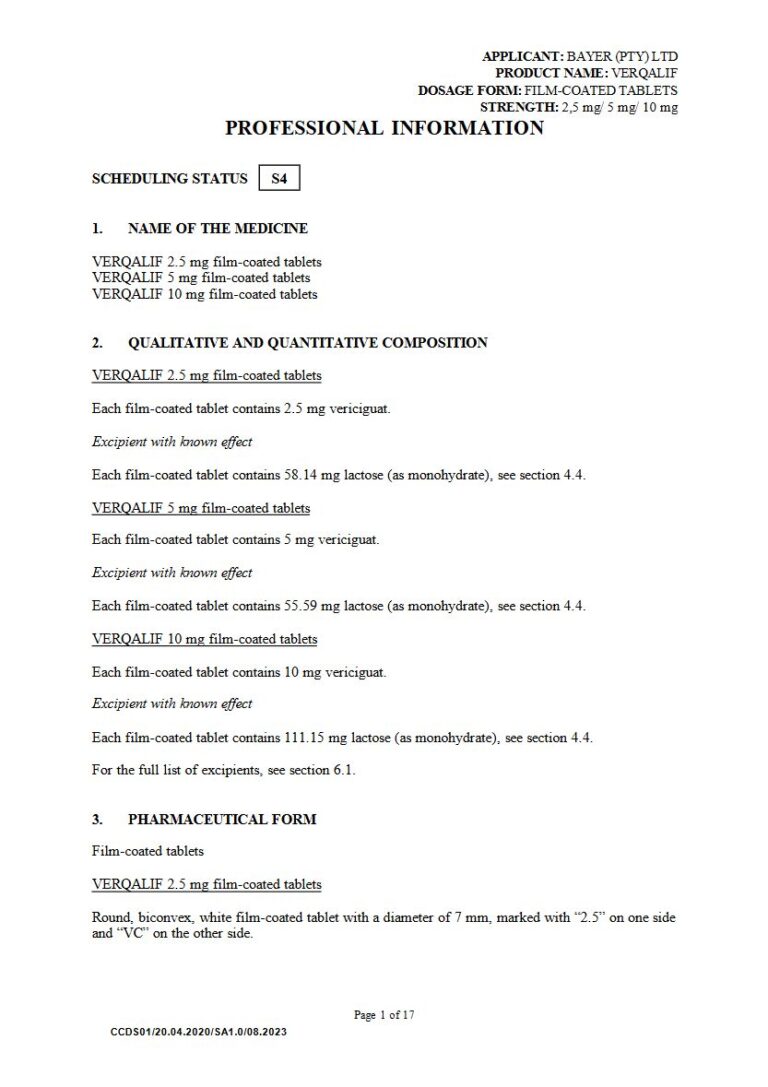
Verqalif 2,5 mg, 5 mg & 10 mg Tablet
PDF Leaflet Revision Date: 15 August 2023
Clinical Summary
Quick overview from the medicine insert
Indication
Treatment of symptomatic chronic heart failure with reduced ejection fraction.
Dosage (summary)
Start at 2.5 mg once daily, titrate to 10 mg once daily as tolerated.
Special Populations
- Elderly
- Renal impairment
- Hepatic impairment
Pregnancy & Breastfeeding
Not recommended during pregnancy; unknown if excreted in breast milk.
Key Drug Interactions
- Concomitant use with other sGC stimulators
- PDE5 inhibitors
Contraindications
- Hypersensitivity to vericiguat or excipients
- Severe renal impairment (eGFR <15 mL/min/1.73 mu00b2)
- Severe hepatic impairment (Child-Pugh class C)
Common side effects
- Hypotension
- Dizziness
- Nausea
- Headache
Counselling Points
- Take with food
- Monitor blood pressure regularly
- Report any symptoms of hypotension
Serious warnings
- Risk of symptomatic hypotension
- Not studied in patients with SBP <100 mmHg
Important Disclaimer
The Verqalif 2,5 mg, 5 mg & 10 mg Tablet professional information leaflet below is the property of Bayer and is provided on Medinsert exactly as issued, with no.. alterations or editorial changes. We make every effort to keep content current by updating documents as soon as new versions become available. Medinsert serves as a trusted access point for healthcare professionals, but does not replace official sources or clinical judgement. For more details, please read our full disclaimer. read more>>
 Healthcare Professionals Only
This content is for registered healthcare professionals
Sign in or create a free account to read the full package insert.
Free for HPCSA-registered professionals. Powered by Medinsert.
Clinical Particulars
Section 4 of the official insert — extracted exactly as issued, no alterations
4.1 Therapeutic indications
VERQALIF is indicated for the treatment of symptomatic chronic heart failure in adult patients with reduced ejection fraction (< 45 %) who are stabilised after a recent decompensation event requiring IV therapy (see section 5.1).
4.2 Posology and method of administration
Posology
Vericiguat is administered in conjunction with other heart failure therapies. Before starting vericiguat, care should be taken to optimise volume status and diuretic therapy to stabilise patients after the decompensation event, particularly in patients with very high NT-proBNP levels (see section 5.1). The recommended starting dose is 2.5 mg vericiguat once daily. The dose should be doubled approximately every 2 weeks to reach the target maintenance dose of 10 mg once daily, as tolerated by the patient. If patients experience tolerability issues (symptomatic hypotension or systolic blood pressure [SBP] less than 90 mmHg), temporary down-titration or discontinuation of vericiguat is recommended (see section 4.4). Treatment should not be initiated in patients with SBP <100 mmHg (see section 4.4).
Missed dose
If a dose is missed, it should be taken as soon as the patient remembers on the same day of the missed dose. Patients should not take two doses of vericiguat on the same day.
Special populations
Elderly
No dose adjustment is required for elderly patients (see sections 5.1 and 5.2).
Renal impairment
No dose adjustment is required in patients with estimated glomerular filtration rate (eGFR) >15 mL/min/1.73 m2 (without dialysis). Treatment with VERQALIF is not recommended in patients with eGFR <15 mL/min/1.73 m2 at treatment initiation or on dialysis (see sections 4.4 and 5.2).
Hepatic impairment
No dose adjustment is required in patients with mild (Child-Pugh class A) or moderate (Child-Pugh class B) hepatic impairment. Treatment with VERQALIF is not recommended in patients with severe (Child-Pugh class C) hepatic impairment (see sections 4.4 and 5.2).
Paediatric population
The safety and efficacy of vericiguat in children and adolescents aged below 18 years have not yet been established. No clinical data are available. Undesirable effects were observed on growing bone in non-clinical studies (see section 5.3).
Method of administration
For oral use. VERQALIF should be taken with food (see section 5.2).
Crushed tablets
For patients who are unable to swallow whole tablets, VERQALIF may be crushed and mixed with water immediately before administration (see section 5.2).
4.3 Contraindications
- Hypersensitivity to the active substance or to any of the excipients listed in section 6.1.
- Concomitant use of other soluble guanylate cyclase (sGC) stimulators, such as riociguat (see section 4.5).
4.4 Special warnings and precautions for use
Symptomatic hypotension
VERQALIF may cause symptomatic hypotension (see section 4.8). Patients with SBP less than 100 mmHg or symptomatic hypotension at treatment initiation were not studied. The potential for symptomatic hypotension should be considered in patients with hypovolaemia, severe left ventricular outflow obstruction, resting hypotension, autonomic dysfunction, history of hypotension, or concomitant treatment with antihypertensives or organic nitrates (see section 4.5). If patients experience tolerability issues (symptomatic hypotension or SBP less than 90 mmHg), temporary down-titration or discontinuation of VERQALIF is recommended (see section 4.2).
Renal impairment
Patients with eGFR <15 mL/min/1.73 m2 at treatment initiation or on dialysis have not been studied, therefore treatment with VERQALIF is not recommended in these patients (see sections 4.2 and 5.2).
Hepatic impairment
Patients with severe (Child-Pugh class C) hepatic impairment have not been studied, therefore treatment with VERQALIF is not recommended in these patients (see sections 4.2 and 5.2).
Excipients
Lactose
This medicinal product contains lactose. Patients with rare hereditary problems of galactose intolerance, total lactase deficiency or glucose-galactose malabsorption should not take this medicinal product.
Sodium
This medicinal product contains less than 1 mmol sodium (23 mg) per dose, that is to say essentially u201csodium-freeu201d.
4.5 Interaction with other medicines and other forms of interaction
Pharmacodynamic interactions
Vericiguat co-administration with haemodynamic active substances did not result in a more than additive effect (see sections 4.4 and 5.1). In addition, vericiguat reduced systolic blood pressure by approximately 1 to 2 mmHg when co-administered with other medicinal products used in patients with heart failure (see section 4.8).
Other soluble guanylate cyclase (sGC) stimulators
VERQALIF is contraindicated in patients with concomitant use of other soluble guanylate cyclase (sGC) stimulators, such as riociguat (see section 4.3).
PDE5 inhibitors
Addition of single doses of sildenafil (25, 50, or 100 mg) to multiple doses of vericiguat (10 mg) once daily in healthy subjects was associated with additional seated blood pressure (BP) reduction of less than or equal to 5.4 mmHg (systolic/diastolic BP, mean arterial pressure [MAP]) compared to administration of vericiguat alone. Co-administration was not associated with a clinically relevant effect on the exposure (AUC and C max) of either medicinal product. Concomitant use of vericiguat and PDE5 inhibitors, such as sildenafil, has not been studied in patients with heart failure and is therefore not recommended due to the potential increased risk for symptomatic hypotension (see section 4.4).
4.6 Fertility, pregnancy and lactation
Pregnancy
There are no data from the use of vericiguat in pregnant women. Studies in animals have shown reproductive toxicity in presence of maternal toxicity (see section 5.3). As a precautionary measure, VERQALIF should not be used during pregnancy and in women of childbearing potential not using contraception.
Breast-feeding
There is no information regarding the presence of vericiguat in human milk, the effects on the breastfed infant, or the effects on milk production. Vericiguat is present in the milk of lactating rats. A risk to the breastfed child cannot be excluded. A decision must be made whether to discontinue breast-feeding or to discontinue or abstain from VERQALIF therapy, taking into account the benefit of breast-feeding for the child and the benefit of therapy for the woman.
Fertility
There are no data available on the effect of vericiguat on human fertility. In a study with male and female rats, vericiguat showed no impairment of fertility (see section 5.3).
4.7 Effects on ability to drive and use machines
VERQALIF has minor influence on the ability to drive or use machines. When driving vehicles or operating machines it should be taken into account that dizziness may occur occasionally.
4.8 Undesirable effects
Summary of the safety profile
The most frequently reported adverse reaction under treatment with vericiguat was hypotension (16.4%).
Tabulated list of adverse reactions
The safety of vericiguat was evaluated in a phase III study (VICTORIA) which included a total of 2,519 patients treated with vericiguat (up to 10 mg once daily) (see section 5.1). The mean duration of vericiguat exposure was 1 year and the maximum duration was 2.6 years. The adverse reactions reported with vericiguat obtained from clinical studies are listed in the table below by MedDRA system organ class and by frequency. Frequencies are defined as very common ( u2265 1/10), common ( u2265 1/100 to <1/10), uncommon ( u2265 1/1,000 to <1/100), rare ( u2265 1/10,000 to <1/1,000), and very rare (<1/10,000).
4.9 Overdose
Overdose of vericiguat may lead to hypotension. If necessary, symptomatic treatment should be provided. The medicinal product is unlikely to be removed by haemodialysis due to high protein binding.
