
Vesiculture 30 mg Freeze-dried powder for reconstitution
PDF Leaflet Revision Date: 08 June 2020
Clinical Summary
Quick overview from the medicine insert
Indication
Immunoprophylaxis and immunotherapy for superficial bladder cancer.
Dosage (summary)
120 mg (4 vials) for intravesical use, 6 installations at weekly intervals.
Special Populations
- Renal impairment
- Hepatic impairment
Pregnancy & Breastfeeding
Contraindicated in pregnancy and breastfeeding.
Key Drug Interactions
- Antibiotics
- Immunosuppressants
- Anti-tuberculosis medicines
Contraindications
- Hypersensitivity to BCG
- Active tuberculosis
- Reduced immune response
- Pregnancy
- Breastfeeding
Common side effects
- Cystitis
- Pollakiuria
- Fever
- General malaise
Counselling Points
- Avoid contact with immunocompromised individuals
- Postpone treatment if urinary tract infection is present
- Use condoms for one week post-treatment
Serious warnings
- Risk of systemic BCG infection
- Monitor for urinary tract infection
- Traumatic catheterization risks
Important Disclaimer
The Vesiculture 30 mg Freeze-dried powder for reconstitution professional information leaflet below is the property of Kahma Biotech and is provided on Medinsert exactly as issued, with no.. alterations or editorial changes. We make every effort to keep content current by updating documents as soon as new versions become available. Medinsert serves as a trusted access point for healthcare professionals, but does not replace official sources or clinical judgement. For more details, please read our full disclaimer. read more>>
 Healthcare Professionals Only
This content is for registered healthcare professionals
Sign in or create a free account to read the full package insert.
Free for HPCSA-registered professionals. Powered by Medinsert.
Clinical Particulars
Section 4 of the official insert — extracted exactly as issued, no alterations
4.1 Therapeutic indications
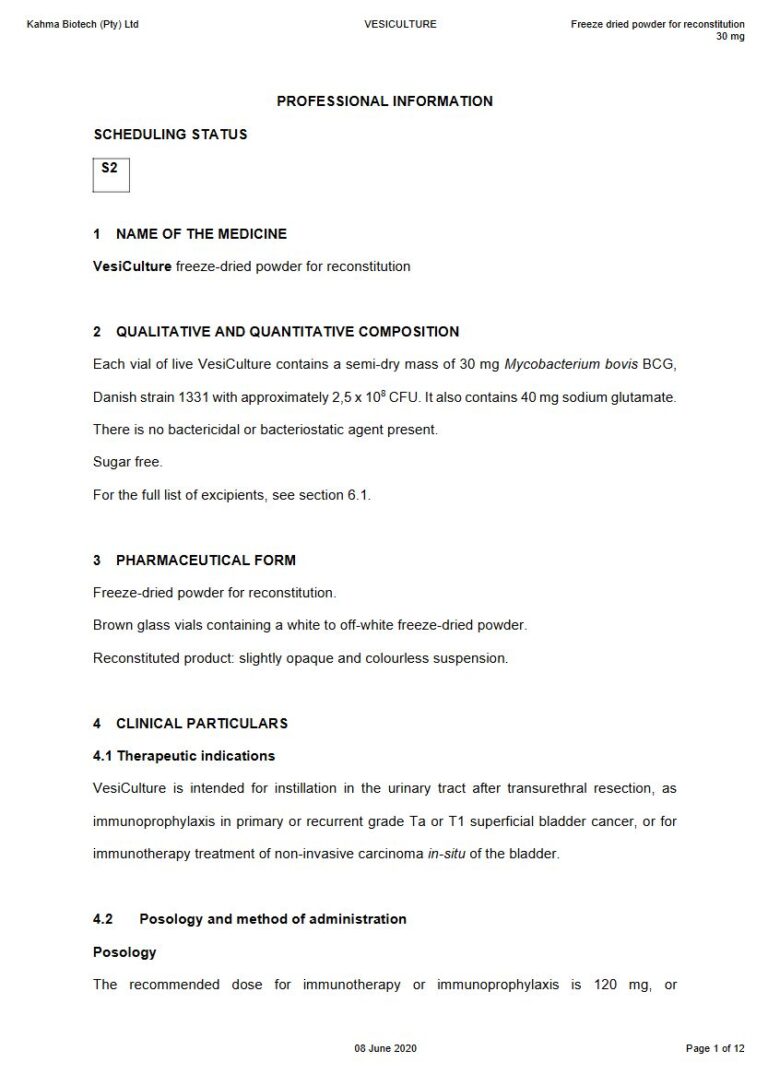
VesiCulture is intended for instillation in the urinary tract after transurethral resection, as immunoprophylaxis in primary or recurrent grade Ta or T1 superficial bladder cancer, or for immunotherapy treatment of non-invasive carcinoma in-situ of the bladder.
4.2 Posology and method of administration
Posology
The recommended dose for immunotherapy or immunoprophylaxis is 120 mg, or approximately 1 x 10⁹ CFU. This dose should not be exceeded. Seven to fourteen days should elapse after a transurethral section, bladder biopsy, or traumatic catheterisation before initiating treatment with VesiCulture. The standard schedule of treatment consists of 6 installations, with an interval of one week between each instillation. This treatment schedule may be repeated once if insufficient or no response is achieved after the first immunotherapy treatment. Maintenance treatment may be recommended for certain high risk patients.
Intravesical dosage: The required dosage of VesiCulture, (normal dose = 120 mg = 4 reconstituted vials) is resuspended in 50 ml sterile saline (preservative free 0,9 % sodium chloride).
Method of administration
FOR INTRALUMINAL URINARY TRACT USE ONLY. Must not be administered intravenously, subcutaneously or intramuscularly. The VesiCulture should not be prepared in the same sterile area as chemotherapeutic agents due to the possible iatrogenic transmission of BCG to these agents. Aseptic conditions are necessary and care must be taken in order to properly resuspend clusters of freeze-dried bacteria. Using a disposable syringe add approximately 2-3 ml sterile saline to the first vial. GENTLY release/push back the plunger to thoroughly resuspend the living BCG CULTURE. Each vial must be carefully inverted a few times, then gently swirled (AVOID VIGOROUS SHAKING) before being transferred to a syringe. Transfer the contents of the vial to a 50 ml syringe. Repeat for vials 2, 3 and 4. Add a further volume of the sterile saline, until the total volume is 50 ml. The suspension should be homogenous, and slightly cloudy. The suspension must be prepared shortly before use (less than 4 hours) and should not be exposed to light. Aseptic insertion of a urethral catheter must be performed atraumatically to avoid damage to the surface of the urethra and bladder. Treatment with VesiCulture must be postponed if the urothelium becomes traumatised during catheterisation, as a lesion in the urothelium increases the risk of systemic BCG infection. Only small quantities of lubricants should be used during catheterisation as large quantities may inhibit BCG viability. The 50 ml BCG CULTURE is slowly instilled into the empty bladder, taking care never to force the flow. At the end of instillation, the catheter is removed, and the patient is instructed to retain the suspension in the bladder for 2 hours, if possible. (Restrictions of fluid intake 3 u2013 6 hours prior to and during the instillation may be recommended for patients with a limited bladder capacity). As BCG CULTURE is not a biohazardous material, the suspension may be voided in a normal manner, and no special precautions are necessary.
Paediatric population
There is no experience in treatment of children.
4.3 Contraindications
- Hypersensitivity to Mycobacterium bovis BCG or any of the excipients of VesiCulture (see section 6.1)
- Clinically verified or suspected active tuberculosis. Active tuberculosis should be excluded in patients with a positive Mantoux test before they begin treatment with VesiCulture.
- Treatment with anti-tuberculosis medicines such as isoniazid, rifampicin and ethambutol.
- Reduced immune response, including active HIV disease, regardless of whether congenital or triggered by illness, medication or other treatment, e.g. high dose systemic corticosteroid therapy.
- Pregnancy and breastfeeding.
- Medical history including radiation therapy of the bladder.
4.4 Special warnings and precautions for use
Treatment with VesiCulture should only be carried out by doctors with special expertise in malignant illnesses and their treatment. VesiCulture may only be used for instillation in the bladder. VesiCulture must not be used for BCG vaccination. A Mantoux test should be performed prior to intravesicular instillation. If the test is positive, VesiCulture is contraindicated if there is any further medical evidence of active tuberculosis infection. Urinary tract infection should be ruled out prior to every bladder instillation of VesiCulture (inflammation of the mucous membranes of the bladder can increase the risk of haematological spread of BCG). If a urinary tract infection is diagnosed during VesiCulture treatment, treatment should be discontinued until a negative urine culture is achieved and treatment with antibiotics and/or antiseptics has been discontinued. Immunotherapy with VesiCulture should be postponed in patients with a urinary tract infection, or unexplained fever, until a negative urine culture is obtained, and treatment with antibiotics and/or antiseptics has ceased. Macroscopic haematuria: Such cases are considered signs of mucous membrane lesions in the urinary tract; treatment should therefore be stopped or deferred until haematuria has been completely treated or has been spontaneously resolved. Damage to the urethra or mucous membranes of the bladder, e.g. when triggered by traumatic catheterisation, may result in systemic BCG infection in conjunction with treatment with VesiCulture. Treatment should be deferred until the mucous membranes have healed. Traumatic instillation can result in BCG septicaemia reactions, potentially accompanied by septic shock and fatality. Infection of implants and transplants has been reported after treatment with BCG bladder irrigation in patients with, for example, aneurysm or prosthesis. Patients should be monitored for presence of symptoms of systemic BCG infection and toxic symptoms after each bladder irrigation. It is recommended to screen patients who may be HIV-positive prior to initiating treatment. In order to protect the patient's partner, it is recommended that the patient either abstain from intercourse for one week after bladder irrigation or use a condom. Use of VesiCulture may sensitise patients to tuberculin, which will result in a positive Mantoux test. The risk of bladder contraction may increase in patients with low bladder capacity. In patients with tissue type HLA-B27, presence of reactive arthritis or Reiteru2019s syndrome may increase. Spillage of VesiCulture can cause BCG contamination. Any spilt VesiCulture must therefore be covered with paper wetted with hospital disinfectant or 10 % chloramine solution for at least 10 minutes. All waste materials must be disposed of as potentially hazardous waste. Personnel may be exposed to BCG through self-inoculation, such as on the skin through an open wound, through inhalation or through ingestion of VesiCulture. Exposure to BCG has no health consequences for healthy individuals. If there is any suspicion of self-inoculation, it is recommended to carry out a Mantoux test on the skin immediately and then again 6 weeks later. Patients with reduced immune response should avoid contact with patients being treated with BCG.
4.5 Interaction with other medicines and other forms of interaction
VesiCulture is sensitive to most antibiotics (see BCG strainu2019s sensitivity to antibiotics in section 4.8). The effect of VesiCulture may be affected by simultaneous treatment with antibiotics. If the patient is being treated with antibiotics, it is recommended to defer bladder irrigation until the antibiotic treatment is completed (see also section 4.3). Immunosuppressants, bone marrow suppressants and/or radiation therapy may affect immune response and thereby also the therapeutic effect of VesiCulture. These types of medications should therefore not be used in combination with VesiCulture. Medicines with known anti-mycobacterial action should not be co-administered with VesiCulture. These include common anti-tuberculosis medicines as well as amino glycosides and fluoroquinolones.
4.6 Fertility, pregnancy and lactation
Pregnancy
VesiCulture is contraindicated during pregnancy (see section 4.3).
Breastfeeding
VesiCulture is contraindicated during breastfeeding (see section 4.3).
4.7 Effects on ability to drive and use machines
VesiCulture has minor or moderate influence on the ability to drive and use machines.
4.8 Undesirable effects
Summary of the safety profile
Toxicity and undesirable effects appear to be directly related to the cumulative quantity of CFU of BCG given in a treatment course. Treatment results in cystitis and inflammatory reactions (granulomas), resulting in pollakiuria and dysuria in approx. 90 % of patients. These reactions are probably an essential part of BCGu2019s anti-tumour activity. These symptoms usually subside within 2 days after instillation and do not require treatment. During the course of treatment, cystitis symptoms may become more pronounced and persistent. Episodes of severe symptoms may be treated with isoniazid 300 mg daily and analgesics until symptoms have subsided.
Common (u2265 1/100 to < 1/10) undesirable effects include general malaise, low to moderate fever and/or influenza-like symptoms (fever, stiffness, malaise and muscle pain). Symptoms usually appear within 4 hours after instillation and last 24 - 48 hours. Fever above 39 u00b0C usually disappears within 24 - 48 hours when the patient is treated with antipyretics (preferably paracetamol) and fluids. It is often difficult to differentiate uncomplicated fever reactions from early symptoms of a systemic BCG infection, where anti-tuberculosis treatment is indicated. Fever over 39 u00b0C that does not subside within 12 hours despite antipyretic treatment should be considered a systemic BCG infection, which necessitates clinical diagnosis and treatment.
b. Tabulated summary of adverse reactions
Very common (u2265 1/10), Common (u2265 1/100 to < 1/10), Rare (u2265 1/10,000 to < 1/1,000), Very rare (< 1/10,000)
MedDRA system organ class
Frequency Adverse reactions
Infections and infestations
Common Cystitis 1 .
Rare Orchitis.
Very rare Systemic BCG infections 2 .
Skin and subcutaneous tissue disorders
Rare Cutaneous rash.
Musculoskeletal and connective tissue disorders
Rare Arthritis/arthralgia.
Renal and urinary disorders
Very common Pollakiuria.
Common Inflammation of the mucous membranes of the bladder.
Rare Macroscopic haematuria, temporary urethral obstruction.
Very rare Bladder contraction.
Reproductive system and breast disorders
Rare Granulomatous prostatitis.
General disorders and administration site conditions
Common Malaise, subfebrile, influenza-like symptoms.
Uncommon Fever > 39 u00b0C.
4.9 Overdose
The risk of BCG infection is expected to increase in the event of an overdose. If an overdose takes place, the patient should be observed for symptoms of systemic BCG infection and, if necessary, treated with anti-tuberculosis medicines (see section 4.8).
