
Viagra FC tablets
PDF Leaflet Revision Date: 17 April 2024
Clinical Summary
Quick overview from the medicine insert
Indication
Treatment of erectile dysfunction.
Dosage (summary)
50 mg taken as needed, max 100 mg once daily.
Onset of Action / Duration
Onset: 30-60 mins, Duration: 4-6 hours
Special Populations
- Elderly
- Renal impairment
- Hepatic impairment
Pregnancy & Breastfeeding
Not indicated for women; safety in pregnancy unknown.
Key Drug Interactions
- Nitrates
- CYP3A4 inhibitors
- Alpha-blockers
Contraindications
- Hypersensitivity to sildenafil
- Concurrent use with nitrates
- Severe hepatic impairment
- Severe renal impairment
Common side effects
- Headache
- Flushing
- Dizziness
- Nausea
Counselling Points
- Take 1 hour before sexual activity.
- Avoid nitrates and CYP3A4 inhibitors.
- Seek medical help for erections lasting over 4 hours.
Serious warnings
- Risk of cardiovascular events
- Prolonged erections (priapism)
- Risk of NAION
Important Disclaimer
The Viagra FC tablets professional information leaflet below is the property of Viatris Healthcare and is provided on Medinsert exactly as issued, with no.. alterations or editorial changes. We make every effort to keep content current by updating documents as soon as new versions become available. Medinsert serves as a trusted access point for healthcare professionals, but does not replace official sources or clinical judgement. For more details, please read our full disclaimer. read more>>
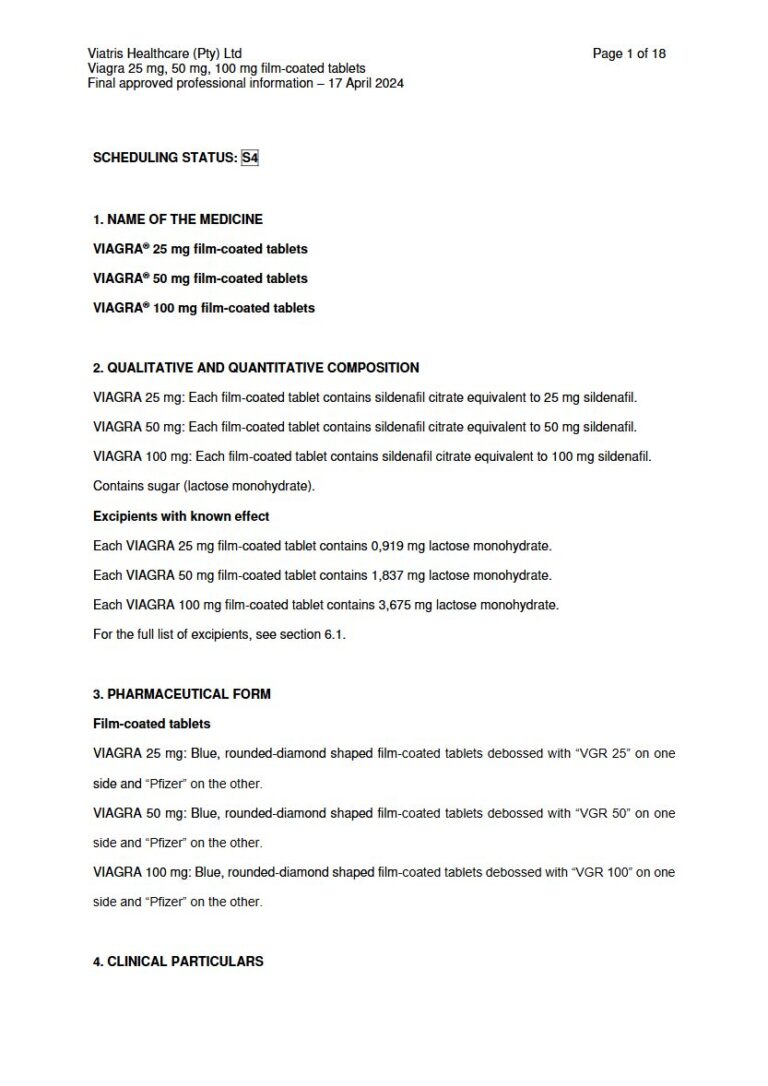 Healthcare Professionals Only
This content is for registered healthcare professionals
Sign in or create a free account to read the full package insert.
Free for HPCSA-registered professionals. Powered by Medinsert.
Clinical Particulars
Section 4 of the official insert — extracted exactly as issued, no alterations
4.1 Therapeutic indications
VIAGRA is indicated only for the treatment of erectile dysfunction. VIAGRA IS NOT AN APHRODISIAC.
4.2 Posology and method of administration
Posology
Use in adults
The recommended dose is 50 mg, taken as needed approximately one hour before sexual activity. Based on efficacy and toleration, the dose may be increased to 100 mg or decreased to 25 mg. The maximum recommended dose is 100 mg. The maximum recommended dosing frequency is once per day.
The following factors are associated with increased plasma levels of VIAGRA Age > 65 (40 % increase in AUC), hepatic impairment (e.g. cirrhosis, 80 %), severe renal impairment (creatinine clearance u2264 30 mL/min, 100 %), and concomitant use of potent cytochrome P450 3A4 inhibitors (erythromycin 182 %, saquinavir 210 %, ketoconazole, itraconazole, 200 %, ritonavir 1 000 %) (see section 4.3).
Special populations
Use in patients with mild to moderately impaired renal function A starting dose of 25 mg should not be exceeded.
Use in patients with mild to moderately impaired hepatic function Since VIAGRA clearance is reduced in patients with hepatic impairment (e.g. cirrhosis), a starting dose of 25 mg should not be exceeded.
Use in elderly patients Healthy elderly volunteers (65 years or over) had a reduced clearance of VIAGRA. A starting dose of 25 mg should be considered in patients older than 65 years of age.
Use in patients using potent CYP 3A4 inhibitors Given the extent of the interaction with patients receiving concomitant therapy with cytochrome P450 3A4 inhibitors (e.g. ritonavir, erythromycin, saquinavir, ketoconazole, itraconazole), VIAGRA should not be used concomitantly with these medicines (see section 4.3).
VIAGRA was shown to potentiate the hypotensive effects of nitrates and its administration in patients who use nitric oxide donors or nitrates in any form is therefore contraindicated (see section 4.3).
Paediatric population VIAGRA is not indicated for use in children below 18 years of age.
Method of administration VIAGRA tablets are for oral use.
4.3 Contraindications
Use of VIAGRA is contraindicated in patients with a known hypersensitivity to sildenafil or to any excipients of VIAGRA (listed in section 6.1).
Administration of VIAGRA to patients who are using nitric oxide donors, organic nitrates or organic nitrites in any form either regularly or intermittently is contraindicated.
Consistent with its known effects on the nitric oxide/cGMP pathway (see section 5.1), VIAGRA was shown to potentiate the hypotensive effects of acute and chronic nitrates. Medical practitioners should discuss with patients the contraindication of concurrent use of VIAGRA with organic nitrates.
Concomitant use of VIAGRA with potent cytochrome P450 3A4 inhibitors e.g. ritonavir, erythromycin, saquinavir, ketoconazole and itraconazole is contraindicated (see section 4.5).
VIAGRA is contraindicated in patients who have loss of vision in one eye because of non-arteritic anterior ischaemic optic neuropathy (NAION), regardless of whether this episode was in connection or not with previous PDE5 inhibitor exposure.
The co-administration of PDE5 inhibitors, including VIAGRA, with guanylate cyclase stimulators such as riociguat, is contraindicated as it may potentially lead to symptomatic hypotension.
The use of VIAGRA is contraindicated in patients with severe hepatic impairment and patients with severe impairment of renal function (creatinine clearance < 30 mL/min) not on haemodialysis or continuous ambulatory peritoneal dialysis.
4.4 Special warnings and precautions for use
Serious cardiovascular events, including myocardial infarction, sudden cardiac death, ventricular dysrhythmia, cerebrovascular haemorrhage and transient ischaemic attack have been reported post-marketing in temporal association with the use of VIAGRA for erectile dysfunction. Most, but not all, of these patients had pre-existing cardiovascular risk factors. Many of these events were reported to occur during or shortly after sexual activity, and a few were reported to occur shortly after the use of VIAGRA without sexual activity. Others were reported to have occurred hours to days after the use of VIAGRA and sexual activity. It is not possible to determine whether these events are related directly to VIAGRA, to sexual activity, to the patientu2019s underlying cardiovascular disease, to a combination of these factors, or to other factors.
The cardiovascular status of patients should be assessed prior to initiating treatment for erectile dysfunction. VIAGRA should not be used in men for whom sexual activity is inadvisable.
Prolonged erections and priapism have been reported with VIAGRA in post-marketing experience. In the event of an erection that persists longer than 4 hours, the patient should seek immediate medical assistance. If priapism is not treated immediately, penile tissue damage and permanent loss of potency could result.
A thorough medical history and physical examination should be undertaken to diagnose erectile dysfunction, determine potential underlying causes and identify appropriate treatment.
VIAGRA has systemic vasodilatory properties that resulted in transient decreases in supine blood pressure in healthy volunteers. Medical practitioners should carefully consider whether their patients with underlying cardiovascular disease could be affected adversely by such vasodilatory effects, especially in combination with sexual activity.
Patients with increased susceptibility to vasodilators include those with left ventricular outflow obstruction (e.g. aortic stenosis, hypertrophic obstructive cardiomyopathy), or those with the rare syndrome of multiple system atrophy manifesting as severely impaired autonomic control of blood pressure.
A large-scale epidemiological study found evidence of an increased risk of retinal detachment with regular use of PDE5 inhibitors. Non-arteritic anterior ischaemic optic neuropathy (NAION) with some loss of vision or irreversible blindness has been reported with the use of PDE5 inhibitors including VIAGRA. Most of these patients had risk factors such as low cup to disc ratio (u201ccrowded disku201d), age over 50, diabetes, hypertension, coronary artery disease, hyperlipidaemia and smoking.
In case of sudden visual loss, patients should be advised to stop taking VIAGRA and consult a medical practitioner immediately.
Individuals who have already experienced NAION are at increased risk of NAION recurrence. Therefore, medical practitioners should discuss this risk with these patients and whether they could be adversely affected by use of PDE5 inhibitors. PDE5 inhibitors, including VIAGRA, should be used with caution in these patients and the patientu2019s NAION risk factors should be evaluated when considering prescribing VIAGRA. NAION appears to be a class effect of these medicines.
Concomitant administration of VIAGRA to patients taking alpha-blocker therapy may lead to symptomatic hypotension in susceptible individuals (see section 4.5). In order to minimise the potential for developing postural hypotension, patients should be haemodynamically stable on alpha-blocker therapy prior to initiating VIAGRA treatment. Initiation of VIAGRA at lower doses should be considered (see section 4.2). Medical practitioners should advise patients what to do in the event of postural hypotensive symptoms.
There are no controlled clinical data on the safety or efficacy of VIAGRA in the following patient groups; if prescribed, this should be done with caution.
- Patients who have suffered a myocardial infarction, stroke, or life-threatening dysrhythmia within the last 6 months.
- Patients with resting hypotension (BP 170/110 mmHg).
- Patients with cardiac failure or coronary artery disease causing unstable angina.
A minority of patients with the inherited condition retinitis pigmentosa have genetic disorders of retinal phosphodiesterases. There is no safety information on the administration of VIAGRA to patients with retinitis pigmentosa, therefore, VIAGRA should be administered with caution to these patients.
VIAGRA has no effect on bleeding time, including during co-administration with aspirin. In vitro studies with human platelets indicate that sildenafil potentiates the anti-aggregatory effect of sodium nitroprusside (a nitric oxide donor). There is no safety information on the administration of VIAGRA to patients with bleeding disorders or active peptic ulceration. Therefore, VIAGRA should be administered with caution to these patients.
VIAGRA should not be used in patients with anatomical deformation of the penis (such as angulation, cavernosal fibrosis or Peyronieu2019s disease), or in patients who have conditions which may predispose them to priapism (such as sickle cell anaemia, multiple myeloma or leukaemia).
The safety and efficacy of combinations of VIAGRA with other PDE5 inhibitors, or other pulmonary arterial hypertension (PAH) treatments containing sildenafil, or other treatments for erectile dysfunction have not been studied. Therefore, the use of such combinations is not recommended.
A sudden unilateral or bilateral decrease or loss of hearing (sensorineural deafness) with or without associated vestibular symptoms has been reported with the use of PDE5 inhibitors, including VIAGRA. There is insufficient information regarding the reversibility of the hearing loss and the role of underlying risk factors for hearing loss in individual subjects. In case of sudden decrease or loss of hearing, patients should be advised to stop taking VIAGRA and consult a medical practitioner promptly.
The film-coating of the VIAGRA tablet contains lactose. Men with rare hereditary problems of galactose intolerance, total lactase deficiency or glucose-galactose malabsorption should not take this medicine.
4.5 Interaction with other medicines and other forms of interaction
Effects of other medicines on VIAGRA
In vitro studies: VIAGRA metabolism is principally mediated by the cytochrome P450 (CYP) isoforms 3A4 (major route) and 2C9 (minor route). Therefore, inhibitors of these isoenzymes may reduce VIAGRA clearance and inducers of these isoenzymes may increase VIAGRA clearance.
In vivo studies: Population pharmacokinetic analysis of clinical trial data indicated a reduction in VIAGRA clearance when co-administered with CYP3A4 inhibitors (such as itraconazole, ketoconazole, erythromycin, and cimetidine). However, there was no increased incidence of adverse events in these patients.
Cimetidine (800 mg), a cytochrome P450 inhibitor and a non-specific CYP3A4 inhibitor, caused a 56 % increase in plasma sildenafil concentrations when co-administered with VIAGRA (50 mg) to healthy volunteers.
When a single 100 mg dose of VIAGRA was administered with erythromycin, a moderate CYP3A4 inhibitor, at steady state (500 mg two times daily for 5 days), there was a 182 % increase in VIAGRA systemic exposure (AUC).
In addition, co-administration of the HIV protease inhibitor saquinavir, also a CYP3A4 inhibitor, at steady state (1 200 mg three times daily) with VIAGRA (100 mg single dose) resulted in a 140 % increase in VIAGRA C max and a 210 % increase in VIAGRA AUC. VIAGRA had no effect on saquinavir pharmacokinetics (see section 4.2). Stronger CYP3A4 inhibitors such as ketoconazole and itraconazole would be expected to have still greater effects.
Co-administration with the HIV protease inhibitor ritonavir, which is a highly potent P450 inhibitor, at steady state (500 mg twice daily) with VIAGRA (100 mg single dose) resulted in a 300 % (4-fold) increase in VIAGRA C max and a 1 000 % (11-fold) increase in VIAGRA plasma AUC. At 24 hours, the plasma levels of VIAGRA were still approximately 200 ng/mL, compared to approximately 5 ng/mL when VIAGRA was dosed alone. This is consistent with ritonaviru2019s marked effects on a broad range of P450 substrates. VIAGRA had no effect on ritonavir pharmacokinetics (see section 4.2).
Single doses of antacid (magnesium hydroxide/aluminium hydroxide) did not affect the bioavailability of VIAGRA.
In a study of healthy male volunteers, co-administration of the endothelin antagonist, bosentan, (an inducer of CYP3A4 [moderate], CYP2C9 and possibly of CYP2C19) at steady state (125 mg twice a day) with VIAGRA at steady state (80 mg three times a day) resulted in 62,6 % and 55,4 % decrease in VIAGRA AUC and C max, respectively. VIAGRA increased bosentan AUC and C max by 49,8 % and 42 %, respectively. Concomitant administration of strong CYP3A4 inducers, such as rifampicin, is expected to cause greater decreases in plasma concentrations of VIAGRA.
Pharmacokinetic data from patients in clinical trials showed no effect on VIAGRA pharmacokinetics of CYP2C9 inhibitors (such as tolbutamide, warfarin), CYP2D6 inhibitors (such as selective serotonin reuptake inhibitors, tricyclic antidepressants), thiazide and related diuretics, loop and potassium sparing diuretics, angiotensin converting enzyme (ACE) inhibitors, calcium channel blockers, beta-adrenoreceptor antagonists or inducers of CYP450 metabolism (such as rifampicin, barbiturates).
In healthy male volunteers there was no evidence of an effect of azithromycin (500 mg daily for 3 days) on the AUC, C max, T max elimination rate constant, or subsequent half-life of VIAGRA or its major circulating metabolite.
Effects of VIAGRA on other medicines
In vitro studies: VIAGRA is a weak inhibitor of the cytochrome P450 isoforms 1A2, 2C9, 2C19, 2D6, 2E1 and 3A4 (IC50 >150 u03bcM). Given VIAGRA peak plasma concentrations of approximately 1 u03bcM after recommended doses, it is unlikely that VIAGRA will alter the clearance of substrates of these isoenzymes.
In vivo studies: VIAGRA was shown to potentiate the hypotensive effect of acute and chronic nitrates. Therefore, use of nitric oxide donors, organic nitrates or organic nitrites in any form, either regularly or intermittently with VIAGRA is contraindicated (see section 4.3).
In three specific interactions studies, the alpha-blocker doxazosin (4 mg and 8 mg) and VIAGRA (25 mg, 50 mg, or 100 mg) were administered simultaneously to patients with benign prostatic hyperplasia (BPH) stabilised on doxazosin therapy. In these study populations, mean additional reductions of supine blood pressure of 7/7 mmHg, 9/5 mmHg, and 8/4 mmHg, and mean additional reductions of standing blood pressure of 6/6 mmHg, 11/4 mmHg, and 4/5 mmHg, respectively, were observed. When VIAGRA and doxazosin were administered simultaneously to patients stabilised on doxazosin therapy, there were reports of patients who experienced symptomatic postural hypotension. These reports included dizziness and light-headedness, but not syncope. Concomitant administration of VIAGRA to patients taking alpha-blocker therapy may lead to symptomatic hypotension in a few susceptible individuals (see section 4.4).
No significant interactions were shown when VIAGRA (50 mg) was co-administered with tolbutamide (250 mg) or warfarin (40 mg), both of which are metabolised by CYP2C9. VIAGRA (100 mg) did not affect the steady state pharmacokinetics of the HIV protease inhibitors, saquinavir and ritonavir, both of which are CYP3A4 substrates (see Effects of other medicines on VIAGRA). VIAGRA at steady state (80 mg three times a day) resulted in a 49,8 % increase in bosentan AUC and a 42 % increase in bosentan C max (125 mg twice a day) (see Effects of other medicines on VIAGRA). VIAGRA (50 mg) did not potentiate the increase in bleeding time caused by aspirin (150 mg). VIAGRA (50 mg) did not potentiate the hypotensive effects of alcohol in healthy volunteers with mean maximum blood alcohol levels of 4,4 mmol/L.
No interaction was seen when VIAGRA (100 mg) was co-administered with amlodipine in hypertensive patients. The mean additional reduction on supine blood pressure was 8 mmHg systolic and 7 mmHg diastolic. Analysis of the safety database showed no difference in the side effect profile in patients taking VIAGRA with and without antihypertensive medication. Addition of a single dose of VIAGRA to sacubitril/valsartan at steady state in patients with hypertension was associated with a significantly greater blood pressure reduction compared to administration of sacubitril/valsartan alone. Therefore, caution should be exercised when VIAGRA is initiated in patients treated with sacubitril/valsartan.
4.6 Fertility, pregnancy and lactation
VIAGRA is not indicated for use in women. There was no effect on sperm motility or morphology after single 100 mg oral doses of VIAGRA in healthy volunteers.
4.7 Effects on ability to drive and use machines
As dizziness and altered vision were reported in clinical trials with VIAGRA, patients should be aware how they react to VIAGRA and exercise caution before driving, operating hazardous machinery or performing hazardous tasks.
4.8 Undesirable effects
The most commonly reported adverse reactions were headache and flushing. Tabulated summary of adverse reactions The side effects reported in clinical trials were categorised utilising the incidence rate as follows: Very common ( uf0b3 1/10); common ( uf0b3 1/100 to < 1/10); uncommon ( uf0b3 1/1 000 to < 1/100); rare ( uf0b3 1/10 000 to < 1/1 000), very rare ( < 1/10 000).
MedDRA system organ class Frequency Side effects Infections and infestations Common Rhinitis, flu syndrome Uncommon Respiratory tract infection, infection, herpes simplex, pharyngitis, bronchitis Rare Urinary tract infection, sinusitis, laryngitis Blood and lymphatic system disorders Uncommon Anaemia Rare Leukopenia Immune system disorders Uncommon Hypersensitivity reactions (including skin rashes) Rare Allergic reaction Metabolism and nutrition disorders Uncommon Unstable diabetes Rare Hyperglycaemia, hypernatraemia, gout, hyperuricaemia, hypoglycaemic reaction Psychiatric disorders Uncommon Insomnia Rare Depression, abnormal dreams, anorgasmia Nervous system disorders Very common Headache Common Dizziness Uncommon Somnolence, hypertonia, paraesthesia, hypoaesthesia, ataxia, neuropathy Rare Syncope, vertigo, migraine, myasthenia, tremor, decreased reflexes, neuralgia Eye disorders Common Blurred vision, visual disturbance, cyanopsia, abnormal vision (increased perception of light), chromatopsia (mild and transient, predominantly colour tinge to vision) Uncommon Eye pain, photophobia, photopsia, ocular hyperaemia, visual brightness, conjunctivitis Rare Eye oedema, eye swelling, dry eye, asthenopia, halo vision, xanthopsia, erythropsia, eye disorder, conjunctival hyperaemia, eye irritation, abnormal sensation in eye, eyelid oedema, eye haemorrhage, cataract Ear and labyrinth disorders Uncommon Tinnitus Rare Deafness, ear pain Cardiac disorders Common Palpitations Uncommon Tachycardia, angina pectoris Rare AV block, cardiac arrest, heart failure, cardiomyopathy Vascular disorders Very common Vasodilation (flushing) Common Hot flush Uncommon Hypotension Rare Shock, postural hypotension Respiratory, thoracic and mediastinal disorders Common Nasal congestion Uncommon Epistaxis, sinus congestion, respiratory disorder, dyspnoea, asthma Rare Throat tightness, nasal dryness, nasal oedema, increased cough, increased sputum Gastrointestinal disorders Common Nausea, dyspepsia Uncommon Gastroesophageal reflux disease, vomiting, upper abdominal pain, dry mouth, diarrhoea, gastritis, gastroenteritis, gingivitis, rectal haemorrhage Rare Oral hypoaesthesia, glossitis, oesophagitis, colitis, dysphagia, stomatitis Skin and subcutaneous tissue disorders Uncommon Rash, sweating, skin ulcer Rare Pruritus, face oedema, exfoliative dermatitis, photosensitivity reaction, urticaria, contact dermatitis, erythema Musculoskeletal and connective tissue disorders Uncommon Myalgia, pain in extremity, arthralgia, back pain, tenosynovitis, synovitis Rare Arthritis, tendon rupture, arthrosis, bone pain Renal and urinary disorders Rare Cystitis, nocturia, urinary frequency/incontinence, haematuria Reproductive system and breast disorders Rare Increased erection, abnormal ejaculation, prostatic disorder, breast enlargement, genital oedema General disorders and administration site conditions Uncommon Feeling hot, asthenia, pain, chest pain, thirst Rare Irritability, chills, oedema, peripheral oedema Investigations Uncommon Increased heart rate Rare Abnormal electrocardiogram, abnormal liver function tests Injury, poisoning and procedural complications Uncommon Accidental injury/fall Post-marketing experience Other events that have been reported in post-marketing surveillance and not listed in the pre-marketing experience include: MedDRA system organ class Side effects Nervous system disorders Seizure, seizure recurrence Eye disorders Red eyes/bloodshot eyes, non-arteritic anterior ischaemic optic neuropathy with some loss of vision or irreversible blindness, diplopia, temporary vision loss/decreased vision, ocular burning, ocular swelling/pressure, increased intra-ocular pressure, retinal vascular disease or bleeding, vitreous detachment/traction and paramacular oedema Cardiac disorders Myocardial infarction, sudden cardiac death, ventricular dysrhythmia Vascular disorders Hypotensive events after the use of VIAGRA in combination with alpha blockers, cerebrovascular haemorrhage, transient ischaemic attack, hypertension Reproductive system and breast disorders Prolonged erection, priapism Reporting of suspected adverse reactions Reporting suspected adverse reactions after authorisation of the medicine is important. It allows continued monitoring of the benefit/risk balance of the medicine. Health care providers are asked to report any suspected adverse reactions to SAHPRA via the u201c6.04 Adverse Drug Reactions Reporting Formu201d, found online under SAHPRAu2019s publications: https://www.sahpra.org.za/Publications/Index/8.
4.9 Overdose
In studies with healthy volunteers of single doses up to 800 mg, adverse events were similar to those seen at lower doses, but incidence rates and severities were increased. Side effects may be exacerbated or exaggerated (see section 4.8). In cases of overdose, supportive measures should be adopted as required. Renal dialysis is not expected to accelerate clearance as VIAGRA is highly bound to plasma proteins and not eliminated in the urine.
