
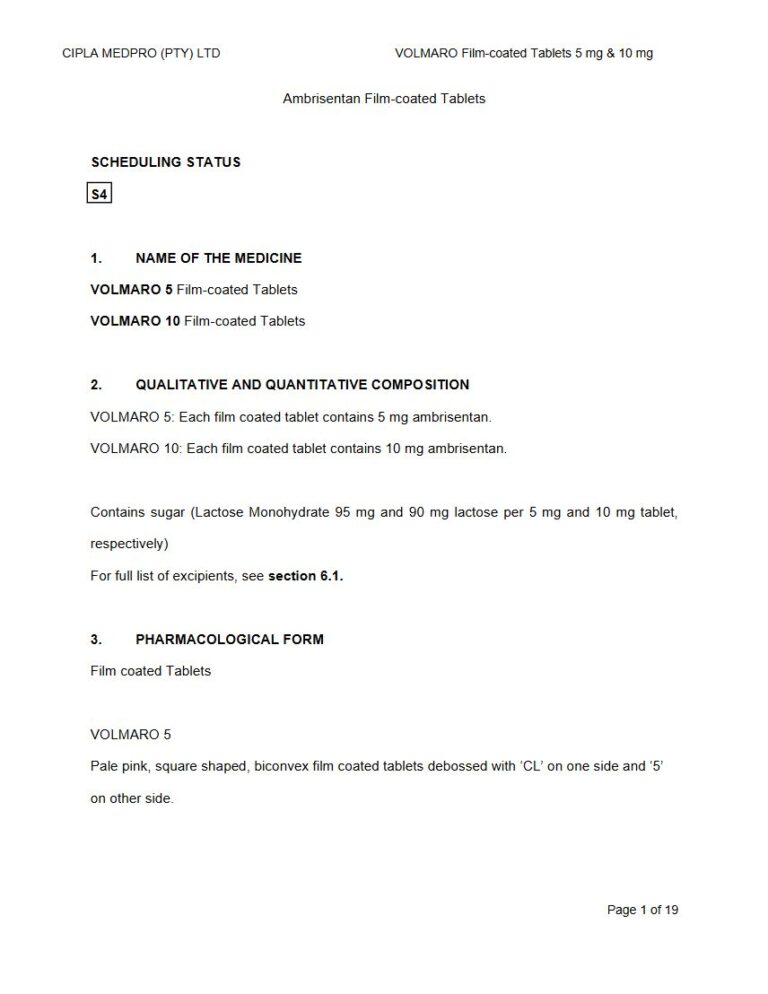
Volmaro 5 mg &10 mg FC Tablets
PDF Leaflet Revision Date: 30 March 2022
Clinical Summary
Quick overview from the medicine insert
Indication
Treatment of pulmonary arterial hypertension (PAH).
Dosage (summary)
5 mg once daily, may increase to 10 mg if tolerated.
Special Populations
- Elderly
- Renal impairment
- Hepatic impairment
Pregnancy & Breastfeeding
Contraindicated in pregnancy; breastfeeding not recommended.
Key Drug Interactions
- Ciclosporin A
- Ketoconazole
- Rifampicin
- Warfarin
Contraindications
- Pregnancy
- Breastfeeding
- Severe hepatic impairment
Common side effects
- Peripheral oedema
- Headache
- Anaemia
- Dizziness
Counselling Points
- Avoid in pregnancy; reliable contraception required.
- Monitor for signs of hepatic injury.
- Report any signs of anaemia.
Serious warnings
- Hepatic injury
- Autoimmune hepatitis
- Fluid retention
Important Disclaimer
The Volmaro 5 mg &10 mg FC Tablets professional information leaflet below is the property of Cipla Medpro and is provided on Medinsert exactly as issued, with no.. alterations or editorial changes. We make every effort to keep content current by updating documents as soon as new versions become available. Medinsert serves as a trusted access point for healthcare professionals, but does not replace official sources or clinical judgement. For more details, please read our full disclaimer. read more>>
 Healthcare Professionals Only
This content is for registered healthcare professionals
Sign in or create a free account to read the full package insert.
Free for HPCSA-registered professionals. Powered by Medinsert.
Clinical Particulars
Section 4 of the official insert — extracted exactly as issued, no alterations
4.1 Therapeutic indications
VOLMARO is indicated for the treatment of:
- Pulmonary arterial hypertension (PAH), to improve exercise capacity, decrease the symptoms of PAH, and delay clinical worsening.
4.2 Posology and method of administration
Treatment with VOLMARO should only be initiated by a medical doctor experienced in the treatment of PAH.
Posology
Recommended adult dosage
VOLMARO treatment should be initiated at a dose of 5 mg once daily. Consider increasing the dose to 10 mg once daily if 5 mg is tolerated.
Use in combination with ciclosporin A
When co-administered with ciclosporin A, the dose of VOLMARO should be limited to 5 mg once daily (see section 4.5).
Special populations
Elderly patients
No dose adjustment is required in patients aged 65 years and over. (see section 5.2).
Renal impairment
Renal metabolism and excretion of ambrisentan is minimal, so dose adjustment is unlikely to be required in patients with renal impairment. There is limited experience with ambrisentan in individuals with severe renal impairment (creatinine clearance <30 mL/min), therapy should be initiated cautiously in this group and particular care taken if the dose is increased to 10 mg.
Hepatic impairment
VOLMARO has not been studied in individuals with severe hepatic impairment or with clinically significant elevated hepatic transaminases. However, hepatic impairment would be expected to increase exposure (C max and AUC) to ambrisentan, since its main routes of metabolism are glucuronidation and, to a lesser extent, oxidation, with subsequent elimination in the bile. Therefore, VOLMARO is not recommended in this patient population (see section 4.4 and 5.2).
Paediatric population
There are no data available on the use of VOLMARO in patients under 18 years of age and therefore, the use VOLMARO in these patients is not recommended.
Method of administration
VOLMARO is for oral use and can be administered with or without food.
4.3 Contraindications
VOLMARO is contraindicated in:
- patients with hypersensitivity to ambrisentan or any other ingredients of AMBRISENTAN CIPLA (section 6.1).
- pregnancy and lactation (see section 4.6)
- women of child-bearing potential who are not using reliable contraception
- patients with severe hepatic impairment (see section 4.4)
- patients with baseline value of hepatic amino transferases [aspartate aminotransferases (AST) and/or alanine aminotransferases (ALT)] > values more than 3 times the upper limit of normal
- patients with idiopathic pulmonary fibrosis (IPF) with or without pulmonary hypertension.
4.4 Special warnings and precautions for use
Hepatic impairment
Hepatic enzyme elevations have been observed with VOLMARO. (see section 5.1). Therefore, hepatic function should be evaluated prior to initiation of VOLMARO. If aminotransferases (alanine aminotransferase, ALT or aspartate aminotransferase, AST) are greater than 3 times upper limit of normal, initiation of VOLMARO is not recommended (see section 4.3). In addition, monthly monitoring of aminotransferases is recommended. If patients develop clinically significant aminotransferase elevations or if aminotransferase elevations are accompanied by signs or symptoms of hepatic injury (e.g. jaundice), VOLMARO therapy should be discontinued. In patients without clinical symptoms of hepatic injury or of jaundice, re-initiation of VOLMARO may be considered following resolution of hepatic enzyme abnormalities. Hepatic injury and auto-immune hepatitis are known to occur in PAH patients and auto-antibodies are frequently found in IPAH. Cases consistent with auto-immune hepatitis, including possible exacerbation of underlying auto-immune hepatitis, and hepatic injury have been reported with VOLMARO therapy. Therefore, patients should be monitored for signs of hepatic injury and caution exercised when VOLMARO is used alone or concomitantly with other medicines known to be associated with hepatic injury as the additive effects of VOLMARO with these medicines are not known. Management of auto-immune hepatitis in PAH patients should be optimised prior to initiation of VOLMARO and during VOLMARO therapy. If patients develop signs or symptoms of hepatitis or suffer exacerbation of existing auto-immune hepatitis VOLMARO should be discontinued.
Haematological changes
Reductions in haemoglobin concentrations and haematocrit have been observed with VOLMARO and there have been cases where this has resulted in anaemia, sometimes requiring transfusion. It is recommended that haemoglobin and/or haematocrit levels are measured prior to initiation of VOLMARO again at one month and periodically thereafter. Initiation of VOLMARO therapy is not recommended for patients with clinically significant anaemia. If a clinically significant decrease in haemoglobin or haematocrit is observed during therapy and other causes have been excluded, dose reduction or discontinuation of treatment should be considered.
Fluid retention
Peripheral oedema has been observed with VOLMARO. Peripheral oedema may also be a clinical consequence of PAH. If clinically significant fluid retention develops during therapy with VOLMARO, with or without associated weight gain, further evaluation should be undertaken to determine the cause, such as VOLMARO or underlying heart failure, and the possible need for specific treatment or discontinuation of VOLMARO therapy.
Women of child-bearing age
VOLMARO treatment must not be initiated in women of child-bearing age unless the result of a pre-treatment pregnancy test is negative and reliable contraception is practiced. If there is any doubt on what contraceptive advice should be given to the individual patient, consultation with a gynaecologist should be considered. Monthly pregnancy tests during treatment with ambrisentan are recommended (see section 4.3 and 4.6).
Pulmonary veno-occlusive disease
Cases of pulmonary oedema have been reported with vasodilating medicines, when used in patients with pulmonary veno-occlusive disease. If patients develop acute pulmonary oedema during initiation of therapy with vasodilating medicines such as VOLMARO, the possibility of pulmonary veno-occlusive disease should be considered.
Lactose intolerance
VOLMARO contains lactose monohydrate. Patients with rare hereditary problems of galactose intolerance, total lactase deficiency or glucose-galactose malabsorption should not take this medicine.
4.5 Interaction with other medicines and other forms of interaction
VOLMARO is primarily metabolised by glucuronidation and to a lesser extent by oxidative metabolism, principally by CYP3A and CYP2C19. VOLMARO does not inhibit or induce phase I or II drug metabolising enzymes at clinically relevant concentrations in non-clinical studies, suggesting a low potential for VOLMARO to alter the profile of medicines metabolised by these pathways.
Ciclosporin A
Steady-state co-administration of VOLMARO and ciclosporin A increases plasma concentrations of ambrisentan by about 2-fold and more than doubles the AUC; therefore, doses of VOLMARO should be limited to 5 mg once daily when co-administered with ciclosporin A (see section 4.2).
Ketoconazole
Steady-state administration of ketoconazole (a strong inhibitor of CYP3A4) did not result in a clinically significant increase in exposure to ambrisentan.
Rifampicin
No dose adjustment of VOLMARO is required when co-administered with rifampicin. Patients on VOLMARO therapy should be closely monitored when starting treatment with rifampicin.
Other targeted PAH treatments
Co-administration of VOLMARO and omeprazole (an inhibitor of CYP2C19) did not significantly affect the pharmacokinetics of ambrisentan. Therefore, caution is recommended in the case of co-administration with other treatments for PAH (e.g. prostanoids and soluble guanylate cyclase stimulators).
Phosphodiesterase inhibitors
Co-administration of VOLMARO with a phosphodiesterase inhibitor, either sildenafil or tadalafil (both substrates of CYP3A4) does not significantly affect the pharmacokinetics of the phosphodiesterase inhibitor or ambrisentan (see section 5.2).
Oral contraceptives
Steady-state dosing with VOLMARO 10 mg once daily does not significantly affect the single-dose pharmacokinetics of the ethinyl oestradiol and norethindrone components of a combined oral contraceptive. Based on the pharmacokinetic studies, ambrisentan would not be expected to significantly affect exposure to oestrogen- or progestogen-based contraceptives.
Warfarin
Ambrisentan had no effects on the steady-state pharmacokinetics and anticoagulant activity of warfarin in a healthy volunteer study. Warfarin also had no clinically significant effects on the pharmacokinetics of ambrisentan. In addition, in patients, ambrisentan had no overall effect on the weekly warfarin-type anticoagulant dose, prothrombin time (PT) and international normalised ratio (INR).
Digoxin
Steady-state administration of VOLMARO in healthy volunteers had no clinically relevant effects on the single-dose pharmacokinetics of digoxin, a substrate for P-gp.
4.6 Fertility, pregnancy, and lactation
Women of Childbearing Potential
VOLMARO treatment must not be initiated in women of child-bearing potential unless the result of a pre-treatment pregnancy test is negative and reliable contraception is practiced. Monthly pregnancy tests during treatment with ambrisentan are recommended.
Pregnancy
VOLMARO is contraindicated in pregnancy (see section 4.3). Animal studies have shown that ambrisentan is teratogenic. Women receiving ambrisentan must be advised of the risk of foetal harm and alternative therapy initiated if pregnancy occurs.
Breastfeeding
It is not known whether ambrisentan is excreted in human breast milk. Therefore, breastfeeding is contraindicated in patients taking VOLMARO (see section 4.3).
Fertility
The development of testicular tubular atrophy in male animals has been linked to the chronic administration of VOLMARO. The effect on male human fertility is not known, but a deterioration of spermatogenesis cannot be excluded.
4.7 Effects on ability to drive and use machines
VOLMARO has minor or moderate influence on the ability to drive and use machines. The clinical status of the patient and the adverse reaction profile of ambrisentan (such as hypotension, dizziness, asthenia, fatigue) should be borne in mind when considering the patient's ability to perform tasks that require judgement, motor or cognitive skills (see section 4.8). Patients should be aware of how they might be affected by ambrisentan before driving or using machines.
4.8 Undesirable effects
a) Summary of the safety profile
Peripheral oedema, fluid retention and headache (including sinus headache, migraine) were the most common adverse reactions observed with VOLMARO. The higher dose of 10 mg was associated with a higher incidence of these adverse reactions, and peripheral oedema tended to be more severe in patients u2265 65 years (see section 4.4).
b) Tabulated summary of adverse reactions
Blood and lymphatic system disorders
Frequent: Anaemia (decreased haemoglobin and/or haematocrit).
Immune system disorders
Less frequent: Hypersensitivity reactions (e.g. angioedema, rash, pruritis).
Nervous system disorders
Frequent: headache (including sinus headache, migraine); dizziness.
Eye disorders
Less frequent: Blurred vision, visual impairment.
Ear and labyrinth disorders
Frequent: Tinnitus
Rare: Sudden hearing loss.
Cardiac disorders
Frequent: Palpitations, heart failure (associated with fluid retention).
Vascular disorders
Less frequent: Hypotension, flushing, syncope.
Respiratory, thoracic, and mediastinal disorders
Frequent: Nasal congestion, sinusitis, nasopharyngitis, rhinitis, upper respiratory congestion, dyspnoea, epistaxis.
Gastrointestinal disorders
Frequent: Abdominal pain, constipation, nausea, vomiting, diarrhoea.
Hepatobiliary disorders
Frequent: Increased hepatic transaminases.
Less Frequent: Hepatic injury, autoimmune hepatitis.
Skin and subcutaneous tissue disorders
Less frequent: Rash.
General disorders and administration site conditions
Frequent: Fluid retention, peripheral oedema, chest pain/discomfort, asthenia, fatigue.
Post-marketing experience
In addition to adverse reactions identified from clinical studies, the following adverse reactions were identified during post-approval use of ambrisentan. Because these events have been reported voluntarily from a population of unknown size, estimates of frequency cannot be made.
Blood and lymphatic system disorders: anaemia requiring transfusion
Cardiac disorders: heart failure (associated with fluid retention).
Respiratory, thoracic, and mediastinal disorders: dyspnoea. Cases of worsening dyspnoea of unclear aetiology have been reported shortly after starting ambrisentan therapy.
Gastrointestinal disorders: nausea and vomiting.
Hepatobiliary disorders
Common: hepatic transaminases increased
Unknown: hepatic injury, auto-immune hepatitis (see section 4.4). Cases of auto-immune hepatitis, including cases of exacerbation of auto-immune hepatitis, and hepatic injury of unclear aetiology have been reported during ambrisentan therapy.
c) Description of selected adverse reactions
Decreased haemoglobin
In the post-marketing period, cases of anaemia requiring blood cell transfusion have been reported (see section 4.4). The frequency of decreased haemoglobin (anaemia) was higher with 10 mg ambrisentan.
Reporting of suspected adverse reactions
Reporting suspected adverse reactions after authorisation of the medicine is important. It allows continued monitoring of the benefit/risk balance of the medicine. Health care providers are asked to report any suspected adverse reactions to SAHPRA via the u201c6.04 Adverse Drug Reactions Reporting Formu201d, found online under SAHPRAu2019s publications: https://www.sahpra.org.za/Publications/Index/8 or [email protected]
4.9 Overdose
Symptoms and signs
In healthy volunteers, single doses of 50 and 100 mg (5 to 10 times the maximum recommended dose) were associated with headache, flushing, dizziness, nausea, and nasal congestion. Due to its mechanism of action, an overdose of VOLMARO also could potentially result in hypotension; active cardiovascular support may be required. No specific antidote is available.
