
Xefo FC tablets
PDF Leaflet Revision Date: 13 February 2025
Clinical Summary
Quick overview from the medicine insert
Indication
Short-term treatment of mild to moderate pain and inflammation.
Dosage (summary)
8-16 mg/day in 2-3 divided doses; max 16 mg/day.
Special Populations
- Elderly
- Renal impairment
- Hepatic impairment
Pregnancy & Breastfeeding
Contraindicated in pregnancy and breastfeeding.
Key Drug Interactions
- Anticoagulants
- Diuretics
- Lithium
- Methotrexate
Contraindications
- Hypersensitivity
- Active peptic ulcer
- Severe liver impairment
- Severe renal impairment
- Pregnancy
Common side effects
- Nausea
- Dyspepsia
- Abdominal pain
- Diarrhoea
Counselling Points
- Take with sufficient liquid before meals
- Monitor for GI symptoms
- Avoid in pregnancy and breastfeeding
Serious warnings
- GI bleeding
- Cardiovascular risks
- Serious skin reactions
Important Disclaimer
The Xefo FC tablets professional information leaflet below is the property of Acino Pharma and is provided on Medinsert exactly as issued, with no.. alterations or editorial changes. We make every effort to keep content current by updating documents as soon as new versions become available. Medinsert serves as a trusted access point for healthcare professionals, but does not replace official sources or clinical judgement. For more details, please read our full disclaimer. read more>>
 Healthcare Professionals Only
This content is for registered healthcare professionals
Sign in or create a free account to read the full package insert.
Free for HPCSA-registered professionals. Powered by Medinsert.
Clinical Particulars
Section 4 of the official insert — extracted exactly as issued, no alterations
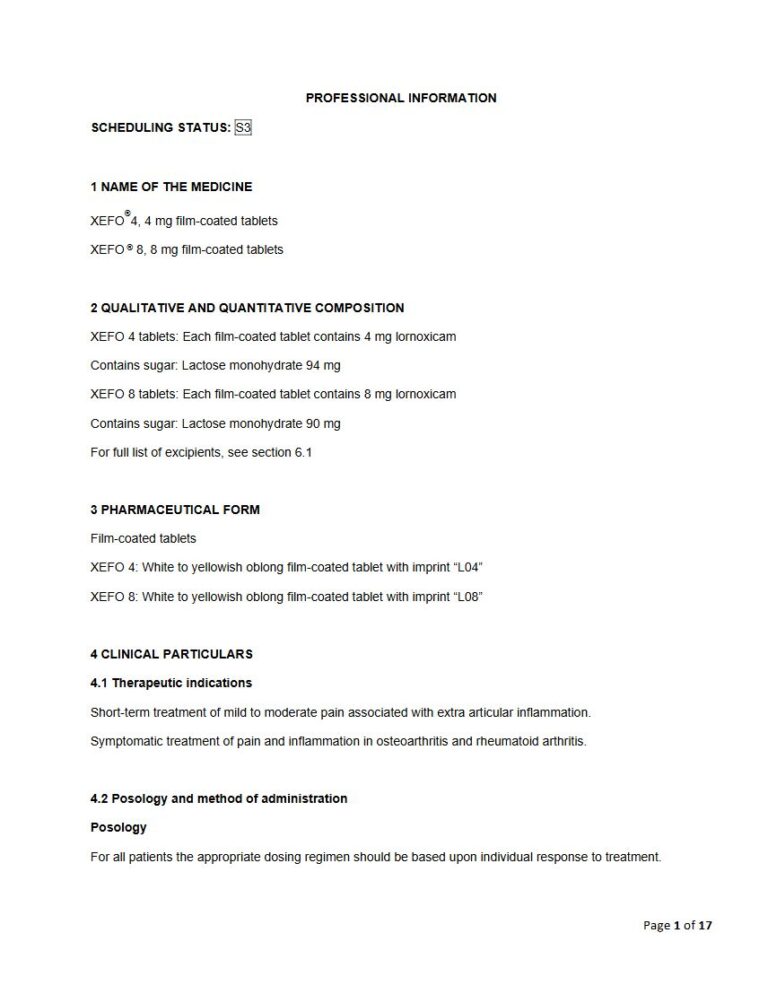
4.1 Therapeutic indications
Short-term treatment of mild to moderate pain associated with extra articular inflammation.
Symptomatic treatment of pain and inflammation in osteoarthritis and rheumatoid arthritis.
4.2 Posology and method of administration
Posology
For all patients the appropriate dosing regimen should be based upon individual response to treatment. Use the lowest effective dose for the shortest possible duration of treatment necessary to control symptoms, (see section 4.4)
Treatment of pain: 8 mg to 16 mg per day given in 2 to 3 divided doses. The total daily dose should not exceed 16 mg.
Osteoarthritis and rheumatoid arthritis: Initial recommended total daily dose is 12 mg divided in two or three doses. Maintenance dose should not exceed 16 mg per day.
Special populations
Paediatric population
XEFO is not recommended for use in children under 18 years of age.
Elderly
No special dosage modification is required for elderly patients (> 65 years of age), unless renal or hepatic function is impaired, in which case the daily dosage should be restricted, (see section 4.4).
Renal or hepatic impairment
For patients with renal or hepatic impairment, the maximal recommended daily dose is reduced to 12 mg (one film-coated tablet XEFO 4 mg tid) see section 4.4
Method of administration
XEFO film-coated tablets are supplied for oral administration and should be taken before meals with a sufficient quantity of liquid.
4.3 Contraindications
XEFO is contra-indicated in the following groups of patients:
- Hypersensitivity to the active substance, lornoxicam, or any of the excipients listed in section 6.1.
- those who have suffered hypersensitivity reactions (bronchospasm, asthma, rhinitis, angioedema or urticaria) to other non-steroidal anti-inflammatory medicines, including, acetylsalicylic acid
- history of gastro-intestinal bleeding or perforation related to previous NSAID use
- cerebrovascular bleeding
- those with bleeding and coagulation disorders
- those with active peptic ulcer or history of recurrent peptic ulceration/ haemorrhage/ perforations
- those with severe liver impairment
- those with severe renal impairment (serum creatinine > 700 u03bcmol/l)
- those with thrombocytopenia
- heart failure
- the elderly (> 65 years), those weighing less than 50 kg and those undergoing acute surgery
- Pregnancy, due to the risk of foetal renal dysfunction, leading to oligohydramnios and, in some cases, neonatal renal impairment associated with the use of NSAIDs during pregnancy, and lactation
- those under 18 years of age
4.4 Special warnings and precautions for use
Lornoxicam reduces platelet aggregation and prolongs bleeding time. Consequently, caution should be taken when administering to patients with increased bleeding tendency.
XEFO should only be administered after careful risk-benefit assessment in patients with:
- Renal impairment: XEFO should be administered with caution in patients with mild (serum creatinine 150 u2013 300 u03bcmol/L) to moderate (serum creatinine 300 u2013 700 u03bcmol/L) renal impairment due to dependence on renal prostaglandins for maintenance of renal blood flow (see section 4.2). Treatment with XEFO should be discontinued if renal function deteriorates during treatment.
- Renal function should be monitored in patients:
- who undergo major surgery
- with cardiac failure
- receiving concomitant treatment with diuretics or medicinal products that are suspected to, or known to be able to cause kidney damage (see section 4.5).
- Patients with blood coagulation disorders: careful clinical monitoring and laboratory assessment is recommended (e.g. APTT).
- Hepatic impairment (e.g. liver cirrhosis): clinical monitoring and laboratory assessments are recommended in patients with hepatic impairment, as accumulation of lornoxicam (increase in AUC) may occur (see section 5.2) after treatment with daily doses of 12-16 mg. Apart from that, hepatic impairment does not seem to affect pharmacokinetic parameters of lornoxicam as compared to healthy subjects.
- Patients receiving long term treatment (longer than 3 months): with NSAIDs should be monitored regularly for renal and hepatic function and haematology.
- In elderly patients above 65 years of age: monitoring of renal and hepatic function is recommended. Caution is advised in elderly postoperative patients.
Concomitant NSAID use
The use of lornoxicam with concomitant NSAIDs (including cyclooxygenase-2 selective inhibitors) should be avoided (see section 4.5).
Minimisation of undesirable effects
Undesirable effects may be minimised by using lowest effective dose for the shortest duration necessary to control symptoms (see section 4.2, and gastrointestinal and cardiovascular risks below).
Drug Reaction with Eosinophillia and Systemic Symptoms (DRESS) has been reported in patients taking NSAIDs such as XEFO. Some of these events have been fatal or life-threatening. DRESS typically, although not exclusively, presents with fever, rash, lymphadenopathy, and/or facial swelling. Other clinical manifestations may include hepatitis, nephritis, haematological abnormalities, myocarditis, or myositis. Sometimes symptoms of DRESS may resemble an acute viral infection. Eosinophillia is often present. Because this disorder is variable in its presentation, other organ systems not noted here may be involved. It is important to note that early manifestations of hypersensitivity, such as fever or lymphadenopathy, may be present even though rash is not evident. If such signs or symptoms are present, discontinue XEFO and evaluate the patient immediately
Gastrointestinal bleeding, ulceration and perforation
GI bleeding, ulceration or perforation, which can be fatal, has been reported with all NSAIDs at any time during treatment, with or without warning symptoms or a previous history of serious GI events.
The risk of GI bleeding, ulceration or perforation is higher with increasing NSAID doses, in patients with a history of ulcer, particularly if complicated with haemorrhage or perforation (see section 4.3) and in the elderly. These patients should commence treatment on the lowest dose available (see section 4.2). Combination therapy with gastroprotective agents (e.g. misoprostol or proton pump inhibitors) should be considered for these patients, and also for patients requiring concomitant low dose acetylsalicylic acid or other medicinal products likely to increase gastrointestinal risk (see below and section 4.5). Clinical monitoring at regular intervals is recommended.
Patients with a history of GI toxicity, particularly the elderly, should be instructed to report any unusual abdominal symptoms (especially GI bleeding) particularly in the initial stages of treatment.
Caution should be advised in patients receiving concomitant medicinal products, which could increase the risk of ulceration, or bleeding, such as oral corticosteroids, anticoagulants such as warfarin, selective serotonin-reuptake inhibitors or anti-platelet agents such as acetylsalicylic acid (see section 4.5).
When GI bleeding or ulceration occurs in patients receiving XEFO, treatment should be withdrawn.
NSAIDs should be given with caution to patients with a history of GI disease (e.g. ulcerative colitis, Crohnu2019s disease) as their condition may be exacerbated (see section 4.8).
Elderly
The elderly have an increased frequency of adverse reactions to NSAIDs especially gastrointestinal bleeding and perforation, which may be fatal (see section 4.2).
Cardiovascular and cerebrovascular effects
Appropriate monitoring and advice are required for patients with a history of or present hypertension and/or mild to moderate congestive heart failure, as fluid retention and oedema have been reported in association with NSAID therapy.
Clinical trial and epidemiological data suggest that use of some NSAIDs, particularly at high doses and in long term treatment, may be associated with an increased risk of arterial thrombotic events (for example myocardial infarction or stroke). There are insufficient data to exclude such a risk for lornoxicam.
Patients with uncontrolled hypertension, congestive heart failure, established ischaemic heart disease, peripheral arterial disease, and/or cerebrovascular disease should only be treated with Lornoxicam after careful consideration. Similar consideration should be made before initiating longer-term treatment of patients with risk factors for cardiovascular disease (e.g. hypertension, hyperlipidaemia, diabetes mellitus, smoking).
Concomitant treatment with NSAIDs and heparin in the context of a spinal or epidural anaesthesia increases the risk of spinal/epidural haematoma (see section 4.5).
Skin disorders
Serious skin reactions, some of which are fatal, including exfoliative dermatitis, Stevens-Johnson syndrome (SJS), and toxic epidermal necrolysis (TEN), have been reported very rarely in association with the use of NSAIDs (see section 4.8). Patients appear to be at highest risk of these reactions early in the course of therapy, the onset of reactions occurring within the first month of treatment in the majority of cases. Lornoxicam should be discontinued at the first appearance of skin rash, mucosal lesions, or any other sign of hypersensitivity.
Respiratory disorders
Caution is required if administered to patients suffering from, or with a previous history of, bronchial asthma as NSAIDs have been reported to precipitate bronchospasm in such patients.
Systemic Lupus Erythematosus and mixed connective tissue disease
Caution is required in patients with systemic lupus erythematosus (SLE) and mixed connective tissue disorders, as there may be an increased risk of aseptic meningitis.
Nephrotoxicity
Concomitant treatment of NSAIDs and tacrolimus may increase the risk of nephrotoxicity, due to reduced synthesis of prostacyclin in the kidney. Renal function must therefore be monitored closely in patients receiving combination therapy (see section 4.5).
Laboratory abnormalities
As with most NSAIDs, occasional increases in serum transaminases level, increase in serum bilirubin or other liver function parameters, as well as increases in serum creatinine and blood urea nitrogen and other laboratory abnormalities have been reported. Should any such abnormality prove significant or persist the administration of lornoxicam should be stopped and appropriate investigations prescribed.
XEFO contains lactose/fructose. Patients with the rare hereditary conditions of galactose intolerance e.g. galactosaemia, Lapp lactase deficiency, glucose-galactose malabsorption or fructose intolerance should not take XEFO. Contains lactose, which may have an effect on the glycaemic control of patients with diabetes mellitus.
4.5 Interactions with other medicines
- Concomitant administration of XEFO and anticoagulants or platelet aggregation inhibitors may prolong the bleeding time.
- Sulphonylureas (e.g. glibenclamide): May increase the hypoglycaemic effect.
- Other non-steroidal anti-inflammatory medicines and aspirin: increased risk of adverse reactions such as gastrointestinal bleeding or ulceration.
- Diuretics: Decreased diuretic and antihypertensive effect of loop diuretics, thiazide diuretics, and with potassium sparing diuretics (increased risk of hyperkalaemia and nephrotoxicity).
- ACE inhibitors: The antihypertensive effect of the ACE inhibitor may decrease and there is a risk of acute renal insufficiency.
- Lithium: NSAIDs inhibit renal clearance of lithium, thus the serum concentration of lithium may increase above toxicity limits. Therefore, serum lithium levels require monitoring, especially during initiation, adjustment and withdrawal of treatment.
- Methotrexate: Increased serum concentration of methotrexate. Increased toxicity may result. When concomitant therapy has to be used careful monitoring should be undertaken.
- Cimetidine: Increased plasma concentrations of lornoxicam, which may increase the risk of adverse effects of XEFO. (No interaction between XEFO and ranitidine, or XEFO and antacids has been demonstrated)
- Digoxin: Decreased renal clearance of digoxin, which increases risk of digoxin toxicity.
- Cyclosporin: Increased serum concentration of cyclosporin. Nephrotoxicity of cyclosporin may be enhanced via renal prostaglandin mediated effects. During combined treatment renal function should be monitored.
- Corticosteroids: Increased risk of gastrointestinal ulceration or bleeding (see section 4.4).
- Anti-coagulants: XEFO may enhance the effects of anti-coagulants such as Warfarin (see section 4.4). Careful monitoring of INR should be undertaken.
- Antiplatelet agents (e.g. clopidogrel) and selective serotonin reuptake inhibitors (SSRIs): increased risk of gastrointestinal bleeding see section 4.4.
- Known inducers and inhibitors of CYP2C9 isoenzymes: Lornoxicam (as other NSAIDs depending on the cytochrome P450 2C9 [CYP2C9 isoenzyme]) has interactions with known inducers and inhibitors of CYP2C9 isoenzymes (see section 5.2. Biotransformation).
- Phenprocoumon: Decreased effect of phenprocoumon treatment.
- Heparin: NSAIDs increase the risk of bleeding and spinal or epidural haematomas when given concomitantly to heparin in the context of spinal or epidural anaesthesia (see section 4.4).
- Beta-adrenergic blockers: Decreased antihypertensive efficacy.
- Angiotensin II receptor blocker: Decreased antihypertensive efficacy.
- Quinolone antibiotics (e.g. levofloxacin, ofloxacin): Increased risk of seizures.
- Tacrolimus: Increase the risk of nephrotoxicity owing to reduced synthesis of prostacyclin in the kidney. During combined treatment renal function should be monitored (see section 4.4).
- Pemetrexed: NSAIDs may reduce renal clearance of pemetrexed resulting in increased renal and gastrointestinal toxicity, and myelosuppression.
XEFO film-coated tablets show a delayed absorption of lornoxicam when given with food. Therefore, XEFO film-coated tablets should not be taken with food when a quick onset of efficacy (relief of pain) is required. Food may decrease the absorption with about 20 % and increase T max (see section 5.2).
4.6 Fertility, pregnancy and lactation
Pregnancy
XEFO should not be used during pregnancy. Inhibition of prostaglandin synthesis may adversely affect pregnancy and/or embryo/foetal development. Data from epidemiological studies suggest an increased risk of miscarriage and of cardiac malformation after use of a prostaglandin synthesis inhibitor in early pregnancy. The risk is believed to increase with dose and duration of therapy. In animals, administration of a prostaglandin synthesis inhibitor has been shown to result in increased pre- and post-implantation loss and embryo-foetal lethality.
The use of NSAIDs around 20 weeks gestation or later in pregnancy may cause a rare but serious foetal renal dysfunction leading to oligohydramnios and, in some cases, neonatal renal impairment. Complications of prolonged oligohydramnios include limb contractures and delayed lung maturation, which may require invasive procedures such as exchange transfusion or dialysis, in some cases (see section 4.3).
Breastfeeding
There are no data on the excretion of lornoxicam in human breast milk. Lornoxicam is excreted in milk of lactating rats in relatively high concentrations. Lornoxicam should not be used in breastfeeding women.
Fertility
The use of lornoxicam, as with any medicine known to inhibit cyclooxygenase / prostaglandin synthesis, may impair fertility and is not recommended in women attempting to conceive. In women who have difficulties conceiving or who are undergoing investigation of infertility, withdrawal of lornoxicam should be considered.
4.7 Effects on ability to drive and use machines
Patients showing dizziness and/or somnolence under treatment with XEFO should refrain from driving or the operation of machinery.
4.8 Undesirable effects
The most commonly observed adverse events of NSAIDs are gastrointestinal in nature. Peptic ulcers, perforation or GI bleeding, sometimes fatal, particularly in the elderly, may occur (see section 4.4). Nausea, vomiting, diarrhoea, flatulence, constipation, dyspepsia, abdominal pain, melaena, haematemesis, ulcerative stomatitis, exacerbation of colitis and Crohnu2019s disease (see section 4.4) have been reported following administration of NSAIDs. Less frequently, gastritis has been observed.
Approximately 20 % of patients treated with lornoxicam can be expected to experience adverse reactions. The most frequent adverse effects of lornoxicam include nausea, dyspepsia, indigestion, abdominal pain, vomiting, and diarrhoea. These symptoms have generally occurred in less than 10 % of patients in available studies.
Oedema, hypertension, and cardiac failure, have been reported in association with NSAID treatment. Clinical trial and epidemiological data suggest that use of some NSAIDs (particularly at high doses and in long term treatment) may be associated with an increased risk of arterial thrombotic events (for example myocardial infarction or stroke) (see section 4.4). Exceptionally, occurrence of serious cutaneous and soft tissues infectious complications during varicella. NSAIDs, such as XEFO, can cause Drug Reaction with Eosinophillia and Systemic Symptoms (DRESS) (see Section 4.4)
Listed below in table 1 are undesirable effects, which generally occurred in more than 0,05 % of the 6,417 patients treated in clinical phase II, III and IV trials.
The following convention is used for the classification of the frequency of an adverse drug reaction: very common ( uf0b3 1/10); common ( uf0b3 1/100 to <1/10); uncommon ( uf0b3 1/1,000 to <1/100); rare ( uf0b3 1/10,000 to <1/1,000); very rare (<1/10,000), not known (cannot be estimated from the available data).
Table 1: Adverse effects
System organ class Frequency Adverse reaction(s)
Infections and infestations Rare Pharyngitis
Blood and lymphatic system disorders Rare Anaemia, thrombocytopenia, leucopenia, prolonged bleeding time Very rare Ecchymosis. NSAIDs have been reported to cause potentially severe haematological disorders like neutropenia, agranulocytosis, aplastic anaemia, and haemolytic anaemia as class effects
Immune system disorders Rare Hypersensitivity including anaphylactoid reactions and anaphylaxis
Metabolism and nutrition disorders Uncommon Anorexia, weight changes
Psychiatric disorders Uncommon Insomnia, depression Rare Confusion, nervousness, agitation
Nervous system disorders Common Mild and transient headache, dizziness Rare Somnolence, paraesthesia, dysgeusia, tremor, migraine Very rare Aseptic meningitis in patients with SLE and mixed connective tissue disorder (see section 4.4)
Eye disorders Common Conjunctivitis Rare Visual disturbances
Ear and labyrinth disorders Uncommon Vertigo, tinnitus
Cardiac disorders Uncommon Palpitations, tachycardia, oedema, cardiac failure (see section 4.4)
Vascular disorders Uncommon Flushing, oedema Rare Hypertension, hot flush, haemorrhage, haematoma
Respiratory, thoracic and mediastinal disorders Uncommon Rhinitis Rare Dyspnoea, cough, bronchospasm
Gastrointestinal disorders Common Nausea, abdominal pain, dyspepsia, diarrhoea, vomiting Uncommon Constipation, flatulence, eructation, dry mouth, gastritis, gastric ulcer, upper abdominal pain, duodenal ulcer, mouth ulceration Rare Melaena, haematemesis, oesophagitis, gastro-oesophageal reflux, dysphagia, aphthous stomatitis, glossitis, perforated peptic ulcer, gastrointestinal haemorrhage
Hepatobiliary disorders Uncommon Increase in liver function tests, SGPT (ALT) or SGOT (AST) Very rare Hepatotoxicity resulting in e.g. hepatic failure, hepatitis, jaundice and cholestasis
Skin and subcutaneous tissue disorders Uncommon Rash, pruritus, hyperhidrosis, rash erythematous, urticaria, angioedema, alopecia Rare Dermatitis, and eczema, purpura Very rare Oedema and bullous reactions, Stevens-Johnson syndrome, toxic epidermal necrolysis
Musculoskeletal and connective tissue disorders Uncommon Arthralgia Rare Bone pain, muscle spasms, myalgia
Renal and urinary disorders Rare Nocturia, micturition disorders, increase in blood urea nitrogen and creatinine levels Very rare Lornoxicam may precipitate acute renal failure in patients with pre-existing renal impairment, who are dependent on renal prostaglandins for maintenance of renal blood flow (see section 4.4). Nephrotoxicity in various forms including nephritis and nephrotic syndrome has been associated with NSAIDs as class effect
General disorders and administration site conditions Uncommon Malaise, face oedema Rare Asthenia
4.9 Overdose
At this time, there is no experience of overdose to permit definition of the consequence of an overdose, or to suggest specific management. However, it can be expected that after an overdose with lornoxicam, the following symptoms may be observed: nausea, vomiting, cerebral symptoms (dizziness, disturbances in vision). Severe symptoms such as ataxia (ascending to coma and cramps), liver and kidney damage and potentially coagulation disorders may also occur.
In the case of a real or suspected overdose, the medicinal product should be withdrawn. Due to its short half-life, lornoxicam is rapidly excreted. Lornoxicam is not dialysable. No specific antidote is known to date. The usual emergency measures should be considered. Based on principles, only administering activated charcoal immediately after the intake of lornoxicam can lead to diminished absorption of the preparation. Gastrointestinal disorders can for example be treated with a prostaglandin analogue or ranitidine.
