
Xofigo 1100 kBq/mL Solution for injection
PDF Leaflet Revision Date: 11 September 2023
Clinical Summary
Quick overview from the medicine insert
Indication
Treatment of castration-resistant prostate cancer with bone metastases.
Dosage (summary)
55 kBq/kg body weight every 4 weeks for 6 injections.
Special Populations
- Elderly
- Hepatic impairment
- Renal impairment
- Paediatric patients
Pregnancy & Breastfeeding
Not indicated for women; contraindicated in pregnancy and breastfeeding.
Key Drug Interactions
- Concomitant chemotherapy may increase bone marrow suppression.
- Not recommended with abiraterone plus prednisone/prednisolone.
Contraindications
- Hypersensitivity to radium-223 dichloride.
- Children and adolescents under 18.
Common side effects
- Diarrhoea
- Nausea
- Vomiting
- Thrombocytopenia
Counselling Points
- Use condoms and effective contraception during and up to 6 months post-treatment.
- Monitor blood counts before each dose.
- Handle with care due to radiation safety.
Serious warnings
- Bone marrow suppression.
- Potential effects on spermatogenesis.
- Risk of secondary malignant neoplasms.
Important Disclaimer
The Xofigo 1100 kBq/mL Solution for injection professional information leaflet below is the property of Bayer and is provided on Medinsert exactly as issued, with no.. alterations or editorial changes. We make every effort to keep content current by updating documents as soon as new versions become available. Medinsert serves as a trusted access point for healthcare professionals, but does not replace official sources or clinical judgement. For more details, please read our full disclaimer. read more>>
 Healthcare Professionals Only
This content is for registered healthcare professionals
Sign in or create a free account to read the full package insert.
Free for HPCSA-registered professionals. Powered by Medinsert.
Clinical Particulars
Section 4 of the official insert — extracted exactly as issued, no alterations
4.1 Therapeutic indications
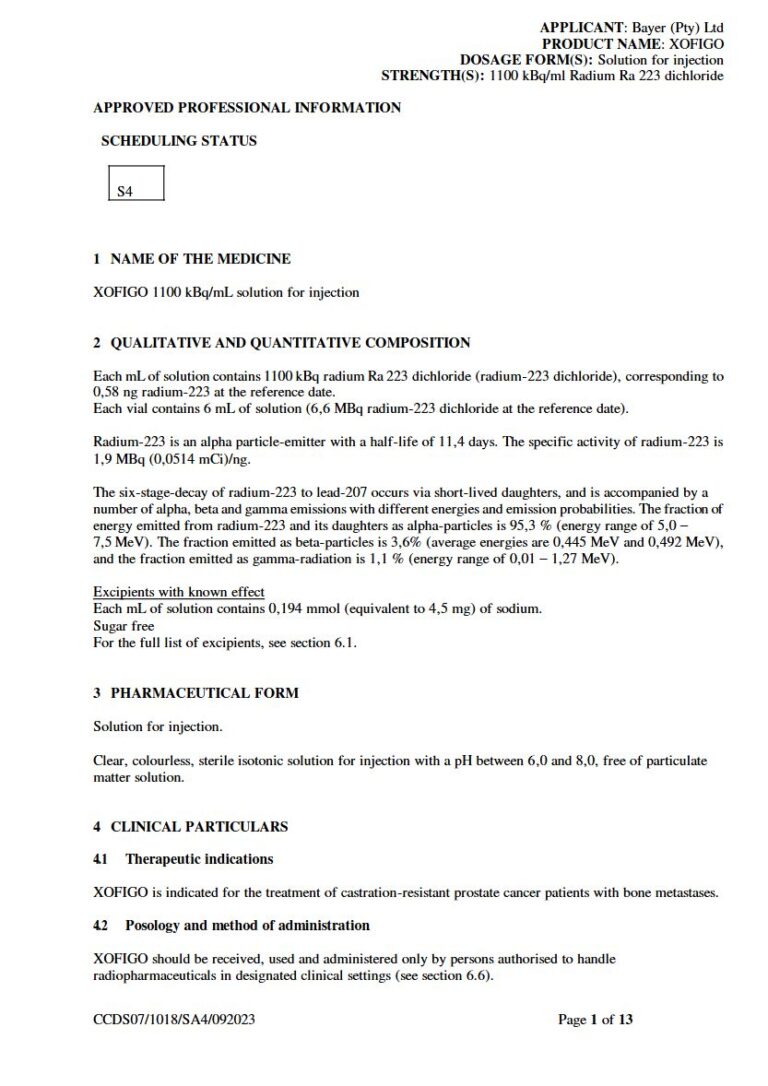
XOFIGO is indicated for the treatment of castration-resistant prostate cancer patients with bone metastases.
4.2 Posology and method of administration
XOFIGO should be received, used and administered only by persons authorised to handle radiopharmaceuticals in designated clinical settings (see section 6.6).
Posology
The dose regimen of XOFIGO is 55 kBq (0,00149 mCi) per kg body weight, given at 4-week intervals for 6 injections. Safety and efficacy beyond 6 injections with XOFIGO have not been studied. For details on the calculation of the volume to be administered, see section 12.
Special populations
Elderly
Of the 600 patients treated with XOFIGO in the phase III study, 447 patients (74, 5 %) were 65 years of age and over, while 196 patients (32,7 %) were 75 years of age and over. No overall differences in safety or effectiveness were observed between elderly (aged u2265 65 years) and younger patients (aged < 65 years). No dose adjustment is considered necessary in elderly patients.
Patients with hepatic impairment
Safety and efficacy of XOFIGO have not been studied in patients with hepatic impairment. Since radium-223 dichloride is neither metabolised by the liver nor eliminated via the bile, hepatic impairment is not expected to affect the pharmacokinetics of radium-223 dichloride. No dose adjustment is considered necessary in patients with hepatic impairment.
Patients with renal impairment
In the phase III clinical study, no relevant differences in safety or efficacy were observed between patients with mild renal impairment (creatinine clearance [CLCR]: 50 to 80 ml/min) and normal renal function. Limited data are available on patients with moderate (CLCR: 30 to 50 ml/min) and severe (CLCR: <30 ml/min) renal impairment. No data are available on patients with end-stage renal disease. However, since excretion in urine is minimal and the major route of elimination is via the faeces, renal impairment is not expected to affect the pharmacokinetics of radium-223 dichloride. No dose adjustment is considered necessary in patients with renal impairment.
Paediatric patients
The safety and efficacy of XOFIGO in children and adolescents below 18 years of age have not been studied.
Method of administration
XOFIGO is to be administered by slow intravenous injection (generally up to 1 minute). The intravenous access line or cannula must be flushed with 0, 9 % sodium chloride before and after injection of XOFIGO. For additional instructions on the use of the medicinal product, see sections 6.6 and 12.
4.3 Contraindications
XOFIGO is contraindicated in patients with hypersensitivity to radium-223 dichloride or any of the other ingredients of XOFIGO. XOFIGO is also contraindicated in children and adolescents below 18 years of age. The safety and efficacy of XOFIGO in children and adolescents below 18 years of age have not been studied (see section 4.2).
4.4 Special warnings and precautions for use
Bone marrow suppression
Bone marrow suppression, notably thrombocytopenia, neutropenia, leukopenia and pancytopenia, has been reported in patients treated with XOFIGO (see section 4.8). Haematological evaluation of patients must be performed at baseline and prior to every dose of XOFIGO. Before the first administration of XOFIGO, the absolute neutrophil count (ANC) should be u2265 1,5 x 10 9 /L, the platelet count u2265 100 x 10 9 /L and haemoglobin u2265 10,0 g/dL. Before subsequent administrations, the ANC should be u2265 1,0 x 10 9 /L and the platelet count u2265 50 x 10 9 /L. If there is no recovery in these values within 6 weeks after the last administration of XOFIGO despite receiving standard of care, further treatment with XOFIGO should be discontinued. Patients with evidence of compromised bone marrow reserve should be treated with caution.
Crohnu2019s disease and ulcerative colitis
Safety and efficacy of XOFIGO in patients with Crohnu2019s disease and with ulcerative colitis have not been studied.
Effect on spermatogenesis
Because of potential effects on spermatogenesis associated with radiation, men who are sexually active should be advised to use condoms and their female partners of reproductive potential to use a highly effective contraceptive method during and up to 6 months after treatment with XOFIGO (see section 4.6).
Secondary malignant neoplasms
XOFIGO contributes to a patientu2019s overall long-term cumulative radiation exposure. Long-term cumulative radiation exposure is associated with an increased risk of cancer and hereditary defects. No cases of XOFIGO-induced cancer have been reported with limited duration of clinical trials follow-up (up to three years) (see section 4.8).
Spinal cord compression
In patients with untreated imminent or established spinal cord compression, treatment with standard of care, as clinically indicated, should be completed before starting or resuming treatment with XOFIGO (see section 4.4).
Bone fractures
In patients with bone fractures, orthopaedic stabilisation of fractures should be performed before starting or resuming treatment with XOFIGO.
Combination with abiraterone plus prednisone/prednisolone
XOFIGO is not recommended for use in combination with abiraterone acetate plus prednisone/prednisolone. The clinical efficacy and safety of concurrent initiation of XOFIGO treatment and abiraterone acetate plus prednisone/prednisolone treatment was assessed in a randomized, placebo-controlled multicenter phase 3 study (ERA-223 trial) in 806 patients with asymptomatic or mildly symptomatic castration resistant prostate cancer with bone metastases. The study was unblinded early based on an Independent Data Monitoring Committee Recommendation. At the primary analysis an increased incidence of fractures (28,6% vs 11,4%) and deaths (38,5% vs 35,5%) among patients receiving XOFIGO in combination with abiraterone acetate plus prednisone/prednisolone compared to patients receiving placebo in combination with abiraterone acetate plus prednisone/prednisolone was observed. Concurrent use of bisphosphonates or denosumab reduced the incidence of fractures in both treatment arms.
4.5 Interaction with other medicines and other forms of interaction
No clinical interaction studies have been performed. Concomitant chemotherapy with XOFIGO may have additive effects on bone marrow suppression (see section 4.4). Safety and efficacy of concomitant chemotherapy with XOFIGO have not been established.
4.6 Fertility, pregnancy and lactation
Contraception in males and females
Because of potential effects on spermatogenesis associated with radiation, men who are sexually active should be advised to use condoms and their female partners of reproductive potential to use a highly effective contraceptive method during and up to 6 months after treatment with XOFIGO (see section 4.4).
Pregnancy and Breastfeeding
XOFIGO is not indicated in women. XOFIGO is not to be used in women who are or may be pregnant or breast-feeding.
Fertility
There are no human data on the effect of XOFIGO on fertility. There is a potential risk that radiation from XOFIGO could cause adverse effects on testes (see section 5.3). Since XOFIGO binds to bone, the potential risk for adverse effects in the male gonads in cancer patients with castration-resistant prostate cancer cannot be excluded. Patients should be informed accordingly (see section 4.4).
4.7 Effects on ability to drive and use machines
There is neither evidence nor is it expected that XOFIGO will affect the ability to drive or use machines.
4.8 Undesirable effects
a. Summary of the safety profile
The overall safety profile of XOFIGO is based on data from 600 patients treated with XOFIGO in the phase III study. The most serious adverse reactions were thrombocytopenia and neutropenia (see section 4.4 and subsection u2018Description of selected adverse reactionsu2019). The most frequently observed adverse reactions (u226510 %) in patients receiving XOFIGO were diarrhoea, nausea, vomiting and thrombocytopenia.
b. Tabulated list of adverse reactions
Table 1: Adverse reactions reported in clinical trials in patients treated with XOFIGO:
System Organ Class (MedDRA) Very common (u2265 1/10) Common (u2265 1/100 to < 1/10) Uncommon (u2265 1/1,000 to < 1/100)
Blood and lymphatic system disorders Thrombocytopenia Neutropenia, Pancytopenia, Leukopenia Lymphopenia
Gastrointestinal Disorders Diarrhoea, Vomiting, Nausea
General disorders and administration site Conditions Injection site reactions
c. Description of selected adverse reactions
Thrombocytopenia and Neutropenia
Thrombocytopenia (all grades) occurred in 11,5 % of patients treated with XOFIGO and 5,6 % of patients receiving placebo. Grade 3 and 4 thrombocytopaenia was observed in 6,3 % of patients treated with XOFIGO and in 2 % of patients receiving placebo (see section 4.4). Overall, the frequency of grade 3 and 4 thrombocytopaenia was lower in patients that did not previously receive docetaxel (2,8 % in patients treated with XOFIGO versus 0,8 % in patients receiving placebo) compared to patients that previously received docetaxel (8,9 % in patients treated with XOFIGO versus 2,9 % in patients receiving placebo). Neutropenia (all grades) was reported in 5 % of patients treated with XOFIGO and in 1 % of patients receiving placebo. Grade 3 and 4 neutropenia was observed in 2,2 % of patients treated with XOFIGO and in 0,7 % of patients receiving placebo. Overall, the frequency of grade 3 and 4 neutropenia was lower in patients that did not previously receive docetaxel (0,8 % in patients treated with XOFIGO versus 0,8 % in patients receiving placebo) compared to patients that previously received docetaxel (3,2 % in patients treated with XOFIGO versus 0,6 % in patients receiving placebo). In a phase I study, neutrophil and platelet count nadirs occurred at 2 to 3 weeks after intravenous administration of a single dose of XOFIGO.
Injection site reactions
Grade 1 and 2 injection site reactions, such as erythema, pain and swelling, were reported in 1,2 % of patients treated with XOFIGO and in 0 % of patients receiving placebo.
Secondary malignant neoplasms
XOFIGO contributes to a patientu2019s overall long-term cumulative radiation exposure. Long-term cumulative radiation exposure may be associated with an increased risk of cancer and hereditary defects. No cases of XOFIGO-induced cancer have been reported in clinical trials in follow-up of up to three years.
Reporting of suspected adverse reactions
Reporting suspected adverse reactions after authorisation of the medicine is important. It allows continued monitoring of the benefit/risk balance of the medicine. Health care providers are asked to report any suspected adverse reactions to SAHPRA via the u201c 6.04 Adverse Drug Reactions Reporting Form u201d, found online under SAHPRAu2019s publications: https://www.sahpra.org.za/Publications/Index/8
4.9 Overdose
There is no specific antidote. In the event of an inadvertent overdose, general supportive measures, including monitoring for potential haematological and gastrointestinal toxicity should be undertaken.
