
Yomesan 500 mg Chewable tablet
PDF Leaflet Revision Date: 17 January 2022
Clinical Summary
Quick overview from the medicine insert
Indication
Treatment of tapeworm infections.
Dosage (summary)
Adults: 4 chewable tablets on Day 1; Children: 1-2 tablets based on age.
Special Populations
- Hepatic impairment
- Renal impairment
- Children
Pregnancy & Breastfeeding
Use in pregnancy only if strictly indicated; unknown if excreted in breast milk.
Key Drug Interactions
- Alcohol may enhance absorption
Contraindications
- Hypersensitivity to niclosamide
Common side effects
- Dizziness
- Nausea
- Vomiting
- Rash
Counselling Points
- Chew tablets thoroughly before swallowing
- Drink acidic juice to aid elimination
- Use saline laxative for Taenia solium infections
Serious warnings
- May impair ability to drive or operate machinery
Important Disclaimer
The Yomesan 500 mg Chewable tablet professional information leaflet below is the property of Bayer and is provided on Medinsert exactly as issued, with no.. alterations or editorial changes. We make every effort to keep content current by updating documents as soon as new versions become available. Medinsert serves as a trusted access point for healthcare professionals, but does not replace official sources or clinical judgement. For more details, please read our full disclaimer. read more>>
 Healthcare Professionals Only
This content is for registered healthcare professionals
Sign in or create a free account to read the full package insert.
Free for HPCSA-registered professionals. Powered by Medinsert.
Clinical Particulars
Section 4 of the official insert — extracted exactly as issued, no alterations
4.1 Therapeutic indications
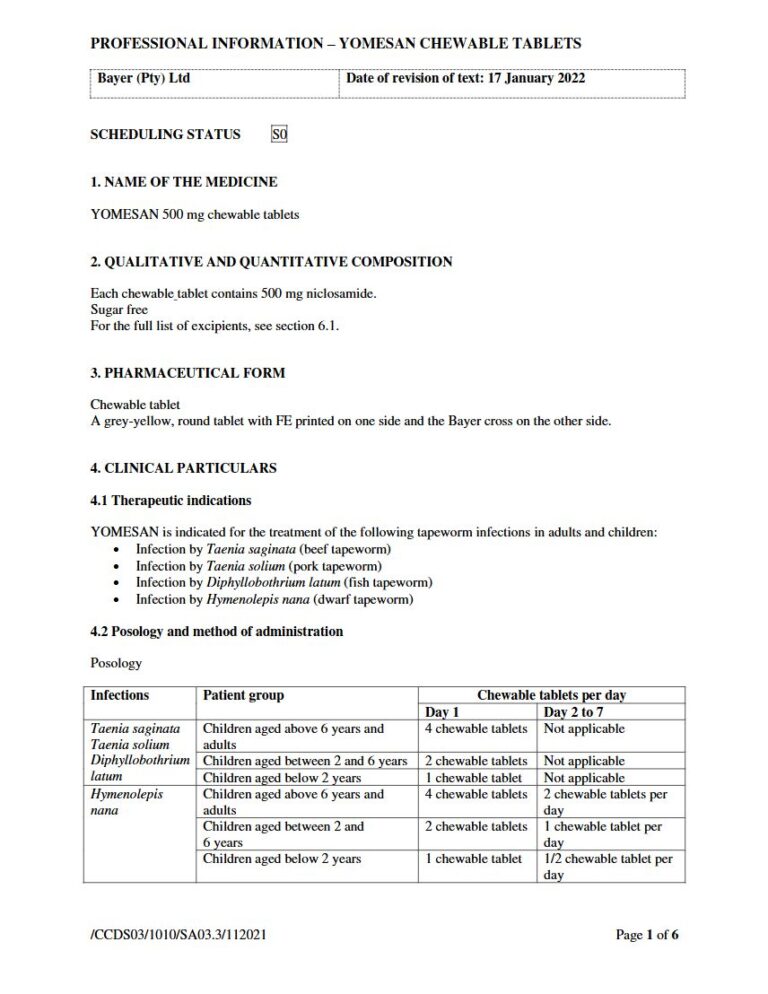
YOMESAN is indicated for the treatment of the following tapeworm infections in adults and children:
- Infection by Taenia saginata (beef tapeworm)
- Infection by Taenia solium (pork tapeworm)
- Infection by Diphyllobothrium latum (fish tapeworm)
- Infection by Hymenolepis nana (dwarf tapeworm)
4.2 Posology and method of administration
Posology
Infections
Patient group
Chewable tablets per day
Day 1
Day 2 to 7
- Taenia saginata
- Taenia solium
- Diphyllobothrium latum
Children aged above 6 years and adults
4 chewable tablets
Not applicable
Children aged between 2 and 6 years
2 chewable tablets
Not applicable
Children aged below 2 years
1 chewable tablet
Not applicable
- Hymenolepis nana
Children aged above 6 years and adults
4 chewable tablets
2 chewable tablets per day
Children aged between 2 and 6 years
2 chewable tablets
1 chewable tablet per day
Children aged below 2 years
1 chewable tablet
1/2 chewable tablet per day
Special Populations
Patients with hepatic impairment
Niclosamide is not absorbed appreciably from the gastrointestinal tract and does not affect hepatic function. Therefore, dosing adjustment is not required in hepatic impairment.
Patients with renal impairment
Niclosamide is not absorbed appreciably from the gastrointestinal tract and does not affect normal renal function. Therefore, dosing adjustment is not required in renal impairment.
Children
For young children, the chewable tablets should be crushed to a fine paste and given with a little water.
Method of administration
For oral use. The daily dose is taken as a single dose after breakfast. The pleasant tasting tablets should be thoroughly chewed to a fine paste and washed down with a little water. They can also be taken crushed in water.
Special monitoring advice
Elimination of the intestinal mucus produced abundantly in a tapeworm infection can be promoted by drinking acidic fruit juice, which allows easier access of the product to worms situated underneath the mucus. If constipated, regular bowel movements should always be established before treatment with YOMESAN. No special dietary measures are necessary. A saline laxative (e.g., sodium sulphate, magnesium sulphate) can be given two hours after taking the YOMESAN dose (or in the case of Hymenolepis nana, after the last dose) to ensure a rapid and complete expulsion of the worm. Without purgation, the parasite is excreted in pieces for about 2 days after the end of treatment. In the case of Taenia solium (pork tapeworm) infections, a saline laxative is imperative.
4.3 CONTRAINDICATIONS
Hypersensitivity to niclosamide or any of the excipients listed in section 6.1.
4.4 Special warnings and precautions for use
YOMESAN has no systemic therapeutic effects. It works by eliminating tapeworms present in the intestine. Through elimination of tapeworms, it may have an effect on cysticercosis, or echinococcosis caused by larvae (cysts) of T. solium, E. ultilocularis or E. granulosus by preventing their establishment extraintestinally in the tissue. The risk of cysticercosis existing in cases of pork tapeworm infestation is avoided by the recommended saline laxative purging, the aim being to excrete as quickly as possible the lower tapeworm segments containing the ripe eggs. This prevents the eggs being later transferred to the fingers as a result of deficient defaecation hygiene and from the fingers into the mouth of the patient, where they can cause cysticercosis.
4.5 Interaction with other medicines and other forms of interactions
Niclosamide is soluble in alcohol which may enhance its absorption. Therefore, YOMESAN should not be taken together with any alcohol-containing beverage (see section 4.7).
4.6 Fertility, pregnancy and lactation
Pregnancy
During pregnancy, and especially during the first trimester, YOMESAN should be used only where it is strictly indicated.
Lactation
It is unknown whether niclosamide is excreted in human breast milk. YOMESAN should only be used in breast-feeding woman after risk/benefit evaluation by a healthcare professional.
4.7 Effects on the ability to drive and use machines
YOMESAN may result in an impairment of the patientu2019s ability to drive or operate machinery due to central nervous system reactions (see section 4.8).
4.8 Undesirable effects
The listed adverse reactions are based on spontaneous reports, and their frequencies are therefore unknown.
Immune system disorders
- Allergic reaction (e.g., with erythema, pruritus and exanthema), anaphylactic reaction and anaphylactic shock.
Nervous system disorders
- Dizziness (light-headedness)
Vascular disorders
- Cyanosis
Gastrointestinal disorders
- Nausea, vomiting, gastrointestinal and abdominal pains, retching and diarrhoea
Skin and subcutaneous tissue disorders
- Rash, pruritus and hyperhidrosis
General disorders and administration site conditions
- Feeling unwell (fatigue)
Reporting suspected adverse reactions after authorisation of the medicine is important. It allows continued monitoring of the risk/benefit balance of the medicine. Health care providers are asked to report any suspected adverse reactions to SAHPRA via the u201c6.04 Adverse Drug Reactions Reporting Formu201d, found online under SAHPRAu2019s publications: https://www.sahpra.org.za/Publications/Index/8
4.9 OVERDOSE
According to available evidence, the active substance of YOMESAN, niclosamide, is only slightly absorbed, so that toxic effects are not expected. Should a patient have taken a marked overdosage, for safety reasons the usual therapeutic measures for the treatment of poisoning should be applied (symptomatic therapy). No cases of overdose have been reported.
