
Zinforo 600 mg Powder for concentrate for solution for infusion
PDF Leaflet Revision Date: 12 July 2023
Clinical Summary
Quick overview from the medicine insert
Indication
Treatment of ABSSSI and CABP caused by susceptible bacteria.
Dosage (summary)
600 mg IV every 12 hours; high dose 600 mg every 8 hours for specific infections.
Special Populations
- Elderly
- Renal impairment
- Hepatic impairment
Pregnancy & Breastfeeding
Not recommended in pregnancy; unknown if excreted in breast milk.
Key Drug Interactions
- Low interaction potential with CYP450 drugs
Contraindications
- Hypersensitivity to ceftaroline or beta-lactams
Common side effects
- Diarrhoea
- Headache
- Nausea
- Pruritus
Counselling Points
- Report any allergic reactions
- Monitor for diarrhoea during treatment
Serious warnings
- Serious hypersensitivity reactions
- Clostridium difficile-associated diarrhoea
Important Disclaimer
The Zinforo 600 mg Powder for concentrate for solution for infusion professional information leaflet below is the property of Pfizer Laboratories and is provided on Medinsert exactly as issued, with no.. alterations or editorial changes. We make every effort to keep content current by updating documents as soon as new versions become available. Medinsert serves as a trusted access point for healthcare professionals, but does not replace official sources or clinical judgement. For more details, please read our full disclaimer. read more>>
 Healthcare Professionals Only
This content is for registered healthcare professionals
Sign in or create a free account to read the full package insert.
Free for HPCSA-registered professionals. Powered by Medinsert.
Clinical Particulars
Section 4 of the official insert — extracted exactly as issued, no alterations
4.1 Therapeutic indications
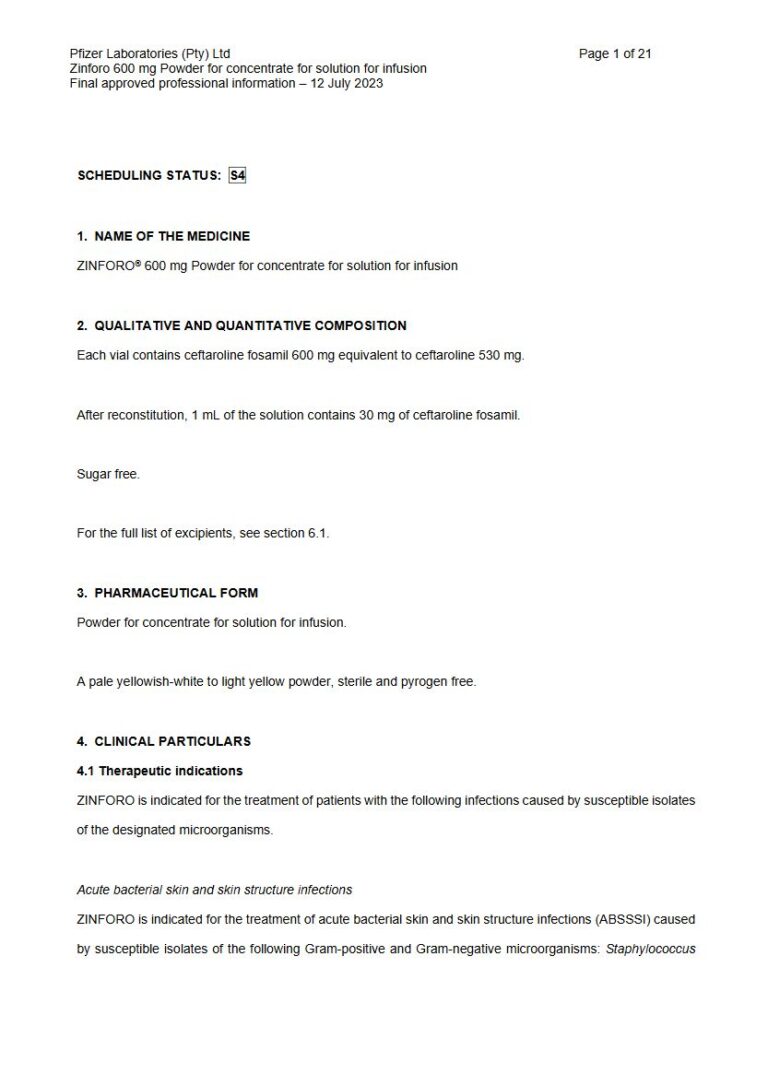
ZINFORO is indicated for the treatment of patients with the following infections caused by susceptible isolates of the designated microorganisms.
Acute bacterial skin and skin structure infections
ZINFORO is indicated for the treatment of acute bacterial skin and skin structure infections (ABSSSI) caused by susceptible isolates of the following Gram-positive and Gram-negative microorganisms:
- Staphylococcus aureus (including methicillin-susceptible and resistant isolates),
- Streptococcus pyogenes,
- Streptococcus agalactiae,
- Escherichia coli,
- Klebsiella pneumonia and Klebsiella oxytoca.
Community-acquired bacterial pneumonia
ZINFORO is indicated for the treatment of community-acquired bacterial pneumonia (CABP) caused by susceptible isolates of the following Gram-positive and Gram-negative microorganisms:
- Streptococcus pneumoniae (including cases with concurrent bacteraemia),
- Staphylococcus aureus (methicillin-susceptible isolates only),
- Haemophilus influenzae,
- Klebsiella pneumonia and Escherichia coli.
ZINFORO is indicated in neonates, infants, children, adolescents and adults (see sections 4.4 and 5.1).
4.2 Posology and method of administration
Posology
The recommended dosage of ZINFORO is 600 mg administered every 12 hours by intravenous infusion over 5 to 60 minutes (standard dose), with appropriate reductions for paediatric patients (see Table 3). The duration of treatment should be guided by the type of infection to be treated, its severity, and the patientu2019s clinical response.
For the treatment of patients with acute bacterial skin and skin structure infection (ABSSSI) confirmed or suspected to be caused by S. aureus with an MIC = 2 mg/L or 4 mg/L to ceftaroline, the dose of ZINFORO is 600 mg administered every 8 hours by intravenous infusion over 120 minutes (high dose), with appropriate reductions for paediatric patients (see Table 3).
The recommended duration of antimicrobial treatment for ABSSSI is 5 u2013 14 days and for community-acquired bacterial pneumonia (CABP) is 5 u2013 7 days.
Table 1: Dosage in adults with normal renal function, creatinine clearance (CrCL) > 50 mL/min
Indication Posology (mg/infusion) Infusion time (minutes)/frequency
- Standard dose a
- Acute bacterial skin and skin structure infection (ABSSSI) 600 mg 5 u2013 60 b / every 12 hours
- Community-acquired bacterial pneumonia (CABP) 600 mg 5 u2013 60 b / every 12 hours
- High dose b
- ABSSSI confirmed or suspected to be caused by S. aureus with an MIC = 2 mg/L or 4 mg/L to ZINFORO c 600 mg 120/every 8 hours
a For patients with supranormal renal clearance receiving the standard dose, an infusion time of 60 minutes may be preferable.
b Infusion times of less than 60 minutes and high dose recommendations are based on pharmacokinetic and pharmacodynamic analyses only. See sections 4.4 and 5.1.
c For treatment of S. aureus for which the ZINFORO MIC is u2264 1 mg/L, the standard dose is recommended.
Special populations
Elderly patients
No dosage adjustment is required for the elderly with creatinine clearance (CrCL) values > 50 mL/min (see section 5.2).
Renal impairment
The dose should be adjusted when CrCL is u2264 50 mL/min, as shown in Tables 2 and 4 (see sections 4.9 and 5.2). The recommended durations of treatment are 5 - 14 days for ABSSSI and 5 - 7 days for CABP.
Table 2: Dosage in adults with impaired renal function, CrCL u2264 50 mL/min
Indications CrCL (mL/min) a Posology (mg/infusion) Infusion time (minutes)/frequency
- Standard dose
- ABSSSI CABP > 30 to u2264 50 400 mg 5 u2013 60 c /every 12 hours
- u2265 15 to u2264 30 300 mg
- End-stage renal disease (ESRD), including haemodialysis b 200 mg
- High dose c
- ABSSSI confirmed or suspected to be caused by S. aureus with an MIC = 2 mg/L or 4 mg/L to ZINFORO d > 30 to u2264 50 400 mg 120/every 8 hours
- u2265 15 to u2264 30 300 mg
- ESRD, including haemodialysis b 200 mg
a Calculated using the Cockcroft-Gault formula for adults. Dose is based on CrCL. CrCL should be closely monitored and the dose adjusted according to changing renal function.
b Ceftaroline is haemodialysable; thus ZINFORO should be administered after haemodialysis on haemodialysis days.
c Infusion times of less than 60 minutes and high dose recommendations are based on pharmacokinetic and pharmacodynamic analyses only. See sections 4.4 and 5.1.
d For treatment of S. aureus for which the ZINFORO MIC is u2264 1 mg/L, the standard dose is recommended.
Hepatic impairment
No dosage adjustment is considered necessary in patients with hepatic impairment (see section 5.2).
Paediatric population
Dose recommendations for neonates, infants and children and adolescents are based on pharmacokinetic (PK) modelling.
Table 3: Dosage in paediatric patients with normal renal function, CrCL > 50 mL/min*
Indications Age group Posology (mg/infusion) Infusion time (minutes)/Frequency
- Standard dose a
- ABSSSI CABP Adolescents aged from 12 to < 18 years with bodyweight u2265 33 kg 600 mg 5 u2013 60 b /every 12 hours
- Adolescents aged from 12 years to < 18 years bodyweight < 33 kg and children u2265 2 years to < 12 years 12 mg/kg to a maximum of 400 mg 5 u2013 60 b /every 8 hours
- Infants u2265 2 months to < 2 years 8 mg/kg 5 u2013 60 b /every 8 hours
- Neonates from birth to < 2 months b 6 mg/kg 60/every 8 hours
- High dose b
- ABSSSI confirmed or suspected to be caused by S. aureus with an MIC = 2 mg/L or 4 mg/L to ZINFORO c Children and adolescents aged from u2265 2 years to < 18 years 12 mg/kg to a maximum of 600 mg 120/every 8 hours
- Infants u2265 2 months to < 2 years 10 mg/kg 120/every 8 hours
a For patients with supranormal renal clearance receiving the standard dose, an infusion time of 60 minutes may be preferable.
b Infusion times of less than 60 minutes, neonatal and high dose recommendations are based on pharmacokinetic and pharmacodynamic analyses only. See sections 4.4 and 5.1.
c For treatment of S. aureus for which the ceftaroline MIC is u2264 1 mg/L, the standard dose is recommended.
* Calculated using the Schwartz formula (in mL/min/1,73 m2) for paediatric patients. There is insufficient information to recommend dosage adjustments in adolescents aged from 12 to < 18 years with bodyweight < 33 kg and in children aged from 2 to 12 years with end-stage renal disease (ESRD). There is insufficient information to recommend dosage adjustments in paediatric patients < 2 years with moderate or severe renal impairment or ESRD.
Table 4: Dosage in paediatric patients with impaired renal function, CrCL u2264 50 mL/min
Indications Age group CrCL (mL/min) a Posology (mg/infusion) Infusion time (minutes)/Frequency
- Standard dose
- ABSSSI CABP Adolescents aged from 12 to 30 to u2264 50 400 mg 5 - 60 c / every 12 hours
- u2265 15 to u2264 30 300 mg
- ESRD, including haemodialysis b 200 mg
- Adolescents aged from 12 years to 30 to u2264 50 8 mg/kg to a maximum of 300 mg 5 u2013 60 c / every 8 hours
- bodyweight < 33 kg and children u2265 2 years to < 12 years u2265 15 to u2264 30 6 mg/kg to a maximum of 200 mg
- High dose c
- ABSSSI confirmed or suspected to be caused by S. aureus with an MIC = 2 mg/L or 4 mg/L to ceftaroline d Children and adolescents aged from u2265 2 years to 30 to u2264 50 10 mg/kg to a maximum of 400 mg 120/every 8 hours
- u2265 15 to u2264 30 8 mg/kg to a maximum of 300 mg
a Calculated using the Schwartz formula for paediatric patients (in mL/min/1,73 m2). Dose is based on CrCL. CrCL should be closely monitored and the dose adjusted according to changing renal function.
b ZINFORO is haemodialysable; thus ZINFORO should be administered after haemodialysis on haemodialysis days.
c Infusion times of less than 60 minutes and high dose recommendations are based on pharmacokinetic and pharmacodynamic analyses only. See sections 4.4 and 5.1.
d For treatment of S. aureus for which the ZINFORO MIC is u2264 1 mg/L, the standard dose is recommended.
Method of administration
For intravenous use.
ZINFORO solution for infusion can be administered in a 50 mL, 100 mL or 250 mL intravenous bag or bottle. Once the intravenous solution is prepared in the intravenous bag or bottle it should be administered within 6 hours of preparation. For instructions on reconstitution and dilution of the medicine before administration, see section 6.6.
4.3 Contraindications
- Hypersensitivity to ceftaroline fosamil or to any of the excipients of ZINFORO (listed in section 6.1).
- Hypersensitivity to the cephalosporin class of antibacterials.
- Immediate and severe hypersensitivity (e.g. anaphylactic reaction) to any other type of beta-lactam antibacterial medicine (e.g., penicillins or carbapenems).
4.4 Special warnings and precautions for use
Hypersensitivity reactions
Serious and fatal hypersensitivity reactions have been reported in patients receiving beta-lactam antibacterials, such as ZINFORO (see sections 4.3 and 4.8). Severe cutaneous adverse reactions (SCARs), such as Stevens-Johnson syndrome (SJS), toxic epidermal necrolysis (TEN), drug reaction with eosinophilia and systemic symptoms (DRESS), and acute generalised exanthematous pustulosis (AGEP) have been reported in patients taking beta-lactam antibiotics. Patients who have a history of hypersensitivity to cephalosporins, penicillins or other beta-lactam antibacterials may also be hypersensitive to ZINFORO. Before initiating therapy with ZINFORO, careful inquiry should be made concerning previous hypersensitivity reactions to beta-lactam antibacterials. If a severe allergic reaction or SCAR occurs, ZINFORO should be discontinued and appropriate measures taken (see section 4.3).
Clostridium difficile-associated diarrhoea
Antibacterial-associated colitis and pseudomembranous colitis have been reported with ZINFORO and may range in severity from mild to life threatening. Therefore, it is important to consider this diagnosis in patients who present with diarrhoea during, or subsequent to the administration of ZINFORO (see section 4.8). In such circumstance, the discontinuation of therapy with ZINFORO and the use of supportive measures together with the administration of specific treatment for Clostridium difficile should be considered.
Non-susceptible organisms
Superinfections may occur during or following treatment with ZINFORO.
Patients with pre-existing seizure disorder
Convulsions have been reported with ZINFORO. Clinical study experience with ZINFORO in patients with pre-existing seizure disorders is limited. Therefore, ZINFORO should be used with caution in this patient population.
Direct antiglobulin test (Coombs test) seroconversion
The development of a positive direct antiglobulin test (DAGT) may occur during treatment with ZINFORO. The incidence of DAGT seroconversion in patients receiving ZINFORO was 11,2 % in the five pooled Phase 3 studies with administration every 12 hours (600 mg administered over 60 minutes every 12 hours) and 32,3 % in a study in patients receiving ZINFORO every 8 hours (600 mg administered over 120 minutes every 8 hours). There was no evidence of haemolysis in any patient receiving ZINFORO who developed a positive DAGT.
ABSSSI caused by S. aureus with an MIC > 1 mg/L to ZINFORO
There are limited clinical trial data on the use of ZINFORO to treat ABSSSI caused by S. aureus with an MIC of > 1 mg/L. The recommended dosages of ZINFORO shown in Tables 1 to 4 for the treatment of ABSSSI caused by S. aureus with ZINFORO MIC of 2 or 4 mg/L are based on pharmacokinetic-pharmacodynamic modelling and simulation (see section 4.2).
Paediatric population
Paediatric patients < 2 months of age
The recommended dosage of ZINFORO shown in Table 3 for paediatric patients < 2 months of age are based on pharmacokinetic-pharmacodynamic modelling and simulation.
4.5 Interaction with other medicines and other forms of interaction
No clinical medicine interaction studies have been conducted with ZINFORO. The interaction potential of ZINFORO on medicines metabolised by CYP450 enzymes is expected to be low, since ZINFORO is not an inhibitor (CYP1A1, CYP1A2, CYP2A6, CYP2B6, CYP2C8, CYP2C9, CYP2C19, CYP2D6, CYP2E1 and CYP3A4) nor an inducer (CYP1A2, CYP2B6, CYP2C8, CYP2C9, CYP2C19, or CYP3A4/5) of CYP450 enzymes in vitro. ZINFORO is not metabolised by CYP450 enzymes in vitro, so co-administered CYP450 inducers or inhibitors are unlikely to influence the pharmacokinetics of ZINFORO. In vitro, ZINFORO is not transported by efflux transporters P-gp (P-glycoprotein) or BCRP (breast cancer resistance protein). ZINFORO does not inhibit P-gp, therefore an interaction with substrates, such as digoxin, is not expected. ZINFORO is a weak inhibitor of BCRP, but the effect is too small to be clinically relevant. In vitro studies demonstrated that ZINFORO is not a substrate of, nor did it inhibit the renal uptake transporters OCT2, OAT1, and OAT3; interactions with medicines that inhibit active renal secretion (e.g. probenecid) or with medicines that are substrates of these transporters would therefore not be expected.
4.6 Fertility, pregnancy and lactation
The safety of ZINFORO in pregnancy and lactation has not been established.
Pregnancy
No clinical data on pregnancies are available for ZINFORO. ZINFORO should not be used during pregnancy.
Breastfeeding
It is not known whether ZINFORO is excreted in human milk, but because many beta-lactams are excreted in breast milk, women who are breastfeeding their infants should not be treated with ZINFORO.
4.7 Effects on ability to drive and use machines
No studies on the effects on the ability to drive and use machines have been performed. Undesirable effects may occur which may have an effect on the ability to drive and use machines (see section 4.8).
4.8 Undesirable effects
Summary of the safety profile
The 4 clinical trials (2 in ABSSSI and 2 in CABP) included 1 305 adult patients treated with ZINFORO (600 mg administered over 60 minutes every 12 hours). The incidence of treatment emergent adverse events in the pooled ABSSSI and CABP studies was 45,7 %. The most common adverse reactions occurring in u2265 3 % of patients treated with ZINFORO were diarrhoea, headache, nausea, and pruritus and were generally mild or moderate in severity. A greater incidence of rash in Asian patients and a greater incidence of DAGT seroconversion (see section 4.4) were observed in a study of adult patients with ABSSSI conducted with ZINFORO 600 mg administered over 120 minutes every 8 hours.
Tabulated summary of adverse reactions
The following adverse reactions have been identified during clinical trials with ZINFORO. Adverse reactions are classified according to frequency and system organ class. Frequency categories are derived from the adverse events observed in the pooled and CABP studies and are defined according to the following conventions: very common (u2265 1/10), common (u2265 1/100 to < 1/10), uncommon (u2265 1/1 000 to < 1/100), rare (u2265 1/10 000 to < 1/1 000).
Frequency of adverse reactions in clinical trials
System organ class Frequency Adverse event
- Infections and infestations
- Uncommon Clostridium difficile colitis (see section 4.4)
- Blood and lymphatic system disorders
- Uncommon Anaemia, leukopenia, thrombocytopenia
- Immune system disorders
- Uncommon Hypersensitivity/ anaphylaxis (see section 4.3 and section 4.4)
- Nervous system disorders
- Common Headache, dizziness
- Vascular disorders
- Common Phlebitis
- Gastrointestinal disorders
- Common Diarrhoea, nausea, vomiting, abdominal pain
- Hepato-biliary disorders
- Common Increased transaminases
- Skin and subcutaneous tissue disorders
- Common Rash, pruritus
- Uncommon Urticaria
- Renal and urinary disorders
- Uncommon Increased blood creatinine
- General disorders and administration site conditions
- Common Pyrexia, infusion site reactions (erythema, phlebitis, pain)
- Investigations
- Very common Positive Coombs direct test (see section 4.4)
- Uncommon Prolonged prothrombin time, increased international normalised ratio
Post-marketing experience
Blood and lymphatic system disorders Agranulocytosis, neutropenia, eosinophilia
Nervous system disorders Encephalopathy
Respiratory, thoracic and mediastinal disorders Eosinophilic pneumonia
Description of selected adverse reactions
Rash was observed at a common frequency in the pooled Phase III studies in ABSSI with administration of ZINFORO every 12 hours (600 mg administered over 60 minutes every 12 hours) and the study in ABSSSI with administration every 8 hours (600 mg administered over 120 minutes every 8 hours). However, the frequency of rash in the subgroup of Asian patients receiving ZINFORO every 8 hours was very common (18,5 %).
Paediatric population
The safety assessment in paediatric patients is based on the safety data from 2 trials in which 227 patients aged from 2 months to 17 years with ABSSSI or CABP received ZINFORO. Overall, the safety profile in these 227 patients was similar to that observed in the adult population. In addition, the safety assessment in neonates is based on the safety data from 2 trials in which 34 patients (age range from birth to less than 60 days) received ZINFORO; 23 of these patients received only a single dose of ZINFORO. Overall, the adverse events reported in these studies were consistent with the known safety profile for ZINFORO.
4.9 Overdose
Limited data in patients receiving higher than recommended ZINFORO dosages show similar adverse reactions as observed in the patients receiving recommended dosages.
Patients with renal impairment
Relative overdosing can occur particularly in patients with moderate renal impairment. Neurological sequelae, including encephalopathy, have been noted in cases where beta-lactam antibiotics (including cephalosporins) have been given to patients with impaired renal function without reducing the dose (see section 4.2).
Treatment should be symptomatic and supportive. ZINFORO can be removed by haemodialysis; over a 4-hour dialysis session, approximately 74 % of a given dose was recovered in the dialysate.
