
Zymar Eye Drops
PDF Leaflet Revision Date: 21 April 2023
Clinical Summary
Quick overview from the medicine insert
Indication
Treatment of bacterial conjunctivitis.
Dosage (summary)
Days 1-2: 1 drop every 2 hours (up to 8 times daily). Days 3-7: 1 drop up to 4 times daily.
Special Populations
- Paediatric use not established
- Geriatric use shows no differences
Pregnancy & Breastfeeding
Not recommended during pregnancy; unknown if excreted in breast milk.
Key Drug Interactions
- May elevate theophylline levels
- Interferes with caffeine metabolism
- Enhances warfarin effects
Contraindications
- Hypersensitivity to gatifloxacin or quinolones
Common side effects
- Conjunctivitis
- Punctate keratitis
- Increased lacrimation
- Eye irritation
- Headache
Counselling Points
- Do not wear contact lenses during treatment
- Avoid contact with the eye tip
- Wait 15 mins before reinserting contact lenses
Serious warnings
- Not suitable for injection
- Risk of serious hypersensitivity reactions
- Prolonged use may cause superinfection
Important Disclaimer
The Zymar Eye Drops professional information leaflet below is the property of AbbVie and is provided on Medinsert exactly as issued, with no.. alterations or editorial changes. We make every effort to keep content current by updating documents as soon as new versions become available. Medinsert serves as a trusted access point for healthcare professionals, but does not replace official sources or clinical judgement. For more details, please read our full disclaimer. read more>>
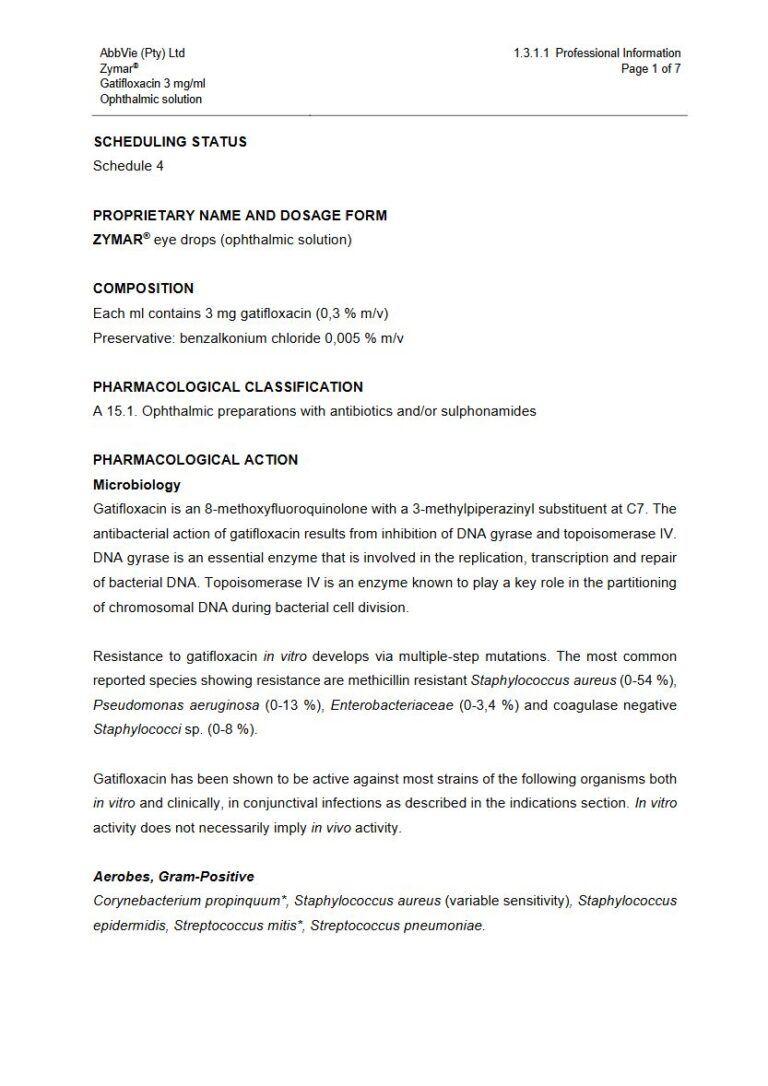 Healthcare Professionals Only
This content is for registered healthcare professionals
Sign in or create a free account to read the full package insert.
Free for HPCSA-registered professionals. Powered by Medinsert.
Clinical Particulars
Section 4 of the official insert — extracted exactly as issued, no alterations
4.1 Therapeutic indications
ZYMAR u00ae solution is indicated for the treatment of bacterial conjunctivitis caused by susceptible strains of the following organisms:
- Aerobic Gram-Positive bacteria
- Corynebacterium propinquum*
- Staphylococcus aureus
- Staphylococcus epidermidis
- Streptococcus mitis*
- Streptococcus pneumoniae
- Aerobic Gram-Negative bacteria
- Haemophilus influenzae
* Efficacy for this organism was studied in fewer than 10 infections.
4.2 Posology and method of administration
The recommended dosage regimen for the treatment of bacterial conjunctivitis is:
Days 1 and 2: Instil one drop every two hours in the affected eye(s) while awake, up to 8 times daily.
Days 3 through 7: Instil one drop up to four times daily while awake.
4.3 Contraindications
ZYMAR u00ae solution is contra-indicated in patients with a history of hypersensitivity to gatifloxacin, to other quinolones, or to any of the components in this medication.
4.4 Special warnings and precautions for use
NOT SUITABLE FOR INJECTION. ZYMAR u00ae solution should not be injected subconjunctivally, nor should it be introduced directly in the anterior chamber of the eye. As the possibility of adverse effects on the corneal permeability, and the danger of disruption of the corneal epithelium with prolonged or repeated usage of benzalkonium chloride preserved ophthalmological preparations, cannot be excluded, regular ophthalmological examination is required. Caution should be exercised in the use of benzalkonium chloride preserved topical medication over an extended period in patients with extensive ocular surface diseases.
In patients receiving systemic quinolones, including gatifloxacin, serious and occasionally fatal hypersensitivity (anaphylactic) reactions, some following the first dose, have been reported. Some reactions were accompanied by cardiovascular collapse, loss of consciousness, angioedema (including laryngeal, pharyngeal or facial oedema), airway obstruction, dyspnoea, urticaria, and itching. There have been reports of Steven-Johnson Syndrome and anaphylactic reaction reported in associated with topical gatifloxacin use. If a rash or an allergic reaction to gatifloxacin occurs, discontinue the medicine and contact your doctor. Serious acute hypersensitivity reactions may require immediate emergency treatment. Oxygen and airway management should be administered as clinically indicated. Prolonged use may result in overgrowth of non-susceptible organisms, including fungi. If superinfection occurs discontinue use and institute alternative therapy. Whenever clinical judgement dictates, the patient should be examined with the aid of magnification, such as slit lamp biomicroscopy and, where appropriate, fluorescein staining.
Patients should be advised not to wear contact lenses if they have signs and symptoms of bacterial conjunctivitis. ZYMAR u00ae contains the preservative benzalkonium chloride, which may be absorbed by and cause discolouration of soft contact lenses. Patients wearing soft (hydrophilic) contact lenses should be instructed to remove contact lenses prior to administration of ZYMAR u00ae and wait at least 15 minutes following administration before reinserting soft contact lenses. Patients should be instructed to avoid allowing the tip of the bottle to contact the eye or surrounding structures, fingers, or any other surface.
Paediatric use: Safety and effectiveness in infants below the age of one year have not been established.
Geriatric use: No overall differences in safety or effectiveness have been observed between elderly and younger patients.
4.5 Interactions with other medicines
Specific medicine interaction studies have not been conducted with ZYMAR u00ae ophthalmic solution. However, the systemic administration of some quinolones has been shown to elevate plasma concentrations of theophylline, interfere with the metabolism of caffeine, and enhance the effects of the oral anticoagulant warfarin and its derivatives, and has been associated with transient elevations in serum creatinine in patients receiving systemic cyclosporine concomitantly.
4.6 Fertility, pregnancy and lactation
Because there are no adequate and well-controlled studies in pregnant women, ZYMAR u00ae solution should not be used during pregnancy.
Nursing mothers: It is not known whether this medicine is excreted in human milk. ZYMAR u00ae should not be used by nursing mothers.
4.7 Effects on ability to drive and use machines
If transient blurred vision occurs at instillation, the patient should wait until the vision clears before driving or using machinery.
4.8 Undesirable effects
For each indication the frequency of adverse reactions arising from clinical experience is given as follows: Very common ( u2265 1/10); Common ( u2265 1/100, <1/10); Uncommon ( u2265 1/1 000, <1/100); Rare ( u2265 1/10 000, <1/1 000); Very rare (<1/10 000).
Eye disorders
- Very common: Conjunctivitis NEC
- Common: Punctate keratitis, papillary conjunctivitis, increased lacrimation, conjunctival disorder NOS, eyelid oedema, reduced visual acuity, red eye, eye irritation, eye pain, eye discharge, dry eye NEC, conjunctival haemorrhage.
- Uncommon: Chemosis
Skin and subcutaneous tissue disorders
- Common: Erythema NEC
- Uncommon: Contact dermatitis
Gastrointestinal disorders
- Common: Taste disturbance
Nervous system disorders
- Common: Headache NOS
Post-marketing experience
The following adverse reactions have been identified during post-marketing use of ZYMAR u00ae in clinical practice. Because post-marketing reporting of these reactions is voluntary and from a population of uncertain size, it is not always possible to reliably estimate the frequency of these reactions. The reactions have been chosen for inclusion due to a combination of the frequency of reporting and possible causal connection to ZYMAR u00ae.
Eye disorders: Blepharitis, conjunctival/ocular hyperaemia, blurred vision, eye pruritus, eye swelling (including corneal and conjunctival oedema), eye irritation, eye pain.
Gastrointestinal disorders: Nausea.
Immune system disorders: Hypersensitivity, anaphylactic reactions and angioedema (including pharyngeal, oral or facial oedema).
Respiratory, thoracic and mediastinal disorders: Dyspnoea.
Skin and subcutaneous tissue disorders: Pruritus (including generalised pruritus), rash, urticaria.
4.9 Overdose
See SIDE EFFECTS. Treatment is symptomatic and supportive.
