
Zytiga 250mg & 500 mg Tablet
PDF Leaflet Revision Date: 15 November 2022
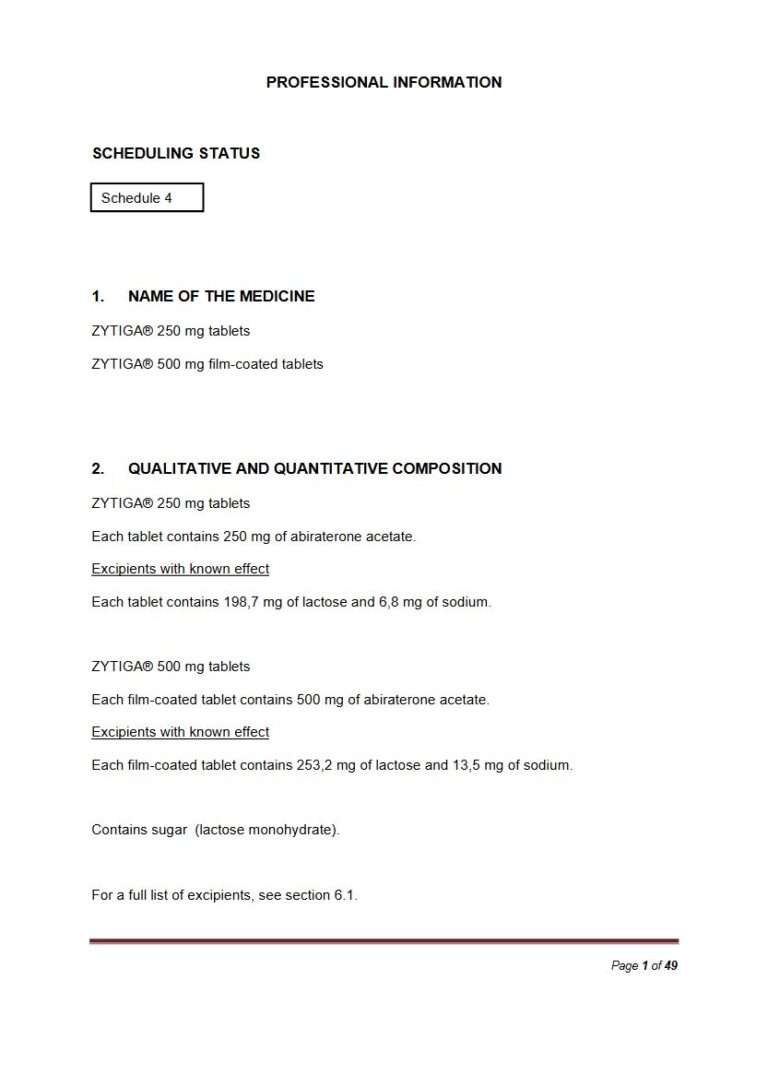
Clinical Summary
Quick overview from the medicine insert
Indication
Treatment of high-risk metastatic prostate cancer and metastatic castration-resistant prostate cancer.
Dosage (summary)
1 g daily (two 500 mg or four 250 mg tablets) on an empty stomach.
Special Populations
- Hepatic impairment
- Renal impairment
Pregnancy & Breastfeeding
Contraindicated in pregnancy; not for use in women.
Key Drug Interactions
- Strong CYP3A4 inducers
- Corticosteroids
Contraindications
- Hypersensitivity to abiraterone
- Moderate to severe hepatic impairment
- Pregnancy
- Women
Common side effects
- Hypokalaemia
- Hypertension
- Peripheral oedema
- Increased liver enzymes
Counselling Points
- Take on an empty stomach
- Monitor for liver function
- Use contraception during treatment
Serious warnings
- Hepatotoxicity
- Cardiovascular risks
- Mineralocorticoid excess
Important Disclaimer
The Zytiga 250mg & 500 mg Tablet professional information leaflet below is the property of Janssen Pharmaceutica and is provided on Medinsert exactly as issued, with no.. alterations or editorial changes. We make every effort to keep content current by updating documents as soon as new versions become available. Medinsert serves as a trusted access point for healthcare professionals, but does not replace official sources or clinical judgement. For more details, please read our full disclaimer. read more>>
 Healthcare Professionals Only
This content is for registered healthcare professionals
Sign in or create a free account to read the full package insert.
Free for HPCSA-registered professionals. Powered by Medinsert.
Clinical Particulars
Section 4 of the official insert — extracted exactly as issued, no alterations
4.1 Therapeutic indications
ZYTIGA is indicated with low-dose corticosteroids (prednisone or prednisolone) in adult males for the treatment of:
- high-risk metastatic hormone treatment nau00d4ve prostate cancer (mHNPC) or newly diagnosed high-risk metastatic hormone sensitive prostate cancer (mHSPC) in combination with androgen deprivation therapy (LHRH agonist or surgical castration). High-risk is defined as having at least 2 of the following 3 risk factors: (1) Gleason score of u2265 8, (2) presence of 3 or more bone lesions, (3) presence of measurable visceral (excluding lymph node disease) metastasis.
- metastatic castration resistant prostate cancer with bone metastases who are asymptomatic or mildly symptomatic after failure of androgen deprivation therapy in whom chemotherapy is not yet clinically indicated.
- metastatic advanced prostate cancer (castration resistant prostate cancer) who have received prior chemotherapy containing docetaxel.
4.2 Posology and method of administration
This medicine should be prescribed by an appropriate healthcare professional.
Posology
The recommended dose of ZYTIGA is 1 g (two 500 mg tablets or four 250 mg tablets) as a single daily dose that must not be taken with food. ZYTIGA tablets must be taken as a single dose once daily on an empty stomach. ZYTIGA must be taken at least two hours after eating and food must not be eaten for at least one hour after taking ZYTIGA (see Method of administration below). Taking ZYTIGA with food increases systemic exposure to abiraterone (see sections 4.5 and 5.2).
Patients should be maintained on ZYTIGA until radiographic progression and symptomatic/clinical progression and until PSA progression (confirmed 25 % increase over the patientu2019s baseline/nadir).
Dosage of prednisone or prednisolone
For metastatic hormone nau00d4ve prostate cancer (mHNPC) or hormone sensitive prostate cancer (mHSPC), ZYTIGA is used with 5 mg prednisone or prednisolone once daily. For metastatic castration-resistant prostate cancer (mCRPC), ZYTIGA is used with 10 mg prednisone or prednisolone daily.
Recommended monitoring
Serum transaminases and bilirubin should be measured prior to starting treatment with ZYTIGA, every two weeks for the first three months of treatment and monthly thereafter. Blood pressure, serum potassium and fluid retention should be monitored monthly (see section 4.4).
In the event of a missed daily dose of either ZYTIGA, prednisone or prednisolone, treatment should be resumed the following day with the usual daily dose.
Hepatic impairment: No dose adjustment is necessary for patients with pre-existing mild hepatic impairment, Child-Pugh class A. There are no data on the clinical safety and efficacy of multiple doses of ZYTIGA when administered to patients with moderate or severe hepatic impairment (Child Pugh Class B or C). No dose adjustment can be predicted. ZYTIGA should not be used in patients with moderate to severe hepatic impairment (see section 4.3).
For patients who develop hepatotoxicity during treatment with ZYTIGA (alanine aminotransferase (ALT) or aspartate aminotransferase (AST) increases above 5 times the upper limit of normal or bilirubin increases above 3 times the upper limit of normal), treatment should be withheld immediately until liver function tests normalise (see section 4.4).
Re-treatment following return of liver function tests to the patientu2019s baseline may be given at a reduced dose of 500 mg once daily. For patients being re-treated, serum transaminases and bilirubin should be monitored at a minimum of every two weeks for three months and monthly thereafter. If hepatotoxicity recurs at the reduced dose of 500 mg daily, treatment should be discontinued. Reduced doses should not be taken with food (see previous).
If patients develop severe hepatotoxicity (ALT or AST 20 times the upper limit of normal) anytime while on therapy, ZYTIGA should be discontinued and patients should not be re-treated with ZYTIGA.
Renal impairment: No dose adjustment is necessary for patients with renal impairment (see section 5.2).
Paediatric population: There is no relevant use of ZYTIGA in paediatric patients, as prostate cancer is not present in the paediatric population.
Method of administration
ZYTIGA is for oral use. ZYTIGA must be taken on an empty stomach, at least one hour before or at least two hours after a meal. The tablets should be swallowed whole with water.
Precautions to be taken before handling or administering ZYTIGA. Based on its mechanism of action, ZYTIGA may harm a developing foetus; therefore, women (including healthcare professionals), who are pregnant or women who may be pregnant should not handle ZYTIGA 250 mg tablets without protection, e.g., gloves (see section 4.6 and 6.6). For concomitant use with prednisolone, the Professional Information for prednisolone should be consulted.
4.3 Contraindications
ZYTIGA is contraindicated in:
- Patients with hypersensitivity to abiraterone acetate or to any of the excipients listed in section 6.1.
- Pregnancy and Lactation (see section 4.6).
- Moderate (Child-Pugh B) to severe (Child-Pugh C) hepatic impairment (see sections 4.2, 4.4 and 5.2).
- Women should not use ZYTIGA.
- Concomitant administration with rifampicin (see section 4.5).
- ZYTIGA with prednisone or prednisolone is contraindicated in combination with Ra-223.
4.4 Special warnings and precautions for use
Hypertension, hypokalaemia, fluid retention and cardiac failure due to mineralocorticoid excess
ZYTIGA may cause hypertension, hypokalaemia and fluid retention (see section 4.8) as a consequence of increased mineralocorticoid levels resulting from CYP17 inhibition (see section 5.1). Co-administration of a corticosteroid suppresses adrenocorticotropic hormone (ACTH) drive, resulting in a reduction in incidence and severity of these adverse reactions. Caution is required in treating patients whose underlying medical conditions might be compromised by increases in blood pressure, hypokalaemia (e.g., those on cardiac glycosides) or fluid retention (e.g., those with heart failure, severe or unstable angina pectoris, recent myocardial infarction or ventricular dysrhythmia and those with severe renal impairment).
ZYTIGA should be used with caution in patients with a history of cardiovascular disease. The Phase 3 studies conducted with ZYTIGA excluded patients with uncontrolled hypertension, clinically significant heart disease as evidenced by myocardial infarction, or arterial thrombotic events in the past 6 months, severe or unstable angina, or New York Heart Association Class (NYHA) III or IV heart failure (study 301) or Class II to IV heart failure (studies 3011 and 302) or cardiac ejection fraction measurement of < 50 %. In studies 3011 and 302, patients with atrial fibrillation, or other cardiac arrhythmia requiring medical therapy were excluded. Safety in patients with left ventricular ejection fraction (LVEF) < 50 % or NYHA Class III or IV heart failure (in study 301) or NYHA Class II to IV heart failure (in studies 3011 and 302) was not established (see sections 4.8 and 5.1).
Before treating patients with a significant risk for congestive heart failure (e.g. a history of cardiac failure, uncontrolled hypertension, or cardiac events such as ischaemic heart disease), consider obtaining an assessment of cardiac function (e.g. echocardiogram). Before treatment with ZYTIGA, cardiac failure should be treated and cardiac function optimised. Hypertension, hypokalaemia and fluid retention should be corrected and controlled. During treatment, blood pressure, serum potassium, fluid retention (weight gain, peripheral oedema), and other signs and symptoms of congestive heart failure should be monitored every 2 weeks for 3 months, then monthly thereafter and abnormalities corrected. QT prolongation has been observed in patients experiencing hypokalaemia in association with ZYTIGA treatment. Assess cardiac function as clinically indicated, institute appropriate management and consider discontinuation of this treatment if there is a clinically significant decrease in cardiac function (see section 4.2).
Hepatotoxicity and hepatic impairment
Marked increases in liver enzymes leading to ZYTIGA discontinuation or dose modification occurred in controlled clinical studies (see section 4.8). Serum transaminase and bilirubin levels should be measured prior to starting treatment with ZYTIGA, every two weeks for the first three months of treatment, and monthly thereafter. If clinical symptoms or signs suggestive of hepatotoxicity develop, serum transaminases should be measured immediately. If at any time the ALT or AST rises above 5 times the upper limit of normal or the bilirubin rises above 3 times the upper limit of normal, treatment with ZYTIGA should be interrupted immediately and liver function closely monitored.
Re-treatment with ZYTIGA may take place only after return of liver function tests to the patientu2019s baseline and at a reduced dose level (see section 4.2). If patients develop severe hepatotoxicity (ALT or AST 20 times the upper limit of normal) anytime while on therapy, ZYTIGA should be permanently discontinued and patients should not be re-treated with ZYTIGA. There are no data on the clinical safety and efficacy of multiple doses of ZYTIGA when administered to patients with moderate or severe hepatic impairment (Child Pugh Class B or C). ZYTIGA should not be used in patients with moderate to severe hepatic impairment (see section 4.3). There have been post-marketing reports of acute liver failure and fulminant hepatitis, some with fatal outcome (see section 4.8).
4.5 Interactions with other medicines
Strong inducers of CYP3A4 during treatment are to be avoided unless there is no therapeutic alternative, due to risk of decreased exposure to abiraterone (see section 4.5).
Corticosteroid withdrawal and coverage of stress situations
Caution is advised and monitoring for adrenocortical insufficiency should occur if patients need to be withdrawn from prednisone or prednisolone. If ZYTIGA is continued after corticosteroids are withdrawn, patients should be monitored for symptoms of mineralocorticoid excess (see previous).
In patients on prednisone or prednisolone who are subjected to unusual stress, increased dosage of corticosteroids may be indicated before, during and after the stressful situation.
Bone density
Decreased bone density may occur in men with metastatic advanced prostate cancer. The use of ZYTIGA in combination with a glucocorticoid could increase this effect.
Use with chemotherapy
The safety and efficacy of concomitant use of ZYTIGA with cytotoxic chemotherapy has not been established.
Use in combination with radium 223 dichloride
In a randomised clinical trial in patients with asymptomatic or mildly symptomatic bone-predominant metastatic castration resistant prostate cancer, at the time of unblinding, the addition of radium 223 dichloride to ZYTIGA plus prednisone/prednisolone showed an increase in mortality and an increased rate of fracture. Radium 223 dichloride is not recommended for use in combination with ZYTIGA plus prednisone/prednisolone outside of clinical trials.
Hypoglycaemia
Cases of hypoglycaemia have been reported when Zytiga plus prednisone/prednisolone was administered to patients with pre-existing diabetes receiving pioglitazone or repaglinide (see Section 4.5). Blood glucose should be monitored in patients with diabetes.
Vaccination with live attenuated bacterial or viral vaccines
Prostate cancer patients on treatment should receive guidance on age and indication appropriate vaccinations, in particular live attenuated bacterial or viral vaccines. Patients should also be advised to take extra precaution should they come into contact with someone who has received a live vaccine.
Tuberculosis and/or HIV
Prostate cancer patients with tuberculosis and/or HIV, who are not well-controlled on treatment should be monitored closely.
Intolerance to excipients
Lactose ZYTIGA contains lactose. Patients with rare hereditary problems of galactose intolerance; e.g. galactosaemia the Lapp lactase deficiency or glucose-galactose malabsorption should not take ZYTIGA.
Sodium
This medicine also contains more than 1 mmol (or 27,2 mg) sodium per dose of four 250 mg tablets or two 500 mg tablets. To be taken into consideration by patients on a controlled sodium diet.
4.6 Fertility, pregnancy and lactation
Women should not use ZYTIGA. Women of childbearing potential There are no human data on the use of ZYTIGA in pregnancy and ZYTIGA is not for use in women of childbearing potential. Maternal use of a CYP17 inhibitor is expected to produce changes in hormone levels that could affect development of the foetus.
Contraception in males and females
It is not known whether abiraterone or its metabolites are present in semen. A condom is required if the patient is engaged in sexual activity with a pregnant woman. If the patient is engaged in sex with a woman of childbearing potential, a condom is required along with another effective contraceptive method until one week after the last dose of ZYTIGA.
Pregnancy
ZYTIGA is contraindicated in women who are or may potentially be pregnant (see section 4.3). Pregnant women or women of child-bearing potential should handle ZYTIGA uncoated tablets with gloves.
Breastfeeding
ZYTIGA is not for use in women. It is not known if either abiraterone or its metabolites are excreted in human breast milk.
Fertility
In fertility studies in both male and female rats, ZYTIGA reduced fertility, which was completely reversible in 4 to 16 weeks after ZYTIGA was stopped. It is recommended to store semen before starting treatment with ZYTIGA in patients who might want to father a child.
4.7 Effects on ability to drive and use machines
ZYTIGA has no or negligible influence on the ability to drive or use machines.
4.8 Undesirable effects
Clinical trial data
Summary of the safety profile In an analysis of adverse reactions of composite Phase 3 studies with ZYTIGA, adverse reactions that were observed in u2265 10 % of patients were peripheral oedema, hypokalaemia, hypertension, urinary tract infection, and increased alanine aminotransferase and/or increased aspartate aminotransferase. Other important adverse reactions include, cardiac disorders, hepatotoxicity, fractures, and allergic alveolitis. ZYTIGA may cause hypertension, hypokalaemia and fluid retention as a pharmacodynamic consequence of its mechanism of action. In Phase 3 studies anticipated mineralocorticoid effects were seen more commonly in patients treated with ZYTIGA versus patients treated with placebo: hypokalaemia 18 % versus 8 %, hypertension 22 % versus 16 % and fluid retention (peripheral oedema) 23 % versus 17 %, respectively.
In patients treated with ZYTIGA versus patients treated with placebo: Grades 3 and 4 hypokalaemia were observed in 6 % versus 1 %, grades 3 and 4 hypertension were observed in 7 % versus 5 %, and grades 3 and 4 fluid retention oedema were observed in 1 % versus 1 % of patients, respectively. Mineralocorticoid reactions generally were able to be successfully managed medically. Concomitant use of a corticosteroid reduces the incidence and severity of these adverse reactions (see section 4.4).
Tabulated summary of clinical adverse reactions
In studies of patients with metastatic advanced prostate cancer who were using a LHRH agonist, or were previously treated with orchiectomy, ZYTIGA was administered at a dose of 1 g daily in combination with low dose prednisone or prednisolone (either 5 or 10 mg daily depending on the indication). Adverse reactions observed during clinical studies with ZYTIGA are listed below by frequency category. Frequency categories are defined as follows: very common (u2265 1/10); common (u2265 1/100 to < 1/10); uncommon (u2265 1/1 000 to < 1/100); rare (u2265 1/10 000 to < 1/1 000) and very rare (< 1/10 000). Within each frequency grouping, undesirable effects are presented in order of decreasing seriousness.
4.9 Overdose
There is no specific antidote. In the event of an overdose, administration of ZYTIGA should be stopped and general supportive measures undertaken, including monitoring for dysrrhythmias. Liver function should also be assessed. In cases of overdose, side effects may be exacerbated and exaggerated.
Cardiac disorders
Myocardial infarction, QT prolongation
Respiratory, thoracic and mediastinal disorders
Allergic alveolitis
Hepatobiliary disorders
Fulminant hepatitis, acute hepatic failure
Musculoskeletal and connective tissue disorders
Rhabdomyolysis, myopathy
Immune System Disorders
Anaphylactic reaction
