
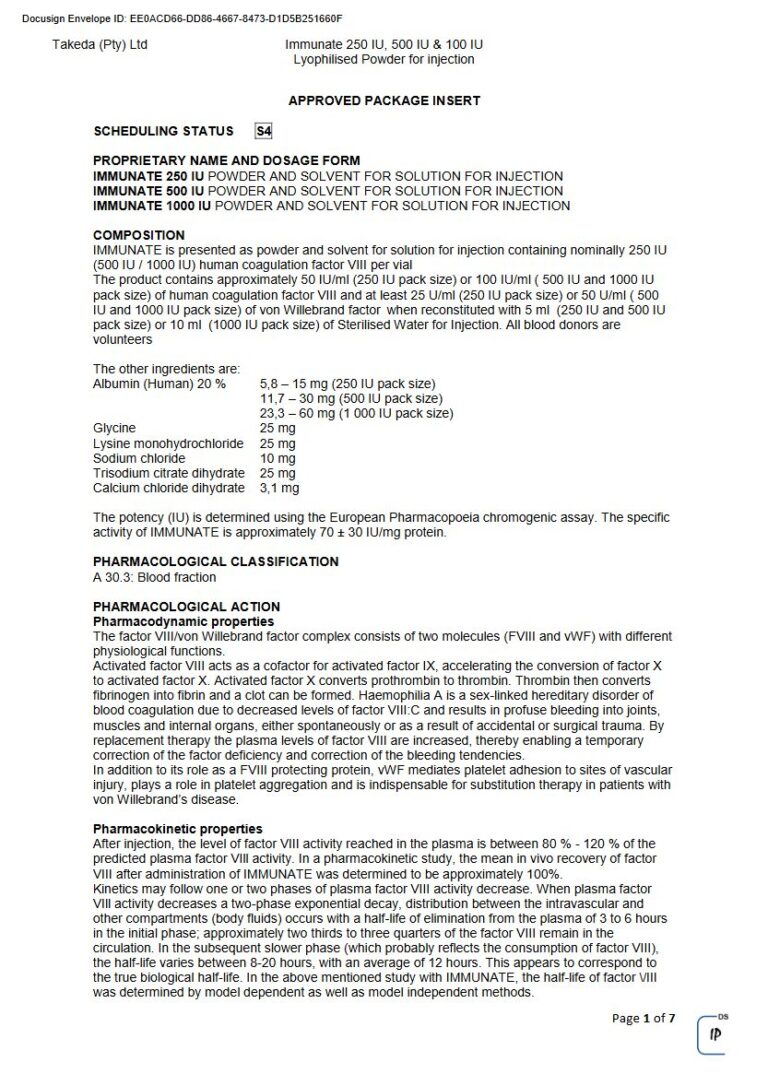
Immunate 250 Iu/500 Iu/100 Iu Injection
PDF Leaflet Revision Date: 20 July 2020
Clinical Summary
Quick overview from the medicine insert
Indication
Treatment and prophylaxis of bleeding in patients with haemophilia A and von Willebrand's disease.
Dosage (summary)
Dosage varies based on severity; typically 20-40 IU/kg every 2-3 days for prophylaxis.
Onset of Action / Duration
Onset: 30 mins, Duration: 8-20 hours
Special Populations
- Children under 6 years
- Pregnant women
Pregnancy & Breastfeeding
Use only if clearly indicated; limited data available.
Contraindications
- Hypersensitivity to active substance or excipients
Common side effects
- Allergic reactions
- Headache
- Nausea
- Vomiting
Counselling Points
- Inform about signs of allergic reactions
- Use aseptic technique for administration
Serious warnings
- Risk of hypersensitivity reactions
- Monitor for inhibitor development
Important Disclaimer
The Immunate 250 Iu/500 Iu/100 Iu Injection professional information leaflet below is the property of Takeda and is provided on Medinsert exactly as issued, with no.. alterations or editorial changes. We make every effort to keep content current by updating documents as soon as new versions become available. Medinsert serves as a trusted access point for healthcare professionals, but does not replace official sources or clinical judgement. For more details, please read our full disclaimer. read more>>
 Healthcare Professionals Only
This content is for registered healthcare professionals
Sign in or create a free account to read the full package insert.
Free for HPCSA-registered professionals. Powered by Medinsert.
Clinical Particulars
Section 4 of the official insert — extracted exactly as issued, no alterations
4.1 Therapeutic indications
u2022 Treatment and prophylaxis of bleeding in patients with congenital factor VIII deficiency or acquired factor VIII deficiency (haemophilia A, haemophilia A with factor VIII inhibitor, acquired factor VIII deficiency due to spontaneous development of factor VIII inhibitor).
u2022 Treatment of bleeding in patients with Von Willebrand's disease with factor VIII deficiency.
4.2 Posology and method of administration
Treatment should be initiated under the supervision of a physician experienced in the treatment of haemophilia.
Posology
The dosage and duration of the substitution therapy depend on the severity of the factor VIII deficiency, on the location and extent of the bleeding and on the patient's clinical condition. The number of units of factor VIII administered is expressed in International Units (IU), which is related to the current WHO standard for factor VIII products. Factor VIII activity in plasma is expressed either as a percentage (relative to normal human plasma) or in International Units (relative to an International Standard for Factor VIII concentrates). One International Unit (IU) of factor VIII activity is equivalent to that quantity of factor VIII in 1 ml of normal human plasma.
Dosage in Haemophilia A
The calculation of the required dosage of factor VIII as specified below is based on the empirical finding that 1 International Unit (IU) factor VIII per kg body weight raises the plasma factor VIII activity by 1.5% to 2% of normal activity. The required dosage is determined using the following formula:
Required units = body weight (kg) x desired factor VIII rise (%) x 0.5
The amount to be administered and the frequency of administration should always be oriented to the clinical effectiveness in the individual case.
Haemorrhages and Surgery
In the case of the following haemorrhagic events, the factor VIII activity should not fall below the given plasma activity level (in % of normal or IU/dl) in the corresponding period. The following table can be used to guide dosing in bleeding episodes and surgery:
Degree of haemorrhage / Type of surgical procedure
- Early haemarthrosis, muscle bleeding or oral bleeding: 20 - 40% (IU/dl) - Repeat every 12 to 24 hours. At least 1 day, until the bleeding episode as indicated by pain is resolved or healing is achieved.
- More extensive haemarthrosis, muscle bleeding or haematoma: 30 - 60% (IU/dl) - Repeat infusion every 12 u2013 24 hours for 3 u2013 4 days or more until pain and acute disability are resolved.
- Life threatening haemorrhages: 60 - 100% (IU/dl) - Repeat infusion every 8 to 24 hours until threat is resolved.
- Minor surgery (including tooth extraction): 30 - 60% (IU/dl) - Every 24 hours, at least 1 day, until healing is achieved.
- Major surgery: 80 u2013 100% (IU/dl) - Repeat infusion every 8 u2013 24 hours until adequate wound healing, then therapy for at least another 7 days to maintain a factor VIII activity of 30% to 60% (IU/dl).
The amount and frequency of administration should be adapted to the clinical response in the individual case. Under certain circumstances (e.g. presence of a low titre inhibitor) doses larger than those calculated using the formula may be necessary. During the course of treatment, appropriate determination of factor VIII levels is advised to guide the dose to be administered and the frequency of repeated infusions. In the case of major surgical interventions in particular, precise monitoring of the substitution therapy by means of coagulation analysis (plasma factor VIII activity) is indispensable. Individual patients may vary in their response to factor VIII, achieving different levels of in-vivo recovery and demonstrating different half-lives.
Long term prophylaxis
For long term prophylaxis against bleeding in patients with severe haemophilia A, the usual doses are 20 to 40 IU of factor VIII per kg body weight at intervals of 2 to 3 days. In some cases, especially in younger patients, shorter dosage intervals or higher doses may be necessary.
Haemophiliacs with inhibitor to factor VIII
Patients should be monitored for the development of factor VIII inhibitors. If the expected factor VIII activity plasma levels are not attained, or if bleeding is not controlled with an appropriate dose, an assay should be performed to determine if a factor VIII inhibitor is present. In patients with high levels of inhibitor, factor VIII therapy may not be effective and other therapeutic options should be considered. Management of such patients should be directed by physicians with experience in the care of patients with haemophilia.
Von Willebrandu2019s disease with factor VIII deficiency
IMMUNATE is indicated for factor VIII replacement therapy in patients with von Willebrand's disease in whom factor VIII activity is reduced. Replacement therapy with IMMUNATE to control haemorrhages and to prevent bleeding episodes associated with surgical interventions follows the guidelines given for haemophilia A.
Method of administration
IMMUNATE should be administered slowly via the intravenous route. The rate of administration should be determined, at a rate that ensures the comfort of the patient up to a maximum of 2 ml per minute. IMMUNATE is to be reconstituted only immediately before administration. The solution should then be used immediately (preparation does not contain preservatives). Solutions that are turbid or have deposits must not be used. It is advisable to rinse a common venous access with isotonic saline prior to and after infusion of IMMUNATE.
4.3 Contraindications
Hypersensitivity to the active substance or to any of the excipients.
4.4 Special warnings and precautions for use
As with any intravenous protein product, allergic type hypersensitivity reactions are possible. Patients should be informed of the early signs of hypersensitivity reactions including hives, generalised urticaria, tightness of the chest, wheezing, hypotension, and anaphylaxis. If these symptoms occur, they should be advised to discontinue use of the product immediately and contact their physician. In the case of shock, the current medical standards for shock treatment should be observed. As the quantity of sodium in the maximum daily dose may exceed 200 mg, it may be harmful to people on a low sodium diet. The formation of neutralising antibodies (inhibitors) to Factor VIII is a known complication in the management of individuals with haemophilia A. These inhibitors are usually IgG immunoglobulins directed against the factor VIII procoagulant activity, which are quantified in Bethesda Units (BU) per ml of plasma using the modified assay. The risk of developing inhibitors is correlated to the exposure to anti-haemophilic factor VIII, this risk being highest within the first 20 exposure days. Rarely, inhibitors may develop after the first 100 exposure days. Patients treated with human coagulation factor VIII should be carefully monitored for the development of inhibitors by appropriate clinical observations and laboratory testing. The product should be used with caution in children less than 6 years of age, who have limited exposure to factor VIII products, as there is limited clinical data available for this patient group. When medicinal products prepared from human blood or plasma are administered, infectious diseases due to transmission of infective agents cannot be totally excluded. This also applies to pathogens of unknown nature. The risk of transmission of infective agents is however reduced by:
- selection of donors by a medical interview and screening of individual donations and plasma pools for HBsAg and antibodies to HIV and HCV.
- testing of plasma pools for genomic material of HIV-1, HIV-2, HAV, HBV, HCV, and parvovirus B19.
- viral inactivation/removal procedures included in the production process that have been validated using target and/or model viruses. These procedures are considered effective for HIV-1, HIV-2, HAV, HBV and HCV.
The viral inactivation/removal procedures may be of limited value against non-enveloped viruses such as parvovirus B19. Parvovirus B19 infection may be serious for pregnant women (foetal infection) and for individuals with immunodeficiency or increased red cell turnover (e.g. in haemolytic anaemia). Appropriate vaccination (hepatitis A and B) for patients receiving plasma derived Factor VIII concentrates is recommended. In the interest of patients, it is recommended that, whenever possible, the name and batch number of the product is recorded every time IMMUNATE is administered to them.
4.5 Interactions with other medicines
No interactions of human coagulation factor VIII products with other medicinal products are known.
4.6 Fertility, pregnancy and lactation
Animal reproduction studies have not been conducted with factor VIII. Based on the rare occurrence of haemophilia A in women, experience regarding the use of factor VIII during pregnancy and breast-feeding is not available. Therefore, factor VIII should be used during pregnancy and lactation only if clearly indicated.
4.7 Effects on ability to drive and use machines
Not applicable.
4.8 Undesirable effects
The undesirable effects reported in the listings hereafter are based on reports from clinical trials and on post-marketing experience for IMMUNATE. Their frequency has been evaluated by using the following criteria: very common (>1/10), common (>1/100, 1/1,000, 1/10,000, <1/1,000) and very rare (<1/10,000).
Clinical trials
The incidence rate is uncommon (>1/1,000, <1/100), for all the Adverse Events reported below.
Immune system disorder
- Allergic reaction
Post Marketing Experience
The incidence rate is <1/10,000, i.e. very rare, for all the Adverse Events reported below.
Blood and lymphatic system disorders
- Antibodies (Inhibitors) to Factor VIII
- Haemolysis in blood group A, B or AB patients
Immune system disorders
- Angioedema
- Urticaria (Generalised)
- Hives
Nervous system disorders
- Headache
Cardiac disorders
- Tachycardia
Vascular disorders
- Flushing
- Hypotension
Respiratory, thoracic and mediastinal disorder
- Wheezing
Gastrointestinal disorders
- Nausea
- Vomiting
General disorders and administration site conditions
- Burning and stinging at the infusion site
- Chills
- Lethargy
- Tightness of the chest
- Fever
- Therapeutic response decreased
Hypersensitivity or allergic reactions (which may include angioedema, burning and stinging at the infusion site, chills, flushing, generalised urticaria, headache, hives, hypotension, lethargy, nausea, restlessness, tachycardia, tightness of the chest, tingling, vomiting, wheezing) have been observed very rare, and may in very rare cases progress to severe anaphylaxis (including shock). On very rare occasions, fever has been observed. Patients with haemophilia A may develop neutralising antibodies (inhibitors) to factor VIII. If such inhibitors occur, the condition will manifest itself as an insufficient clinical response. In such cases, it is recommended that a specialised haemophilia centre be contacted. Following administration of large doses (e.g. when more than 100% of plasma Factor VIII levels are intended), hemolysis may occur in blood group A, B or AB patients, due to the presence of isoagglutinins in the product.
4.9 Overdose
No symptoms of overdose with human coagulation factor VIII have been reported.
