
Neostigmine Methylsulphate Fresenius Injection
Clinical Summary
Quick overview from the medicine insert
Important Disclaimer
The Neostigmine Methylsulphate Fresenius Injection professional information leaflet below is the property of Fresenius Kabi Manufacturing Sa and is provided on Medinsert exactly as issued, with no.. alterations or editorial changes. We make every effort to keep content current by updating documents as soon as new versions become available. Medinsert serves as a trusted access point for healthcare professionals, but does not replace official sources or clinical judgement. For more details, please read our full disclaimer. read more>>
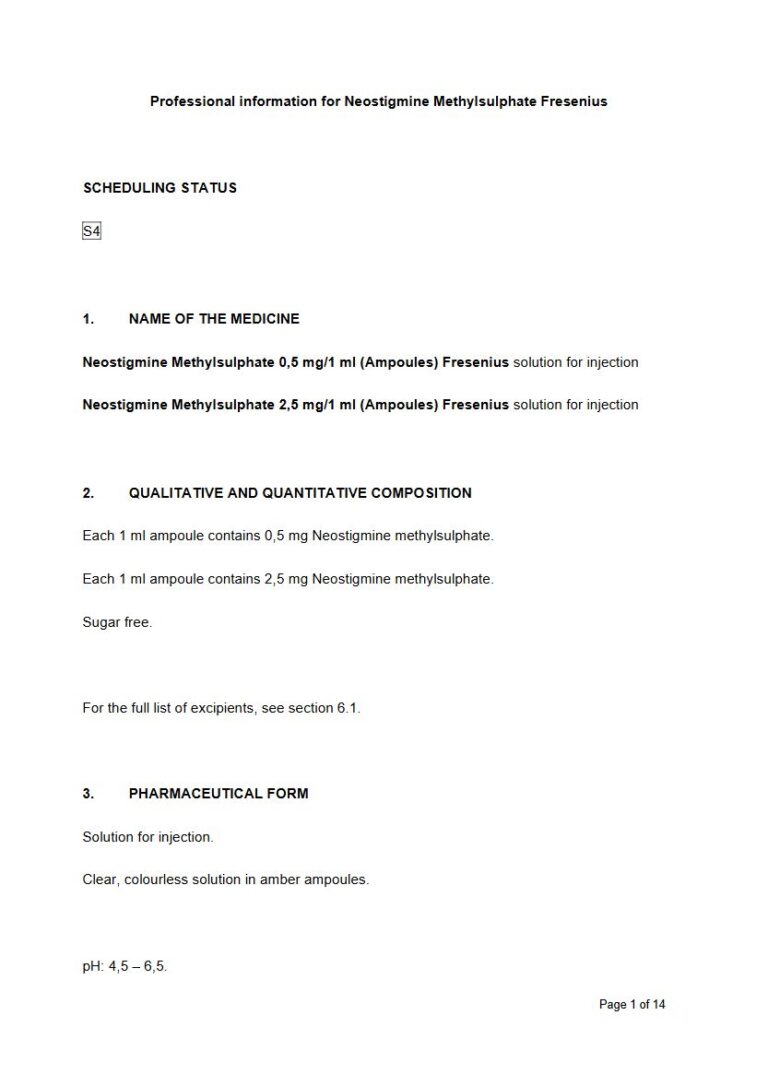 Healthcare Professionals Only
This content is for registered healthcare professionals
Sign in or create a free account to read the full package insert.
Free for HPCSA-registered professionals. Powered by Medinsert.
Clinical Particulars
Section 4 of the official insert — extracted exactly as issued, no alterations
4.1 Therapeutic indications
u2022 Atony of the smooth muscle of the gastrointestinal tract: Paralytic ileus and abdominal distension.
u2022 Atony of the smooth muscle of the urinary bladder: Post-operative dysuria.
u2022 Myasthenia gravis.
u2022 2,5 mg/ml injection: Termination of the effects of competitive neuromuscular blocking agents such as d-tubocurarine and gallamine.
4.2 Posology and method of administration
Childrenu2019s dose: A suggested dose for children is 50 mcg per kg body mass.
Paralytic ileus, abdominal distension or dysuria: 0,5 to 1,0 mg subcutaneously or intramuscularly.
Termination of the effects of neuromuscular blockade: 2 to 3 mg given by slow intravenous injection over a period of 60 seconds. Additional Neostigmine Methylsulphate Fresenius may be given until the muscle power is normal but a total of 5 mg should not be exceeded. Atropine sulphate may be given concomitantly at a dose of 0,6 u2013 1,2 mg to control adverse effects. The recommended ratio of atropine to neostigmine given, varies from 1:2 to 1:3.
Myasthenia gravis: 1 to 2,5 mg daily in divided doses subcutaneously or intramuscularly.
Method of administration Neostigmine Methylsulphate Fresenius may be administered by intravenous (IV), intramuscular (IM) or subcutaneous (SC) injection. Neostigmine Methylsulphate Fresenius should be given very slowly by the IV route.
4.3 Contraindications
u2022 Hypersensitivity to neostigmine methylsulphate or to any of the excipients of Neostigmine Methylsulphate Fresenius listed in section 6.1.
u2022 Mechanical intestinal or urinary obstruction.
u2022 In conjunction with depolarising muscle relaxants, such as suxamethonium.
u2022 During cyclopropane or halothane anaesthesia, although it may be used after withdrawal of these medicines.
u2022 Patients with diabetes, gangrene or peritonitis.
4.4 Special warnings and precautions for use
Allergic reactions have been reported. Neostigmine Methylsulphate Fresenius should be used with extreme caution in patients who have undergone recent intestinal or bladder surgery, and in patients with bronchial asthma, as the parasympathomimetic action of neostigmine may cause bronchoconstriction. Patients who are hyperreactive to neostigmine experience a severe cholinergic reaction to the medicine. When Neostigmine Methylsulphate Fresenius is given by injection, atropine should always be available to counteract any excessive muscarinic reactions.
When Neostigmine Methylsulphate Fresenius injection is used for myasthenia gravis; absence of clinical improvement may be indicative of overdosage or underdosage. Overdosage may lead to a cholinergic crisis characterised by muscle weakness affecting respiration. Increase in the severity of the disease may lead to myasthenic crisis also characterised by severe muscle weakness. Differential diagnosis can be aided by the edrophonium chloride test. If 0,1 ml (1 mg) or at most 0,2 ml (2 mg) of edrophonium chloride is given intravenously, a marked improvement indicates myasthenic crisis. Any other response, whether equivocal or exacerbation of symptoms, must be considered to be cholinergic in origin. Bradycardia, with the potential for progression to asystole, may occur in patients receiving neostigmine by intravenous injection unless atropine is given simultaneously. Neostigmine Methylsulphate Fresenius should be used with caution in patients with bronchial asthma, cardiovascular disorders including, cardiac dysrhythmias, pre-existing bradycardia, recent myocardial infarction or coronary occlusion, epilepsy, hypotension, hyperthyroidism, Parkinsonism, peptic ulceration or vagotonia. As the severity of myasthenia gravis can fluctuate considerably, Neostigmine Methylsulphate Fresenius should be used with caution in patients with myasthenia gravis to avoid provoking a cholinergic crisis with increased muscular weakness. Administration of anticholinesterase medicines to patients with intestinal anastomoses may produce rupture of the anastomosis or leakage of intestinal contents.
Neostigmine Methylsulphate Fresenius should be used with caution in elderly patients, these patients may be more susceptible to dysrhythmias than younger patients. As Neostigmine Methylsulphate Fresenius is excreted mainly by the kidneys, caution is advised in cases of impaired renal function and Addisonu2019s disease.
4.5 Interaction with other medicines and other forms of interaction
Anticholinesterase medicines are sometimes effective in reversing neuromuscular block induced by aminoglycoside antibiotics. However, aminoglycosides, clindamycin, colistin, cyclopropane and the halogenated inhalation anaesthetics possess neuromuscular blocking activity and may antagonize the effects of Neostigmine Methylsulphate Fresenius. These medicines must be used with care in conjunction with Neostigmine Methylsulphate Fresenius in patients with myasthenia gravis. Hypotension and prolonged bradycardia have occurred in patients receiving beta-adrenoceptor blocking agents following administration of Neostigmine Methylsulphate Fresenius. Some antidysrhythmic medicines such as quinidine may antagonise Neostigmine Methylsulphate Fresenius action by interfering with neuromuscular transmission. Chloroquinine, hydroxychloroquine, beta-blockers and lithium may also reduce the effectiveness of treatment with Neostigmine Methylsulphate Fresenius.
Administration of methylprednisone to patients receiving Neostigmine Methylsulphate Fresenius or pyridostigmine has exacerbated symptoms and produced profound weakness often necessitating assisted ventilation. Neostigmine Methylsulphate Fresenius effectively antagonises the effect of non-depolarizing muscle relaxants (e.g. tubocurarine, gallamine or pancuronium) and this interaction is used to therapeutic advantage to reverse muscle relaxation after surgery. Neostigmine does not antagonise, and it may in fact prolong, the phase I block of depolarizing muscle relaxants such as succinylcholine. Neostigmine Methylsulphate Fresenius can inhibit the metabolism of suxamethonium and enhance and prolong its action. Prolonged respiratory depression with extended periods of apnoea may occur. Atropine antagonises the muscarinic effects of Neostigmine Methylsulphate Fresenius, the interaction is utilised to counteract the muscarinic symptoms of the neostigmine toxicity.
4.6 Fertility, pregnancy and lactation
Pregnancy Neostigmine Methylsulphate Fresenius is contraindicated during pregnancy and lactation (see section 4.3). The severity of myasthenia gravis often fluctuates considerably during pregnancy, particular care is needed to avoid cholinergic crisis caused by overdosage; it has been reported that neonatal myasthenia may follow administration of large doses during pregnancy.
Breastfeeding The amount of Neostigmine Methylsulphate Fresenius distributed into breast milk is very small, but breastfed infants need to be monitored.
4.7 Effects on ability to drive and use machines
There is no information of the effects of Neostigmine Methylsulphate Fresenius on the ability to drive and use machines. Patients should be advised to take special care before performing tasks requiring their attention, until they know how Neostigmine Methylsulphate Fresenius will affect them.
4.8 Undesirable effects
After the administration of Neostigmine Methylsulphate Fresenius the following side effects may occur:
System organ class (SOC) Frequency Not known (cannot be estimated from the available data)
- Immune system disorders: Hypersensitivity, angioedema, anaphylactic reaction
- Nervous system disorders: Cholinergic syndrome, especially at high doses. In patients with myasthenia gravis, cholinergic crisis may be difficult to distinguish from myasthenia crisis (see section 4.9)
- Eye disorders: Miosis, lacrimation increased
- Cardiac disorders: Bradycardia, decreased cardiac conduction, in severe cases possibly leading to heart block or cardiac arrest
- Vascular disorders: Hypotension
- Respiratory, thoracic or mediastinal disorders: Increased bronchial secretion, bronchospasm
- Gastrointestinal disorders: Anorexia, nausea, vomiting, abdominal cramps, diarrhoea, salivary hypersecretion. Increased intestinal motility may result in involuntary defecation.
- Skin and subcutaneous tissue disorders: Hyperhidrosis
- Musculoskeletal, connective tissue and bone disorders: Muscle cramps, fasciculation, weakness
- Renal and urinary disorders: Urinary incontinence.
Reporting of suspected adverse reactions: Health care providers are asked to report any suspected adverse drug reactions to the Holder of the Certificate of Registration at the following email address: [email protected] and to the relevant medicineu2019s regulatory authority in the country where the product is marketed. Reporting suspected adverse reactions after authorisation of Neostigmine Methylsulphate Fresenius is important. It allows continued monitoring of the benefit/risk balance of Neostigmine Methylsulphate Fresenius. Health care providers are asked to report any suspected adverse reactions to SAHPRA via the u201c6.04 Adverse Drug Reactions Reporting Formu201d, found online under SAHPRAu2019s publications: https://www.sahpra.org.za/Publications/Index/8
4.9 Overdose
Overdosage may include cholinergic crisis, which is characterised by nausea, vomiting, diarrhoea, sweating, lacrimation, watery nasal discharge, eructation, increased peristalsis, involuntary defaecation, urination or the desire to urinate, flushing, muscle cramps, miosis, conjunctival congestion, ciliary spasm, brow ache, nystagmus, restlessness, agitation, fear, excessive dreaming, hallucinations, convulsions, slurred speech, tight chest, wheezing, increased bronchial secretion combined with bronchoconstriction, bradycardia and hypotension, cardiospasm, scattered fasciculations and eventually severe weakness and paralysis, convulsions and coma. Paradoxical effects may also occur due to interaction between nicotinic and muscarinic actions. Accordingly, there may be tachycardia and hypertension. Death may follow due to cardiac arrest or central respiratory paralysis and pulmonary oedema. The major symptom of overdosage in myasthenia gravis is increased muscular weakness. Fasciculation and adverse parasympathomimetic effects may be mild or absent making cholinergic crisis difficult to distinguish from myasthenia crisis.
Treatment: Maintenance of adequate respiration is of primary importance. Tracheostomy, bronchial aspiration and postural drainage may be required; respiration can be assisted mechanically or with oxygen, if necessary. Neostigmine Methylsulphate Fresenius should be discontinued immediately. Give atropine sulphate 1 u2013 2 mg intravenously to control the muscarinic effects. The dose may be repeated intramuscularly every 2 u2013 4 hours as necessary to control muscarinic symptoms. Further treatment is symptomatic and supportive. Atropine overdosage should be avoided as tenacious secretions and bronchial plugs may result.
