
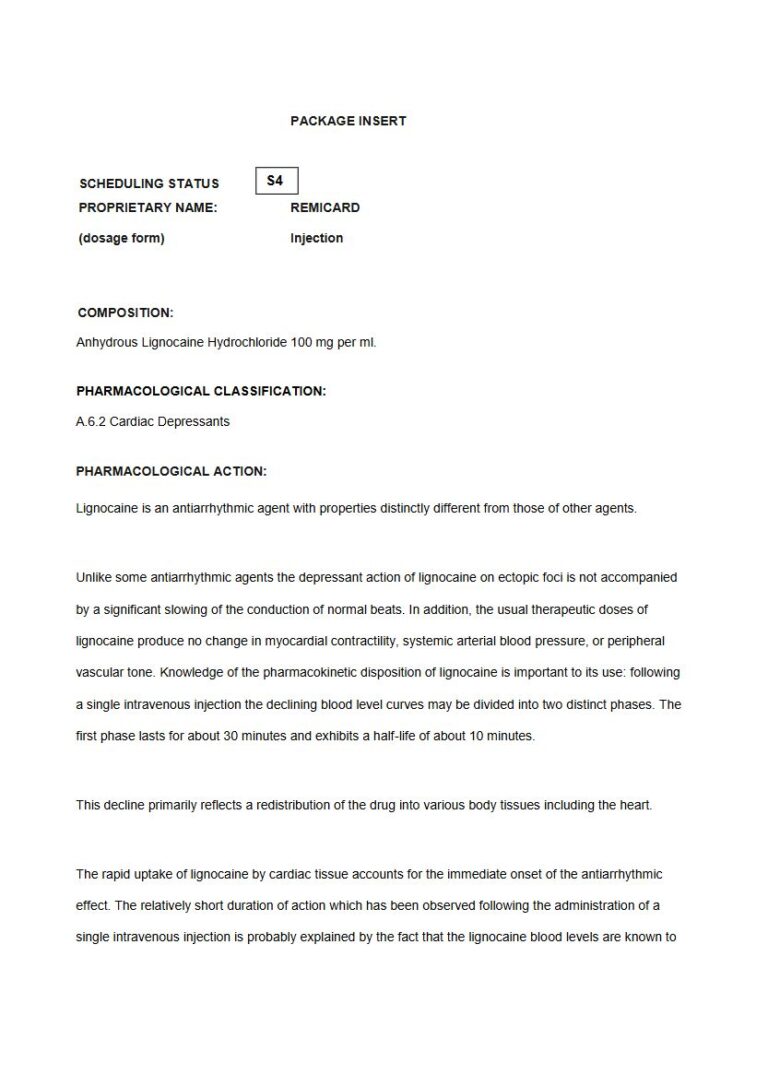
Remicard 100mg Injection
PDF Leaflet Revision Date: 20 June 1980
Clinical Summary
Quick overview from the medicine insert
Indication
Treatment or prophylaxis of ventricular arrhythmias.
Dosage (summary)
Infuse 0.2% solution at 2-4 mg/min; initial IV injection of 50-100 mg recommended.
Onset of Action / Duration
Onset: 30 mins, Duration: 6-8 hours
Special Populations
- Severe liver impairment
- Severe renal impairment
- Hypovolemia
- Shock
Pregnancy & Breastfeeding
Use with caution; safety not established.
Key Drug Interactions
- Atropine
- Cardiac pacing
Contraindications
- A-V block grade 3
- Cardiac decompensation
Common side effects
- Dizziness
- Drowsiness
Counselling Points
- Monitor for CNS and cardiovascular side effects
- Avoid rapid administration
Serious warnings
- Dilute for IV infusion only
- Risk of asystole
Important Disclaimer
The Remicard 100mg Injection professional information leaflet below is the property of Adcock Ingram and is provided on Medinsert exactly as issued, with no.. alterations or editorial changes. We make every effort to keep content current by updating documents as soon as new versions become available. Medinsert serves as a trusted access point for healthcare professionals, but does not replace official sources or clinical judgement. For more details, please read our full disclaimer. read more>>
 Healthcare Professionals Only
This content is for registered healthcare professionals
Sign in or create a free account to read the full package insert.
Free for HPCSA-registered professionals. Powered by Medinsert.
Clinical Particulars
Section 4 of the official insert — extracted exactly as issued, no alterations
4.1 Therapeutic indications
Treatment or prophylaxis of ventricular arrhythmias and tachycardias associated with myocardial infarction; general anaesthesia (in patients predisposed to ventricular arrhythmias); or following resuscitation from cardiac arrest.
4.2 Posology and method of administration
The usual procedure for adults is to infuse a 0,2 % REMICARD solution at a rate of 2 - 4 mg per minute. Two ampoules of REMICARD diluted with 500 ml dextrose 5 % in 0,9 % sodium chloride, yields a 0,2 % REMICARD solution. The average drip rate of this solution would be 1 - 2 ml per minute or 15 - 30 drops per minute where 1 ml corresponds to 15 drops.
In order to rapidly obtain antiarrhythmic effect, an intravenous injection of 50 to 100 mg should always be given at the commencement of infusion. Several hours may be required to obtain therapeutic blood levels by constant rate infusion only. Therapeutic levels can be achieved more rapidly by administering a further two intravenous injections of 50 - 100 mg at 15 to 20 minute intervals. In some cases increasing the infusion rate above 4 mg per minute may be warranted to obtain an antiarrhythmic effect. When using higher doses the risk of side effects increases. In cases of shock, severe congestive cardiac failure, or marked impairment of liver function, the dosage should be substantially reduced. To suppress ventricular tachyarrhythmias following acute myocardial infarction the infusion therapy should usually be given for 48 hours or more and continued until 24 hours have elapsed without occurrence of significant ectopic activity. If during an infusion it is necessary to increase the infusion rate to maintain the antiarrhythmic effect, a slow intravenous injection of 50 to 100 mg of lignocaine should first be given in order to rapidly obtain therapeutic blood levels. After this the infusion rate is adjusted in order to achieve and maintain adequate antiarrhythmic protection. As a rule a concentration of 0,2 % REMICARD is used in the infusion solution. At higher doses and when the supply of fluid - litres per 24 hours - should be restricted, a higher concentration is used. It is often necessary that lignocaine solution concentrations be expressed as a percentage rather than in terms of milligrams per millilitre. The following table may be found useful: - 5 ml (1 ampoule) diluted with 250 ml yields an 0,2 % solution 10 ml (2 ampoules) diluted with 250 ml yields an 0,4 % solution 15 ml (3 ampoules) diluted with 250 ml yields an 0,6 % solution 20 ml (4 ampoules) diluted with 250 ml yields an 0,8 % solution.
4.3 Contraindications
A - V block grade 3 and other serious conduction disorders; cardiac decompensation (left ventricular failure and congestive heart failure) except when due to tachyarrhythmia.
4.4 Special warnings and precautions for use
To be diluted and used for intravenous infusion only. REMICARD should usually not be used when there is an impending risk of asystole, e.g. complete heart block or signs of severely damaged conduction system. Caution should be employed in the repeated use of REMICARD in patients with severe liver or renal disease because accumulation may occur and may lead to toxic phenomena, since lignocaine is metabolised mainly in the liver and the metabolites are excreted via the kidneys. The drug should also be used with caution in patients with hypovolemia and shock. In case of bradyarrhythmias complicated by ventricular tachyarrhythmias, a combination of REMICARD and atropine or atropine-like drugs or a combination of REMICARD and cardiac pacing may be considered.
4.5 Interactions with other medicines
Not specified in the provided text.
4.6 Fertility, pregnancy and lactation
Not specified in the provided text.
4.7 Effects on ability to drive and use machines
Not specified in the provided text.
4.8 Undesirable effects
Mild and transient side - effects (dizziness, drowsiness) may occur following a rapid intravenous loading dose and during the infusion therapy. More severe side - effects are indicative of overdosage or too rapid a rate of administration. When properly administered, severe reactions of the central nervous system or cardiovascular type are rare.
4.9 Overdose
The following are symptoms of overdosage or too rapid a rate of administration: - Central nervous system: light headedness, drowsiness, dizziness, apprehension, euphoria, tinnitus, blurred or double vision, vomiting, sensation of heat, cold or numbness, twitching, tremors, convulsions, unconsciousness and respiratory depression. Cardiovascular system: hypotension and bradycardia which may lead to cardiac arrest. When severe side - effects occur, the administration of REMICARD should be stopped immediately and the appropriate resuscitative procedures should be instituted. - Hypotension may be counteracted by a vasopressor agent or a myocardial stimulant and proper positioning of the patient. - Bradycardia may be treated with atropine or atropine-like drugs. - Asystole requires immediate cardiopulmonary resuscitation including if necessary agents such as adrenaline or isoprenaline, and cardiac pacing if required. - Convulsions may be treated with small doses of a short - acting barbiturate, and pulmonary ventilation should be ensured (free airway and oxygen). Artificial ventilation if required can be facilitated by the i.v. injection of a short - acting muscle relaxant.
