
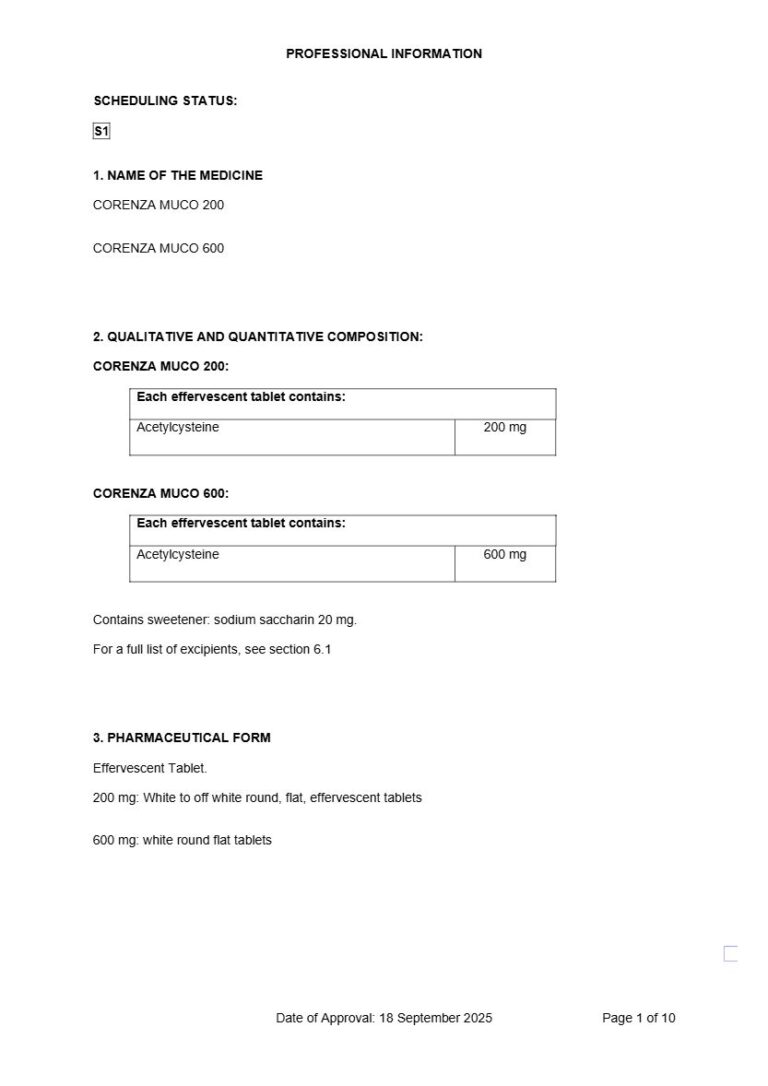
Corenza Muco 200 & 600 200 mg & 600 mg Effervescent Tablet.
PDF Leaflet Revision Date: 18 September 2025
Clinical Summary
Quick overview from the medicine insert
Indication
Mucolytic for acute respiratory conditions.
Dosage (summary)
Adults: 1 tablet 2-3 times daily (200 mg) or 1 tablet daily (600 mg).
Special Populations
- Children under 2 years
- Patients with peptic ulcer
Pregnancy & Breastfeeding
Not recommended in pregnancy or breastfeeding.
Key Drug Interactions
- Antitussives
- Tetracycline antibiotics
- Glyceryl trinitrate
- Activated charcoal
Contraindications
- Hypersensitivity to acetylcysteine
- Active peptic ulceration
- Pregnancy
- Breastfeeding
Common side effects
- Hypersensitivity
- Headache
- Bronchial spasms
- Vomiting
- Diarrhoea
Counselling Points
- Take dissolved in water after meals
- Do not exceed recommended dosage
- Report any skin reactions immediately
Serious warnings
- Severe skin reactions
- Bronchial obstruction in children under 2
Important Disclaimer
The Corenza Muco 200 & 600 200 mg & 600 mg Effervescent Tablet. professional information leaflet below is the property of Adcock Ingram and is provided on Medinsert exactly as issued, with no.. alterations or editorial changes. We make every effort to keep content current by updating documents as soon as new versions become available. Medinsert serves as a trusted access point for healthcare professionals, but does not replace official sources or clinical judgement. For more details, please read our full disclaimer. read more>>
 Healthcare Professionals Only
This content is for registered healthcare professionals
Sign in or create a free account to read the full package insert.
Free for HPCSA-registered professionals. Powered by Medinsert.
Clinical Particulars
Section 4 of the official insert — extracted exactly as issued, no alterations
4.1 Therapeutic Indications
CORENZA MUCO is used as a mucolytic in acute respiratory conditions.
4.2 Posology and method of administration
Posology:
CORENZA MUCO 200:
Children from 2-5 years of age: u03a9 (half) an effervescent tablet 2 to 3 times a day. (equivalent to 200 to 300 mg acetylcysteine/day).
Children from 6-14 years of age: 1 effervescent tablet twice daily (equivalent to 400 mg acetylcysteine/day).
Adults & adolescents from 14 years of age: 1 effervescent tablet 2 to 3 times daily (equivalent to 400 to 600 mg acetylcysteine/day).
CORENZA MUCO 600:
Adults & adolescents from 14 years of age: 1 effervescent tablet daily or u03a9 effervescent tablet twice daily (equivalent to 600 mg acetylcysteine per day).
Do not exceed the recommended dosage.
Method of administration: The effervescent tablets are taken dissolved in a glass of water before use after meals.
Duration of use: Do not use continuously for more than 14 days without medical advice.
4.3 Contraindications
- Known hypersensitivity to the acetylcysteine or to any of the excipients listed under Section 6.1.
- Should not be used in pregnancy & breastfeeding (see Section 4.6)
- Active peptic ulceration.
- Children below 2 years of age
4.4 Special warnings and precautions for use
- Patients with bronchial asthma should be closely monitored during therapy, if bronchospasm occurs, treatment should be discontinued immediately and appropriate treatment initiated.
- Mucolytics can induce bronchial obstruction in children under 2 years of age. In fact, the drainage capacity of bronchial mucus is limited in this age group, due to the physiological characteristics of the respiratory tract. They should therefore not be used in children less than 2 years of age (see section 4.3).
- The use in patients affected by peptic ulcer or with a history of peptic ulcer requires special attention, especially in case of concurring intake of other medicines with known harmful effects on the gastrointestinal tract.
- Administration of N-acetylcysteine, especially early on in the treatment, is known for its thinning effect on bronchial secretions, and for simultaneously increasing their volume. If the patient is unable to expectorate effectively, in order to avoid retention of secretions, it is necessary to employ postural drainage and broncho aspiration.
- CORENZA MUCO can affect histamine metabolism. Therefore, caution should be used when administering CORENZA MUCO to patients with histamine intolerance, as doing so may lead to symptoms of hypersensitivity.
- The occurrence of severe skin reactions such as Stevens-Johnson syndrome and Lyellu2019s syndrome has very rarely been reported in temporal connection with the use of acetylcysteine. If cutaneous and mucosal changes occur, the use of CORENZA MUCO must be terminated without delay (see section 4.8).
4.5 Interaction with other medicines and other forms of interaction
Interactions with other medicines
u2022 It is advisable not to mix other medicines with the CORENZA MUCO mucolytic solution.
u2022 Combined administration of CORENZA MUCO with antitussives may cause a dangerous secretory congestion due to the reduced cough reflex, so that an especially careful diagnosis is required for this combination treatment.
u2022 Tetracycline hydrochloride (with the exception of doxycycline) and other oral antibiotics must be administered separately from CORENZA MUCO and with an interval of at least 2 hours.
u2022 The concomitant administration of acetylcysteine can potentially result in an intensification of the vasodilatory and inhibition of platelet aggregation effects of glyceryl trinitrate (nitroglycerine). If concomitant treatment with glyceryl trinitrate and CORENZA MUCO is considered necessary, patients should be monitored for the possible development of hypotension, which can be serious, and advised of the possibility of headaches.
u2022 Activated charcoal in high doses (as an antidote) can reduce the effectiveness of CORENZA MUCO.
Interactions with laboratory tests
u2022 CORENZA MUCO can affect the colorimetric determination of salicylates.
u2022 In urine tests, CORENZA MUCO can affect the results of determinations of ketone bodies.
4.6 Fertility, pregnancy and lactation
Safety and efficacy of acetylcysteine in pregnancy and lactation have not been established (see section 4.3). No fertility data available.
Pregnancy: There are no adequate clinical data from the use of acetylcysteine in pregnant women. Animal studies do not indicate direct or indirect harmful effects with respect to reproductive toxicity. CORENZA MUCO should not be used during pregnancy.
Breastfeeding: No information is available regarding excretion of acetylcysteine or its metabolites into breast milk. A risk for the breast-fed child cannot be excluded. The use of acetylcysteine during breastfeeding is not recommended.
Fertility: Data concerning effects of acetylcysteine on human fertility are not available. In animal studies, no harmful effects on fertility were observed for therapy-relevant doses of acetylcysteine.
4.7 Effects on ability to drive and use machines
CORENZA MUCO does not affect the ability to drive and use machines.
4.8 Undesirable effects
The undesirable effects listed are based on the MedDRA system organ classes (SOC) classification system.
System Organ Class Frequency Undesirable effect
Immune system disorders Less Frequent Hypersensitivity, Anaphylactic shock, anaphylactic/ anaphylactoid reaction
Nervous system disorders Less Frequent Headache
Eye disorders Less Frequent Blurred vision
Ear and labyrinth disorders Less Frequent Tinnitus
Cardiac disorders Less Frequent Tachycardia
Vascular disorders Less frequent Haemorrhage
Respiratory, thoracic and mediastinal disorders Less frequent Bronchial spasms, dyspnoea
Frequency unknown Bronchial obstruction
Gastrointestinal disorders Less Frequent Vomiting, diarrhoea, stomatitis, abdominal pain, nausea, dyspepsia.
Hepato-biliary disorders Less Frequent Disturbances of the liver function, acidosis.
Skin and subcutaneous tissue disorders Less Frequent *Stevens-Johnson syndrome, toxic epidermal necrolysis, urticaria, rash, angioedema, itching, exanthema, pruritus, flushing.
Musculoskeletal and connective tissue disorders Less Frequent Arthralgia
General disorders and administration site conditions Less Frequent Pyrexia, hypotension
Frequency unknown Oedema of the face
*Severe skin reactions such as Stevens-Johnson syndrome and toxic epidermal necrolysis have been reported in temporal association with the use of acetylcysteine.
u2022 If skin or mucous membrane abnormalities develop, the use of CORENZA MUCO must be discontinued immediately.
u2022 A decreased blood platelet aggregation in the presence of CORENZA MUCO has been confirmed by different studies. The clinical relevance has not yet been clarified to date.
4.9 Overdose
Overdose can cause gastrointestinal symptoms such as nausea, vomiting and diarrhoea. Treatment of overdose is supportive and symptomatic.
