
Azomid 250 mg Tablets
PDF Leaflet Revision Date: 24 January 2024
Clinical Summary
Quick overview from the medicine insert
Indication
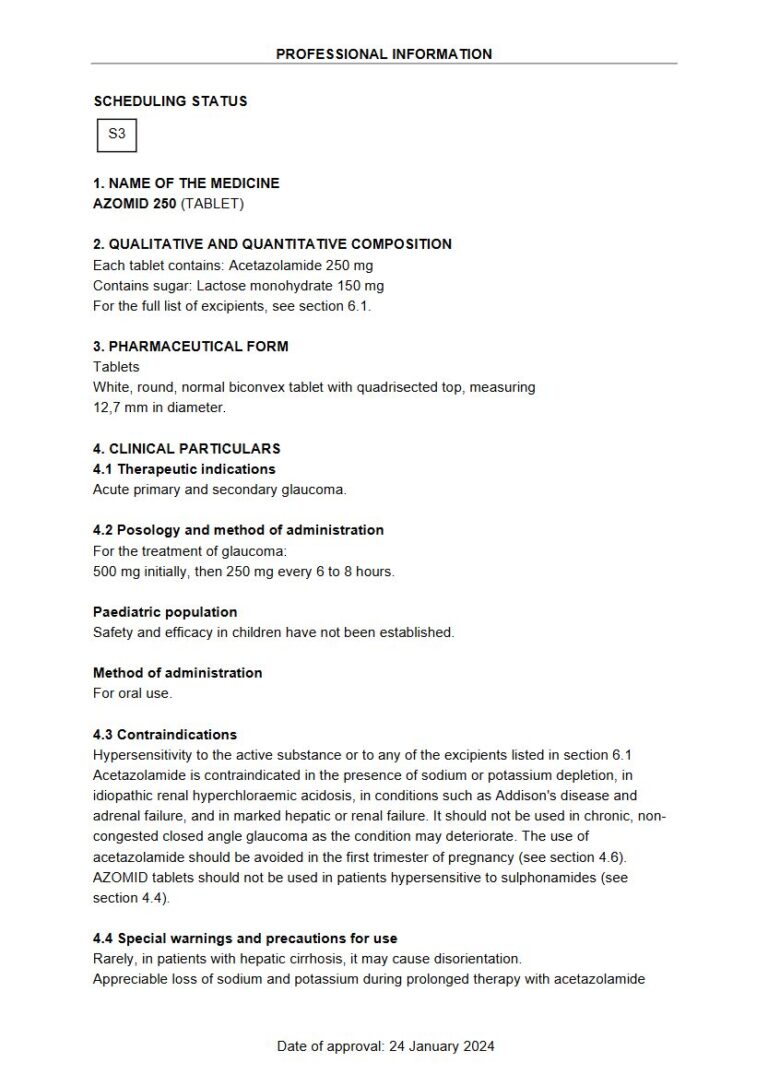
Acute primary and secondary glaucoma.
Dosage (summary)
500 mg initially, then 250 mg every 6 to 8 hours.
Special Populations
- Hepatic impairment
- Renal impairment
Pregnancy & Breastfeeding
Avoid in first trimester; low levels detected in breast milk.
Key Drug Interactions
- Potentiates effects of folic acid antagonists
- Increases lithium excretion
- May enhance effects of amphetamines
Contraindications
- Hypersensitivity to acetazolamide
- Sodium or potassium depletion
- Marked hepatic or renal failure
Common side effects
- Thirst
- Drowsiness
- Electrolyte imbalance
- Transient myopia
Counselling Points
- Report unusual skin rash
- Monitor for signs of suicidal ideation
- Periodic blood tests recommended
Serious warnings
- Risk of suicidal ideation
- Severe reactions to sulphonamides
- Caution in hepatic cirrhosis
Important Disclaimer
The Azomid 250 mg Tablets professional information leaflet below is the property of Adcock Ingram and is provided on Medinsert exactly as issued, with no.. alterations or editorial changes. We make every effort to keep content current by updating documents as soon as new versions become available. Medinsert serves as a trusted access point for healthcare professionals, but does not replace official sources or clinical judgement. For more details, please read our full disclaimer. read more>>
 Healthcare Professionals Only
This content is for registered healthcare professionals
Sign in or create a free account to read the full package insert.
Free for HPCSA-registered professionals. Powered by Medinsert.
Clinical Particulars
Section 4 of the official insert — extracted exactly as issued, no alterations
4.1 Therapeutic indications
Acute primary and secondary glaucoma.
4.2 Posology and method of administration
For the treatment of glaucoma: 500 mg initially, then 250 mg every 6 to 8 hours.
Paediatric population Safety and efficacy in children have not been established.
Method of administration For oral use.
4.3 Contraindications
Hypersensitivity to the active substance or to any of the excipients listed in section 6.1
Acetazolamide is contraindicated in the presence of sodium or potassium depletion, in idiopathic renal hyperchloraemic acidosis, in conditions such as Addison's disease and adrenal failure, and in marked hepatic or renal failure. It should not be used in chronic, non-congested closed angle glaucoma as the condition may deteriorate. The use of acetazolamide should be avoided in the first trimester of pregnancy (see section 4.6). AZOMID tablets should not be used in patients hypersensitive to sulphonamides (see section 4.4).
4.4 Special warnings and precautions for use
Rarely, in patients with hepatic cirrhosis, it may cause disorientation. Appreciable loss of sodium and potassium during prolonged therapy with acetazolamide may result in a tendency towards hypokalaemic acidosis. By rendering the urine alkaline, acetazolamide enhances the effect of amphetamines and reduces the effect of hexamine and its compounds; it may enhance the effect of quinidine (see section 4.5). Suicidal ideation and behaviour have been reported in patients treated with anti-epileptic agents in several indications. A meta-analysis of randomized placebo controlled trials of anti-epileptic drugs has also shown a small increased risk of suicidal ideation and behaviour. The mechanism of this risk is not known and the available data do not exclude the possibility of an increased risk for Acetazolamide. Therefore, patients should be monitored for signs of suicidal ideation and behaviours and appropriate treatment should be considered. Patients (and caregivers of patients) should be advised to seek medical advice should signs of suicidal ideation or behaviour emerge. When AZOMID tablets is prescribed for long-term therapy, special precautions are advisable. The patient should be cautioned to report any unusual skin rash. Periodic blood cell counts and electrolyte levels are recommended. Fatalities have occurred, although rarely, due to severe reactions to sulphonamides (see section 4.3). A precipitous drop in formed blood cell elements or the appearance of toxic skin manifestations should call for immediate cessation of AZOMID tablets therapy. In patients with pulmonary obstruction or emphysema where alveolar ventilation may be impaired, AZOMID tablets may aggravate acidosis and should be used with caution. In patients with a past history of renal calculi, benefit should be balanced against the risk of precipitating further calculi. The occurrence at the treatment initiation of a feverish generalized erythema associated with pustula may be a symptom of acute generalized exanthematous pustulosis (AGEP) (see section 4.8). In case of AGEP diagnosis, acetazolamide should be discontinued and any subsequent administration of acetazolamide contraindicated. Contains lactose Patients with rare hereditary problems of galactose intolerance, total lactose deficiency or glucose-galactose malabsorption should not take this medicine.
4.5 Interaction with other medicines and other forms of interaction
The diuretic effect of acetazolamide is diminished if ammonium chloride is taken concomitantly. Acetazolamide is a sulphonamide derivative. Sulphonamides may potentiate the effects of folic acid antagonists. Possible potentiation of the effects of folic acid antagonists, hypoglycaemics and oral anti-coagulants may occur. Concurrent administration of acetazolamide and aspirin may result in severe acidosis and increase central nervous system toxicity. Adjustment of dose may be required when AZOMID tablets is given with cardiac glycosides or hypertensive agents. When given concomitantly, acetazolamide modifies the metabolism of phenytoin, leading to increased serum levels of phenytoin. Severe osteomalacia has been noted in a few patients taking acetazolamide in combination with other anticonvulsants. There have been isolated reports of reduced primidone and increased carbamazepine serum levels with concurrent administration of acetazolamide. Because of possible additive effects, concomitant use with other carbonic anhydrase inhibitors is not advisable. By increasing the pH of renal tubular urine, acetazolamide reduces the urinary excretion of amphetamine and quinidine and so may enhance the magnitude and the duration of effect of amphetamines and enhance the effect of quinidine. Ciclosporin: Acetazolamide may elevate ciclosporin levels. Methenamine: Acetazolamide may prevent the urinary antiseptic effect of methenamine (see section 4.4). Lithium: Acetazolamide increases lithium excretion and the blood lithium levels may be decreased. Sodium bicarbonate: Acetazolamide and sodium bicarbonate used concurrently increases the risk of renal calculus formation.
4.6 Fertility, pregnancy and lactation
Pregnancy The use of acetazolamide should be avoided in the first trimester of pregnancy (see section 4.3).
Breast-feeding Acetazolamide has been detected in low levels in the milk of lactating who have taken Acetazolamide tablets. Although it is unlikely that this will lead to any harmful effects in the infant, extreme caution should be exercised when Acetazolamide tablets is administered to lactating women.
Fertility Not available.
4.7 Effects on ability to drive and use machines
Increasing the dose does not increase the diuresis and may increase the incidence of drowsiness and/or paraesthesia. Less commonly, fatigue, dizziness and ataxia have been reported. Disorientation has been observed in a few patients with oedema due to hepatic cirrhosis. Such cases should be under close supervision. Transient myopia has been reported. These conditions invariably subside upon diminution or discontinuance of the medication. If affected, the patient should not drive or use machines.
4.8 Undesirable effects
a) Summary of safety profile During short-term therapy, you may experience the feeling of thirst, but this is usually non-serious. During long-term therapy, metabolic acidosis and electrolyte imbalance may occasionally occur. This can usually be corrected by the administration of bicarbonate. Conditions that invariably subsides upon diminution or withdrawal of the medication include transient myopia. Acetazolamide is a sulphonamide derivative and therefore some side-effects similar to those caused by sulphonamides have occasionally been reported. These side-effects include fever, anaphylaxis, crystalluria, renal and ureteral colic, calculus formation, rash (including Erythema multiforme, Steven-Johnson syndrome, Toxic epidermal necrolysis), Fulminant hepatic necrosis and Agranulocytosis.
b) Tabulated list of adverse reactions
SYSTEM ORGAN CLASS FREQUENCY ADVERSE REACTIONS Blood and lymphatic system disorders Frequency unknown Agranulocytosis, Aplastic anaemia, Thrombocytosis, Leukopenia, Bone marrow depression, Pancytopenia Metabolism and nutrition disorders Frequency unknown Hypokalaemia acidosis, Thirst, Metabolic acidosis, Electrolyte imbalance Psychiatric disorders Frequency unknown Excitement, Depression, Irritability, Reduced libido, Occasional instances of confusion Nervous system disorders Frequency unknown Drowsiness and numbness and tingling of face and extremities, Dizziness, Headache, Ataxia, Paraesthesia, Flaccid paralysis Eye disorders Frequency unknown Transient myopia Ear and labyrinth disorders Frequency unknown Tinnitus, Hearing loss Respiratory, thoracic and mediastinal disorders Frequent Hyperpnoea Gastrointestinal disorders Frequency unknown Gastrointestinal disturbances, Melaena, Taste disturbance, Nausea, Vomiting, Diarrhoea Hepatobiliary disorders Frequency unknown Fulminant hepatic necrosis, Hepatitis or cholestatic jaundice Skin and subcutaneous tissue disorders Frequency unknown Skin rash (including Erythema multiforme, Stevens-Johnson syndrome, Toxic epidermal necrolysis), Urticaria, Thrombocytic purpura, Photosensitivity, Acute generalized exanthematous pustulosis (AGEP) Renal and urinary disorders Frequency unknown Renal lesions, Haematuria, Crystalluria, Renal and ureteral colic, Renal failure, Calculus formation, Glycosuria, Polyuria General disorders and administration site conditions Frequency unknown Fatigue, fever, Anaphylaxis, Flushing Investigations Frequency unknown Abnormal liver function
4.9 Overdose
None known. No specific antidote. Supportive measures with correction of electrolyte and fluid balance. Force fluids.
