
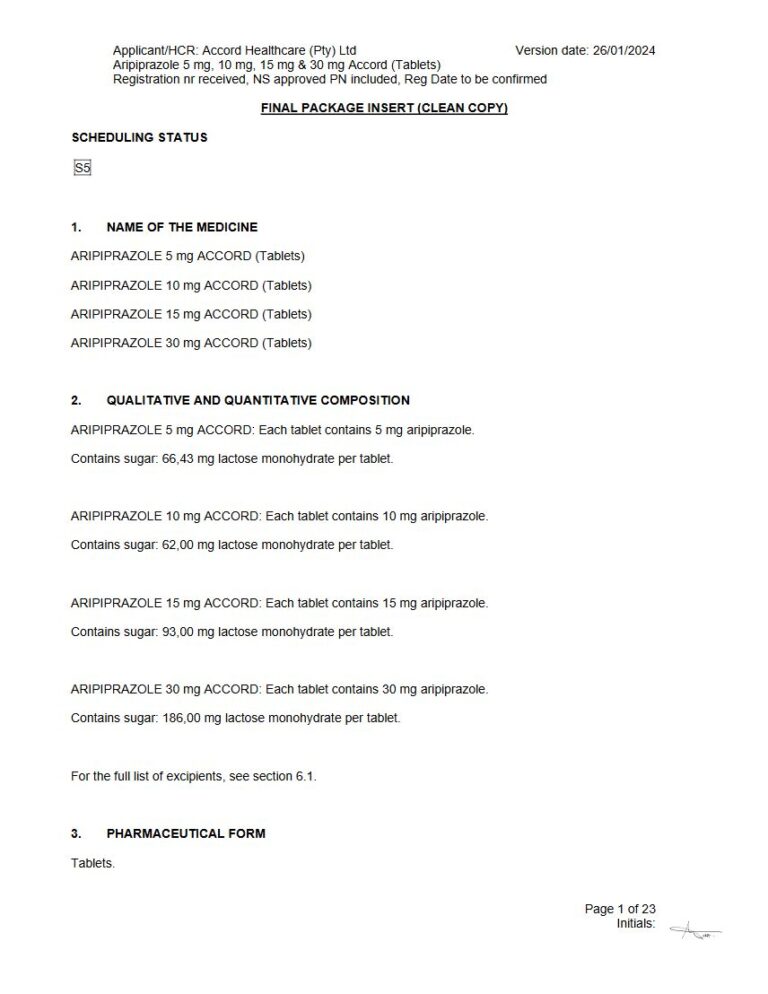
Aripiprazole Accord Tablets
PDF Leaflet Revision Date: 26/01/2024
Clinical Summary
Quick overview from the medicine insert
Indication
Treatment of schizophrenia and acute manic episodes in Bipolar I Disorder.
Dosage (summary)
Starting dose: 10-15 mg/day; Maintenance: 15 mg/day; Max: 30 mg/day.
Special Populations
- Elderly
- Renal impairment
- Hepatic impairment
Pregnancy & Breastfeeding
Safety not established; monitor neonates for withdrawal symptoms if exposed in third trimester.
Key Drug Interactions
- CYP3A4 inhibitors
- CYP2D6 inhibitors
- Valproate
- Lithium
Contraindications
- Hypersensitivity to aripiprazole
Common side effects
- Akathisia
- Nausea
- Weight gain
- Dizziness
Counselling Points
- Avoid alcohol
- Monitor for hyperglycemia
- Caution with driving
- Report new urges or behaviors
Serious warnings
- Risk of suicide
- Tardive dyskinesia
- Neuroleptic malignant syndrome
- Cardiovascular disorders
Important Disclaimer
The Aripiprazole Accord Tablets professional information leaflet below is the property of Accord Healthcare and is provided on Medinsert exactly as issued, with no.. alterations or editorial changes. We make every effort to keep content current by updating documents as soon as new versions become available. Medinsert serves as a trusted access point for healthcare professionals, but does not replace official sources or clinical judgement. For more details, please read our full disclaimer. read more>>
 Healthcare Professionals Only
This content is for registered healthcare professionals
Sign in or create a free account to read the full package insert.
Free for HPCSA-registered professionals. Powered by Medinsert.
Clinical Particulars
Section 4 of the official insert — extracted exactly as issued, no alterations
4.1 Therapeutic indications
Schizophrenia ARIPIPRAZOLE ACCORD is indicated for the treatment of schizophrenia and for the maintenance of clinical improvement in adults.
Bipolar Mania: ARIPIPRAZOLE ACCORD is indicated for the treatment of acute manic episodes associated with Bipolar I Disorder and for prevention of recurrence of new manic episodes in patients who experienced predominantly manic episodes and who responded to ARIPIPRAZOLE ACCORD treatment.
4.2 Posology and method of administration
Posology Schizophrenia: The recommended starting dose for ARIPIPRAZOLE ACCORD is 10 or 15 mg/day with a maintenance dose of 15 mg/day administered on a once - a - day schedule without regard to meals. ARIPIPRAZOLE ACCORD is effective in a dose range of 10 to 30 mg/day. Enhanced efficacy at doses higher than the recommended daily dose of 15 mg has not been demonstrated although individual patients may benefit from a higher dose. The maximum daily dose should not exceed 30 mg.
Bipolar Mania The recommended starting dose for ARIPIPRAZOLE ACCORD is 15 mg administered on a once - a - day schedule without regard to meals as monotherapy or combination therapy (see Section 4.5). Some patients may benefit from a higher dose. The maximum daily dose should not exceed 30 mg. Recurrence prevention of manic episodes in Bipolar I disorder: For preventing recurrence of manic episodes in patients who have been receiving aripiprazole, continue therapy at the same dose. Adjustments of daily dose, including dose reduction should be considered on the basis of clinical status. Prevention of depressive episodes using aripiprazole monotherapy has not been established. Supplementary therapy should be considered for the prevention or treatment of depressive episodes, as clinically appropriate.
Concomitant Medications: Dosage adjustment for patients taking ARIPIPRAZOLE ACCORD concomitantly with potent CYP3A4 or CYP2D6 inhibitors: When concomitant administration of a potent CYP3A4 or CYP2D6 inhibitor with ARIPIPRAZOLE ACCORD occurs, the ARIPIPRAZOLE ACCORD dose should be reduced to one - half of the usual dose. When the CYP3A4 or CYP2D6 inhibitor is withdrawn from the combination therapy, the ARIPIPRAZOLE ACCORD dose should then be increased. Dosage adjustment for patients taking potent CYP3A4 inducers: When a potent CYP3A4 inducer is added to ARIPIPRAZOLE ACCORD therapy, the ARIPIPRAZOLE ACCORD dose should be doubled. Additional dose increases of ARIPIPRAZOLE ACCORD should be based on clinical evaluation. When the CYP3A4 inducer is withdrawn from the combination therapy, the ARIPIPRAZOLE ACCORD dose should be reduced.
Paediatric population The safety and efficacy of ARIPIPRAZOLE ACCORD in patients under 18 years of age have not been established.
Method of administration ARIPIPRAZOLE ACCORD is for oral use.
4.3 Contraindications
Hypersensitivity to the active substance, aripiprazole, or to any of the excipients listed in section 6.1.
4.4 Special warnings and precautions for use
During antipsychotic treatment, improvement in the patientu2019s clinical condition may take several days to some weeks. Patients should be closely monitored during this period.
Suicide: The possibility of a suicide attempt is inherent in psychotic illnesses and mood disorders and in some cases has been reported early after initiation or switch of antipsychotic treatment, including aripiprazole. Close supervision of high - risk patients should accompany medicine therapy. Prescriptions for ARIPIPRAZOLE ACCORD should be written for the smallest quantity of tablets consistent with good patient management, in order to reduce the risk of overdose.
Tardive Dyskinesia: As the risk of tardive dyskinesia increases with long - term exposure to antipsychotic treatment, if signs and symptoms of tardive dyskinesia appear in a patient on ARIPIPRAZOLE ACCORD, a dose reduction or medicine discontinuation should be considered. These symptoms can temporally deteriorate or even arise after discontinuation of treatment.
Neuroleptic Malignant Syndrome: A potentially fatal symptom complex sometimes referred to as Neuroleptic Malignant Syndrome (NMS) has been reported. Clinical manifestations of NMS are hyperpyrexia, muscle rigidity, altered mental status and evidence of autonomic instability (irregular pulse or blood pressure, tachycardia, diaphoresis and cardiac dysrhythmia). Additional signs may include elevated creatine phosphokinase, myoglobinuria (rhabdomyolysis), and acute renal failure. If a patient develops signs and symptoms indicative of NMS, or presents with unexplained high fever without additional clinical manifestations of NMS, all antipsychotic medicines, including ARIPIPRAZOLE ACCORD must be discontinued.
Cardiovascular disorders: ARIPIPRAZOLE ACCORD should be used with caution in patients with known cardiovascular disease (history of myocardial infarction or ischaemic heart disease, heart failure, or conduction abnormalities), cerebrovascular disease, conditions which would predispose patients to hypotension (dehydration, hypovolemia, and treatment with antihypertensive medicines) or hypertension, including accelerated or malignant. Cases of venous thromboembolism (VTE) have been reported with antipsychotic medicines. Since patients treated with antipsychotics often present with acquired risk factors for VTE, all possible risk factors for VTE should be identified before and during treatment with aripiprazole and preventive measures undertaken.
QT prolongation Aripiprazole should be used with caution in patients with a family history of QT prolongation (see Section 4.8).
Seizure: ARIPIPRAZOLE ACCORD should be used cautiously in patients who have a history of seizure disorder or have conditions associated with seizures.
Elderly patients with Dementia - related psychosis: Elderly patients with dementia - related psychosis treated with aripiprazole, as in ARIPIPRAZOLE ACCORD, are at increased risk of death compared to placebo. Although the causes of death were varied, most of the deaths appeared to be either cardiovascular (e.g. heart failure, sudden death) or infectious (e.g. pneumonia) in nature. In elderly patients with psychosis associated with Alzheimeru2019s disease, cerebrovascular adverse events (e.g. stroke, transient ischaemic attack), including fatalities, were reported in patients. ARIPIPRAZOLE ACCORD is not approved for the treatment of patients with dementia - related psychosis.
Hyperglycaemia and Diabetes Mellitus: Hyperglycaemia, in some cases extreme and associated with ketoacidosis or hyperosmolar coma or death, has been reported in patients treated with aripiprazole. Patients treated with ARIPIPRAZOLE ACCORD should be observed for signs and symptoms of hyperglycaemia (such as polydipsia, polyuria, polyphagia and weakness) and patients with diabetes mellitus or with risk factors for diabetes mellitus should be monitored regularly for worsening of glucose control. Patients who develop symptoms of hyperglycaemia during treatment with ARIPIPRAZOLE ACCORD should undergo fasting blood glucose testing. In some cases, hyperglycaemia has resolved when aripiprazole was discontinued; however, some patients required continuation of anti - diabetic treatment despite discontinuation of the suspect medicine.
Hypersensitivity Hypersensitivity reactions, characterised by allergic symptoms, may occur with aripiprazole (see Section 4.8).
Weight Gain: Weight gain is commonly seen in schizophrenic and bipolar mania patients due to co - morbidities, use of antipsychotic medicines known to cause weight gain, or poorly managed lifestyle, and might lead to severe complications. Weight gain has been reported in post - marketing experience among patients prescribed oral aripiprazole. When seen, it is usually in those with significant risk factors such as history of diabetes, thyroid disorder or pituitary adenoma. In clinical trials aripiprazole has not been shown to induce clinically relevant weight gain.
Pathological Gambling and Other Impulse - Control Disorders: Patients can experience increased urges, particularly for gambling, and the inability to control these urges while taking aripiprazole. Other urges reported include: increased sexual urges, compulsive spending, binge or compulsive eating, and other impulsive and compulsive behaviors. It is important for prescribers to ask patients or their caregivers specifically about the development of new or increased gambling urges, sexual urges, compulsive spending, binge or compulsive eating, or other urges while being treated with ARIPIPRAZOLE ACCORD. It should be noted that impulse - control symptoms can be associated with the underlying disorder; however, in some cases, urges were reported to have stopped when the dose was reduced or the medication was discontinued. Impulse - control disorders may result in harm to the patient and others if not recognized. Consider dose reduction or stopping the medication if a patient develops such urges while taking ARIPIPRAZOLE ACCORD.
Orthostatic Hypotension: Potentially due to its u03b1 1 - adrenergic receptor antagonist activity, aripiprazole may be associated with orthostatic hypotension. Symptomatic orthostatic hypotension occurred in 1.3 % of aripiprazole - treated patients during pre - marketing clinical trials. ARIPIPRAZOLE ACCORD should be used with caution in patients with known cardiovascular disease (history of myocardial infarction or ischaemic heart disease, heart failure or conduction abnormalities), cerebrovascular disease or conditions which would predispose patients to hypotension (dehydration, hypovolaemia, and treatment with antihypertensive medications).
Body Temperature Regulation: Disruption of the bodyu2019s ability to reduce core body temperature has been attributed to antipsychotic medicines. Appropriate care is advised when prescribing ARIPIPRAZOLE ACCORD for patients who will be experiencing conditions which may contribute to an elevation in core body temperature, e.g. exercising strenuously, exposure to extreme heat, receiving concomitant medication with anticholinergic activity, or being subject to dehydration.
Dysphagia: Oesophageal dysmotility and aspiration have been associated with antipsychotic medicine use. ARIPIPRAZOLE ACCORD and other antipsychotic medicines should be used cautiously in patients at risk of aspiration pneumonia.
Laboratory Findings: Comparisons between aripiprazole and placebo in the proportions of patients experiencing potentially clinically significant changes in routine laboratory parameters revealed no medically important differences.
Patients with ADHD comorbidity: Despite the high comorbidity frequency of Bipolar I Disorder and ADHD, very limited safety data are available on concomitant use of aripiprazole and stimulants; therefore, extreme caution should be taken when these medicines are co - administered.
Falls: ARIPIPRAZOLE ACCORD may cause somnolence, postural hypotension, motor and sensory instability, which may lead to falls. Caution should be taken when treating patients at higher risk, and a lower starting dose should be considered (e.g. elderly or debilitated patients).
4.5 Interactions with other medicines
General: Given the primary CNS effects of aripiprazole, caution should be used when ARIPIPRAZOLE ACCORD is taken in combination with other centrally acting medicines. Combination use of ARIPIPRAZOLE ACCORD with alcohol should be avoided. Due to its u03b1 1 - adrenergic receptor antagonist activity, ARIPIPRAZOLE ACCORD has the potential to enhance the effect of certain antihypertensive medicines. There was no effect of a high fat meal on the pharmacokinetics of aripiprazole. If aripiprazole is administered concomitantly with medicines known to cause QT prolongation or electrolyte imbalance, caution should be used.
Valproate: When valproate (500 u2013 1500 mg/day) and aripiprazole (30 mg/day) were co - administered at steady - state, the C max and AUC of aripiprazole were decreased by 25 %. No dosage adjustment of ARIPIPRAZOLE ACCORD is required when administered concomitantly with valproate.
Lithium: A pharmacokinetic interaction of aripiprazole with lithium is unlikely because lithium is not bound to plasma proteins, is not metabolised, and is almost entirely excreted unchanged in the urine. Co - administration of therapeutic doses of lithium (1200 u2013 1800 mg/day) for 21 days with aripiprazole 30 mg/day did not result in clinically significant changes in the pharmacokinetics of aripiprazole or its active metabolite dehydro - aripiprazole (C max and AUC increased by less than 20 %). No dosage adjustment of ARIPIPRAZOLE ACCORD is required when administered concomitantly with lithium.
Effect of other medicines on ARIPIPRAZOLE ACCORD: There was no clinically significant effect of the H 2 antagonist, famotidine, on the pharmacokinetics of aripiprazole. Aripiprazole is metabolised by multiple pathways involving the CYP2D6 and CYP3A4 enzymes but not CYP1A enzymes. Accordingly, no dosage adjustment is required for smoking.
Quinidine and other CYP2D6 inhibitors: In a clinical study with healthy subjects, a potent inhibitor of CYP2D6 (quinidine) increased aripiprazole AUC by 107 %, while C max was not changed. The AUC and C max of dehydro - aripiprazole, its active metabolite, decreased by 32 % and 47 %. ARIPIPRAZOLE ACCORD dose should be reduced to one - half of its prescribed dose when concomitant administration of ARIPIPRAZOLE ACCORD with quinidine occurs. Other potent inhibitors of CYP2D6, such as fluoxetine and paroxetine, may be expected to have similar effects and therefore, should be accompanied by similar dose reductions.
Ketoconazole and other CYP3A4 inhibitors: In a clinical study with healthy subjects, a potent inhibitor of CYP3A4 (ketoconazole) increased aripiprazole AUC and C max by 63 % and 37 %. The AUC and C max of dehydro - aripiprazole increased by 77 % and 43 %. In CYP2D6 poor metabolisers, concomitant use of potent inhibitors of CYP3A4 may result in higher plasma concentrations of aripiprazole compared to that in CYP2D6 extensive metabolisers. When considering concomitant administration of ketoconazole or other potent CYP3A4 inhibitors with ARIPIPRAZOLE ACCORD, potential benefits should overweigh the potential risks to the patient. When concomitant administration of ketoconazole with ARIPIPRAZOLE ACCORD occurs, the ARIPIPRAZOLE ACCORD dose should be reduced to one - half of its prescribed dose. Other potent inhibitors of CYP3A4, such as itraconazole and HIV protease inhibitors, may be expected to have similar effects and therefore, should be accompanied by similar dose reductions.
Upon discontinuation of the CYP2D6 or CYP3A4 inhibitor, the dosage of ARIPIPRAZOLE ACCORD should be increased to the level prior to the initiation of the concomitant therapy. When weak inhibitors of CYP3A4 (e.g. diltiazem) or CYP2D6 (e.g. escitalopram) are used concomitantly with aripiprazole, modest increases in plasma aripiprazole concentrations may be expected.
Carbamazepine and other CYP3A4 inducers: Following concomitant administration of carbamazepine, a potent inducer of CYP3A4, the geometric means of C max and steady - state AUC were 68 % and 73 % lower, respectively, compared to when aripiprazole (30 mg) was administered alone. Similarly, for dehydro - aripiprazole the geometric means of C max and steady - state AUC after carbamazepine co - administration were 69 % and 71 % lower, respectively, than those following treatment with aripiprazole alone. ARIPIPRAZOLE ACCORD dose should be doubled when concomitant administration of aripiprazole occurs with carbamazepine. Other potent inducers of CYP3A4 (such as rifampicin, rifabutin, phenytoin, phenobarbitone, primidone, efavirenz, nevirapine and St. Johnu2019s Wort) may be expected to have similar effects and therefore, should be accompanied by similar dose increases. Upon discontinuation of potent CYP3A4 inducers, the dosage of ARIPIPRAZOLE ACCORD should be reduced to the recommended dose.
Medicine Interactions: In clinical studies, 10 - 30 mg/day doses of oral aripiprazole had no significant effect on metabolism of substrates of CYP2D6 (dextromethorphan), CYP2C9 (warfarin), CYP2C19 (omeprazole), and CYP3A4 (dextromethorphan). Additionally, aripiprazole and its predominant human metabolite dehydro - aripiprazole did not show potential for altering CYP1A2 - mediated metabolism in vitro. Thus, ARIPIPRAZOLE ACCORD is unlikely to cause clinically important medicine interactions mediated by these enzymes.
Serotonin syndrome: Cases of serotonin syndrome have been reported in patients taking aripiprazole, and possible signs and symptoms for this condition can occur especially in cases of concomitant use with other serotonergic medicines, such as SSRI/SNRI, or with medicines that are known to increase aripiprazole concentrations (see section 4.8).
4.6 Fertility, pregnancy and lactation
The safety of use of ARIPIPRAZOLE ACCORD during pregnancy and lactation has not been established.
Pregnancy Patients should be advised to notify their medical practitioner if they become pregnant or intend to become pregnant during treatment with ARIPIPRAZOLE ACCORD. Neonates exposed to antipsychotics (including ARIPIPRAZOLE ACCORD) during the third trimester of pregnancy are at risk of adverse reactions including extrapyramidal and/or withdrawal symptoms that may vary in severity and duration following delivery. There have been reports of agitation, hypertonia, hypotonia, tremor, somnolence, respiratory distress, or feeding disorder. Consequently, newborns should be monitored carefully.
Lactation Aripiprazole is excreted in human breast milk.
Fertility Aripiprazole did not impair fertility based on data from reproductive toxicity studies.
4.7 Effects on ability to drive and use machines
ARIPIPRAZOLE ACCORD has minor to moderate influence on the ability to drive and use machines due to potential nervous system and visual effects, such as sedation, somnolence, syncope, vision blurred, diplopia (see section 4.8). Patients should be cautioned about operating hazardous machinery, including motor vehicles until they are reasonably certain that ARIPIPRAZOLE ACCORD does not adversely affect them.
4.8 Undesirable effects
Summary of the safety profile The most frequent adverse reactions were akathisia and nausea.
Tabulated list of adverse reactions SYSTEM ORGAN CLASS FREQUENCY ADVERSE REACTION Blood and lymphatic system disorders Frequency unknown Leucopenia, neutropenia, thrombocytopenia Immune system disorders Frequency unknown Allergic reaction (e.g., anaphylactic reaction, angioedema including swollen tongue, tongue oedema, face oedema, pruritus allergic, or urticaria) Endocrine disorders Less frequent Hyperprolactinaemia Frequency unknown Diabetic hyperosmolar coma, diabetic ketoacidosis Metabolism and nutrition disorders Frequent Diabetes mellitus Less frequent Hyperglycaemia Frequency unknown Hyponatraemia, anorexia, weight increased, weight decreased Psychiatric disorders Frequent Insomnia, anxiety, restlessness Less frequent Depression Frequency unknown Suicide attempt, suicidal ideation and completed suicide (see section 4.4) Pathological gambling, impulse - control disorder, binge eating, compulsive shopping, poriomania, aggression, agitation, nervousness, hypersexuality Nervous system disorders Frequent Akathisia, extrapyramidal disorder, tremor, headache, sedation, somnolence, dizziness Less frequent Tardive dyskinesia, dystonia, restless legs syndrome Frequency unknown Neuroleptic malignant syndrome, grand mal convulsion, serotonin syndrome, speech disorder Eye disorders Frequent Vision blurred Less frequent Diplopia, photophobia Frequency unknown Oculogyric crisis Cardiac disorders Frequent Schizophrenia: tachycardia Less frequent Bipolar mania: tachycardia Frequency unknown Sudden death unexplained, Torsades de pointes, QT prolongation, ventricular dysrhythmia, cardiac arrest, bradycardia Vascular disorders Frequent Schizophrenia: Orthostatic hypotension Less frequent Bipolar mania: Orthostatic hypotension Frequency unknown Venous thromboembolism (including pulmonary embolism and deep vein thrombosis), hypertension, syncope Respiratory, thoracic and mediastinal disorders Frequency unknown Aspiration pneumonia, hiccups, laryngospasm, oropharyngeal spasm Gastrointestinal disorders Frequent Constipation, dyspepsia, nausea, salivary hypersecretion, vomiting, stomach discomfort Frequency unknown Pancreatitis, dysphagia, diarrhoea, abdominal discomfort Hepato - biliary disorders Frequency unknown Hepatic failure, hepatitis, jaundice Skin and subcutaneous tissue disorders Frequency unknown Rash, photosensitivity reaction, alopecia, hyperhidrosis, Drug Reaction with Eosinophilia and Systemic Symptoms (DRESS) Musculoskeletal, connective tissue and bone disorders Frequency unknown Rhabdomyolysis, myalgia, stiffness Renal and urinary disorders Frequency unknown Urinary incontinence, urinary retention Pregnancy, puerperium and perinatal conditions Frequency unknown Drug withdrawal syndrome neonatal (see section 4.6) Reproductive system and breast disorders Frequency unknown Priapism General disorders and administration site conditions Frequent Schizophrenia: Fatigue, asthenia Less frequent Bipolar mania: Peripheral oedema Frequency unknown Temperature regulation disorder (e.g., hypothermia, pyrexia), chest pain, peripheral oedema Investigations Frequency unknown Weight decreased, weight gain, increased ALT, increased AST, increased GGT, increased alkaline phosphatase, QT prolonged, increased blood glucose, increased glycosylated haemoglobin, blood glucose fluctuation, increased creatine phosphokinase
Description of selected adverse events Dystonia Class effect: Symptoms of dystonia, prolonged abnormal contractions of muscle groups, may occur in susceptible individuals during the first few days of treatment. Dystonic symptoms include: spasm of the neck muscles, sometimes progressing to tightness of the throat, swallowing difficulty, difficulty breathing, and/or protrusion of the tongue. While these symptoms can occur at low doses, they occur more frequently and with greater severity with high potency and at higher doses of first generation antipsychotic medicines. An elevated risk of acute dystonia is observed in males and younger age groups.
Reporting of suspected adverse reactions Reporting suspected adverse reactions after authorisation of the medicine is important. It allows continued monitoring of the benefit/risk balance of the medicine. Healthcare professionals are asked to report any suspected adverse reactions to SAHPRA via the u201c6.04 Adverse Drug Reactions Reporting Formu201d, found online under SAHPRAu2019s publications: https://www.sahpra.org.za/Publications/Index/8
4.9 Overdose
In clinical studies and post - marketing experience, accidental or intentional acute overdosage of aripiprazole alone was identified in patients with estimated doses up to 1260 mg with no fatalities. The potentially medically important signs and symptoms observed included lethargy, blood pressure increased, somnolence, tachycardia and vomiting. In addition, reports of accidental overdose with aripiprazole alone (up to 195 mg) in children have been received with no fatalities. The potentially medically serious signs and symptoms reported include somnolence and transient loss of consciousness. Management of overdose should concentrate on supportive therapy, maintaining an adequate airway, oxygenation and ventilation, and management of symptoms. The possibility of multiple medicine involvement should be considered. Therefore, cardiovascular monitoring should commence immediately and should include continuous electrocardiographic monitoring to detect possible dysrhythmias. Following any confirmed or suspected overdose of ARIPIPRAZOLE ACCORD, close medical supervision and monitoring should continue until the patient recovers. Activated charcoal (50 g), administered one hour after aripiprazole ingestion, decreased aripiprazole AUC and C max by 51 and 41 %, respectively, suggesting that charcoal may be effective for overdose management. Although there is no information on the effect of haemodialysis in treating an overdose with aripiprazole, haemodialysis is unlikely to be useful in overdose management since aripiprazole is not eliminated unchanged by the kidneys and is highly bound to plasma proteins.
