
Garsun 60 mg Powder and solvent for solution for injection.
PDF Leaflet Revision Date: 03 April 2024
Clinical Summary
Quick overview from the medicine insert
Indication
Treatment of severe malaria caused by Plasmodium falciparum.
Dosage (summary)
Adults: 2.4 mg/kg IV/IM at 0, 12, 24 hours, then daily. Children: 3 mg/kg IV/IM at 0, 12, 24 hours, then daily.
Onset of Action / Duration
Onset: Rapid, Duration: Until oral treatment can be substituted.
Special Populations
- Hepatic impairment
- Renal impairment
Pregnancy & Breastfeeding
Administer without delay in pregnancy; limited adverse effects noted. Excreted in breast milk, not expected to harm infants.
Contraindications
- Hypersensitivity to artesunate or excipients
Common side effects
- Dizziness
- Light-headedness
- Rash
- Nausea
- Vomiting
Counselling Points
- Monitor blood glucose frequently
- Follow-up for delayed haemolysis
- Use immediately after reconstitution
Serious warnings
- Severe malaria is a medical emergency
- Risk of neurological sequelae
- Post-treatment haemolytic anaemia
Important Disclaimer
The Garsun 60 mg Powder and solvent for solution for injection. professional information leaflet below is the property of Equity Pharmaceuticals and is provided on Medinsert exactly as issued, with no.. alterations or editorial changes. We make every effort to keep content current by updating documents as soon as new versions become available. Medinsert serves as a trusted access point for healthcare professionals, but does not replace official sources or clinical judgement. For more details, please read our full disclaimer. read more>>
 Healthcare Professionals Only
This content is for registered healthcare professionals
Sign in or create a free account to read the full package insert.
Free for HPCSA-registered professionals. Powered by Medinsert.
Clinical Particulars
Section 4 of the official insert — extracted exactly as issued, no alterations
4.1 Therapeutic indication
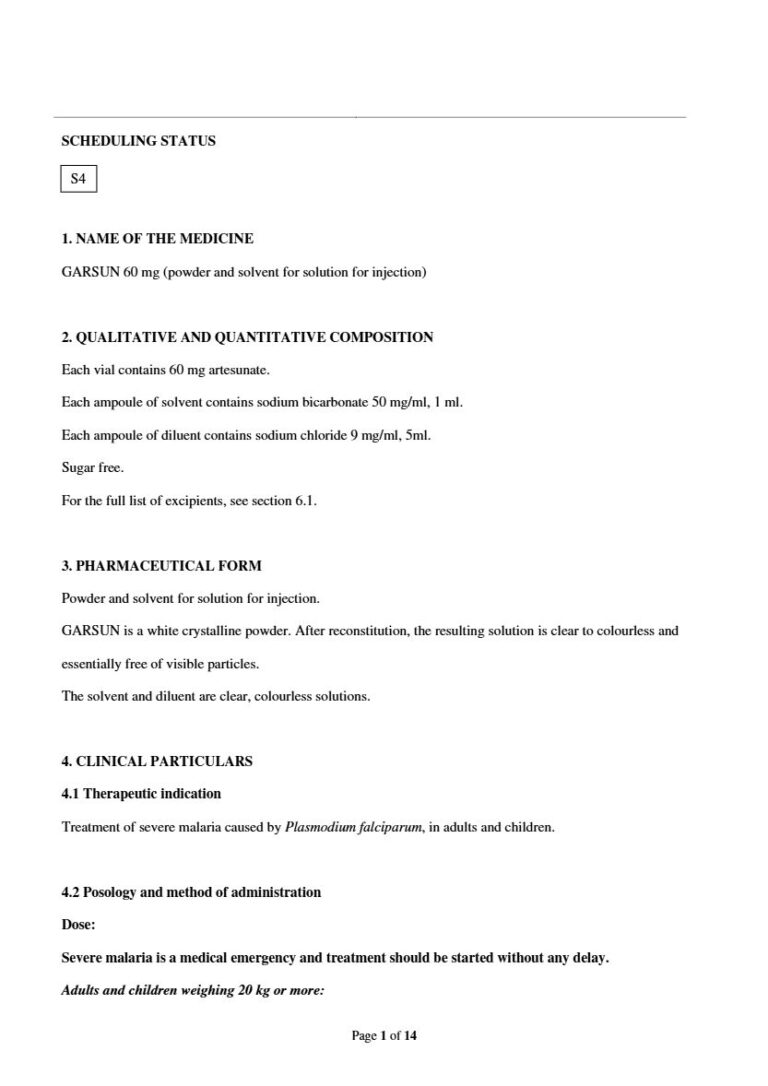
Treatment of severe malaria caused by Plasmodium falciparum, in adults and children.
4.2 Posology and method of administration
Dose: Severe malaria is a medical emergency and treatment should be started without any delay.
Adults and children weighing 20 kg or more: GARSUN is administered at a dose of 2,4 mg of artesunate/kg body weight, by intravenous (IV) injection or intramuscular (IM) injection, at 0, 12 and 24 hours, then once daily until oral treatment can be substituted.
Children weighing less than 20 kg: GARSUN is administered at a dose of 3 mg of artesunate / kg body weight, by intravenous (IV) or intramuscular (IM) injection, at 0, 12 and 24 hours, then once daily until oral treatment can be substituted (see section 5.1).
Special populations
Hepatic and renal impairment: Currently available data do not allow dosing recommendations in hepatic and renal impairment (see sections 4.4 and 5.2).
Method of administration
GARSUN should be administered for a minimum of 24 hours (3 doses), regardless of the patientu2019s ability to tolerate oral medication earlier. After at least 24 hours of GARSUN, and when able to tolerate oral medication, the patient should be put on a complete treatment course with a combination of appropriate antimalarial medicines (see section 4.4). Country-specific guidelines should be consulted when selecting an appropriate regimen.
Preparation
Because of the instability of the medicine in aqueous solutions the reconstituted solution must be used within one hour of preparation. Therefore, the required dose of artesunate should be calculated (dose in mg = patientu2019s weight in kg x 2,4) or dose in mg = patientu2019s weight in kg x 3 for children weighing less than 20 kg, respectively) and the number of vials of GARSUN needed should be determined prior to reconstituting the powder.
For reconstitution and dilution according to the method of injection see section 6.6 below. GARSUN should NOT be administered as an intravenous infusion.
4.3 Contraindications
Known hypersensitivity to artesunate or to any of the excipients of GARSUN listed in 6.1.
4.4 Special warnings and precautions for use
Severe malaria is a medical emergency and treatment must be started without any delay.
Non-falciparum malaria
GARSUN has not been evaluated in the treatment of severe malaria due to Plasmodium vivax, Plasmodium malariae or Plasmodium ovale.
Switching to oral treatment regimen
Acute treatment of severe falciparum malaria with GARSUN should always be followed by a complete treatment course of an appropriate oral combination antimalarial regimen (see section 4.2).
Resistance to antimalarials
Local information on the prevalence of resistance to antimalarials should be considered in choosing the appropriate combination antimalarial regimen for use with GARSUN. Relevant treatment guidelines should be consulted.
There is a risk of neurological sequelae, e.g., convulsions associated with treatment with GARSUN. Severe malaria may cause hypoglycaemia and frequent monitoring of blood glucose is necessary.
Post-treatment haemolytic anaemia
Transient decreases in reticulocyte counts and, post-treatment haemolytic anaemia severe enough to require transfusion have been reported up to 3 months after the use of GARSUN (see section 4.8). The etiology of haemolysis remains unknown. Vigilance for delayed onset anaemia is therefore advised, particularly in hyperparasitaemic patients and younger children. Given the persistent uncertainties regarding the risk of delayed haemolysis, a minimum follow-up should be strictly observed until day 28 (see section 4.8).
Hepatic / renal impairment
Data regarding artesunate pharmacokinetics in patients with hepatic and/or renal impairment are insufficient to make a dosing recommendation in these patients. The vital signs of patients including level of consciousness, temperature, blood glucose, haemoglobin, acid-base status, blood coagulation status, renal and hepatic function should be regularly monitored.
Paediatric population
In clinical trials, the efficacy and safety of intravenous and intramuscular artesunate as contained in GARSUN have been similar in adult and paediatric populations.
4.5 Interaction with other medicines and other forms of interaction
No formal interaction studies have been performed and data on interactions between GARSUN and other medicines are limited. There are limited data on the treatment of malaria in HIV-infected patients.
4.6 Fertility, pregnancy and lactation
Pregnancy
Severe malaria is especially hazardous during pregnancy, therefore full dose parenteral GARSUN treatment should be administered at any stage of pregnancy without delay. Embryotoxity (foetal resorption) and deformities were observed in animal studies. Limited clinical experience with the use of artesunate in the first trimester of pregnancy as well as clinical data from pregnant women treated with artemisinin derivatives in the second and third trimester, do not indicate adverse effects of GARSUN on pregnancy or on the health of the foetus /newborn child. In addition, an observational study conducted in pregnant women with first-trimester falciparum malaria showed no differences in the risk of miscarriage or major congenital malformation in artemisinin derivatives compared to other antimalarial medicines.
Lactation
The active metabolite of GARSUN, namely dihydroartemisinin, is excreted in breast milk. The medicine levels are not expected to cause any adverse effects in breastfed infants. The amount of medicine present in breast milk does not protect the infant from malaria.
Fertility
No specific studies with artesunate in humans have been conducted to evaluate effects on fertility.
4.7 Effects on ability to drive and use machines
No studies on the effects on the ability to drive and use machines have been performed. The patientu2019s clinical status should be considered when assessing ability to drive or operate machinery. GARSUN can cause dizziness and light-headedness (see section 4.8) which can affect the ability to perform or execute activities requiring mental alertness or coordination.
4.8 Undesirable effects
a. Summary of the safety profile
Allergic reactions with an urticarial rash, hypotension, pruritus, oedema, and/or dyspnoea have been reported. A potentially serious delayed haemolysis (Post-Artesunate Delayed Haemolysis, PADH) has been reported frequently in travellers and in children. See section c) below.
Common side effects associated with IV administration have included dizziness, light-headedness, rash, and taste alteration (metallic/bitter taste). Transient elevation in liver transaminases, nausea, vomiting, anorexia and diarrhoea have also been commonly reported, however it is uncertain whether such events have been symptoms of severe malaria. Refer to section c) below.
b. Tabulated summary of adverse reactions
Side effects considered at least possibly related to GARSUN are listed below by body system, organ class and absolute frequency. Frequencies are defined as very common (u2265 1/10), common (1/100 to 1/10), uncommon (1/1000 to 1/100), rare (1/10 000 to 1/1000), and very rare (< 1/10 000).
Blood and lymphatic system disorders
Very common: Post-treatment haemolytic anaemia in travellers, mild and transient decrease in reticulocyte count.
Common to very common: Post-treatment haemolytic anaemia in endemic areas.
Uncommon: neutropenia and anaemia (both occasionally severe), thrombocytopenia, agranulocytosis, reticulocytopenia, erythroblastopenia.
Very rare: Pure red cell aplasia, post-treatment anaemia (see below), mild and transient decrease in reticulocyte count.
Immune system disorders
Uncommon: Hypersensitivity.
Nervous system disorders
Common: Dizziness, light-headedness, headache, insomnia, tinnitus (with or without decrease in auditory function), convulsions.
Very rare: Peripheral neuropathy (or paraesthesia).
Cardiac disorders
Uncommon: Rhythm and conduction disorders.
Rare: Arterial ischaemia.
Vascular disorders
Rare: Hypertensive retinopathy.
Respiratory, thoracic, and mediastinal disorders
Common: Cough and/or nasal symptoms.
Gastrointestinal disorders
Common: Altered taste, nausea, vomiting, abdominal pain or cramps, diarrhoea.
Rare: Raised serum amylase, pancreatitis.
Hepato-biliary disorders
Uncommon: Transient rises in liver transaminases (AST, ALT).
Rare: Hepatitis, calculous cholecystitis.
Skin and subcutaneous tissue disorders
Common: Rash, alopecia.
Musculoskeletal and connective tissue disorders
Common: Arthralgia, muscle disorders.
General disorders and administration site conditions
Common: Fatigue, malaise, fever, pain at injection site.
c. Description of selected adverse reactions
Post-Artesunate Delayed Haemolysis (PADH)
A delayed haemolysis was detected in prospective studies with a frequency ranging from 7 to 27 % of patients treated with artesunate. This adverse event has been observed both in travellers (15 %) and among young African children (7-22 %) in cases of severe malaria. The best-known cases of delayed haemolysis have been reported in travellers (including non-immune tourists and u201cvisiting friends and relativesu201d persons). The pathophysiology of this phenomenon has not been fully elucidated but may include various combinations of delayed destruction of different subpopulations of erythrocytes and an immune-mediated aetiology. All patients treated with parenteral artesunate should be followed for at least 4 weeks to detect signs of haemolysis and enable appropriate treatment.
Cardiac disorders
Some cases of cardiac adverse events and particularly rhythm (bradycardia, sinus dysrhythmia) and conduction disorders (OTc lengthening, abnormal sinoatrial conduction) have been recently described. One case of cardiac arrest has been reported in a context of severe malaria with multi-organ failure but the causality by GARSUN has not been established. Whether or not cardiovascular events should be attributed to GARSUN or to severe malaria is not known, but considering that other artemisinin derivatives (arthemeter, arteether) have been associated with QT prolongation in pre-clinical data, EKG should be monitored before and during treatment, especially in patients with a history of cardiovascular impairment or having risk factors.
Paediatric population: The safety profile of injectable GARSUN is similar in children and adults.
Reporting of suspected adverse reactions
Reporting suspected adverse reactions after authorisation of the medicine is important. It allows continued monitoring of the benefit/risk balance of the medicine. Healthcare providers are asked to report any suspected adverse reactions to SAHPRA via the u201c6.04 Adverse Drug Reaction Reporting Formu201d, found online under SAHPRAu2019s publications: https://www.sahpra.org.za/Publications/Index/8
4.9 Overdose
Experience of acute overdose with GARSUN is limited. Treatment of overdose should be symptomatic and should consist of general supportive measures.
