
Tecentriq 840 Mg/200 Mg Solution
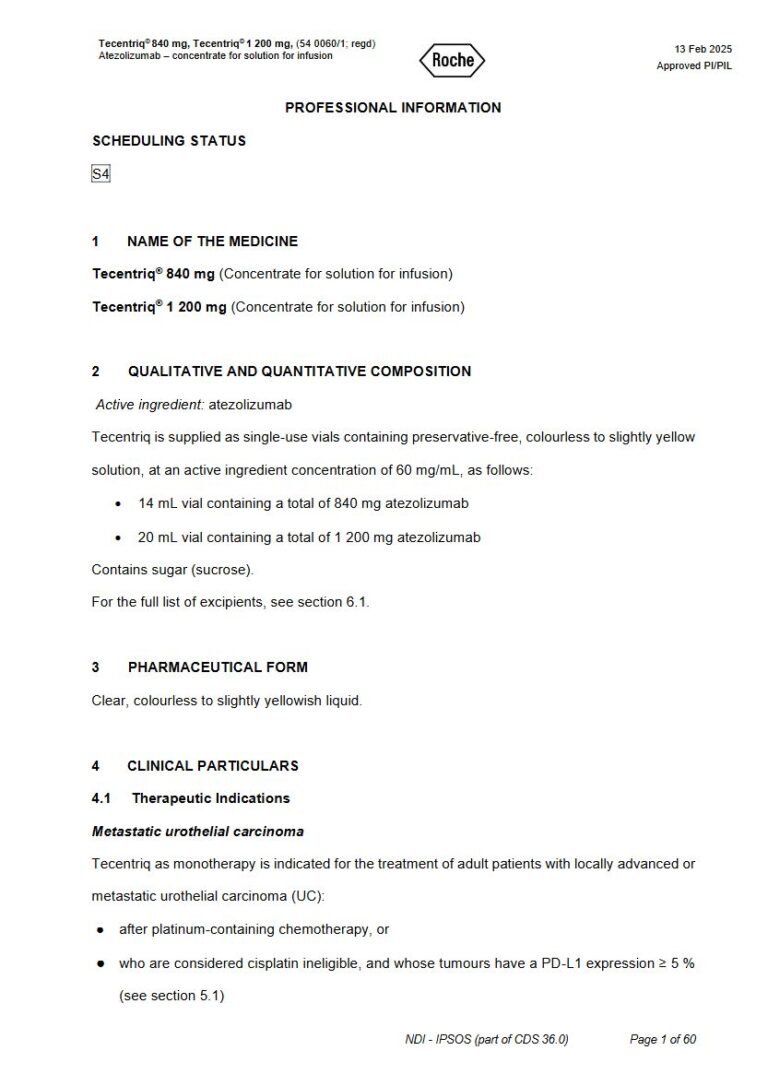
PDF Leaflet Revision Date: 13 February 2025
Clinical Summary
Quick overview from the medicine insert
Indication
Treatment of various cancers including metastatic urothelial carcinoma and non-small cell lung cancer.
Dosage (summary)
840 mg every 2 weeks or 1,200 mg every 3 weeks; adjust based on indication.
Special Populations
- Renal impairment
- Hepatic impairment
- Geriatric patients
Pregnancy & Breastfeeding
Contraindicated in pregnancy; avoid breastfeeding during treatment and for 5 months after.
Key Drug Interactions
- Avoid systemic corticosteroids before starting
- No significant drug-drug interactions expected
Contraindications
- Hypersensitivity to atezolizumab
- Use of live vaccines
Common side effects
- Fatigue
- Nausea
- Diarrhea
- Rash
- Infusion-related reactions
Counselling Points
- Monitor for signs of immune-mediated reactions
- Advise on contraception during treatment
- Inform about potential infusion reactions
Serious warnings
- Immune-mediated pneumonitis
- Hepatitis
- Colitis
- Endocrinopathies
- Severe cutaneous adverse reactions
Important Disclaimer
The Tecentriq 840 Mg/200 Mg Solution professional information leaflet below is the property of Roche Products and is provided on Medinsert exactly as issued, with no.. alterations or editorial changes. We make every effort to keep content current by updating documents as soon as new versions become available. Medinsert serves as a trusted access point for healthcare professionals, but does not replace official sources or clinical judgement. For more details, please read our full disclaimer. read more>>
 Healthcare Professionals Only
This content is for registered healthcare professionals
Sign in or create a free account to read the full package insert.
Free for HPCSA-registered professionals. Powered by Medinsert.
Clinical Particulars
Section 4 of the official insert — extracted exactly as issued, no alterations
4.1 Therapeutic Indications
Metastatic urothelial carcinoma
Tecentriq as monotherapy is indicated for the treatment of adult patients with locally advanced or metastatic urothelial carcinoma (UC):
- after platinum-containing chemotherapy, or
- who are considered cisplatin ineligible, and whose tumours have a PD-L1 expression u2265 5 % (see section 5.1)
Early-stage non-small cell lung cancer (early-stage NSCLC)
Tecentriq as monotherapy is indicated as adjuvant treatment following resection and platinum-based chemotherapy for patients with stage II to IIIA (7th edition of the Union International Centre le Cancer/American Joint Committee on Cancer (UICC/AJCC) - staging system) NSCLC whose tumours have PD-L1 expression on u2265 1 % tumour cells (TC).
Non-small cell lung cancer (NSCLC)
Tecentriq, combined with bevacizumab, paclitaxel and carboplatin is indicated as first-line treatment of patients with metastatic non-squamous non-small cell lung cancer (NSCLC). Patients with EGFR or ALK genomic tumour aberrations should have received targeted therapy, if clinically indicated, before receiving Tecentriq.
Tecentriq, combined with nab-paclitaxel and carboplatin as first-line treatment of patients with metastatic non-squamous non-small cell lung cancer who do not have EGFR or ALK genomic tumour aberrations.
Tecentriq as monotherapy is indicated for the first-line treatment of patients with metastatic NSCLC whose tumours have a PD-L1 expression u2265 50 % tumour cells (TC) or u2265 10 % tumour-infiltrating immune cells (IC) and who do not have EGFR or ALK genomic tumour aberrations.
Tecentriq as monotherapy is indicated for the treatment of patients with locally advanced or metastatic NSCLC after prior chemotherapy.
Tecentriq as monotherapy is indicated for the first-line treatment of adult patients with NSCLC who are ineligible for platinum-based chemotherapy and who do not have EGFR or ALK genomic tumor aberrations, who have:
- locally advanced, unresectable NSCLC not amenable for definitive chemoradiotherapy, or
- metastatic NSCLC
Small cell lung cancer
Tecentriq, combined with carboplatin and etoposide for first-line treatment of patients with extensive-stage small cell lung cancer (ES-SCLC).
Triple-negative breast cancer (TNBC)
Metastatic breast cancer (mBC)
Tecentriq, combined with nab-paclitaxel is indicated for the treatment of patients with unresectable locally advanced or metastatic TNBC whose tumours express PD-L1 u2265 1 %, and who have not been given chemotherapy for metastatic disease.
Early breast cancer (eBC)
Tecentriq in combination with nab-paclitaxel and anthracycline-based chemotherapy, is indicated for the neoadjuvant treatment of patients with locally advanced or early TNBC.
Hepatocellular carcinoma (HCC)
Tecentriq, in combination with bevacizumab, is indicated for the treatment of patients with unresectable hepatocellular carcinoma (HCC) who have not received prior systemic therapy.
4.2 Posology and method of administration
General
Tecentriq must be administered as an intravenous infusion under the supervision of a qualified healthcare professional. Do not administer as an IV push or bolus. Full resuscitative facilities must be present. Do not co-administer other medicinal products through the same infusion line. Substitution by any other biological medicinal product requires the consent of the prescribing doctor. The initial dose of Tecentriq must be administered over 60 minutes. If the first infusion is tolerated all subsequent infusions may be administered over 30 minutes.
Tecentriq monotherapy
If specified in the indication, adult patients should be selected for treatment based on the tumour expression of PD-L1 confirmed by a validated test (see section 4.1 Therapeutic Indications).
Tecentriq combination therapy
For the use of Tecentriq in combination therapy, please also refer to the full professional information for the combination product. Tecentriq should be administered prior to IV combination therapy if given the same day.
Table 1 Recommended dose for Tecentriq monotherapy by intravenous (IV) infusion
Indication Recommended dose and schedule Duration of treatment
1L cisplatin-ineligible mUC
- 840 mg every 2 weeks or
- 1 200 mg every 3 weeks or
- 1 680 mg every 4 weeks
Until loss of clinical benefit or unmanageable toxicity
1L NSCLC Early-stage NSCLC
For 1 year unless disease recurrence or unacceptable toxicity.
Table 2 Recommended dose for Tecentriq combination therapy by intravenous (IV) infusion
Indication Recommended dose and schedule Duration of treatment
1L non-squamous metastatic NSCLC: Tecentriq with bevacizumab, paclitaxel, and carboplatin
Induction Phase:
- 840 mg every 2 weeks or
- 1 200 mg every 3 weeks or
- 1 680 mg every 4 weeks
Induction phase: Bevacizumab, paclitaxel, and then carboplatin are administered every 3 weeks. Maintenance phase: Bevacizumab is administered every 3 weeks.
1L non-squamous metastatic NSCLC: Tecentriq with nab-paclitaxel and carboplatin
Tecentriq should be administered first when given on the same day. Maintenance phase (without chemotherapy): Tecentriq is administered according to its dosing schedules by IV infusion.
Induction Phase:
- Nab-paclitaxel and carboplatin are administered every 3 weeks.
- For each 21-day cycle, nab-paclitaxel and carboplatin are administered on day 1.
- In addition, nab-paclitaxel is administered on days 8 and 15.
Induction phase:
- Four or six cycles
Maintenance phase:
Until disease progression or unmanageable toxicity.
1L ES-SCLC: Tecentriq with carboplatin and etoposide
Induction Phase:
- Carboplatin and etoposide are administered by IV infusion every three weeks.
- Carboplatin and etoposide are administered on day 1 of each cycle, and etoposide is also administered on days 2 and 3.
Locally advanced or early TNBC with chemotherapy
- 840 mg every 2 weeks or
- 1 200 mg every 3 weeks or
- 1 680 mg every 4 weeks
Tecentriq should be administered prior to chemotherapy when given on the same day. The chemotherapy regimen consists of sequential nab-paclitaxel (125 mg/m2 by IV infusion administered once every week for 12 doses), and an anthracycline + cyclophosphamide combination (by IV infusion administered once every 2 weeks for 4 doses).
Until disease progression or unmanageable toxicity. For neoadjuvant treatment of locally advanced or early TNBC, Tecentriq should be administered with chemotherapy, as part of a complete treatment regimen.
1L unresectable locally advanced or metastatic TNBC
Tecentriq with nab-paclitaxel
- 840 mg every 2 weeks or
- 1 200 mg every 3 weeks or
- 1 680 mg every 4 weeks
Tecentriq should be administered prior to nab-paclitaxel when given on the same day. 100 mg/m2 nab-paclitaxel is administered on days 1, 8 and 15 of each 28-day cycle.
Until disease progression or unmanageable toxicity.
HCC: Tecentriq with bevacizumab
- 840 mg every 2 weeks or
- 1 200 mg every 3 weeks or
- 1 680 mg every 4 weeks
Tecentriq should be administered prior to bevacizumab when given on the same day. Bevacizumab is administered at 15 mg/kg body weight every 3 weeks.
Until loss of clinical benefit or unmanageable toxicity.
Delayed or Missed Doses
If a planned dose of Tecentriq is missed, it should be administered as soon as possible. The schedule of administration should be adjusted to maintain the appropriate interval between doses.
Dose Modifications
No dose reductions of Tecentriq are recommended. Dose modifications for immune-mediated adverse reactions Recommendations for specific adverse drug reactions (see section 4.4, General and section 4.8) are presented in Table 3.
4.3 Contraindications
Tecentriq is contraindicated in patients with a known hypersensitivity to atezolizumab or any of the excipients. Live vaccines should not be used while receiving Tecentriq. See section 4.4.
4.4 Special warnings and precautions for use
Contains sucrose. Patients with rare hereditary conditions such as fructose intolerance, glucose-galactose mal-absorption should not take Tecentriq. Tecentriq contains sucrose which may have an effect on the control of your blood sugar if you have diabetes mellitus. Patients who had received or were to receive live vaccines were excluded from the clinical trials due to danger of systemic proliferation of the virus. The use of live virus vaccines is thus contraindicated with Tecentriq. The time that should pass before a live vaccine can be used since the last dose should be 5.5 x the typical elimination half-life (t1/2) of 27 days, i.e.: 148.5 days.
General
In order to improve the traceability of biological medicinal products, the trade name and the batch number of the administered product should be clearly recorded (or stated) in the patient file.
Immune-mediated pneumonitis
Cases of pneumonitis, including fatal cases, have been observed in clinical trials with Tecentriq (see section 4.8). Patients should be monitored for signs and symptoms of pneumonitis. See section 4.2 for recommended dose modifications.
Immune-mediated hepatitis
Cases of hepatitis, some leading to fatal outcomes, have been observed in clinical trials with Tecentriq (see section 4.8). Patients should be monitored for signs and symptoms of hepatitis. Monitor aspartate aminotransferase (AST), alanine aminotransferase (ALT) and bilirubin prior to and periodically during treatment with Tecentriq. Consider appropriate management of patients with abnormal liver function tests (LFTs) at baseline. See section 4.2 for recommended dose modifications.
Immune-mediated colitis
Cases of diarrhoea or colitis have been observed in clinical trials with Tecentriq (see section 4.8). Patients should be monitored for signs and symptoms of colitis. See section 4.2 for recommended dose modifications.
Immune-mediated endocrinopathies
Hypothyroidism, hyperthyroidism, adrenal insufficiency, hypophysitis, and type 1 diabetes mellitus, including diabetic ketoacidosis, have been observed in clinical trials with Tecentriq (see section 4.8). Patients should be monitored for clinical signs and symptoms of endocrinopathies. Monitor thyroid function prior to and periodically during treatment with Tecentriq. Consider appropriate management of patients with abnormal thyroid function tests at baseline. Patients with abnormal thyroid function tests who are asymptomatic may receive Tecentriq. See section 4.2 for recommended dose modifications.
Immune-mediated meningoencephalitis
Meningoencephalitis has been observed in clinical trials with Tecentriq (see section 4.8). Patients should be monitored for clinical signs and symptoms of meningitis or encephalitis. See section 4.2 for recommended dose modifications.
Immune-mediated neuropathies
Myasthenic syndrome/myasthenia gravis or Guillain-Barru00e9 syndrome, which may be life threatening, were observed in patients receiving Tecentriq (see section 4.8). Patients should be monitored for symptoms of motor and sensory neuropathy. See section 4.2 for recommended dose modifications.
Immune-mediated pancreatitis
Pancreatitis, including increases in serum amylase and lipase levels, has been observed in clinical trials with Tecentriq (see section 4.8). Patients should be closely monitored for signs and symptoms that are suggestive of acute pancreatitis. See section 4.2 for recommended dose modifications.
Immune-mediated myocarditis
Myocarditis, including fatal cases, has been observed in clinical trials with Tecentriq (see section 4.8). Patients should be monitored for signs and symptoms of myocarditis. Myocarditis may also be a clinical manifestation of myositis and should be managed accordingly. See section 4.2 for recommended dose modifications.
Immune-mediated myositis
Cases of myositis, including fatal cases, have been observed in clinical trials with Tecentriq (see section 4.8). Patients should be monitored for signs and symptoms of myositis. Patients with possible myositis should be monitored for signs of myocarditis. See section 4.2 for recommended dose modifications.
Immune-mediated nephritis
Nephritis has been observed in clinical trials with Tecentriq (see section 4.8). Patients should be monitored for changes in renal function. See section 4.2 for recommended dose modifications.
Infusion related reactions
Infusion related reactions (IRRs) have been observed in clinical trials with Tecentriq (see section 4.8). See section 4.2 for recommended dose modifications.
Immune-mediated severe cutaneous adverse reactions
Immune-mediated severe cutaneous adverse reactions (SCARs), including cases of Stevens-Johnson syndrome (SJS) and toxic epidermal necrolysis (TEN), have been reported in patients receiving Tecentriq. Patients should be monitored for suspected severe skin reactions and other causes should be excluded. Based on the severity of the adverse reaction, Tecentriq should be withheld for Grade 3 skin reactions until recovery to Grade u2264 1 or permanently discontinued for Grade 4 skin reactions, and corticosteroids should be administered (see section 4.2).
For suspected SCARs patients should be referred to a dermatologist for further diagnosis and management. Tecentriq should be withheld with patients with suspected SJS or TEN. For confirmed SJS or TEN, Tecentriq should be permanently discontinued.
Caution should be used when considering the use of Tecentriq in a patient who has previously experienced a severe or life-threatening skin adverse reaction on prior treatment with other immune-stimulatory anticancer medicines.
Immune-mediated pericardial disorders
Pericardial disorders, including pericarditis, pericardial effusion and cardiac tamponade, some leading to fatal outcomes, have been observed in clinical trials with Tecentriq (see section 4.8). Patients should be monitored for clinical signs and symptoms of pericardial disorders. Refer to section 4.2 for recommended dose modifications.
Special populations
Patients with autoimmune disease were excluded from clinical trials with Tecentriq. In the absence of data, Tecentriq is not recommended for use in patients who have autoimmune diseases.
Embryo-foetal toxicity
Based on the mechanism of action, the use of Tecentriq may cause foetal harm. Animal studies have demonstrated that inhibition of the PD-L1/PD-1 pathway can lead to increased risk of immune-mediated rejection of the developing foetus resulting in foetal death. Pregnant women should be advised of the potential risk to the foetus. Women of childbearing potential should be advised to use highly effective contraception during treatment with Tecentriq and for 5 months after the last dose (see section 4.6, Females and Males of Reproductive Potential).
4.5 Interaction with other medicines and other forms of interaction
No formal pharmacokinetic interaction studies have been conducted with Tecentriq. Since Tecentriq is cleared from the circulation through catabolism, no metabolic drug-drug interactions are expected. The use of systemic corticosteroids or immunosuppressants before starting Tecentriq should be avoided because of their potential interference with the pharmacodynamics activity and efficacy of Tecentriq. However, systemic corticosteroids or immunosuppressants can be used to treat immune-related adverse reactions after starting Tecentriq (See section 4.4).
4.6 Fertility, pregnancy and lactation
Females and Males of Reproductive Potential
Fertility
Based on animal studies, Tecentriq may impair fertility in females of reproductive potential while receiving treatment.
Contraception
Female patients of childbearing potential should use highly effective contraception and take active measures to avoid pregnancy while undergoing Tecentriq treatment and for at least 5 months after the last dose (see section 4.4, General, and Embryo-foetal Toxicity).
Pregnancy
Tecentriq is contraindicated for use during pregnancy (see section 4.4, Embryo-foetal Toxicity). Based on the mechanism of action, the use of Tecentriq may cause foetal harm. Animal studies have demonstrated that inhibition of the PD-L1/PD-1 pathway can lead to increased immune-related rejection of the developing foetus resulting in foetal death.
Lactation
Women receiving Tecentriq must not breast feed their infants, or for 5 months after the last dose. Monoclonal antibodies, such as Tecentriq, are secreted in milk and may harm the infant. (See section 4.3).
4.7 Effects on ability to drive and use machines
No studies on the effects on the ability to drive and to use machines have been performed. Infusion reactions may impair a patientu2019s ability to drive or to handle machines.
4.8 Undesirable effects
a. Summary of the safety profile: Clinical Trials
The corresponding frequency category for each adverse drug reaction is based on the following convention: very common (u2265 1/10), common (u2265 1/100 to < 1/10), uncommon (u2265 1/1,000 to < 1/100), rare (u2265 1/10,000 to < 1/1,000), very rare (< 1/10,000).
Tecentriq monotherapy
The safety of Tecentriq monotherapy is based on pooled data in 3 178 patients with multiple tumour types, with supporting data from the estimated cumulative exposure in > 13 000 patients across all clinical trials. Table 4 summarizes the adverse drug reactions (ADRs) that have been reported in association with the use of Tecentriq.
b. Tabulated list of adverse reactions
Table 4 Summary of adverse reactions occurring in patients treated with Tecentriq monotherapy in clinical trials
4.9 Overdose
There is no information on overdose with Tecentriq. In case of overdose, patients should be closely monitored for signs or symptoms of adverse reactions, and appropriate symptomatic treatment instituted.
