
Alecensa 150mg Capsule
PDF Leaflet Revision Date: 25 August 2022
Clinical Summary
Quick overview from the medicine insert
Indication
First-line treatment for ALK-positive NSCLC.
Dosage (summary)
600 mg orally twice daily; 450 mg for severe hepatic impairment.
Special Populations
- Hepatic impairment
- Renal impairment
Pregnancy & Breastfeeding
Contraindicated in pregnancy and breastfeeding.
Key Drug Interactions
- CYP3A substrates
- P-gp substrates
Contraindications
- Hypersensitivity to alectinib
- Pregnancy
- Lactation
Common side effects
- Constipation
- Oedema
- Myalgia
- Nausea
- Increased bilirubin
- Anaemia
- Rash
Counselling Points
- Take with food
- Avoid sun exposure
- Use effective contraception during treatment
Serious warnings
- Interstitial lung disease
- Hepatotoxicity
- Severe myalgia
- Bradycardia
- Haemolytic anaemia
Important Disclaimer
The Alecensa 150mg Capsule professional information leaflet below is the property of Roche Products and is provided on Medinsert exactly as issued, with no.. alterations or editorial changes. We make every effort to keep content current by updating documents as soon as new versions become available. Medinsert serves as a trusted access point for healthcare professionals, but does not replace official sources or clinical judgement. For more details, please read our full disclaimer. read more>>
 Healthcare Professionals Only
This content is for registered healthcare professionals
Sign in or create a free account to read the full package insert.
Free for HPCSA-registered professionals. Powered by Medinsert.
Clinical Particulars
Section 4 of the official insert — extracted exactly as issued, no alterations
4.1 Therapeutic Indications
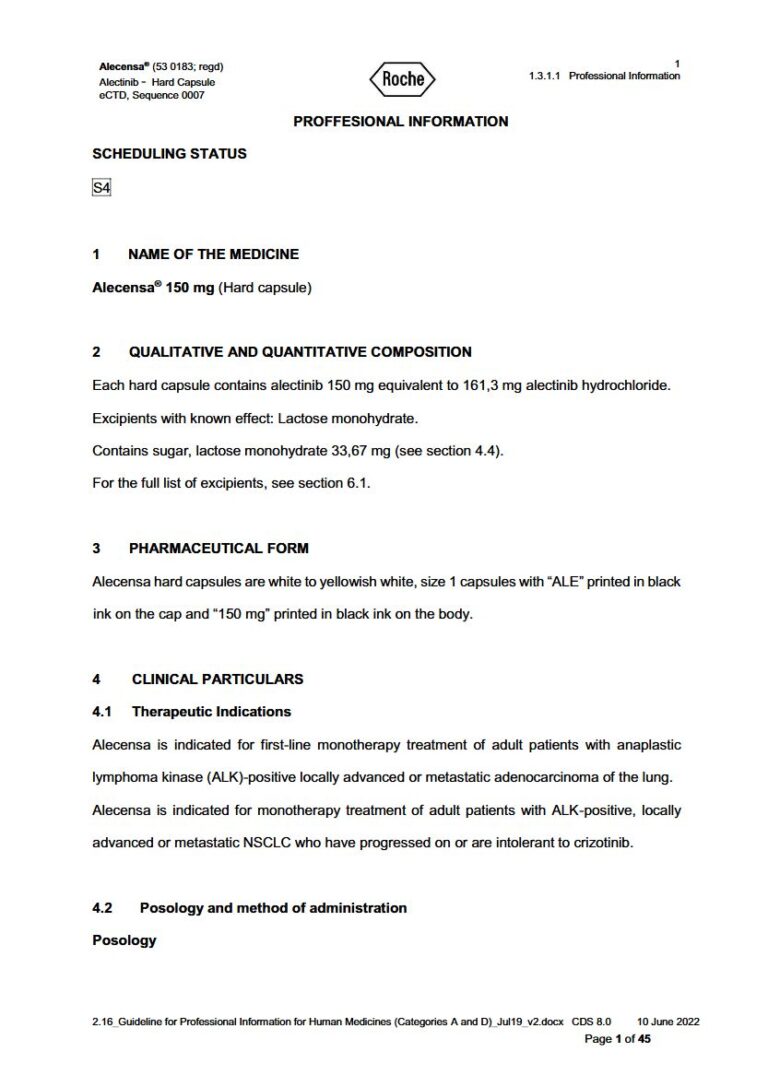
Alecensa is indicated for first-line monotherapy treatment of adult patients with anaplastic lymphoma kinase (ALK)-positive locally advanced or metastatic adenocarcinoma of the lung. Alecensa is indicated for monotherapy treatment of adult patients with ALK-positive, locally advanced or metastatic NSCLC who have progressed on or are intolerant to crizotinib.
4.2 Posology and method of administration
The recommended dose of Alecensa is 600 mg (four 150 mg capsules) given orally, twice daily (total daily dose of 1 200 mg) (see section 5.2). Patients with underlying severe hepatic impairment should receive a dose of 450 mg given orally twice daily (total daily dose of 900 mg) (see Special Dosing Instructions and section 5.2, Pharmacokinetics in Special Populations).
Duration of Treatment
It is recommended that patients are treated with Alecensa until disease progression or unmanageable toxicity.
Delayed or Missed Doses
If a planned dose of Alecensa is missed, patients can make up that dose unless the next dose is due within 6 hours. If vomiting occurs after taking a dose of Alecensa, patients should take the next dose at the scheduled time.
Dose Modifications
Management of adverse events may require temporary interruption, dose reduction, or discontinuation of treatment with Alecensa. The dose of Alecensa should be reduced in steps of 150 mg twice daily based on tolerability. Alecensa treatment should be permanently discontinued if patients are unable to tolerate the 300 mg twice daily dose.
Table 1 below gives general dose modification advice for Alecensa.
Table 1 Dose Reduction Schedule
Dose reduction schedule Dose level Dose
600 mg twice daily First dose reduction 450 mg twice daily Second dose reduction 300 mg twice daily
Table 2 Dose modification advice for specified Adverse Drug Reactions (see sections 4.4 and 4.8):
Grade Alecensa Treatment
Interstitial Lung Disease (ILD)/Pneumonitis (all Grades)
Immediately interrupt and permanently discontinue if no other potential causes of ILD/pneumonitis have been identified
ALT or AST elevation of Grade u22653 (> 5 times ULN) with total bilirubin u2264 2 times ULN
Temporarily withhold until recovery to baseline or u2264 Grade 1 (u2264 3 times ULN), then resume at reduced dose (see Table 1)
ALT or AST elevation of Grade u2265 2 (> 3 times ULN) with total bilirubin elevation > 2 times ULN in the absence of cholestasis or haemolysis
Permanently discontinue Alecensa
Bradycardia a Grade 2 or Grade 3 (symptomatic, may be severe and medically significant, medical intervention indicated)
Temporarily withhold until recovery to u2264 Grade 1 (asymptomatic) bradycardia or to a heart rate of u2265 60 bpm. Evaluate concomitant medications known to cause bradycardia, as well as anti-hypertensive medications. If contributing concomitant medication is identified and discontinued, or its dose is adjusted, resume at previous dose upon recovery to u2264 Grade 1 (asymptomatic) bradycardia or to a heart rate of u2265 60 bpm. If no contributing concomitant medication is identified, or if contributing concomitant medications are not discontinued or dose modified, resume at reduced dose (see Table 1) upon recovery to u2264 Grade 1 (asymptomatic) bradycardia or to a heart rate of u2265 60 bpm.
Bradycardia a Grade 4 (life-threatening consequences, urgent intervention indicated)
Permanently discontinue if no contributing concomitant medication is identified. If contributing concomitant medication is identified and discontinued, or its dose is adjusted, resume at reduced dose (see Table 1) upon recovery to u2264 Grade 1 (asymptomatic) bradycardia or to a heart rate of u2265 60 bpm, with frequent monitoring as clinically indicated. Permanently discontinue in case of recurrence.
CPK elevation > 5 times ULN
Temporarily withhold until recovery to baseline or to u2264 2.5 times ULN, then resume at same dose
CPK elevation >10 times ULN or second occurrence of CPK elevation of > 5 times ULN
Temporarily withhold until recovery to baseline or to u2264 2.5 times ULN, then resume at reduced dose as per Table 1
Haemolytic anaemia with haemoglobin of < 10 g/dL (Grade u2265 2)
Temporarily withhold until resolution, resume at reduced dose (see Table 1) or permanently discontinue.
ALT = alanine transaminase; AST = aspartate transaminase; ULN = upper limit of normal
a Heart rate less than 60 beats per minute (bpm)
Special Dosage Instructions
Paediatric use
The safety and efficacy of Alecensa in children and adolescents (<18 years) have not been studied.
Geriatric use
No dose adjustment of Alecensa is required in patients u2265 65 years of age.
Renal Impairment
No dose adjustment is required in patients with mild or moderate renal impairment. Alecensa has not been studied in patients with severe renal impairment, however since alectinib elimination via the kidney is negligible, no dose adjustment is required in patients with severe renal impairment (see section 5.2, Pharmacokinetics in Special Populations).
Hepatic Impairment
No dose adjustment is required in patients with underlying mild or moderate hepatic impairment. Patients with underlying severe hepatic impairment should receive a dose of 450 mg given orally twice daily (total daily dose of 900 mg) (see section 5.2, Pharmacokinetics in Special Populations).
Method of Administration
Precautions to be taken before manipulating or administering Alecensa. A validated ALK assay is required for the selection of ALK-positive NSCLC patients. ALK-positive NSCLC status should be established prior to initiation of Alecensa therapy. Alecensa hard capsules should be taken with food, swallowed whole and must not be opened or dissolved.
4.3 Contraindications
Alecensa is contraindicated in patients with a known hypersensitivity to alectinib or any of the excipients. Pregnancy and lactation. See section 4.6.
4.4 Special warnings and precautions for use
General
Interstitial lung disease (ILD)/Pneumonitis
Cases of ILD/pneumonitis have been reported in clinical trials with Alecensa (see section 4.8). Patients should be monitored for pulmonary symptoms indicative of pneumonitis. Alecensa should be immediately interrupted in patients diagnosed with ILD/pneumonitis and should be permanently discontinued if no other potential causes of ILD/pneumonitis have been identified (see section 4.2).
Hepatotoxicity
Elevations in alanine aminotransferase (ALT) and aspartate aminotransferase (AST) greater than 5 times the upper limit of normal (ULN) as well as bilirubin elevations of more than 3 times the ULN occurred in patients in pivotal clinical trials with Alecensa (see section 4.8). The majority of these events occurred during the first 3 months of treatment. In the pivotal Alecensa clinical trials there were reports of Grade 3-4 AST/ALT elevations with medicine induced liver injury. Concurrent elevations in ALT or AST greater than or equal to three times the ULN and total bilirubin greater than or equal to two times the ULN, with normal alkaline phosphatase, may occur. Liver function, including ALT, AST, and total bilirubin should be monitored at baseline and then every 2 weeks during the first 3 months of treatment, and then periodically, since events may occur later than 3 months, with more frequent testing in patients who develop transaminase and bilirubin elevations. Based on the severity of the adverse drug reaction, withhold Alecensa and resume at a reduced dose, or permanently discontinue Alecensa as described in Table 2 (see section 4.2).
Severe Myalgia and Creatine Phosphokinase (CPK) elevation
Myalgia or musculoskeletal pain was reported in patients in pivotal trials with Alecensa, including Grade 3 events. Elevations of CPK occurred in pivotal trials with Alecensa, including Grade 3 events. Median time to Grade 3 CPK elevation was 14 - 27.5 days in the pivotal trials (see section 4.8). Advise patients to report any unexplained muscle pain, tenderness, or weakness. Assess CPK levels every two weeks for the first month of treatment and as clinically indicated in patients reporting symptoms. Based on the severity of the CPK elevation, withhold Alecensa, then resume or reduce dose (see section 4.2).
Bradycardia
Symptomatic bradycardia can occur with Alecensa see section 4.2. Heart rate and blood pressure should be monitored as clinically indicated. Dose modification is not required in case of asymptomatic bradycardia (see section 4.2). If patients experience symptomatic bradycardia or life-threatening events, concomitant medications known to cause bradycardia, as well as anti-hypertensive medications should be evaluated and Alecensa treatment should be adjusted as described in Table 2 (see sections 4.2 and 4.5).
Haemolytic anaemia
Haemolytic anaemia has been reported with Alecensa (see section 4.8 Postmarketing Experience). If haemoglobin concentration is below 10 g/dL and haemolytic anaemia is suspected, withhold Alecensa and initiate appropriate laboratory testing. If haemolytic anaemia is confirmed, resume at a reduced dose upon resolution or permanently discontinue Alecensa (see section 4.2).
Photosensitivity
Photosensitivity to sunlight has been reported with Alecensa administration (see section 4.8). Patients should be advised to avoid prolonged sun exposure while taking Alecensa and for at least 7 days after discontinuation of treatment. Patients should also be advised to use a broad-spectrum Ultraviolet A (UVA)/ Ultraviolet B (UVB) sun screen and lip balm (SPF u2265 50) to help protect against potential sunburn.
Embryo-foetal toxicity
Alecensa may cause foetal harm when administered to a pregnant woman. When administrated to pregnant rats and rabbits, alectinib caused embryo-foetal toxicity. Female patients of child-bearing potential, or women of child-bearing potential who are partners of male patients receiving Alecensa, must use highly effective contraceptive methods during treatment and for at least 3 months following the last dose of Alecensa (see section 4.6, Use in Special Populations).
Sugars
Alecensa contains lactose monohydrate. Patients with the rare hereditary conditions of galactose intolerance e.g. galactosaemia, Lapp lactase deficiency, glucose-galactose malabsorption or fructose intolerance should not take Alecensa.
4.5 Interaction with other medicines and other forms of interaction
Effects of alectinib on others medicines
CYP substrates
In vitro studies indicate that neither alectinib nor its major active metabolite (M4) inhibits CYP1A2, CYP2B6, CYP2C9, CYP2C19, or CYP2D6 at clinically relevant concentrations. Alectinib and M4 show weak time-dependent inhibition of CYP3A4. In vitro, alectinib exhibits a weak induction potential of CYP3A4 and CYP2B6 at clinical concentrations. Results from a clinical drug-drug interaction study in ALK-positive NSCLC patients demonstrated that multiple doses of alectinib had no influence on the exposure of midazolam, a sensitive CYP3A substrate. Therefore, no dose adjustment is required for co-administered CYP3A substrates. Although in vitro studies indicate that alectinib is an inhibitor of CYP2C8, physiologically based pharmacokinetic (PBPK) modelling supports that at clinically relevant concentrations alectinib does not have the potential to increase plasma concentrations of co-administered substrates of CYP2C8.
P-gp and BCRP substrates
In vitro, alectinib and M4 are inhibitors of the efflux transporters P-glycoprotein (P-gp) and Breast Cancer Resistance Protein (BCRP). Therefore, alectinib may have the potential to increase plasma concentrations of co-administered substrates of P-gp or BCRP transporters (the increase in exposure is not expected to be more than 2-fold). When alectinib is co-administered with P-gp or BCRP substrates with narrow therapeutic index (e.g. digoxin, dabigatran, methotrexate), appropriate monitoring is recommended.
Effects of other medicines on alectinib
Based on in vitro data, CYP3A4 is the primary enzyme mediating the metabolism of both alectinib and its major active metabolite M4, and CYP3A contributes to 40 % - 50 % of total hepatic metabolism. M4 has shown similar in vitro potency and activity to alectinib against ALK.
CYP3A inducers
Co-administration of multiple oral doses of 600 mg rifampicin once daily, a strong CYP3A inducer, with a single oral dose of 600 mg alectinib exhibited a minor effect on combined exposure of alectinib and M4 (geometric mean ratio with/without rifampicin [90 % confidence interval]: C max: 0.96 [0.88 u2013 1.05], AUC inf: 0.82 [0.74 u2013 0.90]). Therefore, no dose adjustments are required when Alecensa is co-administered with CYP3A inducers.
CYP3A inhibitors
Co-administration of multiple oral doses of 400 mg posaconazole twice daily, a strong CYP3A inhibitor, with a single oral dose of 300 mg alectinib had a minor effect on combined exposure of alectinib and M4 (geometric mean ratio with/without posaconazole [90 % confidence interval]: C max: 0.93 [0.81 u2013 1.08], AUC inf: 1.36 [1.24 u2013 1.49]). Therefore, no dose adjustments are required when Alecensa is co-administered with CYP3A inhibitors.
Medicines that increase gastric pH
Although the aqueous solubility of alectinib in vitro is pH dependent, a dedicated clinical drug-drug interaction study with 40 mg esomeprazole once daily, a proton pump inhibitor, demonstrated no clinically relevant effect on the combined exposure of alectinib and M4. Therefore, no dose adjustments are required when Alecensa is co-administered with proton pump inhibitors or other drugs which raise gastric pH (e.g. H2 receptor antagonists or antacids).
Effect of transporters on alectinib disposition
Based on in vitro data, alectinib is not a substrate of P-gp. Alectinib and M4 are not substrates of BCRP or Organic anion-transporting polypeptide (OATP) 1B1/B3. In contrast, M4 is a substrate of P-gp. Alectinib inhibits P-gp, and therefore, it is not expected that co-medication with P-gp inhibitors has a relevant effect on M4 exposure.
4.6 Fertility, pregnancy and lactation
Use in Special Populations
Females and Males of Reproductive Potential
Contraception
Female patients of child-bearing potential, or women of child-bearing potential who are partners of male patients receiving Alecensa, must use highly effective contraceptive methods during treatment and for at least 3 months following the last dose of Alecensa.
Pregnancy
Alecensa is contraindicated during pregnancy. (See section 4.3). Based on its mechanism of action, Alecensa may cause foetal harm when administered to a pregnant woman. In animal studies, alectinib caused embryo-foetal toxicity. Female patients or women who are partners of male patients receiving Alecensa, who become pregnant while taking Alecensa or during the 3 months following the last dose of Alecensa must contact their doctor and should be advised of the potential harm to the foetus.
Lactation
Alecensa is contraindicated in mothers who are breastfeeding their infants.
4.7 Effects on ability to drive and use machines
Several side effects may impair the patientsu2019 ability to drive or use machines eg. vision disturbances and bradycardia. (see section 4.8)
4.8 Undesirable effects
Clinical Trials
For the clinical development program of Alecensa as a whole, an estimated total of 928 patients have received Alecensa and 203 patients have received blinded Alecensa. The safety of Alecensa has been evaluated in 253 patients in pivotal phase II clinical trials treated with the recommended dose of 600 mg twice daily. The median duration of exposure to Alecensa was 11 months (range 0-35 months). The safety of Alecensa was also evaluated in 152 patients with ALK-positive NSCLC treated with a dose of 600 mg twice daily in the phase III clinical trial. The median duration of exposure to Alecensa was 17.9 months.
The most common adverse drug reactions (u2265 20 %) were constipation (36 %), oedema (34 % including peripheral, generalised, eyelid, periorbital); myalgia (31 % including myalgia and musculoskeletal pain), nausea (22 %), increased bilirubin (21 % including increased blood bilirubin, hyperbilirubinaemia and increased conjugated bilirubin), anaemia (20 %, including anaemia and decreased haemoglobin), and rash (20 %, including rash, maculopapular rash, acneiform dermatitis, erythema, generalised rash, papular rash, pruritic rash and macular rash).
Table 3 lists the adverse drug reactions (ADRs) occurring in patients who received Alecensa in clinical trials. Adverse drug reactions from clinical trials are listed by MedDRA system organ class. The corresponding frequency category for each adverse drug reaction is based on the following convention: very common (u22651/10), common (u22651/100 to <1/10), uncommon (u22651/1,000 to <1/100), rare (u22651/10,000 to <1/1000), very rare (<1/10,000).
Table 3 u2013 Adverse drug reactions occurring in patients treated with Alecensa in pivotal phase II clinical trials (NP28761, NP28673) and phase III trial BO28984
Adverse Reactions (MedDRA) Alecensa N=253 (NP28761, NP28673) /N=152 (BO28984) System Organ Class All Grades (%) Grade 3 u2013 4 (%) Frequency Category (All Grades) Gastrointestinal Disorders Constipation 36 0 very common Nausea 22 0,7 very common Diarrhoea 18 1,2 very common Vomiting 13 0,4 very common
Stomatitis 3,3 0 common General Disorders and Administration Site Conditions Oedema 34 0,8 very common Musculoskeletal and Connective Tissue Disorders Myalgia 31 1,2 very common Increased Blood Creatine Phosphokinase 13 3,6 very common Skin and Subcutaneous Tissue Disorders Rash 20 0,7 very common Photosensitivity Reaction 12 0,7 very common Nervous System Disorders Dysgeusia 3,3 0,7 common Hepatobiliary Disorders Increased Bilirubin 21 3,3 very common Increased AST 16 5,3 very common Increased ALT 15 4,6 very common Drug-Induced Liver Injury 0,8 0,8 uncommon Blood and Lymphatic System Disorders Anaemia 20 4,6 very common Eye Disorders Vision Disorders 12 0 very common Cardiac Disorders Bradycardia 11 0 very common Investigations Increased Weight 9,9 0,7 common Renal and Urinary Disorders Increased Blood Creatinine 7,9 1,3 common Acute kidney injury 2,6 2,6 common Respiratory, Thoracic and Mediastinal Disorders Interstitial Lung Disease/ Pneumonitis 1,3 0,4 common
Further information on selected adverse drug reactions: The safety profile of Alecensa was generally consistent across the phase III clinical trial and the pivotal phase II trials; however, relevant differences between studies are described below.
Interstitial Lung Disease (ILD)/pneumonitis
Severe ILD/pneumonitis occurred in patients treated with Alecensa. In the pivotal phase II clinical trials, 1 out of 253 patients treated with Alecensa (0.4 %) had an ILD event, which was Grade 3, leading to withdrawal from Alecensa treatment. There were no fatal cases of ILD in any of the clinical trials.
Hepatotoxicity
In the pivotal phase II clinical trials two patients with Grade 3-4 AST/ALT elevations had documented drug induced liver injury by liver biopsy. Adverse reactions of increased AST and ALT levels (16 % and 14 % respectively) were reported in patients treated with Alecensa in pivotal phase II clinical trials. The majority of these events were of Grade 1 and 2 intensity, and events of Grade u2265 3 were reported in 2.8 % and 3.2 % of the patients, respectively. The events generally occurred during the first 3 months of treatment, were usually transient and resolved upon temporary interruption of Alecensa treatment (reported for 1.2 % and 3.2 % of the patients, respectively) or dose reduction (1.6 % and 0.8 %, respectively). In 1.2 % and 1.6 % of the patients, AST and ALT elevations, respectively, led to withdrawal from Alecensa treatment.
Adverse reactions of bilirubin elevations were reported in 17 % of the patients treated with Alecensa in pivotal phase II clinical trials. The majority of the events were of Grade 1 and 2 intensity; Grade 3 events were reported in 3.2 % of the patients. The events generally occurred during the first 3 months of treatment, were usually transient and resolved upon temporary interruption of Alecensa treatment (4.7 % of the patients) or dose reduction (2.8 %). In 4 patients (1.6 %), bilirubin elevations led to withdrawal from Alecensa treatment.
Concurrent elevations in ALT or AST greater than or equal to three times the ULN and total bilirubin greater than or equal to two times the ULN, with normal alkaline phosphatase, occurred in 1 patient treated in Alecensa clinical trials.
Bradycardia
Cases of bradycardia (7.9 %) have been reported in patients treated with Alecensa in pivotal phase II clinical trials; all cases were of Grade 1 or 2 intensity. There were 44 of 221 patients (20 %) treated with Alecensa who had post-dose heart rate values below 50 beats per minutes [bpm].
Severe Myalgia and CPK elevation
Cases of myalgia (31 %) including myalgia events (25 %) and musculoskeletal pain (7.5 %) have been reported in patients treated with Alecensa in pivotal phase II clinical trials. The majority of events were Grades 1 or 2 and three patients (1.2 %) had a Grade 3 event. Dose modifications due to these events were only required for two patients (0.8 %). Elevations of CPK occurred in 46 % of 219 patients with CPK laboratory data available in pivotal phase II clinical trials with Alecensa. The incidence of Grade 3 elevations of CPK was 5.0 %. Median time to Grade 3 CPK elevation was 14 days in the pivotal phase II trials. Median time to Grade 3 CPK elevation was 27.5 days in the pivotal phase III clinical trial. Dose modifications for elevation of CPK occurred in 4.0 % of patients.
Laboratory Abnormalities
The following table displays treatment-emergent shifts in laboratory abnormalities occurring in patients treated with Alecensa in phase II clinical trials and phase III trial.
Table 4 Alecensa Treatment-emergent shifts in key laboratory abnormalities
Parameter Alectinib N= 250*/N=152 All Grade (%) Grade 3 -4(%)
Chemistry Increased Blood Creatinine** 38 3.4 Increased AST 53 * 6.2 Increased ALT 40 6.1 Increased Blood Creatine Phosphokinase 46 * 5.0 * Increased Blood Bilirubin 53 5.5
Haematology Decreased Haemoglobin 62 6.8
AST - Aspartate Aminotransferase, ALT - Alanine Aminotransferase
Note: Laboratory abnormalities were based on the normal ranges of the NCI CTCAE. * Rate reported in NP28761 and NP28673 studies, N= 219 for Creatine Phosphokinase.
Post marketing Experience
The adverse drug reaction of increased alkaline phosphatase was reported with Alecensa in the post marketing period. Cases of increased alkaline phosphatase have been reported in Alecensa clinical trials (7.5 % in patients treated with Alecensa in pivotal phase II clinical trials.
The adverse drug reaction of haemolytic anaemia was reported with Alecensa in the post marketing setting. Cases of haemolytic anaemia have been reported in the Alecensa clinical trial (BO29554).
Reporting of suspected adverse reactions
Reporting suspected adverse reactions after authorisation of the medicine is important. It allows continued monitoring of the benefit/risk balance of the medicine. Healthcare professionals are asked to report any suspected adverse reactions to SAHPRA via the u201c6.04 Adverse Drug Reaction Report Formu201d, found online under SAHPRAu2019s publications: https://www.sahpra.org.za/Publications/Index/8
4.9 Overdose
Patients who experience overdose should be closely supervised and supportive care instituted. There is no specific antidote for overdose with Alecensa.
