
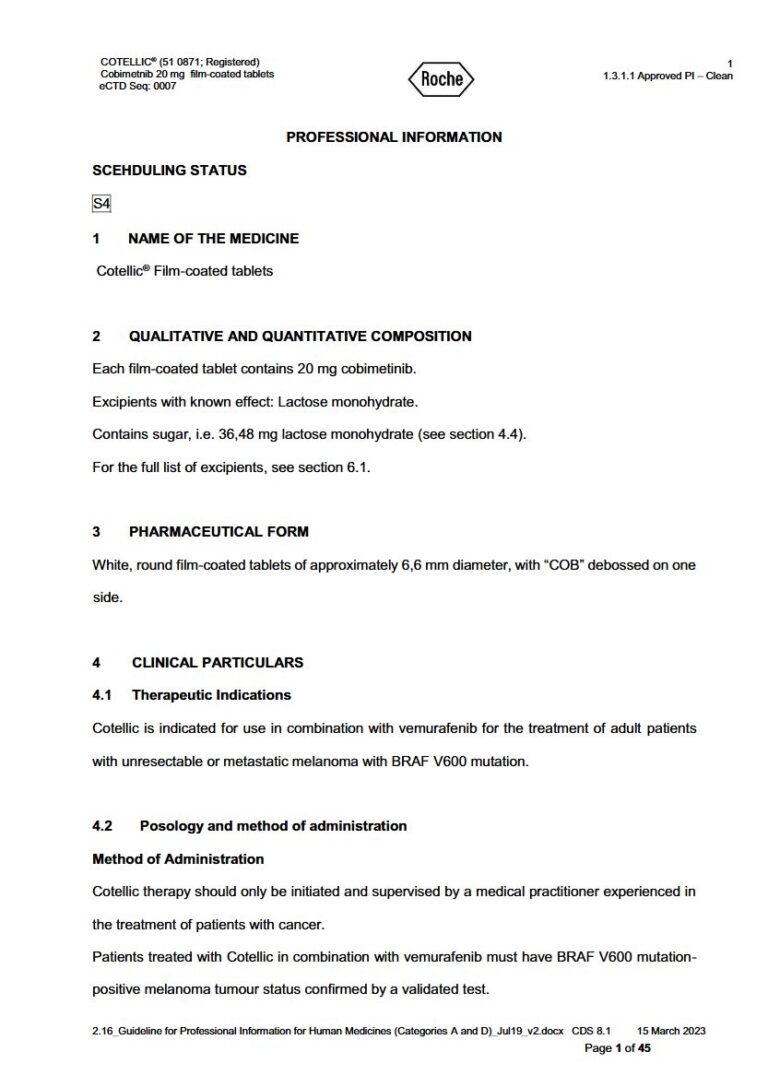
Cotellic 20 Mg Film-Coated Tablets
PDF Leaflet Revision Date: 15 March 2023
Clinical Summary
Quick overview from the medicine insert
Indication
Treatment of unresectable or metastatic melanoma with BRAF V600 mutation.
Dosage (summary)
60 mg (3 tablets) once daily for 21 days, followed by a 7-day break.
Special Populations
- Geriatric use
- Renal impairment
- Hepatic impairment
Pregnancy & Breastfeeding
Not recommended during pregnancy; contraindicated in breastfeeding.
Key Drug Interactions
- CYP3A inhibitors
- CYP3A inducers
Contraindications
- Hypersensitivity to cobimetinib or excipients
Common side effects
- Diarrhea
- Nausea
- Vomiting
- Rash
- Photosensitivity
Counselling Points
- Avoid sun exposure
- Use effective contraception
- Monitor for visual disturbances
Serious warnings
- New primary malignancies
- Severe dermatologic reactions
- Haemorrhage
- Left ventricular dysfunction
Important Disclaimer
The Cotellic 20 Mg Film-Coated Tablets professional information leaflet below is the property of Roche Products and is provided on Medinsert exactly as issued, with no.. alterations or editorial changes. We make every effort to keep content current by updating documents as soon as new versions become available. Medinsert serves as a trusted access point for healthcare professionals, but does not replace official sources or clinical judgement. For more details, please read our full disclaimer. read more>>
 Healthcare Professionals Only
This content is for registered healthcare professionals
Sign in or create a free account to read the full package insert.
Free for HPCSA-registered professionals. Powered by Medinsert.
Clinical Particulars
Section 4 of the official insert — extracted exactly as issued, no alterations
4.1 Therapeutic Indications
Cotellic is indicated for use in combination with vemurafenib for the treatment of adult patients with unresectable or metastatic melanoma with BRAF V600 mutation.
4.2 Posology and method of administration
Method of Administration
Cotellic therapy should only be initiated and supervised by a medical practitioner experienced in the treatment of patients with cancer. Patients treated with Cotellic in combination with vemurafenib must have BRAF V600 mutation-positive melanoma tumour status confirmed by a validated test.
Please refer to the full professional information of the combination product(s).
Standard Dosage (Posology)
The recommended dose of Cotellic is 60 mg (three 20 mg tablets) once daily. Cotellic is taken on a 28 day cycle. Each Cotellic dose consists of three 20 mg tablets (60 mg) and should be taken once daily for 21 consecutive days (days 1 to 21 - treatment period); followed by a 7 day break in Cotellic treatment (days 22 to 28 u2013 treatment break). Each dose of three 20 mg tablets (60 mg) can be taken with or without food (see Section 5.2, Absorption). Cotellic tablets should be swallowed whole with water.
Duration of treatment
Treatment with Cotellic should continue until the patient no longer derives benefit or until the development of unacceptable toxicity.
Delayed or Missed doses
If a planned dose of Cotellic is missed, it can be taken up to 12 hours prior to the next dose to maintain the once-daily regimen.
Vomiting
In case of vomiting after Cotellic administration, the patient should not take an additional dose of Cotellic on that day, and treatment should be continued as prescribed the following day.
Dose Modification
General
Cotellic dose modification should be based on the prescriberu2019s assessment of individual patient safety or tolerability. If doses are omitted for toxicity; missed doses should not be replaced. Once the dose has been reduced, it should not be increased at a later time. Dose modification of Cotellic is independent of the dose modification of any concomitant medicine used with Cotellic as combined therapy. The decision on whether to dose reduce each drug should be based on clinical assessment.
Table 1 Recommended Cotellic dose modifications
Grade (CTC-AE)* Recommended Cotellic dosage
Grade 1 or Grade 2 (tolerable) No dose reduction
Grade 2 (intolerable) or Grade 3 and 4 1st Appearance Interrupt treatment until grade u2264 1, restart treatment at 40 mg once daily
2nd Appearance Interrupt treatment until grade u22641, restart treatment at 20 mg once daily
3rd Appearance Consider permanent discontinuation
* The intensity of clinical adverse events graded by the Common Terminology Criteria for Adverse Events v4.0 (CTC-AE)
Dose modification advice for specified adverse drug reactions (ADRs)
Haemorrhage
Grade 4 events or cerebral haemorrhage (all grades): Interrupt Cotellic treatment. Permanently discontinue Cotellic for haemorrhage events attributed to Cotellic. Grade 3 events: Interrupt Cotellic treatment. There is no data on the effectiveness of Cotellic dose modification for haemorrhage events. Clinical judgment should be applied when considering restarting Cotellic treatment. In combined therapy dosing with other product/s may be interrupted, if clinically indicated.
Left ventricular dysfunction
Permanent discontinuation of Cotellic treatment should be considered if cardiac symptoms are attributed to Cotellic and do not improve after temporary interruption of Cotellic.
4.3 Contraindications
Cotellic is contraindicated in patients with known hypersensitivity to cobimetinib or any of the excipients.
4.4 Special warnings and precautions for use
Please also refer to the full prescribing information for products used in combination with Cotellic.
New primary malignancies
New primary malignancies, cutaneous and non-cutaneous, can occur with Cotellic.
Cutaneous Malignancies:
In Trial 1, the following cutaneous malignancies or premalignant conditions occurred in the Cotellic with vemurafenib arm and the vemurafenib arm, respectively: cutaneous squamous cell carcinoma (cuSCC) or keratoacanthoma (KA) (6 % and 20 %), basal cell carcinoma (4,5 % and 2,4 %), and second primary melanoma (0,8 % and 2,4 %). Among patients receiving Cotellic with vemurafenib, the median time to detection of first cuSCC/KA was 4 months (range: 2 to 11 months), and the median time to detection of basal cell carcinoma was 4 months (range: 27 days to 13 months). The time to onset in the two patients with second primary melanoma was 9 months and 12 months. Perform dermatologic evaluations prior to initiation of therapy and every 2 months while on therapy. Manage suspicious skin lesions with excision and dermatopathologic evaluation. No dose modifications are recommended for Cotellic (see Section 4.2). Conduct dermatologic monitoring for 6 months following discontinuation of Cotellic when administered with vemurafenib.
Non-Cutaneous Malignancies:
Based on its mechanism of action, vemurafenib may promote growth and development of malignancies (please refer to the full professional information for vemurafenib). In Trial 1, 0,8 % of patients in the Cotellic with vemurafenib arm and 1,2 % of patients in the vemurafenib arm developed non-cutaneous malignancies. Monitor patients receiving Cotellic, when administered with vemurafenib, for signs or symptoms of non-cutaneous malignancies.
Severe Dermatologic Reactions
Severe rash and other skin reactions can occur with Cotellic. In Trial 1, Grade 3 to 4 rash, occurred in 16 % of patients receiving Cotellic with vemurafenib and in 17 % of patients receiving vemurafenib, including Grade 4 rash in 1,6 % of patients receiving Cotellic with vemurafenib and 0,8 % of the patients receiving vemurafenib. The incidence of rash resulting in hospitalisation was 3,2 % in patients receiving Cotellic with vemurafenib and 2,0 % in patients receiving vemurafenib. In patients receiving Cotellic, the median time to onset of Grade 3 or 4 rash events was 11 days (range: 3 days to 2,8 months). Among patients with Grade 3 or 4 rash events, 95 % experienced complete resolution with the median time to resolution of 21 days (range 4 days to 17 months). Interrupt, reduce the dose, or discontinue Cotellic (see Section 4.2).
Haemorrhage
Haemorrhage, including major haemorrhages defined as symptomatic bleeding in a critical area or organ, can occur with Cotellic (see Section 4.8). Caution should be used in patients with additional risk factors for bleeding, such as brain metastases, and/or in patients that use concomitant medications that increase the risk of bleeding (including antiplatelet or anticoagulant therapy). For haemorrhage management, (see Section 4.2).
Serous retinopathy
Serous retinopathy (fluid accumulation within the layers of the retina) has been observed in 26 % of patients treated with MEK-inhibitors, including Cotellic (see Section 4.8). The majority of events were reported as chorioretinopathy (13 %) or retinal detachment (12 %). Median time to initial onset of serous retinopathy events was 1 month (range 0 - 9 months). Most events observed in clinical trials were resolved, or improved to asymptomatic grade 1, following dose interruption or reduction. For patients reporting new or worsening visual disturbances, an ophthalmologic examination is recommended. If serous retinopathy is diagnosed, Cotellic treatment should be withheld until visual symptoms improve to Grade u2264 1. Serous retinopathy can be managed with treatment interruption, dose reduction or with treatment discontinuation (see Section 4.2).
Left ventricular dysfunction
Clinically significant decrease in left ventricular ejection fraction (LVEF) from baseline has been reported in 27,1 % of patients receiving Cotellic (see Section 4.8). Median time to initial onset of events was 4 months (1 - 13 months). LVEF should be evaluated before initiation of treatment to establish baseline values, then after the first month of treatment and at least every 3 months or as clinically indicated until treatment discontinuation. Decrease in LVEF from baseline can be managed using treatment interruption, dose reduction or with treatment discontinuation (see Section 4.2). All patients restarting treatment with a dose reduction of Cotellic should have LVEF measurements taken after approximately 2 weeks, 4 weeks, 10 weeks and 16 weeks, and then as clinically indicated. Patients with a baseline LVEF either below institutional lower limit of normal (LLN) or below 50 % have not been studied.
Hepatotoxicity
Hepatotoxicity can occur with Cotellic. The incidences of Grade 3 or 4 liver laboratory abnormalities in Trial 1 among patients receiving Cotellic with vemurafenib compared to patients receiving vemurafenib were: 11 % vs. 5 % for alanine aminotransferase, 8 % vs. 2,1 % for aspartate aminotransferase, 1,6 % vs. 1,2 % for total bilirubin, and 7 % vs. 3,3 % for alkaline phosphatase (See Section 4.8). Concurrent elevation in ALT > 3 times the upper limit of normal (ULN) and bilirubin > 2 X ULN in the absence of significant alkaline phosphatase > 2 X ULN occurred in one patient (0,4 %) receiving Cotellic with vemurafenib and no patients receiving single-agent vemurafenib.
Liver laboratory abnormalities
Liver laboratory abnormalities can occur when Cotellic is used in combination with vemurafenib, and when vemurafenib is used as a single agent (please refer to the full professional information for vemurafenib). Liver laboratory abnormalities, specifically increases in alanine aminotransferase (ALT), aspartate aminotransferase (AST), and alkaline phosphatase (ALP), have been observed in patients treated with Cotellic plus vemurafenib (See Section 4.8). Monitor for liver value abnormalities by liver laboratory tests before initiation of combination treatment and monthly during treatment, or more frequently as clinically indicated. Manage Grade 3 liver laboratory abnormalities with treatment interruption or dose reduction of vemurafenib. Manage Grade 4 liver laboratory abnormalities with dose interruption, reduction or discontinuation of treatment of both Cotellic and vemurafenib (see Section 4.2).
Rhabdomyolysis and Creatine phosphokinase (CPK) elevations
Rhabdomyolysis has been reported in patients receiving Cotellic (See Section 4.8). Interrupt treatment with Cotellic if rhabdomyolysis is diagnosed, and monitor CPK levels and other symptoms until resolution. Depending on the severity of rhabdomyolysis, dose reduction or treatment discontinuation may be required (see Section 4.2). Grade 3 and 4 CPK elevations, including asymptomatic elevations over baseline, also occurred in patients receiving Cotellic with vemurafenib (see Section 4.8). The median time to first occurrence of Grade 3 or 4 CPK elevations was 16 days (range: 11 days to 10 months); the median time to complete resolution was 16 days (range: 2 days to 15 months). Serum CPK and creatinine levels should be measured before initiation of treatment, to establish baseline values, and then monitored monthly during treatment, or as clinically indicated. If serum CPK is elevated, check for signs and symptoms of rhabdomyolysis or other causes. Depending on the severity of symptoms or CPK elevation, treatment interruption, dose reduction or treatment discontinuation may be required (see Section 4.2).
Severe Photosensitivity
Photosensitivity, including severe cases, can occur with Cotellic. In Trial 1, photosensitivity was reported in 47 % of patients receiving Cotellic with vemurafenib: 43 % of patients with Grades 1 or 2 photosensitivity and the remaining 4 % with Grade 3 photosensitivity. Median time to first onset of photosensitivity of any grade was 2 months (range: 1 day to 14 months) in patients receiving Cotellic with vemurafenib, and the median duration of photosensitivity was 3 months (range: 2 days to 14 months). Among the 47 % of patients with photosensitivity reactions on Cotellic with vemurafenib, 63 % experienced resolution of photosensitivity reactions.
Advise patients to avoid sun exposure, wear protective clothing and use a broad-spectrum UVA/UVB sunscreen and lip balm (SPF u2265 30) when outdoors. Manage intolerable Grade 2 or greater photosensitivity with dose modifications (see Section 4.2).
4.5 Interactions with other medicines
Effects of concomitant medications on Cotellic
CYP3A Inhibitors/Inducers:
Cotellic is metabolised by CYP3A and Cotellic AUC increased approximately 7-fold in the presence of a potent CYP3A inhibitor (itraconazole) in healthy subjects. Since Cotellic is a sensitive substrate of CYP3A, it is likely that Cotellic exposures will be lower in the presence of CYP3A inducers. Therefore concomitant administration of potent CYP3A inducers and inhibitors is not recommended. Caution should be exercised when Cotellic is co-administered with moderate CYP3A inducers and inhibitors.
Acid Reducing Agents:
Cotellic pharmacokinetics are not altered by the co-administration of a proton pump inhibitor. Cotellic was administered in the presence of rabeprazole (a proton pump inhibitor) in healthy subjects to determine the effect of increased gastric pH. Thus, gastric pH elevations do not affect Cotellic absorption.
Effects of Cotellic on concomitant medicines
CYP Substrates:
In vitro data indicate that Cotellic is an inhibitor of CYP3A and CYP2D6. A clinical drug-drug interaction (DDI) Study in cancer patients showed that plasma concentrations of midazolam (a sensitive CYP3A substrate) and dextromethorphan (a sensitive CYP2D6 substrate) were not altered in the presence of Cotellic. Therefore Cotellic can be co-administered with medications that are substrates of CYP3A and CYP2D6.
Other anti-cancer agents
Vemurafenib: There is no evidence of any clinically significant drug-drug interaction between Cotellic and vemurafenib in unresectable or metastatic melanoma patients.
Effects of transporters on Cotellic
In vitro studies show that Cotellic is a substrate of P-glycoprotein (P-gp). In vitro studies also show that Cotellic is not a substrate of breast cancer resistance protein (BCRP). In vitro studies show that Cotellic is not a substrate of the liver uptake transporters OATP1B1, OATP1B3, and OCT1.
Effects of Cotellic on transporters
In vitro data suggest that Cotellic is a weak to moderate inhibitor of BCRP, and a weak inhibitor of OATP1B1, OATP1B3 and OCT1. The clinical relevance of these findings has not been investigated. Cotellic is not an inhibitor of P-gp, OAT1, OAT3 or OCT2. It is unlikely that Cotellic would alter the hepatic uptake or renal excretion of drugs that are substrates of these transporters.
4.6 Fertility, pregnancy and lactation
Women of childbearing potential / Contraception in males and females
A woman must take two effective forms of contraception during treatment with Cotellic and for at least three months following treatment discontinuation.
Pregnancy
Cotellic is not recommended during pregnancy. There are no data regarding the use of Cotellic in pregnant women. When administered to pregnant rats, Cotellic caused embryolethality and foetal malformations of the great vessels and skull at clinically relevant exposures.
Breastfeeding
Mothers receiving Cotellic must not breastfeed their infants.
Fertility
The effect of Cotellic on human fertility is unknown. No dedicated fertility studies in animals have been performed with Cotellic.
4.7 Effects on ability to drive and use machines
Cotellic may have a minor influence on the ability to drive and use machines. Chorioretinopathy, blurred vision, or retinal detachment may occur during treatment with Cotellic (see Section 4.8).
4.8 Undesirable effects
Clinical trials Summary of the safety profile
A total of 376 patients with unresectable or metastatic melanoma with BRAF V600 mutation have received Cotellic in combination with vemurafenib. The safety of Cotellic in combination with vemurafenib has been evaluated in 247 patients with advanced BRAF V600 mutated melanoma. The median time to onset of first Grade u2265 3 adverse events was 0,6 months in the Cotellic plus vemurafenib arm vs 0,8 months in the placebo plus vemurafenib arm.
Tabulated summary of adverse drug reactions from clinical trials
Adverse drug reactions (ADRs) from clinical trials (Tables 3 and 4) are listed by MedDRA system organ class. Table 3 summarises the ADRs occurring at a u2265 5 % higher incidence (All Grades) or at a u2265 2 % higher incidence (Grades 3-4) of patients treated with Cotellic in combination with vemurafenib. Table 4 summarises ADRs occurring at a <5 % higher incidence (All Grades) of patients treated with Cotellic in combination with vemurafenib in the Phase III Study. The corresponding frequency category for each adverse drug reaction is based on the following convention: very common (u22651/10), common (u22651/100 to <1/10), uncommon (u22651/1,000 to <1/100), rare (u22651/10,000 to <1/1000), very rare (<1/10,000).
Table 3 Summary of ADRs occurring at a u2265 5% higher incidence (All Grades) or at a u2265 2% higher incidence (Grades 3-4) in the Cotellic arm than the control arm in patients with unresectable or metastatic melanoma
ADRs Phase III Study: GO28141 Frequency a (All Grades) Cotellic + vemurafenib (n = 247) Placebo + vemurafenib (n = 246)
All grades (%) Grade 3-4 (%) All grades (%) Grade 3-4 (%)
Blood and Lymphatic System Disorders Anaemia 13 2 8 2 very common
Eye Disorders Chorioretinopathy 13 <1 <1 - very common
Blurred Vision 10 - 2 - very common
Retinal Detachment 9 2 <1 - common
Gastrointestinal disorders Diarrhoea 60 6 31 1 very common
Nausea 41 1 25 1 very common
Vomiting 24 1 13 1 very common
General disorders and administration site conditions Pyrexia 28 2 23 - very common
Chills 10 - 5 - very common
Investigations Decreased Ejection Fraction 9 2 4 1 common
Metabolism and nutrition disorders Dehydration 4 2 1 - common
Hyponatremia 5 2 1 <1 common
Neoplasms benign, malignant and unspecified Basal Cell Carcinoma 4 4 2 2 common
Skin and subcutaneous tissue disorders Photosensitivity b 47 4 35 - very common
Maculo-papular rash 15 7 15 5 very common
Acneiform Dermatitis 14 2 9 1 very common
Vascular Disorders Hypertension 15 4 8 2 very common
a Based on the Phase III Study GO28141 adverse events of all grades
b Combined figure includes reports of photosensitivity reaction, sunburn, solar dermatitis, actinic elastosis
Table 4: Summary of ADRs (all grades) reported with <5 % greater incidence in the Cotellic arm than the control arm in patients with unresectable or metastatic melanoma:
ADRs Phase III Study: GO28141 Frequency category: Cotellic + vemurafenib arm (All grades) Cotellic plus vemurafenib arm (All grades) placebo plus vemurafenib arm (All grades)
Eye disorders Visual impairment 1 3 % - common
General disorders and administration site conditions Peripheral oedema 15,3 % 11,4 % very common
Metabolism and nutrition disorders Hyperglycaemia 3 % 1 % common
Hypophosphatemia 4 % 1 % common
Respiratory, thoracic and mediastinal disorders Pneumonitis 1 % <1 % common
Skin and subcutaneous tissue disorders Rash Pruritus Dry skin 40 % 20,6 % 14,9 % 38 % 19,2 % 16,7 % very common very common very common
Vascular disorders Cerebral haemorrhage 1 % - common
Gastrointestinal (GI) tract haemorrhage 4 % 1 % common
Reproductive system haemorrhage 2 % <1 % common
Haematuria 3 % 1 % common
1 See sections 4.4 Warnings and Precautions, and 4.7 Ability to Drive and Use Machines
Description of selected adverse reactions from clinical trials
Haemorrhage
Bleeding events have been reported more frequently in the Cotellic plus vemurafenib arm than in the placebo plus vemurafenib arm (all types and grades: 13 % vs 7 %). Higher frequencies seen in the Cotellic plus vemurafenib arm are given in table 4. The majority of events were Grade 1 or 2 and non-serious (12 % of patients in the Cotellic plus vemurafenib arm vs 7 % patients in the placebo plus vemurafenib arm). Most events resolved or were resolving with no change in Cotellic dose. Grade 3-4 events were experienced by 1 % of patients in each arm (see Section 4.4).
Photosensitivity
The majority of events were Grades 1 or 2, with Grade u2265 3 events occurring in 4 % of patients in the Cotellic plus vemurafenib arm vs. 0 % in the placebo plus vemurafenib arm. There were no apparent trends in the time of onset of Grade u2265 3 events. Grade u2265 3 photosensitivity events in the Cotellic plus vemurafenib arm were treated with primary topical medication in conjunction with dose interruptions of both Cotellic and vemurafenib (see Section 4.2, Dose modification advice for specified adverse drug reactions (ADRs), Photosensitivity). No evidence of phototoxicity was observed with Cotellic as a single agent.
Cutaneous squamous cell carcinoma, Keratoacanthoma and Hyperkeratosis
In patients with unresectable or metastatic melanoma cutaneous squamous cell carcinoma has been reported with a lower frequency in the Cotellic plus vemurafenib vs. placebo plus vemurafenib arm (all grade: 3 % vs. 13 %). Keratoacanthoma has been reported with a lower frequency in the Cotellic plus vemurafenib vs. placebo plus vemurafenib arm (all grades: 2 % vs. 9 %). Hyperkeratosis has been reported with a lower frequency in the Cotellic plus vemurafenib vs. placebo plus vemurafenib arm (all grade: 11 % vs. 30 %).
Laboratory Abnormalities
Table 5 Liver function and other laboratory tests observed in the phase III Study GO28141
Test* Cotellic + vemurafenib (n = 247) (%) Placebo + vemurafenib (n = 246) (%)
All Grades Grades 3-4 All Grades Grades 3-4
Liver Function Test Increased ALP 69 7 55 3
Increased ALT 67 11 54 5
Increased AST 71 7 43 2
Increased GGT 62 20 59 17
Increased blood bilirubin 33 2 43 1
Other Laboratory Abnormalities Increase blood CPK 70 12 14 <1
* based on reported laboratory data ALP - alkaline phosphatase, ALT - alanine aminotransferase, AST - aspartate aminotransferase, GGT - gamma-glutamyltransferase, CPK - creatine phosphokinase
Post Marketing Experience
Table 6 Adverse Drug Reactions reported from post marketing experience
System Organ Class (SOC) ADR
Musculoskeletal and connective tissue disorders Rhabdomyolysis
4.9 Overdose
There is no specific antidote for overdosage with Cotellic. Stop the Cotellic and administer symptomatic and supportive treatment. Electrocardiographic monitoring is needed to identify any QTc interval changes.
