
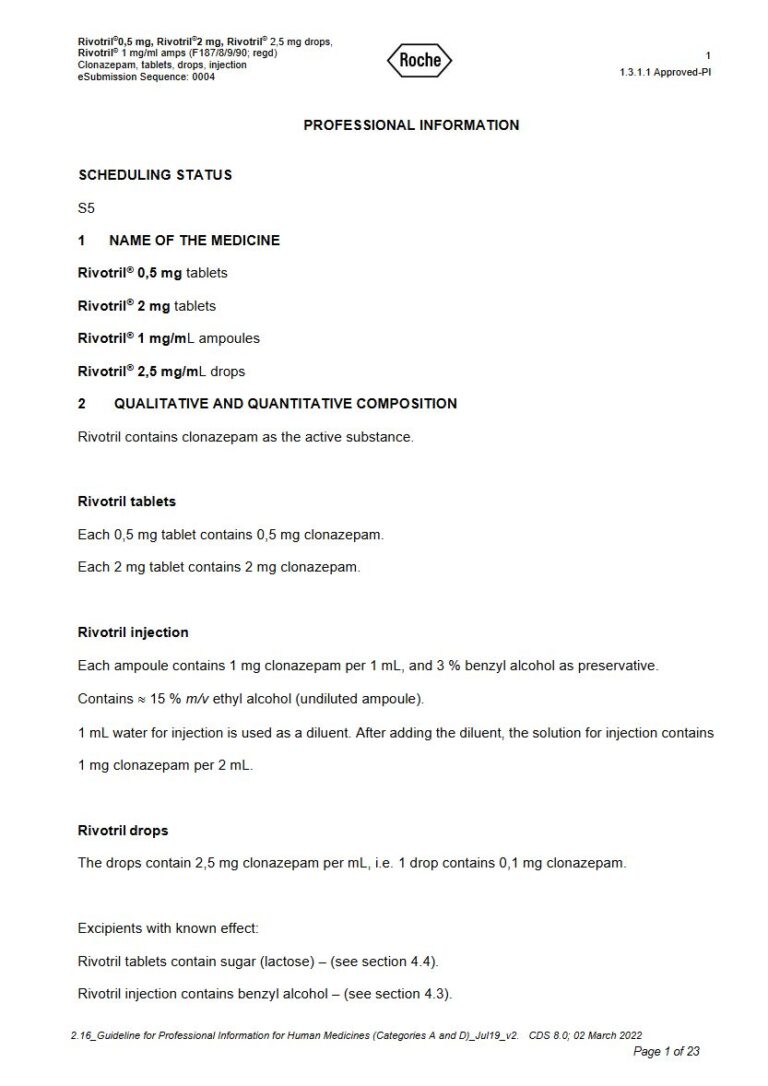
Rivotril Range 0.5 mg/2 mg/1 mg/2.5 mg Tablets
PDF Leaflet Revision Date: 02 March 2022
Clinical Summary
Quick overview from the medicine insert
Indication
Epilepsy and Panic Disorder.
Dosage (summary)
Adults: Initial 1.5 mg/day, max 20 mg/day. Adjust based on response.
Onset of Action / Duration
Onset: 30-60 mins, Duration: 8-12 hours.
Special Populations
- Elderly
- Renal impairment
- Hepatic impairment
Pregnancy & Breastfeeding
Use only if necessary in pregnancy; contraindicated in breastfeeding.
Key Drug Interactions
- CNS depressants
- Phenytoin
- Valproate
Contraindications
- Hypersensitivity to clonazepam
- Severe respiratory insufficiency
- Severe hepatic impairment
- Acute narrow angle glaucoma
- Sleep apnoea
Common side effects
- Somnolence
- Headache
- Dizziness
- Fatigue
- Nausea
Counselling Points
- Avoid alcohol
- Monitor for sedation
- Gradual dose tapering recommended
Serious warnings
- Risk of dependence
- Withdrawal symptoms
- Paradoxical reactions
Important Disclaimer
The Rivotril Range 0.5 mg/2 mg/1 mg/2.5 mg Tablets professional information leaflet below is the property of Roche Products and is provided on Medinsert exactly as issued, with no.. alterations or editorial changes. We make every effort to keep content current by updating documents as soon as new versions become available. Medinsert serves as a trusted access point for healthcare professionals, but does not replace official sources or clinical judgement. For more details, please read our full disclaimer. read more>>
 Healthcare Professionals Only
This content is for registered healthcare professionals
Sign in or create a free account to read the full package insert.
Free for HPCSA-registered professionals. Powered by Medinsert.
Clinical Particulars
Section 4 of the official insert — extracted exactly as issued, no alterations
4.1 Therapeutic Indications
Rivotril tablets and Rivotril drops
Epilepsy
Rivotril is indicated, primarily as an adjunct or in refractory cases, in most forms of epilepsy especially absence seizures including atypical absence seizures; Lennox - Gastaut syndrome; myoclonic and atonic seizures. For infantile spasms (including West - Syndrome) and tonic - clonic seizures it is only indicated as an adjunct or in refractory cases.
Panic disorder
Rivotril is indicated for the treatment of Panic Disorder, with or without agoraphobia.
Rivotril injection
Epileptic disease
Status epilepticus in all its forms.
Panic disorder
Rivotril is indicated for the treatment of Panic Disorder, with or without agoraphobia.
4.2 Posology and method of administration
The dosage of Rivotril must be individually adjusted according to the patientu2019s clinical response and tolerance. Rivotril tablets 0,5 mg can be divided into equal halves to facilitate dosing. Rivotril tablets 2 mg can be divided into equal halves or quarters to facilitate dosing. Tablets are scored to allow administration of lower doses. To break the tablet, hold it with the score facing up and apply downward pressure.
Standard dosage in Epilepsy
Before adding Rivotril to an existing anticonvulsant regimen, it should be considered that the use of multiple anticonvulsants may result in an increase of undesired effects. To ensure optimum dosage adjustment, infants should be given the drops. The 0,5 mg tablets facilitate the administration of lower daily doses to adults in the initial stages of treatment. A single oral dose of Rivotril begins to take effect within 30 - 60 minutes and remains effective for 6 - 8 hours in children and 8 - 12 hours in adults. An IV dose has an immediate effect which lasts for 2 - 3 hours.
Oral treatment
In order to avoid initial side effects, it is essential to increase the daily dose progressively until the maintenance dose suited to the individual patient has been reached.
Posology
The initial daily dose for infants and children up to the age of 10 years (or up to 30 kg bodyweight): Initially 0,01 to 0,03 mg/kg is given in two to three divided doses, the dosage being increased by 0,25 to 0,5 mg every third day, until either a maintenance dose of 0,1 mg per kg of bodyweight per day is reached, or until seizures are controlled or side effects prevent a further increase. The daily maximum dose in children is 0,2 mg/kg of bodyweight and should not be exceeded.
To obtain optimum adjustment of the dose in infants and children the use of the drop form (1 drop contains 0,1 mg active substance) and the tablets 0,5 mg is recommended. The single - scored 0,5 mg tablet facilitates administration of low doses in the early phase of treatment.
Correct method of administration of Rivotril drops: The drops should be mixed with water, tea or fruit juice and administered with a spoon. Caution: Never administer Rivotril drops directly into the mouth from the bottle. After each opening, make sure the dropper is secured within the neck of the bottle.
Recommended dose for children between 10 and 16 years: The initial dose is 1 - 1,5 mg per day given in 2 - 3 divided doses. The dose may be increased by 0,25 - 0,5 mg every third day, until the individual maintenance dose (usually 3 - 6 mg/day) is reached.
The initial dose for adults: This should not exceed 1,5 mg/day, divided into 3 doses. The dose may be increased in increments of 0,5 mg every three days, until either seizures are adequately controlled, or undesired effects preclude any further increase. Usually a maintenance dose of 3 - 6 mg per day is sufficient, but must be individualised for each patient depending upon response. Maximum recommended daily dose is 20 mg and should not be exceeded. The daily dose should be divided into 3 equal doses. If doses are not equally divided, the largest dose should be given before retiring. The maintenance dose level is best attained after 1 to 3 weeks of treatment. Once the maintenance dose level has been reached, the daily amount may be given in a single dose in the evening.
Parenteral treatment
Intravenous administration: The IV administration is mainly used for treatment of status epilepticus. Infants and children: Half an ampoule (0,5 mg = 1 mL reconstituted solution) by slow intravenous injection or by intravenous infusion. Adults: One ampoule (1 mg = 2 mL reconstituted solution) by slow intravenous injection. This dose can be repeated as required, (1 - 4 mg are usually required to reverse the status). In adults, the rate of injection must not exceed 0,25 - 0,5 mg (0,5 - 1,0 mL of the prepared solution) per minute and a total dose of 10 mg should not be exceeded. Slow intravenous injection: The 1 mL ampoule solution containing 1 mg active ingredient may only be employed after addition of 1 mL diluent in order to avoid local irritation to the veins. A vein of sufficient calibre must be chosen. The injection solution should be prepared immediately before use. Intravenous injection should be administered slowly with continuous monitoring of EEG, respiration and blood pressure. If the injection is rapid or the calibre of the vein is insufficient, there is a risk of thrombophlebitis, which may in turn lead to thrombosis. Intravenous infusion: Rivotril (only the ampoule with the active substance) can be diluted for infusion with the following media in a ratio of 1 ampoule (1 mg) to at least 85 mL (e.g. 3 ampoules in 250 mL) to avoid precipitation: sodium chloride 0,9 %; sodium chloride 0,45 % + glucose 2,5 %; glucose 5 % and glucose 10 %. These mixtures are stable for 24 hours at room temperature. The active ingredient can be adsorbed to polyvinylchloride (PVC) infusion bags, and polyurethane (PUR) and silicone infusion sets leading to a reduction in clonazepam concentration by up to 50 %, especially where prepared bags are stored for 24 hours or more, in warm ambient conditions, or where long tubing sets or slow rates of infusion are used. If possible, PVC/PUR/silicone - containing bags and infusion sets should be avoided when infusing Rivotril (see section 6.6). When infusing Rivotril, caution should be exercised when switching between PVC/PUR/silicone - containing and non - containing bags and infusion sets.
Intramuscular administration: The intramuscular route should only be used by way of exception or if IV administration is not feasible. (After intramuscular injection T max is 3 hours).
Dosage in Panic Disorder
Adults: The initial dose for adults with Panic Disorder is 0,25 mg twice daily (0,5 mg/day). An increase to the target dose for most patients of 1 mg/day may be made after 3 days. Subsequent up - titration should be made at intervals of 3 days until panic disorder is controlled or until side effects make further increases undesirable. The usual maintenance dose is 1 mg twice daily (2 mg/day). A maximum dose of 2 mg twice daily (4 mg/day) may be prescribed in exceptional cases. Once a stable dose is achieved, patients may switch to a once daily dose, usually taken at bedtime. Duration of treatment: Maintenance treatment is recommended for at least 12 - 24 months, and in some cases, indefinitely. After at least 1 year of response gradual discontinuation should be attempted, with down - titration of 0.25 mg every 3 days, until the medicine is completely withdrawn and close follow - up of the patient.
Special dosage instructions
Epilepsy and Panic Disorder
Elderly Patients: The lowest possible dose should be used in the elderly and particular care should be taken during up - titration in elderly patients. Renal Impairment: The safety and efficacy of clonazepam in patients with renal impairment has not been studied, however based on pharmacokinetic considerations no dose adjustment is required in these patients (see section 5.2).
Hepatic Impairment: Patients with severe hepatic impairment must not be given Rivotril. (see Section 4.3). Patients with mild to moderate hepatic impairment should be given the lowest dose possible.
Epilepsy
Rivotril can be administered concurrently with one or several other antiepileptic agents, in which case the dosage of each medicine must be adjusted to achieve the optimum effect. Treatment with Rivotril must not be stopped abruptly, but be reduced in a stepwise fashion (see sections 4.4 and 4.8).
Panic disorder
Paediatric Patients: The safety and efficacy of clonazepam for the treatment of Panic Disorder in children has not been studied.
4.3 Contraindications
Rivotril is contraindicated in patients with:
- Known hypersensitivity to clonazepam or any of the medicineu2019s excipients or benzodiazepines.
- Severe respiratory insufficiency.
- Severe hepatic impairment, as Rivotril may precipitate hepatic encephalopathy.
- Acute narrow angle glaucoma.
- Sleep apnoea.
Rivotril injection contains benzyl alcohol. Since there have been associated reports of permanent neuropsychiatric deficits and multiple system organ failure associated with benzyl alcohol, administration to neonates, and especially premature infants, must be avoided.
4.4 Special warnings and precautions for use
Drug abuse and dependence
There is a potential for abuse. Treatment with Rivotril can lead to physical and psychological dependence on the product. The risk of dependence increases with dose and duration of treatment; it is also greater in patients with a medical history of alcohol and/or drug abuse. Abuse has been reported in poly - drug abusers. Rivotril should be used with extreme caution in patients with a history of alcohol or drug abuse. Once physical dependence has developed, abrupt termination of treatment will be accompanied by withdrawal symptoms. During long - term treatment, withdrawal symptoms may develop after a lengthy period of use, especially with high doses or if the daily dose is reduced rapidly or abruptly discontinued. The symptoms include tremor, sweating, agitation, sleep disturbances and anxiety, headaches, diarrhoea, muscle pain, extreme anxiety, tension, restlessness, mood changes, confusion, irritability and epileptic seizures which may be associated with the underlying disease. In severe cases the following symptoms may occur: derealisation, depersonalisation, hyperacusis, numbness and tingling of extremities, hypersensitivity to light, noise and physical contact, or hallucinations. Since the risk of withdrawal symptoms is greater after abrupt discontinuation of treatment, abrupt withdrawal of Rivotril should therefore be avoided and treatment - even if only of short duration - be terminated by gradually reducing the daily dose.
Psychiatric and 'paradoxical' reactions
Paradoxical reactions such as restlessness, agitation, irritability, aggressiveness, anxiety, delusion, anger, nightmares, hallucinations, psychoses, inappropriate behavior and other adverse behavioral effects are known to occur when using benzodiazepines including Rivotril (see section 4.8 Post Marketing). Should this occur, the use of Rivotril should be discontinued. Paradoxical reactions are more likely to occur in children and in the elderly.
CNS, psychosis and depression
Rivotril should be used with particular caution in patients with ataxia. Rivotril is not recommended for the primary treatment of psychotic illness. Patients with a history of depression and/or suicide attempts should be kept under close supervision.
Amnesia
Anterograde amnesia may occur using benzodiazepines at therapeutic dosages, the risk increasing at higher dosages.
Sleep apnoea
Rivotril is not recommended for use in patients with sleep apnoea due to possible additive effects on respiratory depression. Therefore, oral Rivotril should not be used for panic disorder in patients with sleep apnoea. In an acute panic attack, parenteral Rivotril should only be administered if the patient is closely monitored (see section 4.3 Contraindications).
Respiratory disorders
The dosage of Rivotril must be carefully adjusted to individual requirements in patients with pre - existing disease of the respiratory system (e.g. chronic obstructive pulmonary disease).
Hepatic impairment
Rivotril may have a contributory role in precipitating episodes of hepatic encephalopathy in severe hepatic impairment. Special caution should be exercised when administering Rivotril to patients with mild to moderate hepatic impairment (see section 4.3 Contraindications).
Myasthenia gravis
As with any substance with CNS depressant and/or muscle - relaxant properties, particular care should be taken when administering Rivotril to a patient with myasthenia gravis.
Epilepsy
The dosage of Rivotril must be carefully adjusted to individual requirements in patients undergoing treatment with other centrally acting medications or anticonvulsant (antiepileptic) agents (see section 4.5 Interactions with other medicines and other forms of interaction). Anticonvulsant medicines including Rivotril should not be discontinued abruptly in epileptic patients as this may precipitate status epilepticus. When, in the judgment of the clinician, the need for dosage reduction or discontinuation arises, this should be done gradually.
IV Administration
During I.V. administration, a vein of sufficient calibre must be chosen and the injection administered very slowly (see Section 6.6 Special Instructions for Use, Handling and Disposal), with continuous monitoring of EEG, respiration and blood pressure. If the injection is rapid or the calibre of the vein is insufficient, there is a risk of thrombophlebitis, which may in turn lead to thrombosis (see section 4.2).
Porphyria
In patients with porphyria, Rivotril has to be used with care because it may have a porphyrogenic effect.
Paediatric use
Rivotril may give rise to salivary or bronchial hypersecretion in infants and small children. Therefore special attention must be paid to maintaining patency of the airways.
Lactose intolerance
Contains lactose. Patients with rare hereditary problems of galactose intolerance e.g. galactosaemia, the Lapp lactase deficiency or glucose - galactose malabsorption should not take Rivotril tablets.
4.5 Interactions with other medicines
Rivotril can be administered concurrently with one or more antiepileptic agents. The probability of pharmacokinetic interactions with antiepileptic agents these other medicines is low. Nevertheless, adding an extra medicine to the patientu2019s regimen should however involve a careful evaluation of the response to the treatment, because unwanted effects, such as sedation and apathy are more likely to occur. In such cases, the dosage of each medicine must be adjusted to achieve the optimum desired effect.
There is an additive risk of central nervous system depression when central nervous system depressants and Rivotril are taken together.
Pharmacokinetic Interactions
The antiepileptic medicines phenytoin, phenobarbital (phenobarbitone), carbamazepine, lamotrigine and to a lesser extent valproate may increase the clearance of clonazepam, thereby decreasing the plasma concentrations of the latter by up to 38 % during combined treatment. Rivotril has the potential to influence concentrations of phenytoin. Due to the bi - directional nature of the clonazepam - phenytoin interaction, phenytoin levels have been found to be unchanged, increased or decreased upon coadministration with Rivotril depending on dosing and patient factors. Clonazepam itself does not induce the enzymes responsible for its own metabolism. The enzymes involved in the metabolism of Rivotril have not been clearly identified but include CYP3A4. Inhibitors of CYP3A4 (e.g., fluconazole) may impair the metabolism of clonazepam and lead to exaggerated concentrations and effects.
The selective serotonin reuptake inhibitors sertraline (weak CYP3A4 inducer) fluoxetine (CYP2D6 inhibitor) and the anti - epileptic drug felbamate (CYP2C19 inhibitor; CYP3A4 inducer) do not affect the pharmacokinetics of clonazepam when administered concomitantly.
Pharmacodynamic interactions
The combination of Rivotril with valproic acid may occasionally cause petit mal status epilepticus. Enhanced side effects such as sedation and cardio - respiratory depression may also occur when Rivotril is co - administered with any centrally acting depressants including alcohol. Alcohol should be avoided in patients receiving Rivotril since alcohol can provoke epileptic seizures, irrespective of therapy, patients must under no circumstances drink alcohol while under treatment with antiepileptic drugs. In combination with Rivotril, alcohol may modify the effects of the medicine drug, compromise the success of therapy or give rise to unpredictable side - effects. Aligned with IE SmPC for Rivotril See section 4.9 Overdose for warning of other central nervous system depressants, including alcohol. In combination therapy with centrally - acting medications, the dosage of each medicine must be adjusted to achieve the optimum effect.
4.6 Fertility, pregnancy and lactation
Pregnancy
Safety in pregnancy has not been established. During pregnancy, Rivotril may only be administered if there is a compelling indication. Administration of Rivotril in the last trimester of pregnancy or during labour can cause irregularities in the heartbeat of the unborn child and hypothermia, hypotonia, mild respiratory depression and poor feeding in the neonate. It should be borne in mind that both pregnancy itself and abrupt discontinuation of Rivotril can cause exacerbation of epilepsy. Withdrawal symptoms in newborn infants have been reported with benzodiazepines, including Rivotril. During labour it crosses the placenta and may cause the u201cfloppy - infantu201d syndrome characterised by central respiratory depression, hypothermia and poor sucking.
Lactation
Rivotril must not be used during breastfeeding, since it passes into the breast milk. If there is a compelling indication for Rivotril, breastfeeding should be discontinued.
4.7 Effects on ability to drive and use machines
Even if taken as directed, Rivotril can slow reactions to such an extent that the ability to drive a vehicle or operate machinery is impaired. This effect is aggravated by consumption of alcohol. Driving, operating machinery or performing other hazardous activities should therefore be avoided altogether or at least during the first few days of treatment. The decision on this question rests with the patientu2019s medical practitioner and should be based on the patient's response to treatment and the dosage involved (see section 4.5 Interactions with other Medicinal Products and other Forms of Interaction and Section 4.6 Undesirable Effects).
4.8 Undesirable effects
a. Summary of the safety profile: No text
b. Tabulated list of adverse reactions
Panic Disorder: Data from 3 placebo - controlled clinical trials including 477 patients on active treatment in total are presented in the table below. Adverse Events occurring in u2265 5 % of patients in at least one of the Active Treatment Groups are included - see Table 1 below.
Table 1: Adverse Events Occurring in u2265 5 % of Patients in at least one of the Active Treatment Groups.
| Adverse Event | Placebo (%) (n = 294) | 1 to < 2 mg/day (%) (n = 129) | 2 to < 3 mg/ day (%) (n = 113) | > 3 mg/day (%) (n = 235) |
|---|---|---|---|---|
| Somnolence | 15,6 | 42,6 | 58,4 | 54,9 |
| Headache | 24,8 | 13,2 | 15,9 | 21,3 |
| Upper respiratory Infection | 9,5 | 11,6 | 12,4 | 11,9 |
| Fatigue | 5,8 | 10,1 | 8,8 | 9,8 |
| Influenza | 7,1 | 4,7 | 7,1 | 9,4 |
| Depression | 2,7 | 10,1 | 8,8 | 9,4 |
| Dizziness | 5,4 | 5,4 | 12,4 | 8,9 |
| Irritability | 2,7 | 7,8 | 5,3 | 8,5 |
| Insomnia | 5,1 | 3,9 | 8,8 | 8,1 |
| Ataxia | 0,3 | 0,8 | 4,4 | 8,1 |
| Balance loss | 0,7 | 0,8 | 4,4 | 7,2 |
| Nausea | 5,8 | 10,1 | 9,7 | 6,8 |
| Abnormal coordination | 0,3 | 3,1 | 4,4 | 6,0 |
| Light - headed feeling | 1,0 | 1,6 | 6,2 | 4,7 |
| Sinusitis | 3,7 | 3,1 | 8,0 | 4,3 |
| Impaired concentration | 0,3 | 2,3 | 5,3 | 3,8 |
Post Marketing
Epilepsy and Panic Disorder
Immune system disorders: Allergic reactions and cases of anaphylaxis have been reported to occur with Rivotril.
Endocrine disorders: Isolated cases of reversible development of premature secondary sex characteristics in children (incomplete precocious puberty) have been reported.
Psychiatric disorders: Emotional and mood disturbances, confusional state, disorientation have been observed. Depression may occur in patients treated with Rivotril, but it may be also associated with the underlying disease. The following paradoxical reactions have been observed: restlessness, irritability, aggressiveness, agitation, nervousness, hostility, anxiety, sleep disturbances, delusion, anger, nightmares, abnormal dreams, hallucinations, psychoses, hyperactivity, inappropriate behaviour and other behavioural effects are known to occur. Should this occur, the use of Rivotril should be discontinued. Paradoxical reactions are more likely to occur in children and the elderly.
In rare cases changes in libido may occur. Dependence and withdrawal, see section 4.4
Nervous system disorders: Impaired concentration, somnolence (sleepiness), slowed reaction, muscular hypotonia, dizziness (light headedness), ataxia. These undesirable effects occur relatively frequently and are usually transient and generally disappear spontaneously in the course of the treatment or on the reduction of the dosage. They can be partially prevented by increasing the dose slowly at the start of treatment. Headache is possible. Particularly in long - term or high - dose treatment, reversible disorders such as a slowing or slurring of speech (dysarthria), reduced coordination of movements and gait (ataxia) and disorders of vision (double vision, nystagmus) may occur. Anterograde amnesia may occur using Rivotril at therapeutic dosages, the risk increasing at higher dosages. Amnesic effects may be associated with inappropriate behaviour. With certain forms of epilepsy, an increase in the frequency of seizures during long - term treatment is possible.
Eye Disorder: Particularly in long - term or high - dose treatment, reversible disorders of vision (double vision, diplopia) may occur.
Cardiac disorders: Cardiac failure including cardiac arrest has been reported.
Respiratory thoracic and mediastinal system disorders: Respiratory depression may occur, particularly on IV administration of clonazepam. This effect may be aggravated by pre - existing airways obstruction or brain damage or if other medications which depress respiration have been given. As a rule, this effect should be avoided by careful adjustment of the dose to individual requirements. In infants and young children, Rivotril may cause increased production of saliva and bronchial secretion. Particular attention should therefore be paid to maintaining patency of the airways.
Gastrointestinal disorders: Nausea and epigastric symptoms.
Skin and subcutaneous tissue disorders: Urticaria, pruritus, rash, transient hair loss, pigmentation changes.
Musculoskeletal and connective tissue disorders: Muscle weakness, this undesirable effect occurs relatively frequently and is usually transient and generally disappears spontaneously in the course of the treatment or on reduction of the dosage. It may be partially prevented by increasing the dose slowly at the start of treatment.
Renal and urinary disorder: Urinary incontinence.
Reproductive system and breast disorder: Erectile dysfunction (impotence).
General disorders and administration site conditions: Fatigue (tiredness lassitude), this undesirable effect occurs relatively frequently and is usually transient and generally disappears spontaneously in the course of the treatment or on reduction of the dosage. It can be partially prevented by increasing the dose slowly at the start of treatment. Paradoxical reactions including irritability have been observed (see also psychiatric disorders). If the injection is rapid or the calibre of the vein insufficient, there is a risk of thrombophlebitis, which may in turn lead to thrombosis.
Injury, poisoning and procedural complications: There have been reports of falls and fractures in benzodiazepine users, including Rivotril. The risk is increased in those taking concomitant sedatives (including alcoholic beverages) and in the elderly.
Investigations: In rare cases decreased platelet count may occur.
Reporting of suspected adverse reactions
Reporting suspected adverse reactions after authorisation of the medicine is important. It allows continued monitoring of the benefit/risk balance of the medicine. Healthcare professionals are asked to report any suspected adverse reactions to SAHPRA via the u201c6.04 Adverse Drug Reaction Report Formu201d, found online under SAHPRAu2019s publications: https://www.sahpra.org.za/Publications/Index/8
4.9 Overdose
Symptoms: Benzodiazepines such as Rivotril, commonly cause drowsiness, confusion, ataxia, dysarthria and nystagmus. Overdose of Rivotril is seldom life - threatening if it is taken alone, but may lead to areflexia, apnoea, hypotension, cardio - respiratory depression and coma. Coma, if it occurs, usually lasts a few hours but it may be more protracted and cyclical, particularly in elderly patients. Increased frequency of seizures may occur in patients at supratherapeutic plasma concentrations (see section 5.2). Benzodiazepine respiratory depressant effects are more serious in patients with respiratory disease.
Treatment
Monitor the patientu2019s vital signs and institute supportive measures as indicated by the patientu2019s clinical state. In particular, patients may require symptomatic treatment for cardiorespiratory effects or central nervous system effects. Further absorption should be prevented using an appropriate method e.g. treatment within 1 - 2 hours with activated charcoal. If activated charcoal is used airway protection is imperative for drowsy patients. In case of mixed ingestion gastric lavage may be considered, however not as a routine measure. If CNS depression is severe, a benzodiazepine antagonist such as flumazenil may be considered (see professional information of flumazenil). This should only be administered under closely monitored conditions. It has a short half - life (about an hour), therefore patients administered flumazenil will require monitoring after its effects have worn off. Flumazenil is contraindicated in the presence of medicines that reduce seizure threshold (e.g. tricyclic antidepressants). Refer to the professional information for flumazenil, for further information on the correct use of this product.
Warning: The benzodiazepine antagonist flumazenil is not indicated in patients with epilepsy who have been given benzodiazepines. Antagonism of the benzodiazepine effect in such patients may provoke seizures.
In small children it is important to watch the airways due to possible hypersalivation and disturbance of swallowing. Excitation and hyperactivity may appear during recovery phase.
