
Atropine Eye Drops
PDF Leaflet Revision Date: 06/04/2022
Clinical Summary
Quick overview from the medicine insert
Indication
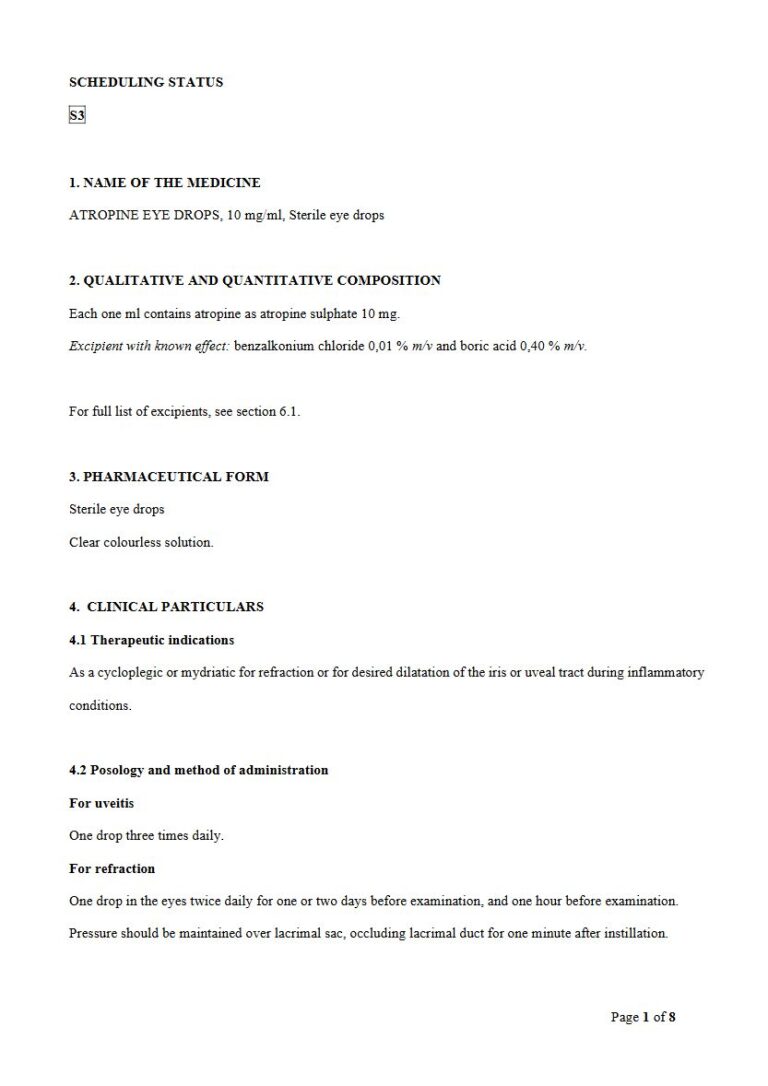
Cycloplegic or mydriatic for refraction or iris dilatation.
Dosage (summary)
One drop three times daily for uveitis; for refraction, one drop twice daily for one or two days before examination.
Special Populations
- Elderly
- Children under 6
Pregnancy & Breastfeeding
Safety in pregnancy and lactation not established.
Key Drug Interactions
- Antimuscarinic drugs
- Antihistamines
- Tricyclic antidepressants
Contraindications
- Hypersensitivity to atropine
- Glaucoma
- Belladonna alkaloids hypersensitivity
Common side effects
- Photosensitivity
- Eye pain
- Blurred vision
- Tachycardia
- Constipation
Counselling Points
- Avoid driving until vision clears
- Remove contact lenses before use
- Monitor for eye pain or irritation
Serious warnings
- Increased intraocular pressure
- CNS disorders
- Risk of hyperthermia
Important Disclaimer
The Atropine Eye Drops professional information leaflet below is the property of Adcock Ingram and is provided on Medinsert exactly as issued, with no.. alterations or editorial changes. We make every effort to keep content current by updating documents as soon as new versions become available. Medinsert serves as a trusted access point for healthcare professionals, but does not replace official sources or clinical judgement. For more details, please read our full disclaimer. read more>>
 Healthcare Professionals Only
This content is for registered healthcare professionals
Sign in or create a free account to read the full package insert.
Free for HPCSA-registered professionals. Powered by Medinsert.
Clinical Particulars
Section 4 of the official insert — extracted exactly as issued, no alterations
4.1 Therapeutic indications
As a cycloplegic or mydriatic for refraction or for desired dilatation of the iris or uveal tract during inflammatory conditions.
4.2 Posology and method of administration
For uveitis One drop three times daily. For refraction One drop in the eyes twice daily for one or two days before examination, and one hour before examination. Pressure should be maintained over lacrimal sac, occluding lacrimal duct for one minute after instillation.
Method of administration Topical
4.3 Contraindications
- Hypersensitivity to atropine or to any of the inactive ingredients of ATROPINE EYE DROPS listed in section 6.1.
- Not to be used in glaucoma or tendency towards glaucoma, and in persons hypersensitive to belladonna alkaloids.
- Should not be used by children under the age of six.
4.4 Special warnings and precautions for use
Administration of ATROPINE EYE DROPS may increase the intraocular pressure, especially in patients with a small anterior chamber or narrow anterior chamber angle. Before starting treatment, the intraocular pressure should be measured and the depth of the anterior chamber angle evaluated to avoid glaucoma attacks. If eye pain occurs, discontinue, and see your doctor immediately, as this may indicate undiagnosed glaucoma. Systemic exposure to ATROPINE EYE DROPS may cause central nervous system disorders (see section 4.8). Elderly patients are at increased risk of systemic adverse effects when using ATROPINE EYE DROPS (see section 4.2.). Due to the risk of hyperthermia, the medicine should be used with caution in patients with fever or at increased ambient temperature. Patients may develop increased photosensitivity and should protect their eyes from bright light (see section 4.8). May only be used on prescription. ATROPINE EYE DROPS contains benzalkonium chloride, which can cause eye irritation and has been found to discolour soft contact lenses. Contact with soft contact lenses should be avoided.
Patients should remove the contact lenses (soft or hard) before administering ATROPINE EYE DROPS and wait for at least 15 minutes before re-inserting them. Benzalkonium chloride has been reported to cause eye irritation, symptoms of dry eyes and may affect the tear film and corneal surface. Should be used with caution in dry eye patients and in patients where the cornea may be compromised. Patients should be monitored in case of prolonged use.
4.5 Interaction with other medicines and other forms of interaction
No interaction studies have been performed. The effects of ATROPINE EYE DROPS may be potentiated by the concomitant administration of other products with antimuscarinic properties, e.g., some antihistamines and tricyclic antidepressants.
4.6 Fertility, pregnancy and lactation
Pregnancy The safety of ATROPINE EYE DROPS in pregnancy has not been established. Breastfeeding The safety of ATROPINE EYE DROPS in lactation has not been established. Fertility No human data available.
4.7 Effects on ability to drive and use machines
ATROPINE EYE DROPS has a major influence on the ability to drive and use machines. ATROPINE EYE DROPS can cause drowsiness, blurred vision and sensitivity to light. Patients using ATROPINE EYE DROPS should not drive or perform dangerous activities until their vision clears.
4.8 Undesirable effects
Tabulated summary of adverse reactions
MedDRA System Organ Class Description and frequency
- Immune system disorders Not known: Hypersensitivity
- Psychiatric disorders Frequent: Hallucinations, confusion, agitation Not known: Disorientation
- Nervous system disorders Not known: Vertigo, headache, ataxia, slurred speech, anxiety, hyperactivity, convulsions, inability to recognize people, sleepiness, dizziness
- Eye disorders Frequent: Photosensitivity, pain in the eye, visual disturbance Less frequent: closed-angle glaucoma Not known: Eyelid oedema, blurred vision, prolonged drug effect (mydriasis), conjunctivitis, hyperaemia, eye oedema and secretion
- Cardiac disorders Frequent: Tachycardia Not known: Bradycardia
- Vascular disorders Not known: Hypotension, vasodilation
- Respiratory, thoracic and mediastinal disorders Not known: Respiratory depression, decreased pharyngeal, bronchial and nasal secretion
- Gastrointestinal disorders Frequent: Constipation Not known: Ileus, bloating, vomiting, decreased gastrointestinal motility and decreased salivary gland secretion, dryness of the mouth
- Skin and subcutaneous tissue disorders Not known: Erythema, rash, decreased sweat gland secretion (dryness of the skin)
- Renal and urinary disorders Not known: Urinary retention
- General disorders and administration site conditions Frequent: Pyrexia and flushing
Description of selected adverse reactions This medicine causes reactions similar to those of other anticholinergics. Adverse reactions from the central nervous system may occur: ataxia, slurred speech, anxiety, hallucinations, hyperactivity, convulsions, time and space disorientation, and inability to recognize people. Other signs of anticholinergic toxicity include skin rash, sleepiness, tachycardia, hyperpyrexia, vasodilatation, urinary retention, and decreased gastrointestinal motility, decreased salivary and sweat secretion, decreased secretion in the pharynx, bronchi and the nasal cavity. Severe reactions such as hypotension with rapidly progressive respiratory failure (respiratory depression) may occur. Mydriatics may increase the intraocular pressure and induce a glaucoma attack in patients with a predisposition to acute narrow-angle glaucoma (see section 4.4). Prolonged use of mydriatics may cause local irritation characterized by conjunctivitis (follicular), ocular hyperaemia, eye oedema, secretion and eczema. Symptoms of toxicity are usually transient (several hours) but may last up to 24 hours.
Reporting of suspected adverse reactions Reporting suspected adverse reactions after authorisation of the medicine is important. It allows continued monitoring of the benefit/risk balance of the medicine. Healthcare providers are asked to report any suspected adverse reactions to SAHPRA via the u201c6.04 Adverse Drug Reactions Reporting Formu201d, found online under SAHPRAu2019s publications: https://www.sahpra.org.za/Publications/Index/8.
4.9 Overdose
Symptoms Toxic doses cause tachycardia, rapid or stertorous respiration, hyperplexia, restlessness, confusion and excitement and hallucination passing into delirium. In severe intoxication depression of the central nervous system may occur with respiratory depression.
Treatment A saline purge should be given to promote peristalsis. Short acting barbiturates may be used for the state of excitement. Peripheral symptoms can be relieved by subcutaneous injection of neostigmine methyl sulphate 5 mg repeated at intervals.
