
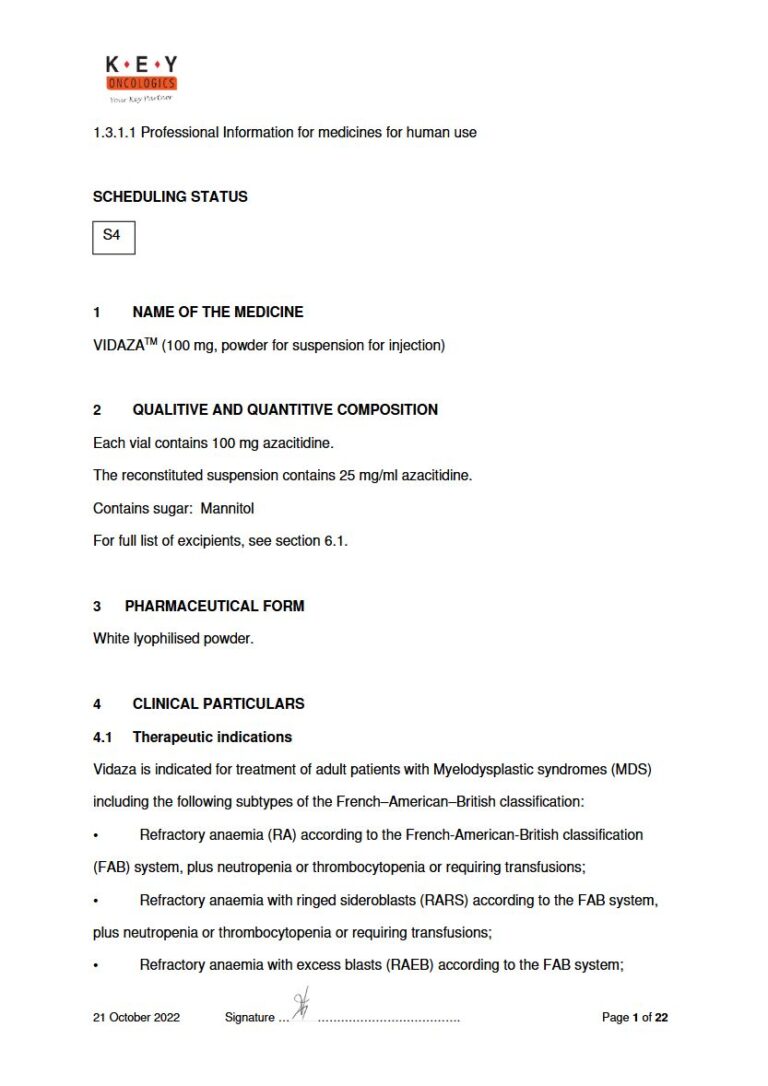
Vidaza 100 mg Powder for suspension for injection
PDF Leaflet Revision Date: 21 October 2022
Clinical Summary
Quick overview from the medicine insert
Indication
Treatment of adult patients with Myelodysplastic syndromes (MDS) and certain leukemias.
Dosage (summary)
75 mg/mu00b2 daily for 7 days, followed by 21 days rest; minimum 6 cycles.
Special Populations
- Renal impairment
- Hepatic impairment
- Elderly
Pregnancy & Breastfeeding
Contraindicated in pregnancy and breastfeeding; effective contraception required.
Contraindications
- Hypersensitivity to azacitidine
- Malignant hepatic tumors
- Live vaccines
- Children under 18
Common side effects
- Anaemia
- Thrombocytopenia
- Neutropenia
- Nausea
- Vomiting
Counselling Points
- Monitor for signs of bleeding
- Report febrile episodes
- Avoid pregnancy during treatment
Serious warnings
- Haematological toxicity
- Differentiation syndrome
- Renal impairment risks
Important Disclaimer
The Vidaza 100 mg Powder for suspension for injection professional information leaflet below is the property of Key Oncologics and is provided on Medinsert exactly as issued, with no.. alterations or editorial changes. We make every effort to keep content current by updating documents as soon as new versions become available. Medinsert serves as a trusted access point for healthcare professionals, but does not replace official sources or clinical judgement. For more details, please read our full disclaimer. read more>>
 Healthcare Professionals Only
This content is for registered healthcare professionals
Sign in or create a free account to read the full package insert.
Free for HPCSA-registered professionals. Powered by Medinsert.
Clinical Particulars
Section 4 of the official insert — extracted exactly as issued, no alterations
4.1 Therapeutic indications
Vidaza is indicated for treatment of adult patients with Myelodysplastic syndromes (MDS) including the following subtypes of the Frenchu2013Americanu2013British classification:
- Refractory anaemia (RA) according to the French-American-British classification (FAB) system, plus neutropenia or thrombocytopenia or requiring transfusions;
- Refractory anaemia with ringed sideroblasts (RARS) according to the FAB system, plus neutropenia or thrombocytopenia or requiring transfusions;
- Refractory anaemia with excess blasts (RAEB) according to the FAB system;
- Refractory anaemia with excess blasts in transformation (RAEB-T) according to the FAB system (or acute myeloid leukaemia with 20-30 % bone marrow blasts and multilineage dysplasia according to World Health Organisation (WHO) classification);
- Vidaza is also indicated for treating adult patients with chronic myelomonocytic leukemia (CMML) according to the FAB system.
- Acute myeloid leukemia (AML) with > 30 % bone marrow blasts according to the WHO classification, in patients who are not eligible for hematopoietic stem cell transplantation (HSCT).
4.2 Posology and method of administration
Posology
Vidaza treatment should be initiated and monitored under the supervision of a medical practitioner experienced in the use of chemotherapeutic agents. Patients should be premedicated with anti-emetics for nausea and vomiting. The recommended starting dose for the first treatment cycle, for all patients regardless of baseline haematology laboratory values, is 75 mg/m2 of body surface area, daily for 7 days, followed by a rest period of 21 days (28-day treatment cycle). It is recommended that patients be treated for a minimum of 6 cycles. Treatment should be continued as long as the patient continues to benefit or until disease progression. Patients should be monitored for haematological response/toxicity and renal toxicities (see section 4.8); a delay in starting the next cycle or a dose reduction as described below may be necessary.
Dosage Adjustment due to haematological toxicity:
Patients with baseline blood counts (i.e. White Blood Cells (WBC) > 3,0 x 10⁹/l and absolute neutrophil count (ANC) > 1,5 x10⁹/l, and platelets > 75,0 x 10⁹/l). If haematological toxicity is observed following Vidaza treatment, the next cycle of Vidaza therapy should be delayed until the platelet count and the ANC have recovered. If recovery is achieved within 14 days, no dose adjustment is necessary. However, if recovery has not been achieved within 14 days, the dose should be reduced according to the following table. Following dose modifications, the cycle duration should return to 28 days.
Nadir counts % Dose in the next cycle, if recovery* is not achieved within 14 days ANC (x109/ L) Platelets (x109/ L) u2264 1,0 u2264 50,0 50 % > 1,0 > 50,0 100 % *Recovery= countsu2265 Nadir count + (0,5 x [ baseline count - Nadir count])
Patients baseline blood counts (i.e. WBC < 3,0 x 10⁹/l or ANC < 1,5 x 10⁹/l or platelets < 75,0 x 10⁹/l): Following Vidaza treatment, if the decrease in WBC or ANC or platelets from baseline is less than 50 %, or greater than 50 % but with an improvement in any cell line differentiation, the next cycle should not be delayed and no dose adjustment be made. If the decrease in WBC or ANC or platelets is greater than 50 % from that prior to treatment, with no improvement in cell line differentiation, the next cycle of Vidaza therapy should be delayed until the platelet count and the ANC have recovered. If recovery is achieved within 14 days, no dose adjustment is necessary. However, if recovery has not been achieved within 14 days, bone marrow cellularity should be determined.
Bone marrow cellularity % Dose in the next cycle, if recovery is not achieved within 14 days Recovery * u2264 21 days Recovery* > 21 days 15-50% 100% 50% < 15% 100% 33% *Recovery= countsu2265 Nadir count + (0.5 x [ baseline count - Nadir count]) Following dose modifications, the cycle duration should return to 28 days.
Special Populations
Patients with Renal Impairment: Vidaza can be administered to patients with renal impairment without initial dose adjustment. If unexplained reductions in serum bicarbonate levels to less than 20 mmol/l occur, the dose should be reduced by 50 % on the next cycle. If unexplained elevations in serum creatinine or blood urea occur, the next cycle should be delayed until values return to normal or baseline and the dose should be reduced by 50 % on the next treatment cycle (see section 4.4).
Patients with Hepatic Impairment: No formal studies have been conducted in patients with hepatic impairment (see section 4.4). Vidaza is contraindicated in patients with malignant hepatic tumours (see sections 4.3 and 4.4).
Elderly: No specific dose adjustments are recommended for the elderly. Because elderly patients are more likely to have decreased renal function, it may be useful to monitor renal function.
Paediatric population: Vidaza is not recommended for use in children below 18 years of age, due to insufficient data on safety and efficacy.
Laboratory Tests: Liver function tests and serum creatinine should be determined prior to initiation of therapy. Complete blood counts should be performed prior to initiation of therapy and as needed to monitor response and toxicity, but at a minimum, prior to each treatment cycle.
Method of Administration
Subcutaneous injection:
- Vidaza should be injected subcutaneously the upper arm, thigh or abdomen.
- Injection sites should be rotated.
- New injections should be given at least 2,5 cm from the previous site and never into areas where the site is tender, bruised, red, or hardened.
Recommendations for safe handling
- Vidaza is a cytotoxic medicine and, as with other potentially toxic compounds, caution should be exercised when handling and preparing Vidaza suspensions.
- Procedures for proper handling and disposal of anticancer medicines should be applied.
- If reconstituted Vidaza comes into contact with the skin, immediately and thoroughly wash with soap and water.
- If it comes into contact with mucous membranes, flush thoroughly with water.
Preparation for the subcutaneous administration:
- Vidaza must be reconstituted to form a uniform suspension prior to administration.
- Add 4 ml of sterilised water for injections.
- Vigorously shake the vial until a uniform cloudy suspension is achieved.
- Do not filter the suspension after reconstitution as this could remove the active substance.
- The suspension contains azacitidine 25 mg/ml.
- To provide a homogeneous suspension, the contents of the syringe must be re-suspended immediately prior to administration.
- To re-suspend, vigorously roll the syringe between the palms until a uniform cloudy suspension is achieved.
- Doses greater than 4 ml should be divided equally into two syringes and injected into two separate sites.
4.3 Contraindications
Vidaza is contraindicated in the following patients:
- Patients with known hypersensitivity to azacitidine or to any of the excipients of Vidaza.
- Patients with malignant hepatic tumours.
- Patients must not receive live vaccines while being treated with Vidaza.
- Pregnancy and breastfeeding (see section 4.6).
- Vidaza is not recommended for use in children and adolescents below the age of 18.
4.4 Special warnings and precautions for use
Haematological toxicity: Treatment with Vidaza is associated with anaemia, neutropenia and thrombocytopenia, particularly during the first 2 cycles (see section 4.8). Complete blood counts should be performed as needed to monitor response and toxicity, but at least prior to each treatment cycle. After administration of the recommended dose for the first cycle, the dose for subsequent cycles should be reduced or delayed based on nadir counts and haematological response (see section 4.2). Patients should be advised to promptly report febrile episodes. Patients and healthcare professionals are also advised to be observant for signs and symptoms of bleeding.
Hepatic impairment: No formal studies have been conducted in patients with hepatic impairment. Patients with extensive tumour burden due to metastatic disease have been reported to experience progressive hepatic coma and death during Vidaza treatment, especially in such patients with baseline serum albumin < 30 g/L. Vidaza is contraindicated in patients with malignant hepatic tumours (see section 4.3).
Renal impairment: Renal abnormalities ranging from elevated serum creatinine to renal failure and death were reported in patients treated with intravenous (IV) Vidaza in combination with other chemotherapeutic agents for non-MDS conditions. In addition, renal tubular acidosis, (defined as a fall in serum bicarbonate to < 20 mmol/l in association with an alkaline urine and hypokalaemia (serum potassium < 3 mmol/l)) developed in subjects with CML treated with Vidaza and etoposide. If unexplained reductions in serum bicarbonate (< 20 mmol/l) or elevations of serum creatinine or BUN occur, the dosage should be reduced or administration delayed. Patients should be advised to report oliguria and anuria to the healthcare professional immediately. Patients with renal impairment should be closely monitored for toxicity since Vidaza and/or its metabolites are primarily excreted by the kidney (see section 4.2).
Laboratory tests: Liver function tests, serum creatinine and serum bicarbonate should be determined prior to initiation of therapy and prior to each treatment cycle. Complete blood counts should be performed prior to initiation of therapy and as needed to monitor response and toxicity, but at a minimum, prior to each treatment cycle, see also section 4.8 and 4.2.
Tumour Lysis Syndrome: The patients at risk of tumour lysis syndrome are those with high tumour burden prior to treatment. These patients should be monitored closely and appropriate precautions taken.
Cardiac and pulmonary disease: The safety and efficacy of azacitidine as contained in Vidaza in patients with a history of severe congestive heart failure, clinically unstable cardiac disease or pulmonary disease have not been established. It is advised to exercise caution when prescribing Vidaza to these patients. Cardiopulmonary assessment before and during the treatment should be considered.
Necrotising fasciitis: Vidaza therapy should be discontinued in patients who develop necrotising fasciitis and appropriate treatment should be promptly initiated.
Differentiation syndrome: Cases of differentiation syndrome (also known as retinoic acid syndrome) have been reported in patients receiving injectable azacitidine as contained in Vidaza. Differentiation syndrome may be fatal and symptoms and clinical findings include respiratory distress, pulmonary infiltrates, fever, rash, pulmonary oedema, peripheral oedema, rapid weight gain, pleural effusions, pericardial effusions, hypotension and renal dysfunction (see section 4.8). Treatment with high-dose IV corticosteroids and haemodynamic monitoring should be considered at first onset of symptoms or signs suggestive of differentiation syndrome. Temporary discontinuation of injectable azacitidine should be considered until resolution of symptoms and if resumed, caution is advised.
Vidaza contains mannitol and may have a laxative effect.
4.5 Interactions with other medicines
No formal clinical interaction studies with Vidaza have been conducted. Based on in vitro data, azacitidine metabolism does not appear to be mediated by cytochrome P450 isoenzymes (CYPs), UDP-glucuronosyltransferases (UGTs), sulfotransferases (SULTs), and glutathione transferases (GSTs); therefore CYP inhibitors and inducers are unlikely to have any impact on the metabolism of azacitidine. Clinically relevant inhibitory or inductive effects of azacitidine on the metabolism of cytochrome P450 substrates are unlikely (see section 5.2).
4.6 Fertility, pregnancy and lactation
Women of childbearing potential/ Contraception in males and females: Women of childbearing potential should be advised to avoid pregnancy during treatment with Vidaza and should use effective contraception during and up to 3 months after treatment.
Pregnancy: Vidaza may cause foetal harm when administered to a pregnant woman. Azacitidine was teratogenic in animals. If this medicine is used during pregnancy or if a patient becomes pregnant while taking Vidaza, the patient should be apprised of the potential hazard to the foetus. Female partners of male patients receiving Vidaza should not become pregnant.
Breastfeeding: Due to the potential serious adverse reactions in the nursing child, breastfeeding must be discontinued during Vidaza therapy.
Fertility: Men should be advised not to father a child while receiving treatment and must use effective contraception during and up to 3 months after treatment. Before starting treatment, male patients should be advised to seek counselling on sperm storage.
4.7 Effects on ability to drive and use machines
VIDAZA may have minor or moderate effect on mental and/or physical abilities to perform or execute tasks or activities requiring mental alertness, judgment and/or sound coordination and vision. Patients who experience dizziness should not drive or use machines when taking Vidaza.
4.8 Undesirable effects
Summary of the safety profile: Adult population with MDS, CMML and AML (20-30% marrow blasts) Adverse reactions considered to be possibly or probably related to the administration of Vidaza have occurred in 97 % of patients. The most commonly reported adverse reactions with treatment with Vidaza were haematological reactions (71,4 %) including anaemia, thrombocytopenia, neutropenia and leukopenia, gastrointestinal events (60,6 %) including nausea and vomiting, and injection site reactions (77,1 %). Adverse reactions associated with intravenously administered Vidaza were similar in frequency and severity compared with subcutaneously administered Vidaza. The most common serious adverse reactions (> 2 %) noted from the pivotal study (AZA PH GL 2003 CL 001) and also reported in the supporting studies (CALGB 9221 and CALGB 8921) included febrile neutropenia (8,0 %) and anaemia (2,3 %). Other less frequently reported serious adverse reactions (< 2 %) included neutropenic sepsis, pneumonia, thrombocytopenia and haemorrhagic events (e.g. cerebral haemorrhage).
Adult population aged 65 years or older with AML with > 30 % marrow blasts: The most commonly reported (u2265 30 %) adverse reactions with Vidaza treatment were gastrointestinal events, including constipation (41,9 %), nausea (39,8 %), and diarrhoea (36,9 %), (usually Grade 1-2), general disorders and administration site conditions including pyrexia (37,7 %; usually Grade 1-2) and haematological events, including febrile neutropenia (32,2 %) and neutropenia (30,1 %), (usually Grade 3-4). The most common serious adverse reactions (u2265 10 %) noted from AZA -AML-001 within the Vidaza treatment arm included febrile neutropenia (25,0 %), pneumonia (20,3 %), and pyrexia (10,6 %). Other less frequently reported serious adverse reactions in the Vidaza treatment arm included sepsis (5,1 %), anaemia (4,2 %), neutropenic sepsis (3,0 %), urinary tract infection (3,0 %), thrombocytopenia (2,5 %), neutropenia (2,1 %), cellulitis (2,1 %), dizziness (2,1 %) and dyspnoea (2,1 %).
The table below contains the adverse reactions for which a causal relationship with Vidaza treatment could reasonably be established. Frequencies given are based on the observations during the clinical studies in MDS and AML and post marketing surveillance. Frequencies are defined as: very common (u2265 1/10), common (u2265 1 /100 to < 1/10); and uncommon (u2265 1/1 000 to < 1/100); rare (u2265 1/10 000 to < 1/1 000). Within each frequency grouping, undesirable effects are presented in order of decreasing seriousness.
Tabulated list of adverse reactions
System Organ Class Very common Common Uncommon Rare Not Known Infections and infestations pneumonia* (including bacterial, viral and fungal), nasopharyngitis sepsis* (including bacterial, viral and fungal), neutropenic sepsis*, respiratory tract infection (includes upper and bronchitis), urinary tract infection, cellulitis, diverticulitis, oral fungal infection, sinusitis, pharyngitis, rhinitis, herpes simplex, skin infection necrotising fasciitis*
Neoplasms benign, malignant and unspecified (including cysts and polyps) differentiation syndrome (see section 4.4)
Blood and lymphatic system disorders febrile neutropenia*, neutropenia, leukopenia, thrombocytopenia, anaemia pancytopenia*, bone marrow failure
Immune system disorders hypersensitivity reactions
Metabolism and nutrition disorders anorexia, decreased appetite, hypokalaemia dehydration tumour lysis syndrome
Psychiatric disorders insomnia confusional state, anxiety
Nervous system disorders dizziness, headache intracranial haemorrhage*, syncope, somnolence, lethargy
Eye disorders eye haemorrhage, conjunctival haemorrhage
Cardiac disorders pericardial effusion Pericarditis
Vascular disorders hypotension*, hypertension, orthostatic hypotension, haematoma
Respiratory, thoracic and mediastinal disorders dyspnoea, epistaxis pleural effusion, exertional dyspnoea, pharyngolaryngeal pain interstitial lung disease
Gastrointestinal disorders diarrhoea, vomiting, constipation, nausea, abdominal pain (includes upper and abdominal discomfort) gastrointestinal haemorrhage * (includes mouth haemorrhage), haemorrhoidal haemorrhage, stomatitis, gingival bleeding, dyspepsia
Hepatobiliary disorders hepatic failure*, progressive hepatic coma
Skin and subcutaneous tissue disorders petechiae, pruritus (includes generalised), rash, ecchymosis purpura, alopecia, urticaria, erythema, rash macular acute febrile neutrophilic dermatosis, pyoderma gangrenosum
Musculoskeletal, and connective tissue disorders arthralgia, musculoskeletal pain (includes back, bone and pain in extremity) muscle spasms, myalgia
Renal and urinary disorders renal failure *, haematuria, elevated serum creatinine renal tubular acidosis
General disorders and administration site conditions pyrexia *, fatigue, asthenia, chest pain, injection site erythema, injection site pain, injection site reaction (unspecified) bruising, haematoma, induration, rash, pruritus, inflammation, discoloration, nodule and haemorrhage (at injection site), malaise, chills, catheter site haemorrhage injection site necrosis (at injection site)
Investigations weight decreased * = rarely fatal cases have been reported
Description of selected adverse reactions: Hypersensitivity: Serious hypersensitivity reactions have been reported in patients receiving Vidaza. In case of an anaphylactic-like reaction, treatment with Vidaza should be immediately discontinued and appropriate symptomatic treatment initiated. Haematologic adverse reactions: The most commonly reported adverse reactions associated with Vidaza treatment were haematological, including anaemia, thrombocytopenia, neutropenia and leukopenia. There is a greater risk of these events occurring during the first 2 cycles, after which they occur with less frequency in patients with restoration of haematological function. Most haematological adverse reactions were managed by routine monitoring of complete blood counts and delaying Vidaza administration in the next cycle, prophylactic antibiotics and/or growth factor support (e.g. G-CSF) for neutropenia and transfusions for anaemia or thrombocytopenia as required. Infections: Myelosuppression may lead to neutropenia and an increased risk of infection. Serious adverse reactions such as neutropenic sepsis (0,8 %) and pneumonia (2,5 %) were reported in patients receiving Vidaza. Infections may be managed with the use of anti-infectives plus growth factor support (e.g. G-CSF) for neutropenia. Bleeding: Bleeding may occur with patients receiving Vidaza. Serious adverse reactions such as gastrointestinal haemorrhage and intracranial haemorrhage have been reported. Patients should be monitored for signs and symptoms of bleeding, particularly those with pre-existing or treatment-related thrombocytopenia. Skin and subcutaneous tissue adverse reactions: The majority of skin and subcutaneous adverse reactions were associated with the injection site. The majority of adverse reactions occurred during the first 2 cycles and tended to decrease with subsequent cycles. Subcutaneous adverse reactions such as injection site rash, inflammation, pruritus, erythema and skin lesion may require management with concomitant medicines, such as antihistamines, corticosteroids and non-steroidal anti-inflammatory drugs (NSAIDs). Gastrointestinal adverse reactions: The most commonly reported gastrointestinal adverse reactions associated with Vidaza treatment included constipation, diarrhoea, nausea and vomiting. These adverse reactions were managed symptomatically with anti-emetics for nausea and vomiting; antidiarrhoeals for diarrhoea, and laxatives and/or stool softeners for constipation. Renal adverse reactions: Renal abnormalities, ranging from elevated serum creatinine to renal tubular acidosis, renal failure and death have been reported in patients treated with Vidaza. Hepatic adverse reactions: Patients with extensive tumour burden due to metastatic disease have been reported to experience progressive hepatic coma and death during Vidaza treatment. Cardiac events: Data from a clinical study allowing enrolment of patients with known history of cardiovascular or pulmonary disease showed an increase in cardiac events in patients with newly diagnosed AML treated with azacitidine (see section 4.4). Elderly population: There is limited safety information available with azacitidine in patients u2265 85 years. Post-marketing Data: The following events have been reported in the post-marketing setting: - Interstitial lung disease. - Tumour lysis syndrome. - Injection site necrosis. - Necrotising fasciitis. - Acute febrile neutrophilic dermatosis. - Pyoderma gangrenosum.
4.9 Overdose
In the event of overdose, side effects will be exaggerated and exaggerated (see section 4.8) the patient should be monitored with appropriate blood counts and should receive supportive treatment, as necessary. There is no known specific antidote for Vidaza overdose.
