
Besivance Eye Drops
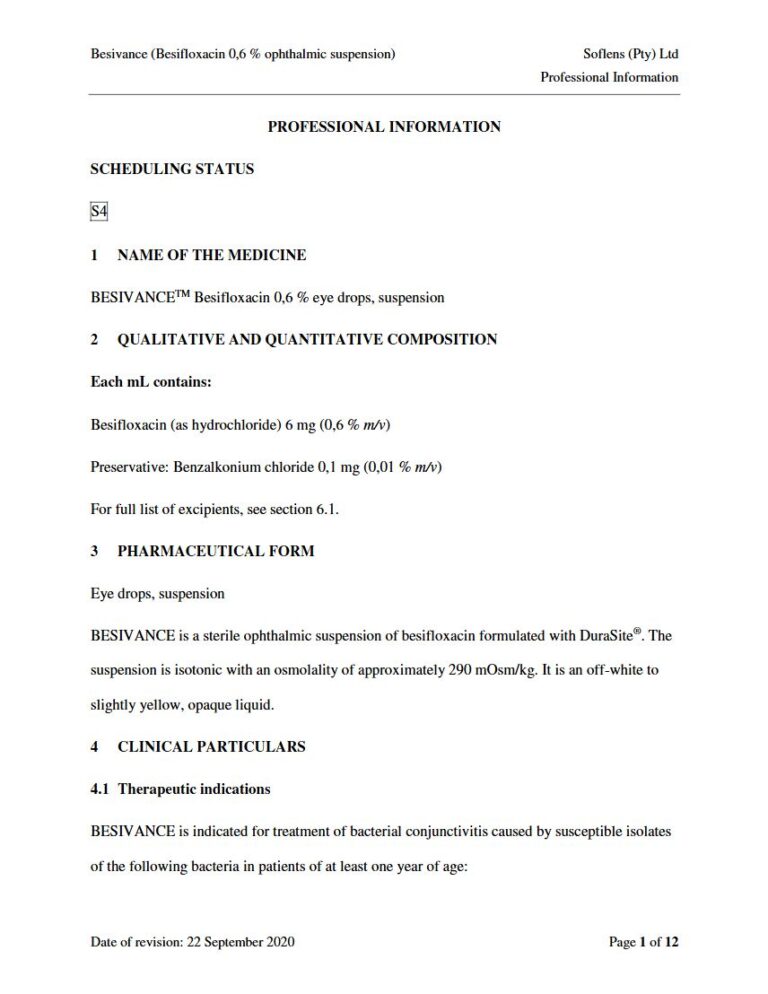
PDF Leaflet Revision Date: 22 September 2020
Clinical Summary
Quick overview from the medicine insert
Indication
Treatment of bacterial conjunctivitis in patients aged one year and older.
Dosage (summary)
1 drop in affected eye(s) 3 times a day for 7 days.
Special Populations
- Paediatric patients under 1 year
- Elderly
Pregnancy & Breastfeeding
Limited data; low systemic exposure; caution advised during breastfeeding.
Contraindications
- Hypersensitivity to besifloxacin or ingredients
Common side effects
- Conjunctival redness
- Blurred vision
- Eye pain
- Eye irritation
- Headache
Counselling Points
- Avoid contact lenses during treatment
- May cause temporary blurred vision
Serious warnings
- Not for injection
- Risk of resistant organisms with prolonged use
- Caution in dry eye patients
Important Disclaimer
The Besivance Eye Drops professional information leaflet below is the property of Soflens and is provided on Medinsert exactly as issued, with no.. alterations or editorial changes. We make every effort to keep content current by updating documents as soon as new versions become available. Medinsert serves as a trusted access point for healthcare professionals, but does not replace official sources or clinical judgement. For more details, please read our full disclaimer. read more>>
 Healthcare Professionals Only
This content is for registered healthcare professionals
Sign in or create a free account to read the full package insert.
Free for HPCSA-registered professionals. Powered by Medinsert.
Clinical Particulars
Section 4 of the official insert — extracted exactly as issued, no alterations
4.1 Therapeutic indications
BESIVANCE is indicated for treatment of bacterial conjunctivitis caused by susceptible isolates of the following bacteria in patients of at least one year of age:
- Aerococcus viridans*
- CDC coryneform group G
- Corynebacterium pseudodiphtheriticum*
- Corynebacterium striatum*
- Haemophilus influenzae
- Moraxella catarrhalis*
- Moraxella lacunata*
- Pseudomonas aeruginosa*
- Staphylococcus aureus
- Staphylococcus epidermidis
- Staphylococcus hominis*
- Staphylococcus lugdunensis*
- Staphylococcus warneri*
- Streptococcus mitis group
- Streptococcus oralis
- Streptococcus pneumoniae
- Streptococcus salivarius*
*Efficacy for this organism was studied in fewer than 10 infections.
4.2 Posology and method of administration
Invert closed bottle and shake once before use.
Adults and children aged one year and older:
Instill one drop in the affected eye(s) 3 times a day, 4 to 12 hours apart for 7 days.
Handling the container:
To avoid contamination, do not let the applicator tip touch the surface of the eye, fingers, or any other surface.
Paediatric population
The safety and efficacy of BESIVANCE in infants below one year of age have not been established. No data are available. The efficacy of BESIVANCE in treating bacterial conjunctivitis in paediatric patients one year or older, at the same dose as for adults, has been demonstrated in controlled clinical trials.
Elderly population
No overall differences in effectiveness have been observed between elderly and younger patients.
4.3 Contraindications
Hypersensitivity to besifloxacin or any other ingredients (see 6.1 List of excipients).
4.4 Special warnings and precautions for use
Not for injection into the eye or other tissue.
Growth of resistant organisms with prolonged use:
Prolonged use of BESIVANCE may result in overgrowth of non-susceptible organisms, including fungi. If super-infection occurs, discontinue use and institute alternative therapy. Whenever clinical judgment dictates, the patient should be examined with the aid of magnification, such as slit-lamp biomicroscopy, and, where appropriate, fluorescein staining.
Avoidance of contact lenses:
Patients should not wear contact lenses if they have signs or symptoms of bacterial conjunctivitis or during the course of therapy with BESIVANCE.
Benzalkonium chloride has been reported to cause eye irritation, symptoms of dry eyes and may affect the tear film and corneal surface. BESIVANCE should be used with caution in dry eye patients and in patients where the cornea may be compromised. Patients should be monitored in case of prolonged use.
4.5 Interaction with other medicines and other forms of interaction
BESIVANCE is administered locally to the eye at low dose levels, and the resulting systemic exposure to besifloxacin is minimal. Therefore, no specific medicine interaction studies were performed.
4.6 Fertility, pregnancy and lactation
Pregnancy
There are no available human data for the use of BESIVANCE during pregnancy to inform any medicine-associated risks; however, systemic exposure to besifloxacin from ocular administration is low (see section 5.2).
Breastfeeding
There are no data on the presence of BESIVANCE in human milk, the effects on the breastfed infant, or the effects on milk production. However, systemic exposure to besifloxacin following topical ocular administration is low (see section 5.2) and it is not known whether measurable levels of besifloxacin would be present in maternal milk following topical ocular administration.
Developmental and health benefits of breastfeeding should be considered, along with the motheru2019s clinical need for BESIVANCE, and any potential adverse effects on the breastfed infant from BESIVANCE.
Caution should be exercised when BESIVANCE is administered to a nursing mother.
Fertility
In a fertility and early embryonic development study in rats, besifloxacin did not impair the fertility of male or female rats at oral doses of up to 500 mg/kg/day. This dose is approximately 26 500 times higher than the mean plasma concentration measured in humans at the recommended ophthalmic use.
4.7 Effects on ability to drive and use machines
Patients may experience temporary blurred vision or irritation, pain or itching of the treated eye(s). If blurred vision occurs at instillation, patients should wait until their vision clears before driving or using machinery.
4.8 Undesirable effects
a. Summary of the safety profile
The data described below reflect exposure to BESIVANCE in approximately 1 000 patients between 1 and 98 years old with clinical signs and symptoms of bacterial conjunctivitis. The most frequently reported ocular adverse reaction was conjunctival redness, reported in approximately 2 % of patients. Other adverse reactions reported in patients receiving BESIVANCE occurring in approximately 1-2 % of patients included: blurred vision, eye pain, eye irritation, eye pruritus and headache.
b. Tabulated list of adverse reactions
Common (u22651/100 to <1/10):
- Conjunctivitis
- Blurred vision
- Eye irritation
- Eye pain
- Eye pruritus
- Headache
Uncommon (u22651/1000 to <1/100):
- Conjunctival haemorrhage
- Eye discharge
- Eyelid oedema
- Conjunctival hyperaemia
- Punctate keratitis
- Ocular hyperaemia
- Viral conjunctivitis
- Dry eye
- Limbal hyperaemia
- Increased lacrimation
d. Paediatric population
The safety of BESIVANCE in infants below one year of age have not been established.
e. Other special populations
Elderly use: No overall differences in safety have been observed between elderly and younger patients.
Reporting of suspected adverse reactions
Reporting suspected adverse reactions after authorisation of the medicine is important. It allows continued monitoring of the benefit-risk balance of the medicine. Health care providers are asked to report any suspected adverse reactions to SAHPRA via the u201c6.04 Adverse Drug Reactions Reporting Formu201d, found online under SAHPRAu2019s publications: https://www.sahpra.org.za/Publications/Index/8 Suspected adverse reactions may also be reported directly to the Holder of the Certificate of registration using the following e-mail address: [email protected]
4.9 Overdose
Overdosage of this medicine is unlikely to occur via the ophthalmic route.
