
Velzomy 3.5 Mg Solution
PDF Leaflet Revision Date: 20 February 2022
Clinical Summary
Quick overview from the medicine insert
Indication
Treatment of multiple myeloma and mantle cell lymphoma.
Dosage (summary)
Starting dose: 1.3 mg/mu00b2 twice weekly for 2 weeks, followed by a 10-day rest.
Special Populations
- Elderly
- Renal impairment
- Hepatic impairment
Pregnancy & Breastfeeding
Not recommended during pregnancy; breastfeeding should be discontinued during treatment.
Key Drug Interactions
- CYP3A4 inhibitors
- CYP3A4 inducers
- Oral hypoglycemics
Contraindications
- Hypersensitivity to bortezomib
- Acute diffuse infiltrative pulmonary disease
Common side effects
- Nausea
- Diarrhoea
- Constipation
- Fatigue
- Thrombocytopenia
- Peripheral neuropathy
Counselling Points
- Use effective contraception during treatment
- Monitor for signs of neuropathy
- Avoid driving if experiencing dizziness or hypotension
Serious warnings
- Fatal intrathecal administration
- Gastrointestinal toxicity
- Cardiac failure
- PML risk
Important Disclaimer
The Velzomy 3.5 Mg Solution professional information leaflet below is the property of Teva Pharmaceuticals and is provided on Medinsert exactly as issued, with no.. alterations or editorial changes. We make every effort to keep content current by updating documents as soon as new versions become available. Medinsert serves as a trusted access point for healthcare professionals, but does not replace official sources or clinical judgement. For more details, please read our full disclaimer. read more>>
 Healthcare Professionals Only
This content is for registered healthcare professionals
Sign in or create a free account to read the full package insert.
Free for HPCSA-registered professionals. Powered by Medinsert.
Clinical Particulars
Section 4 of the official insert — extracted exactly as issued, no alterations
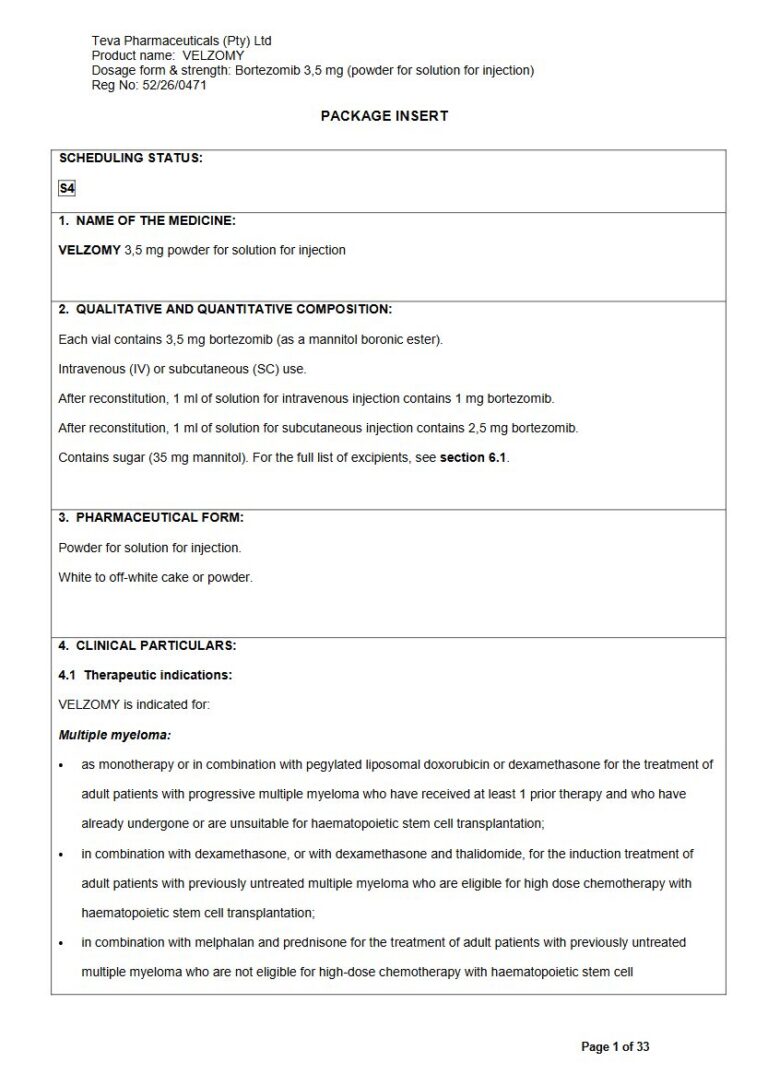
4.1 Therapeutic indications
VELZOMY is indicated for:
Multiple myeloma:
- as monotherapy or in combination with pegylated liposomal doxorubicin or dexamethasone for the treatment of adult patients with progressive multiple myeloma who have received at least 1 prior therapy and who have already undergone or are unsuitable for haematopoietic stem cell transplantation;
- in combination with dexamethasone, or with dexamethasone and thalidomide, for the induction treatment of adult patients with previously untreated multiple myeloma who are eligible for high dose chemotherapy with haematopoietic stem cell transplantation;
- in combination with melphalan and prednisone for the treatment of adult patients with previously untreated multiple myeloma who are not eligible for high-dose chemotherapy with haematopoietic stem cell transplantation.
Mantle cell lymphoma:
- treatment of relapsed or refractory mantle cell lymphoma for patients who have received at least 1 prior line of therapy, one of which should have included an anthracycline (or mitoxantrone) and/or rituximab as part of their chemotherapy regimen;
- treatment for newly diagnosed mantle cell lymphoma (MCL) in adults, in combination with rituximab, cyclophosphamide, doxorubicin and prednisone who are unsuitable for haematopoietic stem cell transplantation.
4.2 Posology and method of administration
VELZOMY 3,5 mg powder for solution for injection is available for:
- intravenous administration at a concentration of 1 mg/ml (as a 3-5 second bolus injection) or
- subcutaneous administration at a concentration of 2,5 mg/ml.
Because each route of administration has a different reconstituted concentration, caution should be used when calculating the volume to be administered. VELZOMY IS FOR INTRAVENOUS AND SUBCUTANEOUS USE ONLY and should not be given by other routes. Intrathecal administration has resulted in death. See section 6.6 for reconstitution instructions.
VELZOMY retreatment may be considered for multiple myeloma patients who had previously responded to treatment with VELZOMY (see below).
Monotherapy:
Relapsed multiple myeloma and relapsed mantle cell lymphoma:
Recommended dosage: The recommended starting dose of VELZOMY is 1,3 mg/mu00b2 body surface area administered twice weekly for two weeks (days 1, 4, 8, and 11) followed by a 10-day rest period (days 12-21). This 3-week period is considered a treatment cycle. It is recommended that patients receive 2 cycles of VELZOMY following a confirmation of a complete response. It is also recommended that responding patients who do not achieve a complete remission receive a total of 8 cycles of therapy. At least 72 hours should elapse between consecutive doses of VELZOMY.
...
Combination therapy:
Previously untreated multiple myeloma - patients who are not eligible for stem cell transplantation:
Recommended dosage in combination with melphalan and prednisone: VELZOMY (bortezomib) for injection is administered in combination with oral melphalan and oral prednisone for nine 6-week treatment cycles as shown in Table 2. In Cycles 1-4, VELZOMY is administered twice weekly (days 1, 4, 8, 11, 22, 25, 29 and 32). In Cycles 5-9, VELZOMY is administered once weekly (days 1, 8, 22 and 29).
...
4.3 Contraindications
Hypersensitivity to bortezomib, to boron or to any of the excipients listed in section 6.1.
Acute diffuse infiltrative pulmonary and pericardial disease.
4.4 Special warnings and precautions for use
There have been fatal cases of inadvertent intrathecal administration of VELZOMY. Bortezomib 1 mg is for IV use only. VELZOMY 3,5 mg is for IV or SC use. DO NOT ADMINISTER VELZOMY INTRATHECALLY.
When VELZOMY is given in combination with other medicines, the professional information of these other medicines must be consulted prior to initiation of treatment with VELZOMY.
Gastrointestinal toxicity: Gastrointestinal toxicity, including nausea, diarrhoea, vomiting and constipation are very common with bortezomib treatment. Reactions usually occur early in treatment (Cycle 1 and 2) and may persist for several cycles. Cases of ileus have been reported (see section 4.8). Therefore, patients who experience constipation should be closely monitored. Patients experiencing treatment emergent gastrointestinal toxicity may benefit from administration of anti-emetics and anti-diarrhoeals. Fluid and electrolyte replacement should be administered to prevent or treat dehydration.
Haematological toxicity: VELZOMY treatment is frequently associated with haematological toxicities (thrombocytopenia and neutropenia). However febrile neutropenia is a less frequent undesirable effect. The most frequent haematologic toxicity is transient thrombocytopenia, which generally resolves between treatment cycles. Platelets were lowest at Day 11 of each cycle of VELZOMY treatment and typically recovered to baseline by the next cycle. The cyclical pattern of platelet decrease and recovery remained consistent over the 8 cycles of twice weekly dosing and there was no evidence of cumulative thrombocytopenia or neutropenia. In a multiple myeloma study with bortezomib and dexamethasone the mean platelet count nadir measured was approximately 40 % of baseline. Severe bleeding, including CNS and gastrointestinal bleeding, associated with thrombocytopenia, has been reported. In patients with advanced myeloma, the severity of thrombocytopenia was related to pre-treatment platelet count. Platelet counts should be monitored prior to each dose of VELZOMY. Therapy should be held when the platelet count is <25 000/u03bcl or in the case of combination with melphalan and prednisone, when the platelet count is u2264 30,000/u03bcl, and re-initiated at a reduced dose after resolution (see SIDE EFFECTS). Potential benefit of the treatment should be carefully weighed against the risks. Platelet transfusions, red blood cell (RBC) transfusions and administration of growth factors may be utilised in the management of haematologic toxicities. Prophylactic platelet transfusions should be considered in thrombocytopenic patients at high risk of bleeding.
...
4.5 Interaction with other medicines and other forms of interaction
In vitro studies indicate that VELZOMY is a weak inhibitor of the cytochrome P450 (CYP) isozymes 1A2, 2C9, 2C19, 2D6 and 3A4. Based on the limited contribution (7 %) of CYP2D6 to the metabolism of bortezomib, the CYP2D6 poor metaboliser phenotype is not expected to affect the overall disposition of VELZOMY.
A medicine interaction study assessing the effect of ketoconazole, a potent CYP3A4 inhibitor, on the pharmacokinetics of VELZOMY (injected intravenously), showed a mean bortezomib AUC increase of 35 % (CI 90 % [1,032 to 1,772]) based on data from 12 patients. Therefore, patients should be closely monitored when given VELZOMY in combination with potent CYP3A4 inhibitors (e.g. ketoconazole, ritonavir).
...
4.6 Fertility, pregnancy and lactation
Contraception in males and females: Male and female patients of childbearing potential must use effective contraceptive measures during and for 3 months following VELZOMY treatment.
Pregnancy: No clinical data are available for VELZOMY with regard to exposure during pregnancy. The teratogenic potential of VELZOMY has not been fully investigated. VELZOMY should not be used during pregnancy and if the patient becomes pregnant while receiving VELZOMY, the patient should be informed of the potential for hazard to the foetus.
Breastfeeding: It is not known whether VELZOMY is excreted in human milk. Because of the potential for serious adverse reactions in breastfed infants, breastfeeding should be discontinued during treatment with VELZOMY.
Fertility: Fertility studies were not conducted with VELZOMY (see section 5.3).
4.7 Effects on ability to drive and use machines
VELZOMY may have a moderate influence on the ability to drive and use machines. VELZOMY may be associated with fatigue, dizziness, syncope and orthostatic/postural hypotension or blurred vision. Therefore, patients must be cautious when driving or using machines and should be advised not to drive or operate machinery if they experience these symptoms (see section 4.8).
4.8 Undesirable effects
Summary of the safety profile: Serious adverse reactions less frequently reported during treatment with VELZOMY include cardiac failure, tumour lysis syndrome, pulmonary hypertension, posterior reversible encephalopathy syndrome, acute diffuse infiltrative pulmonary disorders and autonomic neuropathy. The most frequently reported adverse reactions during treatment with VELZOMY are nausea, diarrhoea, constipation, vomiting, fatigue, pyrexia, thrombocytopenia, anaemia, neutropenia, peripheral neuropathy (including sensory), headache, paraesthesia, decreased appetite, dyspnoea, rash, herpes zoster and myalgia.
...
4.9 Overdose
In patients, overdose more than twice the recommended dose has been associated with the acute onset of symptomatic hypotension and thrombocytopenia with fatal outcomes. There is no known specific antidote for VELZOMY overdose. In the event of an overdose, the patientu2019s vital signs should be monitored and appropriate supportive care given to maintain blood pressure.
