
Astor Tablets
PDF Leaflet Revision Date: 30 September 2025
Clinical Summary
Quick overview from the medicine insert
Indication
Lipid-lowering agent for hyperlipidaemias.
Dosage (summary)
Starting dose: 10 mg daily, max: 80 mg daily.
Onset of Action / Duration
Onset: 1-2 hours, Duration: 20-30 hours.
Special Populations
- Elderly
- Hepatic impairment
- Renal impairment
Pregnancy & Breastfeeding
Contraindicated in pregnancy and lactation.
Key Drug Interactions
- CYP3A4 inhibitors
- Grapefruit juice
- Warfarin
Contraindications
- Hypersensitivity
- Active hepatic disease
- Pregnancy
- Child-Pugh B and C liver impairment
Common side effects
- Myalgia
- Dizziness
- Constipation
- Fatigue
Counselling Points
- Avoid grapefruit juice
- Report unexplained muscle pain
- Monitor liver function tests
Serious warnings
- Risk of myopathy and rhabdomyolysis
- Liver function monitoring required
Important Disclaimer
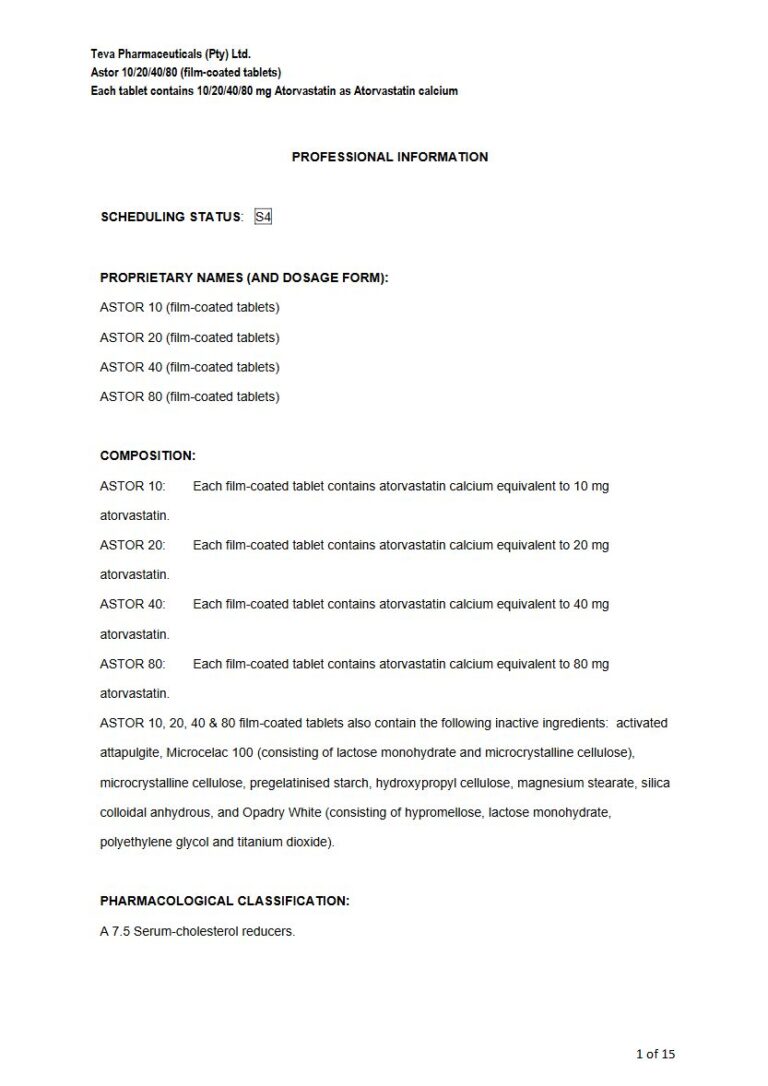
The Astor Tablets professional information leaflet below is the property of Teva Pharmaceuticals and is provided on Medinsert exactly as issued, with no.. alterations or editorial changes. We make every effort to keep content current by updating documents as soon as new versions become available. Medinsert serves as a trusted access point for healthcare professionals, but does not replace official sources or clinical judgement. For more details, please read our full disclaimer. read more>>
 Healthcare Professionals Only
This content is for registered healthcare professionals
Sign in or create a free account to read the full package insert.
Free for HPCSA-registered professionals. Powered by Medinsert.
Clinical Particulars
Section 4 of the official insert — extracted exactly as issued, no alterations
4.1 Therapeutic indications
ASTOR is indicated, in combination with diet, to decrease elevated total cholesterol, LDL-cholesterol, apolipoprotein-B and triglyceride levels in patients with:
- primary hypercholesterolaemia,
- heterozygous familial hypercholesterolaemia, and
- mixed dyslipidaemia.
ASTOR is also indicated to reduce total-C and LDL-C in patients with homozygous familial hypercholesterolaemia, as an adjunct to other lipid-lowering treatments (e.g. LDL apheresis), of if such treatments are not available. Therapy with lipid-lowering agents should be a component of multiple-risk-factor intervention in individuals at increased risk of atherosclerotic vascular disease due to hypercholesterolaemia. Lipid-altering agents should be used in addition to a diet restricted in saturated fat and cholesterol only when the response to diet and other non-pharmacological measures has been inadequate. Secondary causes for hypercholesterolaemia (e.g. poorly controlled diabetes mellitus, nephrotic syndrome, hypothyroidism, obstructive liver disease, dysproteinaemias, alcoholism and therapy with other medicines) should be excluded prior to initiating therapy with ASTOR, and a lipid profile performed to measure total-C, LDL-C, HDL-C and triglycerides.
4.2 Posology and method of administration
The patient must follow a cholesterol-lowering diet before initiation of, and while on ASTOR therapy. ASTOR can be taken at any time of the day with meals or on an empty stomach. ASTOR should not be taken with grapefruit juice.
Hypercholesterolaemia:
Heterozygous familial hypercholesterolaemia and mixed dyslipidaemia: The usual starting dose is 10 mg of ASTOR daily. The dose may be adjusted at intervals of 4 weeks up to a maximum of 80 mg daily.
Children: Treatment experience in the paediatric population is limited.
Homozygous familial hypercholesterolaemia: 10 to 80 mg ASTOR once per day. ASTOR should be used in these patients as an adjunct to other lipid-lowering treatments such as LDL apheresis, or if such treatments are unavailable.
Prevention of cardiovascular complications: The usual dose is 10 mg ASTOR once per day.
Dosage in patients with renal insufficiency: Dosage adjustment in patients with renal dysfunction is not necessary because renal disease does not affect the plasma concentrations nor LDL-C reduction (however, see WARNINGS).
Dosage in patients with hepatic impairment: In patients with moderate to severe hepatic dysfunction, the therapeutic response to ASTOR is unaffected, but serum levels of the medicine are significantly increased. In patients with chronic alcoholic liver disease, plasma concentrations of atorvastatin are markedly increased. Both Cmax and AUC are 4-fold greater in patients with Child-Pugh A disease. Cmax and AUC are approximately 16-fold and 11-fold increased, respectively, in patients with Child-Pugh B disease. Therefore, caution with dosing should be exercised in patients who take substantial quantities of alcohol and/or have a history of liver disease (see CONTRA-INDICATIONS and WARNINGS).
4.3 Contraindications
- Hypersensitivity to atorvastatin, other HMG-CoA reductase inhibitors or any component of ASTOR.
- Active hepatic disease (the condition may be exacerbated) or unexplained persistently raised serum-aminotransferase concentrations (exceeding 3 times the upper limit of normal).
- Pregnancy and lactation (see PREGNANCY AND LACTATION).
- Patients with Child-Pugh B and C liver impairment.
- Concomitant use with rifampicin, diltiazem and grapefruit juice (see INTERACTIONS).
4.4 Special warnings and precautions for use
Effects on the liver: Serum transaminase values may be increased, usually to less than 3 times the upper limit of normal, in slightly less than 1 to 2 % of patients receiving HMG-CoA reductase inhibitors for at least 1 year. Marked increases to more than 3 times the upper limit of normal have occurred. Liver function tests, including serum transaminase: Determinations are recommended prior to initiation of therapy, following each dosage increase, and subsequently when clinically indicated. ASTOR should be discontinued if the rise in transaminase levels is persistent and/or increases to three times the upper limit of normal (ULN) or more. ASTOR should be used with caution in patients who consume substantial amounts of alcohol and/or who have a history of liver disease.
Renal impairment: Renal impairment has no influence on plasma concentrations; therefore dose adjustment is not needed. (See also rhabdomyolysis under Skeletal muscle below).
Skeletal muscle: ASTOR may cause myopathy and rhabdomyolysis, especially at higher doses, and it should be used with caution in patients at risk of rhabdomyolysis, and particularly in patients taking medicines, such as cytochrome P450 inhibitors (see INTERACTIONS), that increase plasma concentrations of the HMG-CoA reductase inhibitor, ASTOR. Rhabdomyolysis with or without renal impairment has been reported with the use of HMG-CoA reductase inhibitors such as ASTOR. A history of renal impairment may be a risk factor for the development of rhabdomyolysis. Such patients merit closer monitoring for the skeletal muscle adverse events.
General measures to reduce the risk of myopathy: Patients starting treatment with ASTOR should be advised of the risk of myopathy and should promptly report unexplained muscle pain, tenderness, or weakness, especially if accompanied by malaise or fever. A creatine kinase (CK) level above 10 times the Upper Limit of Normal (ULN) in a patient, with unexplained symptoms, indicate myopathy. ASTOR should be discontinued if creatine phosphokinase increases significantly or if myopathy is diagnosed.
Measures to reduce the risk of myopathy caused by medicine interactions: The benefits of using ASTOR concomitantly with immunosuppressants, fibrates or lipid-lowering doses of niacin should be carefully considered. Concomitant administration with ciclosporin, itraconazole, ketoconazole, erythromycin, clarithromycin, HIV-protease inhibitors and nefazodone is not recommended. In patients receiving ciclosporin, ASTOR should be temporarily discontinued.
Haemorrhagic stroke: Patients without coronary heart disease who had a stroke or transient ischaemic attack (TIA) within the preceding months who were initiated on atorvastatin 80 mg revealed a higher incidence of haemorrhagic stroke compared to placebo. Patients with haemorrhagic stroke on entry appeared to be at risk for recurrent haemorrhagic stroke.
Paediatric patients: Use in paediatric patients is not recommended, as safety and efficacy have not been established.
4.5 Interactions with other medicines
Inhibitors of cytochrome P450: Atorvastatin is metabolised by cytochrome P450 3A4. Concomitant administration of ASTOR with inhibitors of cytochrome P450 3A4 can lead to an increase in plasma concentrations of atorvastatin. Medicines that inhibit cytochrome P450 isoenzyme CYP3A4 include: ciclosporin, itraconazole, ketoconazole, erythromycin/clarithromycin (see Macrolides below), HIV-protease inhibitors, amiodarone, verapamil and nefazodone. There is a similar interaction with grapefruit juice (contra-indicated); see Grapefruit juice below.
Macrolides: Erythromycin/clarithromycin: In healthy individuals plasma concentrations of atorvastatin increased approximately 40 % with co-administration of erythromycin, a known inhibitor of CYP 3A4. Azithromycin: Co-administration of atorvastatin 10 mg and azithromycin (500 mg once daily) did not alter the plasma concentrations of atorvastatin.
Grapefruit juice: Co-administration of grapefruit juice and atorvastatin may increase the concentration of atorvastatin, as in ASTOR, by 2,5 to 3,3 fold. Therefore the combination should be avoided (see CONTRA-INDICATIONS).
Inducers of cytochrome P450 3A4: Concomitant administration of atorvastatin with inducers of cytochrome P450 3A4, such as efavirenz and rifampicin can lead to variable reductions in plasma concentrations of atorvastatin. Due to the dual mechanism of rifampicin, simultaneous co-administration of ASTOR with rifampicin is not recommended, as delayed administration of atorvastatin after administration of rifampicin has been associated with a significant reduction in atorvastatin plasma concentrations (see CONTRA-INDICATIONS).
Cimetidine: Co-administration of atorvastatin with cimetidine does not alter plasma concentration and LDL reduction.
Diltiazem HCl: Co-administration of atorvastatin with diltiazem was associated with a 51 % increase in the AUC of atorvastatin. Therefore the combination should be avoided (see CONTRA-INDICATIONS).
Fucidic acid: Severe muscle problems such as rhabdomyolysis have been reported with the concomitant use of fucidic acid and atorvastatin. Patients on fucidic acid and ASTOR should be closely monitored and temporary suspension of ASTOR may be appropriate.
Transporter Inhibitors: Inhibitors of the OATP1B1 (organic anion-transporting polypeptide-1B1) transport system, such as ciclosporin, can increase the bioavailability of atorvastatin. Concomitant administration of atorvastatin 10 mg and ciclosporin 5,2 mg/kg per day resulted in a 7,7 fold increase in exposure to atorvastatin.
Warfarin: A possible increase in the anticoagulant effect of warfarin may occur. Patients taking warfarin should have their INR determined before starting ASTOR therapy. The INR should be monitored frequently enough in the early stages of therapy until stabilised. Once a stable INR has been documented, INR can be monitored at the intervals usually recommended for patients on warfarin. When there is a dose adjustment of ASTOR, this procedure should be repeated.
Digoxin: Concurrent use may cause an elevation in serum digoxin concentrations by approximately 20 %.
Bile acid sequestrants: ASTOR should be taken 1 hour before or 4 hours after cholestyramine. Concurrent use may decrease the bioavailability of ASTOR.
Azole antifungals, ciclosporin, gemfibrozil, other fibrates, immunosuppressants, macrolide antibiotics or niacin: Concurrent use with ASTOR may be associated with an increased risk of myopathy, myositis, rhabdomyolysis and acute renal failure (see WARNINGS).
Antacids: Concurrent use may decrease plasma concentrations of atorvastatin by approximately 35 %. LDL-C reduction is however not altered.
Oral contraceptives: Concurrent use with atorvastatin may increase the AUC value for norethindrone and ethinyl oestradiol by approximately 30 % and 20 % respectively.
4.6 Fertility, pregnancy and lactation
Safety and efficacy in pregnancy and lactation have not been established. The use of ASTOR during pregnancy and lactation, or in women who plan to become pregnant, is contra-indicated. Women of child-bearing potential should use appropriate contraceptive measures. In the event of planning a pregnancy, an interval of one month should be allowed from stopping ASTOR treatment.
4.7 Effects on ability to drive and use machines
ASTOR may cause blurred vision, dizziness and confusion. Patients should therefore not operate hazardous machinery, including motor vehicles, until they are reasonably certain that ASTOR does not adversely affect them.
4.8 Undesirable effects
Side-Effects:
Blood and lymphatic system disorders: Less frequent: Thrombocytopenia, anaemia, neutropenia.
Immune system disorders: Frequent: Hypersensitivity reactions, including anaphylaxis and angioedema.
Metabolism and nutrition disorders: Less frequent: Hypoglycaemia, hyperglycaemia, weight gain, anorexia.
Psychiatric disorders: Frequent: Insomnia.
Nervous system disorders: Frequent: Dizziness, headache, paraesthesia, hypoaesthesia. Less frequent: Peripheral neuropathy, cognitive impairment such as memory loss, forgetfulness, amnesia, memory impairment and confusion. Frequency unknown: Myasthenia gravis.
Eye disorders: Less frequent: Blurred vision, visual disturbance. Frequency unknown: Ocular myasthenia.
Ear and labyrinth disorders: Less frequent: Tinnitus, hearing loss.
Vascular disorders: Less frequent: Peripheral oedema.
Respiratory, thoracic and mediastinal disorders: Frequency unknown: Sinusitis, pharyngitis.
Gastrointestinal disorders: Frequent: Constipation, diarrhoea, flatulence, heartburn, abdominal pain and cramps, nausea, dyspepsia. Less frequent: Dysgeusia (taste disturbances), vomiting, pancreatitis, anorexia.
Hepatobiliary disorders: Less frequent: Hepatitis, cholestatic jaundice, hepatic failure.
Skin and subcutaneous tissue disorders: Frequent: Skin rash, pruritus. Less frequent: Alopecia, Stevens-Johnson syndrome, toxic epidermal necrolysis, erythema multiforme, bullous rashes, urticaria.
Musculoskeletal, connective tissue and bone disorders: Frequent: Myalgia, arthralgia, back pain. Less frequent: Myopathy, characterised by myalgia and muscle weakness, and associated with increased creatine phosphokinase concentrations, rhabdomyolysis with acute renal failure, myositis, muscle cramps, tendon rupture.
Reproductive system and breast disorders: Less frequent: Impotence (decreased sexual ability), gynaecomastia.
General disorders and administration site conditions: Frequent: Fatigue, asthenia, chest pain, infection. Less frequent: Malaise.
Laboratory test findings: Marked and persistent increases of serum transaminases and elevated alkaline phosphatase and gamma-glutamyl transpeptidase have been reported. Liver function test abnormalities have generally been mild and transient. Increases in serum creatinine kinase (CK) levels, derived from skeletal muscle, have been reported (see Special Precautions).
4.9 Overdose
(See Side-Effects and Special Precautions). General measures should be adopted and liver function should be monitored. Treatment is symptomatic and supportive. Haemodialysis is not expected to significantly increase atorvastatin (as in ASTOR) clearance, due to extensive plasma protein binding.
