
Adcetris 50 mg Injection
PDF Leaflet Revision Date: 04 August 2020
Clinical Summary
Quick overview from the medicine insert
Indication
Treatment of CD30 positive cancers including Hodgkin lymphoma and systemic anaplastic large cell lymphoma.
Dosage (summary)
1.2 mg/kg IV infusion every 2 weeks for frontline HL; 1.8 mg/kg every 3 weeks for relapsed HL and sALCL.
Onset of Action / Duration
Onset: 30 mins, Duration: up to 16 cycles.
Special Populations
- Renal impairment
- Hepatic impairment
Pregnancy & Breastfeeding
Contraindicated in pregnancy and breastfeeding; men advised not to father a child during treatment and for 6 months after.
Key Drug Interactions
- CYP3A4 inhibitors/inducers
- Doxorubicin
- Vinblastine
- Dacarbazine
Contraindications
- Hypersensitivity
- Pregnancy
- Breastfeeding
- Combined use with bleomycin
Common side effects
- Neutropenia
- Peripheral neuropathy
- Nausea
- Fatigue
- Diarrhoea
Counselling Points
- Monitor for signs of infection
- Report any neurological symptoms
- Avoid pregnancy during treatment
Serious warnings
- Progressive multifocal leukoencephalopathy
- Acute pancreatitis
- Pulmonary toxicity
- Serious infections
Important Disclaimer
The Adcetris 50 mg Injection professional information leaflet below is the property of Takeda and is provided on Medinsert exactly as issued, with no.. alterations or editorial changes. We make every effort to keep content current by updating documents as soon as new versions become available. Medinsert serves as a trusted access point for healthcare professionals, but does not replace official sources or clinical judgement. For more details, please read our full disclaimer. read more>>
 Healthcare Professionals Only
This content is for registered healthcare professionals
Sign in or create a free account to read the full package insert.
Free for HPCSA-registered professionals. Powered by Medinsert.
Clinical Particulars
Section 4 of the official insert — extracted exactly as issued, no alterations
4.1 Therapeutic indications
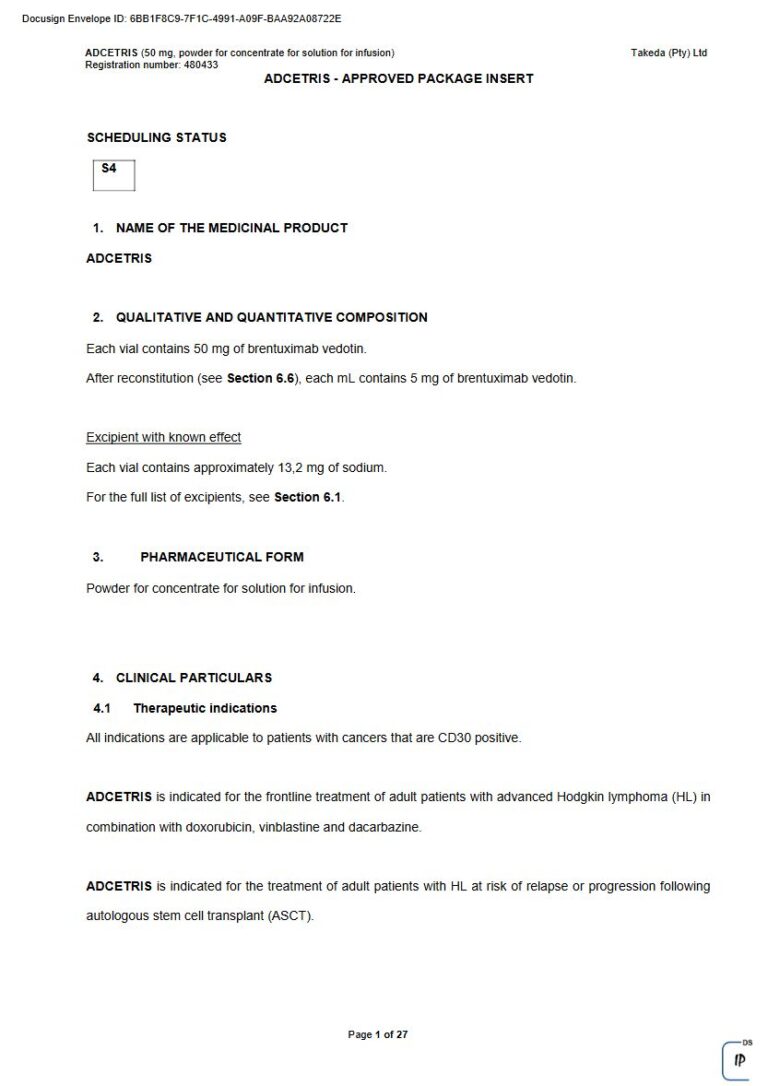
All indications are applicable to patients with cancers that are CD30 positive. ADCETRIS is indicated for the frontline treatment of adult patients with advanced Hodgkin lymphoma (HL) in combination with doxorubicin, vinblastine and dacarbazine. ADCETRIS is indicated for the treatment of adult patients with HL at risk of relapse or progression following autologous stem cell transplant (ASCT). ADCETRIS is indicated for the treatment of adult patients with relapsed or refractory Hodgkin lymphoma (HL). ADCETRIS is indicated for the treatment of adult patients with relapsed or refractory systemic anaplastic large cell lymphoma (sALCL). ADCETRIS is indicated for the treatment of adult patients with cutaneous T-cell lymphoma (CTCL) who require systemic therapy.
4.2 Posology and method of administration
Posology ADCETRIS should be administered under the supervision of a medical practitioner experienced in the use of anticancer agents.
- Frontline HL: The recommended dose in combination with chemotherapy (doxorubicin [A], vinblastine [V] and dacarbazine [D] [AVD]) is 1.2 mg/kg administered as an intravenous infusion over 30 minutes on days 1 and 15 of each 28-day cycle for 6 cycles (see Section 5.1). Primary prophylaxis with growth factor support (granulocyte colony stimulating factor (G-CSF)) is recommended for all patients beginning with the first dose (see Section 4.4, Febrile neutropenia). Refer to the package insert of chemotherapy agents given in combination with ADCETRIS for frontline treatment of patients with HL.
- HL at risk of relapse or progression: The recommended dose is 1.8 mg/kg administered as an intravenous infusion over 30 minutes every 3 weeks. For patients with HL at risk of relapse or progression following ASCT, ADCETRIS treatment should start following recovery from ASCT based on clinical judgment. These patients should receive up to 16 cycles.
- Relapsed or refractory HL: The recommended dose is 1.8 mg/kg administered as an intravenous infusion over 30 minutes every 3 weeks. The recommended starting dose for the retreatment of patients who have previously responded to treatment with ADCETRIS is 1.8 mg/kg administered as an intravenous infusion over 30 minutes every 3 weeks. Alternatively, treatment may be started at the last tolerated dose. Treatment should be continued until disease progression or unacceptable toxicity (see Section 4.4). Patients who achieve stable disease or better should receive a minimum of 8 cycles and up to a maximum of 16 cycles (approximately 1 year) (see Section 5.1).
- Cutaneous T-cell lymphoma (CTCL): The recommended dose is 1.8 mg/kg administered as an intravenous infusion over 30 minutes every 3 weeks. Patients with CTCL should receive up to 16 cycles. If the patientu2019s weight is more than 100 kg, the dose calculation should use 100 kg (see Determining dosage amount). Complete blood counts should be monitored prior to administration of each dose of this treatment (see Section 4.4). Patients should be monitored during and after infusion (see Section 4.4).
Special patient populations: Renal and Hepatic impairment Combination therapy Patients with renal impairment should be closely monitored for adverse events. There is no clinical trial experience using ADCETRIS in combination with chemotherapy in patients with severe renal impairment. Patients with hepatic impairment should be closely monitored for adverse events. There is no clinical trial experience using ADCETRIS in combination with chemotherapy in patients with hepatic impairment, where total bilirubin is > 1.5 times the upper limit of normal (ULN) (unless due to Gilbert syndrome), or aspartate aminotransferase (AST) or alanine aminotransferase (ALT) are >3 times the ULN, or >5 times the ULN if their elevation may be reasonably ascribed to the presence of HL in the liver (see Section 5.2).
Monotherapy The recommended starting dose in patients with severe renal impairment is 1.2 mg/kg administered as an intravenous infusion over 30 minutes every 3 weeks. Patients with renal impairment should be closely monitored for adverse events (see Section 5.2). The recommended starting dose in patients with hepatic impairment is 1.2 mg/kg administered as an intravenous infusion over 30 minutes every 3 weeks. Patients with hepatic impairment should be closely monitored for adverse events.
Elderly The dosing recommendations for patients aged 65 and older are the same as for adults (see Section 5.2). Paediatric population The safety and efficacy of children less than 18 years have not yet been established. See Section 5.2 for new data. In nonclinical studies, thymus depletion has been observed.
Dose adjustments Neutropenia If neutropenia develops during treatment it should be managed by dose delays. See Table 1 below for appropriate dosing recommendations (see also Section 4.4).
Table 1: Dosing recommendations for neutropenia Severity grade of neutropenia (signs and symptoms u2013 abbreviated description of CTCAE a) Modification of dosing schedule (monotherapy) Modification of dosing schedule (combination therapy) Grade 1 (<LLN u2013 1 500/mm3 <LLN u2013 1.5 x 10^9/L) or Grade 2 (<1 500 u2013 1 000/mm3 <1.5 u2013 1.0 x 10^9/L) Continue with the same dose and schedule Continue with the same dose and schedule Grade 3 (<1 000 u2013 500/mm3 <1.0 u2013 0.5 x 10^9/L) or Grade 4 (<500/mm3 <0.5 x 10^9/L) Withhold dose until toxicity returns to u2264 Grade 2 or baseline, then resume treatment at the same dose and schedule b. Consider growth factor support (G-CSF or GM-CSF) in subsequent cycles for patients who develop Grade 3 or Grade 4 neutropenia.
a Grading based on National Cancer Institute (NCI) Common Terminology Criteria for Adverse Events (CTCAE) v3.0; see Neutrophils/granulocytes; LLN = lower limit of normal b Patients who develop Grade 3 or Grade lymphopenia may continue treatment without interruption.
Peripheral neuropathy If peripheral sensory or motor neuropathy emerges or worsens during treatment see Table 2 below for appropriate dosing recommendations (see also Section 4.4).
Table 2: Dosing recommendations for new or worsening peripheral sensory or motor neuropathy Severity of peripheral sensory or motor neuropathy (signs and symptoms u2013 abbreviated description of CTCAE a) Modification of dosing schedule (monotherapy) Modification of dosing schedule (combination therapy) Grade 1 (paraesthesia and/or loss of reflexes, with no loss of function) Continue with the same dose and schedule Continue with the same dose and schedule Grade 2 (interfering with function but not with activities of daily living) or Grade 3 (interfering with activities of daily living) Withhold dose until toxicity returns to u2264 Grade 1 or baseline, then resume treatment at a reduced dose of 1.2 mg/kg every 3 weeks. Reduce dose to 0.9 mg/kg every 2 weeks Grade 3 (interfering with activities of daily living) Withhold dose until toxicity returns to u2264 Grade 1 or baseline, then restart treatment at a reduced dose of 1.2 mg/kg every 3 weeks. Withhold treatment with brentuximab vedotin until toxicity is u2264 Grade 2, then restart treatment at a reduced dose to 0.9 mg/kg every 2 weeks. Consider modifying the dose of other neurotoxic agents as per their package inserts. Grade 4 (sensory neuropathy which is disabling or motor neuropathy that is life threatening or leads to paralysis) Discontinue treatment Discontinue treatment a Grading based on National Cancer Institute (NCI) Common Terminology Criteria for Adverse Events (CTCAE) v3.0; see neuropathy: motor; neuropathy: sensory; and neuropathic pain.
Method of administration The recommended dose of ADCETRIS is infused over 30 minutes. For instructions on reconstitution and dilution of ADCETRIS before administration, see below. ADCETRIS must not be administered as an intravenous push or bolus. ADCETRIS should be administered through a dedicated intravenous line and it must not be mixed with other medicines.
4.3 Contraindications
Hypersensitivity to the active substance or to any of the excipients. Combined use of bleomycin and ADCETRIS causes pulmonary toxicity. ADCETRIS is contraindicated in women who are pregnant or are breastfeeding their infants (see Section 4.6). Men being treated with ADCETRIS are advised not to father a child during treatment and for up to 6 months following the last dose (see Section 4.6).
4.4 Special warnings and precautions for use
Progressive multifocal leukoencephalopathy John Cunningham virus (JCV) reactivation resulting in progressive multifocal leukoencephalopathy (PML) and death can occur in ADCETRIS-treated patients. PML has been reported in patients who received this treatment after receiving multiple prior chemotherapy regimens. PML is a rare demyelinating disease of the central nervous system that results from reactivation of latent JCV and is often fatal. Patients should be closely monitored for new or worsening neurological, cognitive, or behavioural signs or symptoms, which may be suggestive of PML. ADCETRIS dosing should be stopped in any suspected case of PML. Suggested evaluation of PML includes neurology consultation, gadolinium-enhanced magnetic resonance imaging of the brain and cerebrospinal fluid analysis for JCV DNA by polymerase chain reaction or a brain biopsy with evidence of JCV. A negative JCV PCR does not exclude PML. Additional follow up and evaluation may be warranted if no alternative diagnosis can be established. ADCETRIS dosing should be permanently discontinued if a diagnosis of PML is confirmed. The medical practitioner should be particularly alert to symptoms suggestive of PML that the patient may not notice (e.g., cognitive, neurological, or psychiatric symptoms).
Pancreatitis Acute pancreatitis has been observed in patients treated with ADCETRIS. Fatal outcomes have been reported. Patients should be closely monitored for new or worsening abdominal pain, which may be suggestive of acute pancreatitis. Patient evaluation may include physical examination, laboratory evaluation for serum amylase and serum lipase, and abdominal imaging, such as ultrasound and other appropriate diagnostic measures. ADCETRIS should be held for any suspected case of acute pancreatitis. ADCETRIS should be discontinued if a diagnosis of acute pancreatitis is confirmed.
Pulmonary Toxicity Cases of pulmonary toxicity, including pneumonitis, interstitial lung disease, and acute respiratory distress syndrome (ARDS), some with fatal outcomes, have been reported in patients receiving ADCETRIS. Although a causal association with ADCETRIS has not been established, the risk of pulmonary toxicity cannot be ruled out. In the event of new or worsening pulmonary symptoms (e.g., cough, dyspnoea), a prompt diagnostic evaluation should be performed and patients should be treated appropriately. Consider withholding ADCETRIS dosing during evaluation and until symptomatic improvement.
Serious infections and opportunistic infections Serious infections such as pneumonia, staphylococcal bacteraemia, sepsis/septic shock (including fatal outcomes) and herpes zoster, and opportunistic infections such as Pneumocystis jiroveci (carinii) pneumonia and oral candidiasis have been reported in patients treated with ADCETRIS. Patients should be carefully monitored during treatment for the emergence of possible serious and opportunistic infections.
Infusion-related reactions Immediate and delayed infusion-related reactions (IRR), as well as anaphylactic reactions, have been reported. Symptoms of an anaphylactic reaction may include, but are not limited to, urticaria, angioedema, hypotension and bronchospasm. Patients should be carefully monitored during and after infusion. If an anaphylactic reaction occurs, administration of ADCETRIS should be immediately and permanently discontinued and appropriate medical therapy should be administered. If an infusion-related reaction occurs, the infusion should be interrupted and appropriate medical management instituted. The infusion may be restarted at a slower rate after symptom resolution. Patients who have experienced a prior infusion-related reaction should be pre-medicated for subsequent infusions. Pre-medication may include paracetamol, an antihistamine and a corticosteroid. Infusion-related reactions are more frequent and more severe in patients with antibodies to ADCETRIS.
Tumour lysis syndrome Tumour lysis syndrome (TLS) has been reported with ADCETRIS. Patients with rapidly proliferating tumour and high tumour burden are at risk of tumour lysis syndrome. These patients should be monitored closely and managed according to best medical practice. Management of TLS may include aggressive hydration, monitoring of renal function, correction of electrolyte abnormalities, anti-hyperuricaemic therapy, and supportive care.
Peripheral neuropathy ADCETRIS treatment may cause a peripheral neuropathy that is predominantly sensory. Cases of peripheral motor neuropathy have also been reported. ADCETRIS-induced peripheral neuropathy is typically an effect of cumulative exposure to ADCETRIS. In the phase 2 population, at the time of last evaluation, the majority of patients (62%) had improvement or resolution of their peripheral neuropathy symptoms. Patients should be monitored for symptoms of neuropathy, such as hypoesthesia, hyperesthesia, paraesthesia, discomfort, a burning sensation, neuropathic pain or weakness. Patients experiencing new or worsening peripheral neuropathy may require discontinuation of ADCETRIS (see Section 4.2).
Haematological toxicities Grade 3 or Grade 4 anaemia, thrombocytopenia and prolonged (u2265 1 week) Grade 3 or Grade 4 neutropenia can occur with ADCETRIS which may increase the risk of patients developing serious infections. Complete blood counts should be monitored prior to administration of each dose. If Grade 3 or Grade 4 neutropenia develops, refer to Section 4.2.
Febrile neutropenia Febrile neutropenia (fever of unknown origin without clinically or microbiologically documented infection with an absolute neutrophil count, 1.0 x 10^9 / L, fever u2265 38.5 u00b0C) has been reported with treatment with ADCETRIS. ADCETRIS may cause fatal Grade 5 febrile neutropenia after a single dose of 3.5 mg/kg. Complete blood counts should be monitored prior to administration of each dose of ADCETRIS. Patients should be monitored closely for fever and managed according to best medical practice if febrile neutropenia develops (see Section 4.2). When ADCETRIS is administered in combination with chemotherapy, primary prophylaxis with G-CSF is recommended for all patients beginning with the first dose.
Stevens-Johnson syndrome and toxic epidermal necrolysis Stevens-Johnson syndrome and toxic epidermal necrolysis have been reported with ADCETRIS. If Stevens-Johnson syndrome or toxic epidermal necrolysis occurs, treatment with ADCETRIS should be discontinued and appropriate medical therapy should be administered.
Gastrointestinal Complications Gastrointestinal (GI) complications including intestinal obstruction, ileus, enterocolitis, neutropenic colitis, erosion, ulcer, perforation and haemorrhage, some with fatal outcomes, have been reported in patients treated with ADCETRIS. Some cases of GI perforations were reported in patients with GI involvement of underlying lymphoma. In the event of new or worsening GI symptoms, perform a prompt diagnostic evaluation and treat appropriately.
Hepatotoxicity Hepatotoxicity in the form of elevations in alanine aminotransferase (ALT) and aspartate aminotransferase (AST) has been reported with ADCETRIS. Serious cases of hepatotoxicity, including fatal outcomes, have also occurred. Pre-existing liver disease, comorbidities, and concomitant medications may also increase the risk. Liver function should be routinely monitored in patients receiving ADCETRIS. Patients experiencing hepatotoxicity may require a delay, change in dose or discontinuation of ADCETRIS (see Section 4.8).
Hyperglycaemia Hyperglycaemia has been reported during clinical trials in patients with an elevated Body Mass Index (BMI) with or without a history of diabetes mellitus. However, any patient who experiences an event of hyperglycaemia should have their serum glucose closely monitored. Anti-diabetic treatment should be administered as appropriate.
Renal and hepatic impairment There is limited experience in patients with renal and hepatic impairment. Population pharmacokinetic (PK) analysis indicated that MMAE clearance might be affected by moderate and severe renal impairment, and by low serum albumin concentrations (see Section 5.2).
Co-treatment with ritonavir No information is available on the co-treatment with ritonavir-containing ART regimens in HIV-infected patients (see Section 4.5 for available information on co-administration of ADCETRIS with CYP3A4 inhibitors).
Immunogenicity In clinical trials, patients were periodically tested for antibodies to brentuximab vedotin using a sensitive electrochemiluminescent immunoassay. There was a higher incidence of infusion-related reactions observed in patients with antibodies to brentuximab vedotin relative to patients who tested transiently positive or negative. The presence of antibodies to ADCETRIS did not correlate with a clinically meaningful reduction in serum brentuximab vedotin levels and did not result in a decrease in the efficacy of ADCETRIS. While the presence of antibodies to ADCETRIS does not necessarily predict the development of an IRR, there was a higher incidence of IRRs observed in patients with persistently positive ATA (30%) relative to patients with transiently positive ATA (12%) and never positive ATA (7%).
4.5 Interaction with other medicinal products and other forms of interaction
Interaction with medicines metabolised through CYP3A4 route (CYP3A4 inhibitors/inducers) Co-administration of ADCETRIS with ketoconazole, a strong CYP3A4 and P-gp inhibitor, increased the exposure to the antimicrotubule agent MMAE by approximately 73%, and did not alter the plasma exposure to ADCETRIS. Therefore, co-administration of ADCETRIS with strong CYP3A4 and P-gp inhibitors may increase the incidence of neutropenia. If neutropenia develops, refer to Table 3: Dosing recommendations for neutropenia (see Section 4.2). Co-administration of ADCETRIS with rifampicin, a strong CYP3A4 inducer, did not alter the plasma exposure to ADCETRIS; however it reduced exposure to MMAE by approximately 31%. Co-administration of midazolam, a CYP3A4 substrate, with ADCETRIS did not alter the metabolism of midazolam; therefore ADCETRIS is not expected to alter the exposure to medicines that are metabolized by CYP3A4 enzymes. Doxorubicin, Vinblastine and Dacarbazine The serum and plasma pharmacokinetic characteristics of brentuximab vedotin and MMAE respectively following administration of ADCETRIS in combination with doxorubicin, vinblastine and dacarbazine were similar to that in monotherapy. Co-administration of ADCETRIS did not affect the plasma exposure of doxorubicin, vinblastine or dacarbazine.
4.6 Fertility, pregnancy and lactation
Women of childbearing potential Women of childbearing potential should be using two methods of effective contraception during treatment with ADCETRIS and until 6 months after treatment. Pregnancy ADCETRIS is contraindicated in women who are pregnant or intend to become pregnant (see Section 4.3). Studies in animals have shown reproductive toxicity. See the fertility section below pertaining to advice for women whose male partners are being treated with ADCETRIS. Breastfeeding Women who are using ADCETRIS should not breastfeed their infants. Male Fertility In non-clinical studies, ADCETRIS treatment has resulted in testicular toxicity, and may alter male fertility. Men being treated with ADCETRIS are advised to have sperm samples frozen and stored before treatment. Men being treated with ADCETRIS are advised not to father a child during treatment and for up to 6 months following the last dose.
4.7 Effects on ability to drive and use machines
ADCETRIS may have an influence on the ability to drive and use machines and the individual patientu2019s response must be assessed.
4.8 Undesirable effects
Summary of the safety profile The safety profile of ADCETRIS is based on available clinical trial data, the Named Patient Program (NPP), and post-marketing experience to date. Frequencies of adverse reactions described below and in Table 3 have been determined based on data generated from clinical studies.
Monotherapy In the pooled dataset of ADCETRIS as monotherapy across HL, sALCL and CTCL studies the most frequent adverse reactions (u226510%) were infections, peripheral sensory neuropathy, nausea, fatigue, diarrhoea, pyrexia, upper respiratory tract infection, neutropenia, rash, cough, vomiting, arthralgia, peripheral motor neuropathy, infusion-related reactions, pruritus, constipation, dyspnoea, weight decreased, myalgia and abdominal pain. Serious adverse drug reactions occurred in 12% of patients. The frequency of unique serious adverse drug reactions was u22641%. Adverse events led to treatment discontinuation in 24% of patients receiving ADCETRIS. The safety data in patients retreated with ADCETRIS were consistent with those observed in the combined pivotal phase 2 studies, with the exception of peripheral motor neuropathy, which had a higher incidence (28% vs. 9% in the pivotal phase 2 studies) and was primarily Grade 2. Serious adverse drug reactions occurred in 12% of patients. The frequency of unique serious adverse drug reactions was u22641%. Adverse events led to treatment discontinuation in 24% of patients receiving ADCETRIS. The safety data in patients retreated with ADCETRIS were consistent with those observed in the combined pivotal phase 2 studies, with the exception of peripheral motor neuropathy, which had a higher incidence (28% vs. 9% in the pivotal phase 2 studies) and was primarily Grade 2. Patients also had a higher incidence of arthralgia, Grade 3 anaemia, and back pain compared to patients observed in the combined pivotal phase 2 studies.
The safety data in patients with relapsed or refractory HL who had not received an autologous stem cell transplant and were treated with the recommended dose of 1.8 mg/kg every three weeks in a single-arm phase 4 study (n=60), the phase 1 dose escalation and clinical pharmacology studies (n=15 patients) and in the NPP (n=26 patients) were consistent with the safety profile of the pivotal clinical studies.
Combination therapy For safety information of chemotherapy agents given in combination with ADCETRIS (doxorubicin, vinblastine and dacarbazine) for frontline treatment of patients with HL, refer to their package inserts. In the study of ADCETRIS as combination therapy in 662 patients with advanced frontline HL, the most common adverse reactions (u226510%) were: neutropenia, nausea, constipation, vomiting, fatigue, peripheral sensory neuropathy, diarrhoea, pyrexia, alopecia, peripheral neuropathy, decreased weight, abdominal pain, anaemia, stomatitis, febrile neutropenia, bone pain, insomnia, decreased appetite, cough, headache, arthralgia, neutrophil count decreased, dyspepsia, paraesthesia, back pain, dyspnoea, pain in extremity, myalgia, oropharyngeal pain, upper respiratory tract infection, alanine aminotransferase increased. In patients receiving ADCETRIS combination therapy, serious adverse reactions occurred in 36% of patients. Serious adverse reactions occurring in u22653% of patients included febrile neutropenia (17%), pyrexia (6%), and neutropenia (3%). Additionally, there were more serious adverse events reported in the elderly patient population (u226565 years of age) in both arms. Adverse events led to treatment discontinuation in 13% of patients. Adverse events that led to treatment discontinuation in u22652% of patients included peripheral sensory neuropathy, peripheral neuropathy, and peripheral motor neuropathy. Side effects have been classified according to system organ class and frequency. Frequencies are defined as very common (u22651/10); common (u22651/100 to <1/10); uncommon (u22651/1 000 to <1/100); rare (u22651/10 000 to <1/1 000); very rare (<1/10 000); not known (cannot be estimated from available data).
Table 3: The Adverse reactions for ADCETRIS System organ class Adverse reactions (monotherapy) Adverse reactions (combination therapy) Infections and infestations Very common: Infection a, upper respiratory tract infection Infection a, upper respiratory tract infection Common: Sepsis/septic shock, herpes zoster, pneumonia, herpes simplex Pneumonia, oral candidiasis, sepsis/septic shock, herpes simplex Uncommon: Oral candidiasis, Pneumocystis jiroveci pneumonia, staphylococcal bacteraemia, cytomegalovirus infection or reactivation Herpes zoster, Pneumocystis jiroveci pneumonia Frequency not known: Progressive multifocal leukoencephalopathy Blood and lymphatic system disorders Very common: Neutropenia Neutropenia a, anaemia, febrile neutropenia Common: Anaemia, thrombocytopenia Thrombocytopenia Frequency not known: Febrile neutropenia Immune system disorders Uncommon: Anaphylactic reaction Frequency not known: Anaphylactic reaction Metabolism and nutrition disorders Very common: Decreased appetite Common: Hyperglycaemia Hyperglycaemia Uncommon: Tumour lysis syndrome Tumour lysis syndrome Nervous system disorders Very common: Peripheral sensory neuropathy, peripheral motor neuropathy Peripheral sensory neuropathy, peripheral motor neuropathy a, dizziness Common: Dizziness, demyelinating polyneuropathy Respiratory, thoracic and mediastinal disorders Very common: Cough, dyspnea Cough, dyspnoea Gastro-intestinal disorders Very common: Diarrhoea, nausea, vomiting, constipation, abdominal pain Nausea, constipation, vomiting, diarrhoea, abdominal pain, stomatitis Uncommon: Pancreatitis acute Pancreatitis acute Hepatobiliary disorders Very common: Alanine aminotransferase (ALT) increased Common: Alanine aminotransferase/aspartate aminotransferase (ALT/AST) increased Aspartate aminotransferase (AST) increased Skin and subcutaneous tissue disorders Very common: Alopecia, pruritus Alopecia, rash a Common: Rash a Pruritus Uncommon: Stevens-Johnson syndrome b Rare: Stevens-Johnson syndrome/toxic epidermal necrolysis Musculoskeletal and connective tissue disorders Very common: Myalgia, arthralgia Bone pain, arthralgia, back pain, myalgia Common: Back pain General disorders and administration site conditions Very common: Fatigue, chills, pyrexia, infusion-related reactions a Fatigue, pyrexia Common: Infusion-related reactions a, chills Investigations Very common: Weight decreased Weight decreased Psychiatric Disorders Very common: Insomnia a. Represents pooling of preferred terms. b. Toxic epidermal necrolysis was not reported in the combination therapy setting. Adverse reactions that led to dose delays of up to 3 weeks in more than 5% of patients were neutropenia (14%) and peripheral sensory neuropathy (11%) (see Section 4.2). The adverse reaction that led to a dose reduction in more than 5% of patients was peripheral sensory neuropathy (8%). Ninety percent (90%) of patients in the phase 2 studies remained at the recommended dose of 1.8 mg/kg while on treatment. Post-marketing experience In addition to the adverse reactions included above, the following events have been reported in the post-marketing setting. Gastrointestinal disorders: u2022 Pancreatitis (including fatal outcomes). Consider the diagnosis of pancreatitis for patients presenting with severe abdominal pain. u2022 Gastrointestinal complications (including fatal outcomes) Hepatobiliary disorders: hepatotoxicity (including fatal outcomes). Respiratory, thoracic and mediastinal disorders: noninfectious pulmonary toxicity including pneumonitis, interstitial lung disease, and ARDS (some with fatal outcomes). Skin and subcutaneous tissue disorders: toxic epidermal necrolysis (including fatal outcomes). Reporting of suspected adverse reactions Reporting suspected adverse reactions after authorisation of the medicine is important. It allows continued monitoring of the benefit/risk balance of the medicine. Health care providers are asked to report any suspected adverse reactions to SAHPRA via u201c6.04 Adverse Drug Reactions Reporting Formu201d found online under SAHPRAu2019s publications: http://www.sahpra.org.za/Publications/Index/8.
4.9 Overdose
There is no known antidote for overdose of ADCETRIS. In case of overdose, the patient should be closely monitored for adverse reactions, particularly neutropenia, and supportive treatment should be administered (see Section 4.4).
