
Entocord 0,02 Mg Dispersible Tablets
PDF Leaflet Revision Date: 24 May 2023
Clinical Summary
Quick overview from the medicine insert
Indication
Ulcerative colitis involving the rectum and sigmoid colon.
Dosage (summary)
One enema nightly for 4 weeks; may extend to 8 weeks if no remission.
Onset of Action / Duration
Onset: 2-4 weeks, Duration: Not specified.
Special Populations
- Elderly
- Renal impairment
- Hepatic impairment
Pregnancy & Breastfeeding
Safety in pregnancy and breastfeeding not established; corticosteroids are teratogenic.
Key Drug Interactions
- CYP3A inhibitors (e.g., ketoconazole)
- CYP3A4 inducers (e.g., carbamazepine)
Contraindications
- Hypersensitivity to budesonide
- Bacterial, fungal, or viral infections
- Children
Common side effects
- Nausea
- Diarrhoea
- Depression
- Urticaria
Counselling Points
- Administer enema at bedtime
- Monitor for systemic side effects
- Report any allergic reactions
Serious warnings
- Adrenocortical suppression risk
- Systemic corticosteroid effects
- Visual disturbances
Important Disclaimer
The Entocord 0,02 Mg Dispersible Tablets professional information leaflet below is the property of Equity Pharmaceuticals and is provided on Medinsert exactly as issued, with no.. alterations or editorial changes. We make every effort to keep content current by updating documents as soon as new versions become available. Medinsert serves as a trusted access point for healthcare professionals, but does not replace official sources or clinical judgement. For more details, please read our full disclaimer. read more>>
 Healthcare Professionals Only
This content is for registered healthcare professionals
Sign in or create a free account to read the full package insert.
Free for HPCSA-registered professionals. Powered by Medinsert.
Clinical Particulars
Section 4 of the official insert — extracted exactly as issued, no alterations
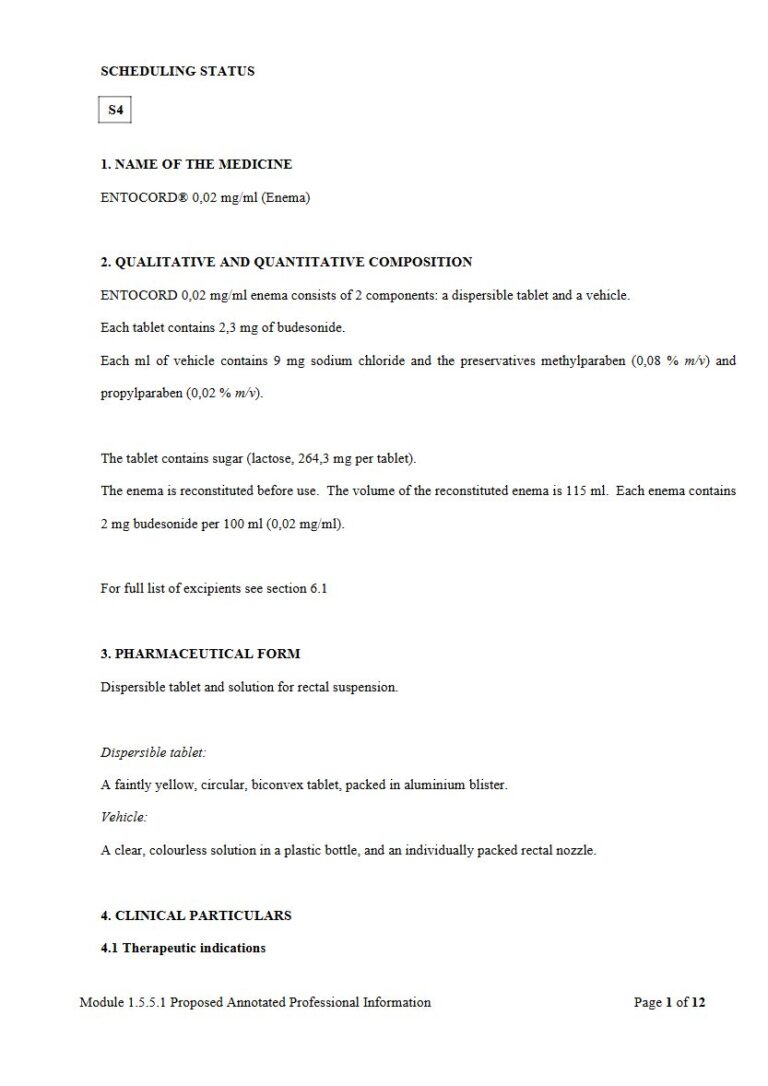
4.1 Therapeutic indications
Ulcerative colitis involving the rectum and sigmoid colon.
4.2 Posology and method of administration
Posology
The dosage recommendation for adults including the elderly is one ENTOCORD 0,02 mg/ml enema nightly for 4 weeks. Full effect is usually achieved within 2 - 4 weeks. If the patient is not in remission after 4 weeks, the treatment period may be prolonged to 8 weeks.
ENTOCORD 0,02 mg/ml enema consists of 2 parts, a dispersible tablet and a bottle containing a vehicle. The enema is prepared just before use, to be administered in the evening before going to bed.
Method of administration
Administer the ENTOCORD 0,02 mg/ml enema per rectum as per instructions in section 6.6.
4.3 Contraindications
Hypersensitivity to the budesonide or any of the excipients of ENTOCORD 0,02 mg/ml enema listed in section 6.1. Patients with local and systemic bacterial, fungal and viral infections. Safety and efficacy have not been established in children.
4.4 Special warnings and special precautions for use
Special care is required in patients who are transferred from systemic glucocorticosteroid treatment with higher systemic effect to ENTOCORD 0,02 mg/ml enema as they may have adrenocortical suppression. Monitoring of adrenocortical function may therefore be considered and the dose of systemic steroid should be reduced cautiously. Patients may feel unwell in a non-specific way during the withdrawal phase, e.g., they may experience pain in the muscles and joints. Symptoms such as tiredness, headache, nausea and vomiting may occur. A general insufficient glucocorticosteroid effect should be suspected and a temporary increase in the dose of systemic glucocorticosteroids is sometimes necessary. Replacement of systemic glucocorticosteroid treatment with a higher systemic effect by ENTOCORD 0,02 mg/ml enema sometimes unmasks allergies, e.g., rhinitis and eczema, which were previously controlled by the systemic medicine. These allergies should be symptomatically controlled with an anti-histamine and/or topical preparations. Reduced liver function may affect the elimination of glucocorticosteroids. The intravenous pharmacokinetics of budesonide, however, were similar in cirrhotic patients and in healthy subjects. The pharmacokinetics after oral ingestion of budesonide were affected by compromised liver function as evidenced by increased systemic availability. Particular care is required when considering the use of systemic corticosteroids in patients with existing or previous history of severe affective disorders in themselves or their first degree relatives. These would include depressive or manic-depressive illness and previous steroid psychosis (See section 4.8). Systemic effects of steroids may occur, particularly when prescribed at high doses and for prolonged periods. Such effects may include Cushing's syndrome, adrenal suppression, growth retardation, decreased bone mineral density, cataract, glaucoma and very rarely a wide range of psychiatric/behavioural effects (see Section 4.8). Co-treatment with CYP3A inhibitors, including ketoconazole and cobicistat-containing products, is expected to increase the risk of systemic side effects. The combination should be avoided unless the benefit outweighs the increased risk of systemic corticosteroid side effects, in which case patients should be monitored for systemic corticosteroid side effects. If this is not possible, the period between treatments should be as long as possible, and a reduction of the budesonide dose could also be considered (see section 4.5). When ENTOCORD Enema is used chronically in excessive doses, systemic glucocorticosteroid effects such as hypercorticism and adrenal suppression may appear. However, the dosage form and the route of administration make any prolonged overdosage unlikely. Visual disturbance may be reported with systemic and topical corticosteroid use. If a patient presents with symptoms such as blurred vision or other visual disturbances, the patient should be considered for referral to an ophthalmologist for evaluation of possible causes which may include cataract, glaucoma or rare diseases such as central serous chorioretinopathy (CSCR) which have been reported after use of systemic and topical corticosteroids. ENTOCORD tablet contains lactose therefore ENTOCORD 0,02 mg/ml enema is not recommended for patients with rare hereditary problems of galactose intolerance, total lactase deficiency or of glucose-galactose malabsorption.
4.5 Interaction with other medicines and other forms of interaction
In vivo studies have shown that oral administration of ketoconazole (a known inhibitor of CYP3A activity in the liver and in the intestinal mucosa) caused a several fold increase of the systemic exposure to oral budesonide. Therefore, it cannot be excluded that concomitant use of ENTOCORD 0,02 mg/ml enema and ketoconazole may result in increased systemic availability of budesonide. Elevated plasma levels and enhanced effects of corticosteroids have been reported in women also receiving oestrogens or oral contraceptives. However, a low-dose combination oral contraceptive that more than doubled the plasma concentration of oral prednisolone had no significant effect on the plasma concentration of oral budesonide. At recommended doses, omeprazole was without effect on the pharmacokinetics of oral budesonide, whereas cimetidine has a slight but clinically insignificant effect. Concomitant treatment with CYP3A4 inducers such as carbamazepine probably reduces budesonide exposure, which may require a dose increase. Because adrenal function may be suppressed, an ACTH stimulation test for diagnosing pituitary insufficiency might show false results (low values).
4.6 Fertility, pregnancy and lactation
Pregnancy
In pregnant animals, administration of budesonide, like other glucocorticosteroids, is associated with abnormalities of foetal development. The relevance of these findings to man has not been established. The safety of ENTOCORD 0,02 mg/ml enema in pregnant women has not been established.
Breastfeeding
Budesonide is excreted in breast milk. The safety of ENTOCORD 0,02 mg/ml enema in lactating women has not been established. Corticosteroids are known teratogens.
4.7 Effects on ability to drive and use machines
ENTOCORD 0,02 mg/ml enema does not affect the ability to drive and use machines.
4.8 Undesirable effects
The following definitions apply to the incidence of undesirable effects: Very Common (u2265 1/10); Common (u2265 1/100 to <1/10); Uncommon (u2265 1/1 000 to < 1/100); Rare (u2265 1/10 000 to < 1/1 000); Very rare (< 1/10 000).
System Organ Class Frequency Description
Immune system disorders Very rare Anaphylactic reaction
Unknown Hypersensitivity reactions such as angioedema
Endocrine disorders Rare Signs or symptoms of systemic glucocorticosteroid effects, including hypofunction of the adrenal gland, may occur with ENTOCORD 0,02 mg/ml enema, probably depending on dose, treatment time, concomitant and previous glucocorticosteroid intake, and individual sensitivity. At recommended doses, ENTOCORD 0,02 mg/ml enema usually causes no or minor suppression of plasma cortisol
Psychiatric disorders Common Depression
Uncommon Agitation, insomnia, nervousness, restlessness, psychomotor hyperactivity
Rare Aggression
Eye disorders Rare Glaucoma, cataract including subcapsular cataract, blurred vision (see also section 4.4)
Gastrointestinal disorders Common Nausea, diarrhoea, flatulence, abdominal pain and constipation
Uncommon Duodenal or gastric ulcer
Rare Pancreatitis
Skin and subcutaneous tissue disorders Common Urticaria, exanthema, rash, dermatitis
Rare Ecchymosis
Musculoskeletal and connective tissue disorders Rare Osteonecrosis
Most of the adverse events mentioned in this Professional Information can also be expected for other treatments with glucocorticoids.
Description of selected adverse events
In rare cases signs or symptoms of systemic glucocorticosteroid effects, including hypofunction of the adrenal gland may occur with rectally administered glucocorticosteroids, probably depending on dose, treatment time, concomitant and previous glucocorticosteroid intake, and individual sensitivity. Very rarely a wide range of psychiatric/behavioural effects may occur, when systemic steroids are prescribed at high doses and for prolonged periods. (See section 4.4)
Reporting of suspected adverse reactions
Reporting suspected adverse reactions after authorisation of the medicine is important. It allows continued monitoring of the benefit/risk balance of the medicine. Healthcare providers are asked to report any suspected adverse reactions to SAHPRA via the u201c6.04 Adverse Drug Reactions Reporting Formu201d, found online under SAHPRAu2019s publications: https://www.sahpra.org.za/Publications/Index/8.
4.9 Overdose
Systemic corticosteroid effects such as hypercorticism and adrenal suppression may occur when ENTOCORD 0,02 mg/ml enema is used chronically in excessive doses. Discontinue treatment and take appropriate measures to protect the patient against stress situations. In the event of acute overdosage, no specific antidote is available. If a high dose of ENTOCORD 2,3 mg dispersible tablets has been taken orally, treatment consists of immediate emesis followed by supportive and symptomatic therapy.
