
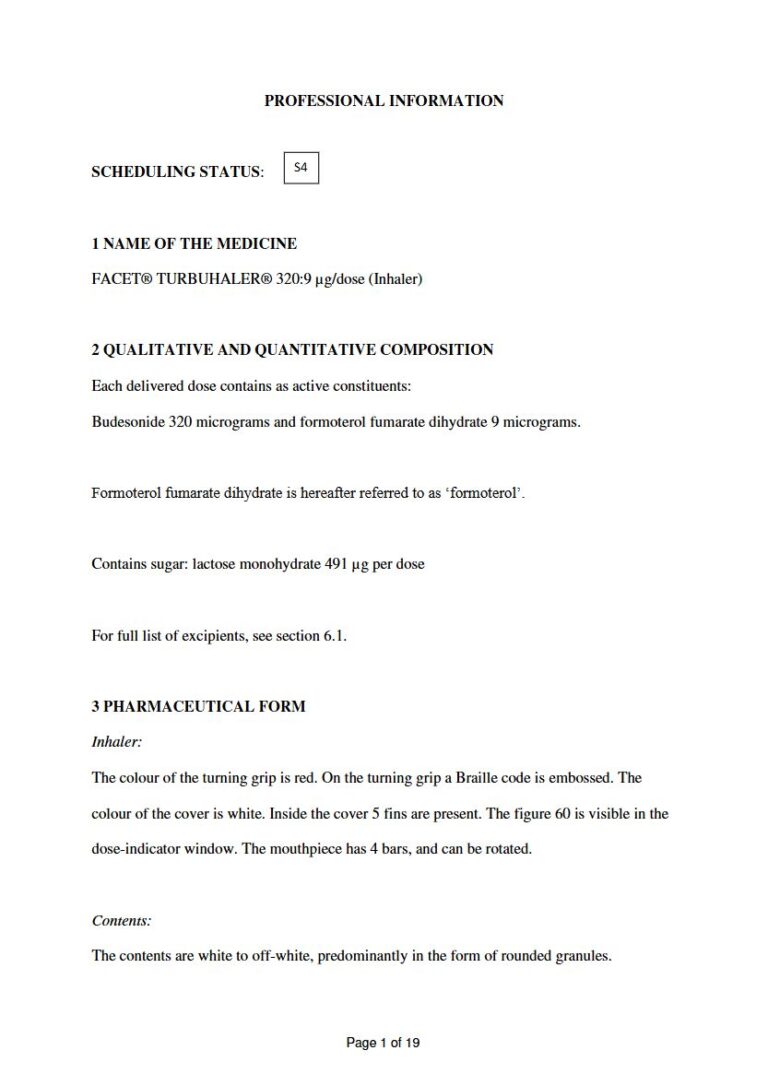
Facet Turbuhaler 320:9 320:9 µg/dose Inhaler
PDF Leaflet Revision Date: 19 July 2022
Clinical Summary
Quick overview from the medicine insert
Indication
Treatment of asthma and COPD.
Dosage (summary)
1 inhalation twice daily for adults; max 2 inhalations twice daily if needed.
Onset of Action / Duration
Onset: 1-3 mins, Duration: up to 12 hours
Special Populations
- Elderly
- Hepatic impairment
- Renal impairment
Pregnancy & Breastfeeding
Safety not established; corticosteroids are teratogenic in animals.
Key Drug Interactions
- CYP3A4 inhibitors
- Beta-adrenergic blockers
- QT prolonging agents
Contraindications
- Hypersensitivity to components
- Children under 12
Common side effects
- Palpitations
- Tremor
- Headache
- Candida infections
Counselling Points
- Use even when asymptomatic
- Rinse mouth after use
- Have rescue inhaler available
Serious warnings
- Not for acute exacerbations
- Risk of pneumonia in COPD
- Adrenal insufficiency risk
Important Disclaimer
The Facet Turbuhaler 320:9 320:9 µg/dose Inhaler professional information leaflet below is the property of Astrazeneca Pharmaceuticals and is provided on Medinsert exactly as issued, with no.. alterations or editorial changes. We make every effort to keep content current by updating documents as soon as new versions become available. Medinsert serves as a trusted access point for healthcare professionals, but does not replace official sources or clinical judgement. For more details, please read our full disclaimer. read more>>
 Healthcare Professionals Only
This content is for registered healthcare professionals
Sign in or create a free account to read the full package insert.
Free for HPCSA-registered professionals. Powered by Medinsert.
Clinical Particulars
Section 4 of the official insert — extracted exactly as issued, no alterations
4.1 Therapeutic indications
Asthma: FACET TURBUHALER 320:9 u03bcg/dose is indicated in the treatment of asthma in adolescents and adults needing inhaled corticosteroids where continued use of a high dose combination (inhaled corticosteroid and long-acting beta-2-agonist) is appropriate.
COPD: FACET TURBUHALER 320:9 u03bcg/dose is indicated in the regular treatment of patients with moderate to severe chronic obstructive pulmonary disease (COPD), with frequent symptoms and a history of exacerbations.
4.2 Posology and method of administration
Posology The dosage of FACET TURBUHALER should be individualised according to disease severity. When control has been achieved, the dose should be titrated to the lowest dose at which effective control of symptoms is maintained. FACET TURBUHALER is taken as regular maintenance treatment. Patients should be advised to have their separate rapid-acting bronchodilator available for rescue use at all times. Increasing use of rapid-acting bronchodilators indicates a worsening of the underlying condition and warrants a reassessment of the therapy.
Patient Dosage Recommendation
Asthma in adults: Adults (18 years and older): 1 inhalation twice daily. In some cases, a maximum of up to 2 inhalations twice daily may be required as a maintenance dose or temporarily during worsening of asthma. Adolescents (12-17 years): 1 inhalation twice daily. During worsening of asthma, the dose may temporarily be increased to a maximum of 2 inhalations twice daily. COPD: Adults (18 years and older): 1 inhalation twice daily Maximum daily dose: 2 inhalations Efficacy and safety have not been studied in children for FACET TURBUHALER 320:9 u03bcg/dose. FACET TURBUHALER 320:9 u03bcg/dose should be used as FACET maintenance therapy only. Lower strengths are available for the FACET maintenance and reliever therapy regimen.
General information: The patients should be instructed that, for optimal benefit, FACET TURBUHALER must be used even when they are asymptomatic.
Special Populations There are no special dosing requirements for elderly patients.
There are no data available for use of FACET TURBUHALER in patients with hepatic or renal impairment. As budesonide and formoterol are primarily eliminated via hepatic metabolism, an increased exposure can be expected in patients with severe liver diseases.
4.3 Contraindications
- Hypersensitivity to budesonide, formoterol or to inhaled lactose.
- Children below the age of 12 years, as safety and efficacy have not been demonstrated.
4.4 Special warnings and precautions for use
Treatment with FACET TURBUHALER 320:9 u03bcg/dose should not be initiated to treat a severe exacerbation. It is recommended that the dose is tapered when long-term treatment is discontinued and should not be stopped abruptly. If patients find the treatment ineffective, or exceed the prescribed dose of FACET TURBUHALER, medical attention must be sought. Sudden and progressive deterioration in control of asthma or COPD is potentially life threatening and the patient should undergo urgent medical assessment. In this situation, consideration should be given to the need for increased therapy with corticosteroids, e.g. a course of oral corticosteroids, or antibiotic treatment if an infection is present.
Medical practitioners should closely follow the growth of children and adolescents taking long-term corticosteroids by any route, and weigh the benefits of the corticosteroid therapy against the possible risk of growth suppression. Particular care is needed in patients who are transferred from systemic to inhaled glucocorticosteroids, since they may remain at risk of impaired adrenal function for a considerable time. Patients who have required prolonged treatment at the highest recommended dose of inhaled corticosteroids, may also be at risk. These patients may exhibit signs and symptoms of adrenal insufficiency when exposed to surgery and infection or conditions associated with severe electrolyte loss or severe stress. Additional systemic corticosteroid cover should be considered during periods of stress or elective surgery.
In recommended doses FACET TURBUHALER 320:9 u03bcg/dose supplies less than normal physiological amounts of glucocorticosteroid systemically and does NOT provide the mineralocorticosteroid activity that is necessary for coping with these emergencies. FACET TURBUHALER should be administered with caution in patients with severe cardiovascular disorders (including heart rhythm abnormalities), diabetes mellitus, untreated hypokalaemia or thyrotoxicosis. High doses of beta-2-agonists can lower serum potassium by inducing a redistribution of potassium from the extracellular to the intracellular compartment, via stimulation of Na+/K+- ATPase in muscle cells. The clinical importance of this effect is uncertain. FACET TURBUHALER contains lactose (< 1 mg/inhalation). This amount may cause problems in lactose intolerant people.
COPD population: Clinical studies and meta-analyses indicate that maintenance treatment of COPD with inhaled corticosteroids may lead to an increased risk of pneumonia. Medical Practitioners should remain vigilant for the possible development of pneumonia in patients with COPD as the clinical features of pneumonia and exacerbations frequently overlap.
4.5 Interaction with other medicines and other forms of interaction
Pharmacokinetic interactions: The metabolism of budesonide is primarily mediated by the enzyme CYP3A4. Inhibitors of this enzyme, e.g. ketoconazole, may therefore increase systemic exposure to budesonide. This is of limited clinical importance for short-term (1-2 weeks) treatment with ketoconazole, but should be taken into consideration during long-term treatment with ketoconazole.
Pharmacodynamic interactions: Beta-adrenergic blockers (including eye drops) can weaken or inhibit the effect of formoterol. Concomitant treatment with quinidine, disopyramide, procainamide, phenothiazines, antihistamines, monoamine oxidase inhibitors and tricyclic antidepressants can prolong the QTc interval and increase the risk of ventricular dysrhythmias. Budesonide and formoterol have not been observed to interact with any other medicine used in the treatment of asthma.
4.6 Fertility, pregnancy and lactation
The safety of FACET TURBUHALER in pregnant and lactating women has not been established. Corticosteroids are teratogenic in animals.
Pregnancy There are no adequate data from use of formoterol in pregnant women. In animal studies formoterol has caused adverse effects in reproduction studies at very high systemic exposure levels.
Breastfeeding Safety in breastfeeding has not been demonstrated. A clinical pharmacology study has shown that inhaled budesonide is excreted in breast milk.
Fertility There are no animal studies on the effect of the budesonide/formoterol combination on fertility.
4.7 Effects on ability to drive and use machines
FACET TURBUHALER is not expected to adversely affect the ability to drive or use machines.
4.8 Undesirable effects
a) Summary of the safety profile Since FACET TURBUHALER contains both budesonide and formoterol, the same type and intensity of undesirable effects as reported for these substances may occur. The most common medicine related adverse reactions are pharmacologically predictable side effects of beta-2-agonist therapy, such as tremor and palpitations. These tend to be mild and usually disappear within a few days of treatment.
b) Tabulated summary of adverse reactions Adverse reactions which have been associated with budesonide or formoterol are given below in Table 1:
Table 1: Adverse reactions by frequency and system organ class (SOC):
Frequency System Organ Class Event Common 1 % to 10 % Cardiac disorders: Palpitations Infections and infestations: Candida infections in oropharynx, Pneumonia (in COPD patients) Nervous system disorders: Headache, tremor Respiratory, thoracic and mediastinal disorders: Irritation in the throat, coughing, hoarseness, Uncommon 0,1 % to 1 % Cardiac disorders: Tachycardia Gastrointestinal disorders: Nausea Musculoskeletal and connective tissue disorders: Muscle cramps Nervous system disorders: Dizziness Psychiatric disorders: Agitation, restlessness, nervousness, sleep disturbances Rare 0,01 % to 0,1 % Cardiac disorders: Cardiac dysrhythmias, e.g. atrial fibrillation, supraventricular tachycardia, extrasystoles Immune system disorders: Immediate and delayed hypersensitivity reactions, e.g. dermatitis, exanthema, urticaria, pruritus, angioedema and anaphylactic reaction. Respiratory, thoracic and mediastinal disorders: Bronchospasm Skin and subcutaneous tissue disorders: Skin bruising Very rare < 0,01 % Cardiac disorders: Angina pectoris Endocrine disorders: Signs or symptoms of systemic gluco- corticosteroid effects, e.g. hypofunction of the adrenal gland Metabolism and nutrition disorders: Hyperglycaemia Psychiatric disorders: Depression, behavioural disturbances
4.9 Overdose
An overdose of formoterol would likely lead to effects that are typical for beta-2-adrenergic agonists: tremor, headache, palpitations, and tachycardia. Hypotension, metabolic acidosis, hypokalaemia and hyperglycaemia may also occur. Supportive and symptomatic treatment may be indicated. A dose of 90 micrograms administered during 3 hours in patients with acute bronchial obstruction raised no safety concerns.
Acute overdosage with budesonide, even in excessive doses, is not expected to be a clinical problem. When used chronically in excessive doses, systemic glucocorticosteroid effects may appear.
