
Calcium Gluconate Injection Fresenius
PDF Leaflet Revision Date: 07 February 2023
Clinical Summary
Quick overview from the medicine insert
Indication
Intravenous calcium supplement.
Dosage (summary)
Adults: 1-2 g IV; Children: varies by age.
Special Populations
- Renal impairment
- Children under 18
Pregnancy & Breastfeeding
Safety not established in pregnancy or breastfeeding.
Key Drug Interactions
- Digoxin
- Adrenaline
- Thiazide diuretics
Contraindications
- Hypersensitivity
- Severe renal failure
- Hypercalcaemia
- Hypercalciuria
Common side effects
- Bradycardia
- Hypotension
- Nausea
- Vomiting
Counselling Points
- Monitor for signs of hypercalcaemia
- Administer slowly
- Avoid mixing with incompatible drugs
Serious warnings
- Risk of cardiac dysrhythmias
- Irritation at injection site
- Risk of precipitation with ceftriaxone
Important Disclaimer
The Calcium Gluconate Injection Fresenius professional information leaflet below is the property of Fresenius Kabi Manufacturing Sa and is provided on Medinsert exactly as issued, with no.. alterations or editorial changes. We make every effort to keep content current by updating documents as soon as new versions become available. Medinsert serves as a trusted access point for healthcare professionals, but does not replace official sources or clinical judgement. For more details, please read our full disclaimer. read more>>
 Healthcare Professionals Only
This content is for registered healthcare professionals
Sign in or create a free account to read the full package insert.
Free for HPCSA-registered professionals. Powered by Medinsert.
Clinical Particulars
Section 4 of the official insert — extracted exactly as issued, no alterations
4.1 Therapeutic indications
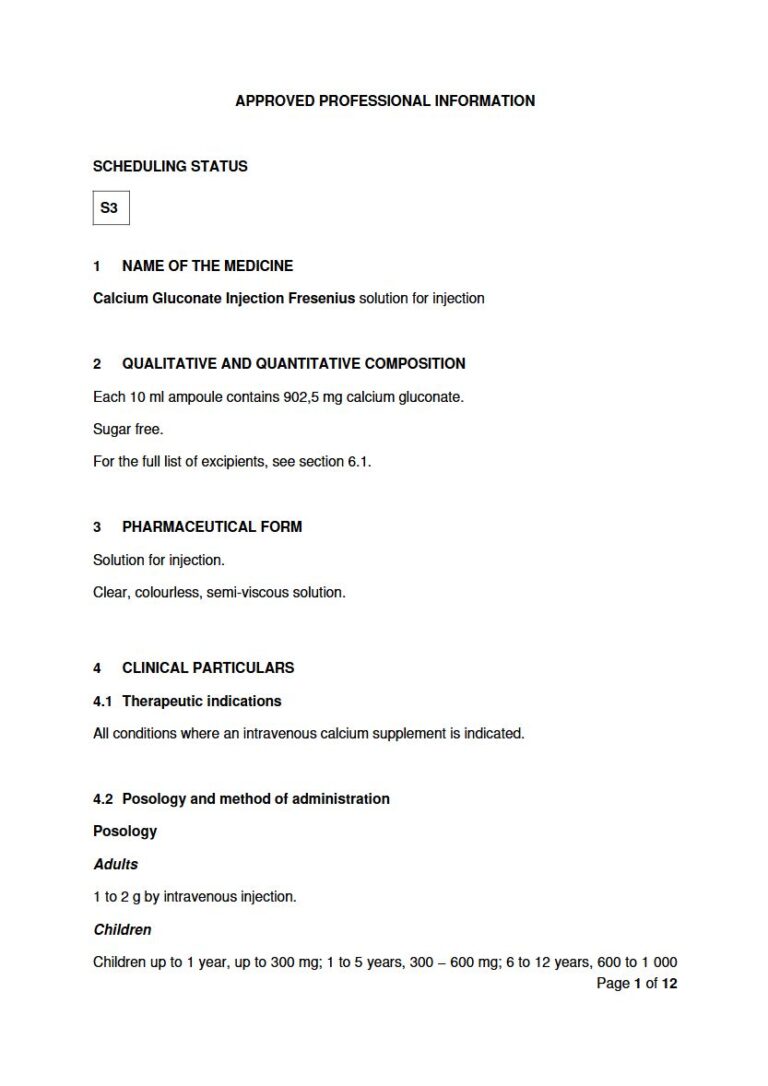
All conditions where an intravenous calcium supplement is indicated.
4.2 Posology and method of administration
Posology
Adults
1 to 2 g by intravenous injection.
Children
Children up to 1 year, up to 300 mg; 1 to 5 years, 300 u2013 600 mg; 6 to 12 years, 600 to 1 000 mg, by slow intravenous injection.
Method of Administration
By intravenous injection.
4.3 Contraindications
- Hypersensitivity to calcium gluconate or to any of the excipients of Calcium Gluconate Injection Fresenius listed in section 6.1.
- Should not be given concurrently with digoxin.
- Patients with severe renal failure.
- Patients with hypercalcaemia (e.g. in hyperparathyroidism, hypervitaminosis D, neoplastic disease with decalcification of bone, renal insufficiency, immobilisation osteoporosis, sarcoidosis, milk-alkali syndrome).
- Patients with hypercalciuria.
- Co-administration with ceftriaxone in:
- premature newborns up to a corrected age of 41 weeks (weeks of gestation + weeks of life) and
- full-term newborns (up to 28 days of age) because of the risk of precipitation of ceftriaxone-calcium (see section 4.4, 4.8 and 6.2).
- Repeated or prolonged treatment, including as an intravenous infusion, in children (less than 18 years of age) and those with impaired renal function, due to the risk of exposure to aluminium. Aluminium oxide can be leached from ampoule glass by calcium gluconate. In order to limit the exposure of patients to aluminium, especially those with impaired renal function and children (less than 18 years of age), Calcium Gluconate Injection Fresenius is not intended for use in the preparation of total parenteral nutrition (TPN).
4.4 Special warnings and precautions for use
Calcium Gluconate Injection Fresenius can produce irritation. In particular intramuscular injection can cause local reactions including sloughing or necrosis of the skin. Soft tissue calcification has followed the use of Calcium Gluconate Injection Fresenius parenterally. Administration should be avoided in patients with calcium renal calculi, or who have a history of renal calculi. Plasma calcium concentrations and calcium excretion should be monitored closely when Calcium Gluconate Injection Fresenius is administered parenterally, especially in children, in patients with renal insufficiency or where there is evidence of calculi formation within the urinary tract. If plasma calcium exceeds 2,75 mmol per litre or if 24-hour urinary calcium excretion exceeds 5 mg/kg, treatment should be discontinued immediately as cardiac dysrhythmias may occur at these levels (see section 4.3). Calcium salts should only be used with caution and after careful establishment of the indication in patients with nephrocalcinosis, heart diseases, sarcoidosis (Boeck's disease), in patients receiving adrenaline (epinephrine) (see section 4.5), or in the elderly. Calcium gluconate is physically incompatible with many other medicines (see section 6.2). Care should be taken to avoid admixture of calcium gluconate and incompatible medicines in giving sets, or in the circulation after separate administration. Serious complications, including fatalities, have occurred following micro crystallisation of insoluble calcium salts in the body following separate administration of physically incompatible solutions or total parenteral nutrition solutions containing calcium and phosphate.
Renal impairment:
Calcium Gluconate Injection Fresenius should be given cautiously to patients with impaired renal function, or disease associated with hypercalcaemia, secondary hyperparathyroidism and some malignancies. Therefore, in patients with renal impairment, Calcium Gluconate Injection Fresenius should be administered only after careful assessment of the indication and the calcium-phosphate balance should be monitored. Patients receiving ceftriaxone Cases of fatal reactions with calcium-ceftriaxone precipitates in lungs and kidneys in premature and full-term new-borns aged less than 1 month have been described. At least one of them had received ceftriaxone and calcium, as in Calcium Gluconate Injection Fresenius, at different times and through different intravenous lines. In the available scientific data, there are no reports of confirmed intravascular precipitations in patients, other than new-borns, treated with ceftriaxone and calcium-containing solutions or any other calcium-containing medicines. In vitro studies demonstrated that new-borns have an increased risk of precipitation of ceftriaxone-calcium compared to other age groups. In patients of any age ceftriaxone must not be mixed or administered simultaneously with Calcium Gluconate Injection Fresenius, even via different infusion lines or at different infusion sites. However, in patients older than 28 days of age ceftriaxone and Calcium Gluconate Injection Fresenius may be administered sequentially one after another if infusion lines at different sites are used or if the infusion lines are replaced or thoroughly flushed between infusions with physiological salt-solution to avoid precipitation (see sections 4.3, 4.8, and 6.2). Sequential infusions of ceftriaxone and Calcium Gluconate Injection Fresenius must be avoided in case of hypovolaemia.
Solutions containing calcium should be administered slowly to minimise peripheral vasodilation and cardiac depression. Intravenous injections should be accompanied by heart rate or ECG control because bradycardia with vasodilatation or arrhythmia can occur when calcium is administered too quickly. Plasma levels and urinary excretion of calcium should be monitored when high-dose parenteral calcium is administered. Calcium salts are irritant. The infusion site must be monitored regularly to ensure extravasation injury has not occurred. Patients receiving calcium salts should be monitored carefully to ensure maintenance of correct calcium balance without tissue deposition. High vitamin D intake should be avoided.
4.5 Interaction with other medicines and other forms of interaction
Cardiac glycosides
The effects of digoxin and other cardiac glycosides may be potentiated by Calcium Gluconate Injection Fresenius which may result in serious toxicity. Therefore, administration of Calcium Gluconate Injection Fresenius to patients under therapy with cardiac glycosides is contraindicated (see section 4.3).
Adrenaline (epinephrine)
Co-administration of Calcium Gluconate Injection Fresenius and adrenaline (epinephrine) attenuate adrenalineu2019s u03b2-adrenergic effects in postoperative heart surgery patients (see section 4.4).
Magnesium
Calcium Gluconate Injection Fresenius and magnesium mutually antagonise their effects.
Calcium antagonists
Calcium Gluconate Injection Fresenius may antagonise the effect of calcium antagonists (calcium channel blockers).
Thiazide diuretics
Hypercalcaemia has occurred when Calcium Gluconate Injection Fresenius is co-administered with thiazide diuretics, as these medicines reduce renal calcium excretion.
Physical incompatibilities including interaction with ceftriaxone
See section 4.4 and section 6.2.
4.6 Fertility, pregnancy and lactation
Pregnancy
The safety of Calcium Gluconate Injection Fresenius in pregnancy has not been established. Calcium passes across the placental barrier and its concentration in foetal blood is higher than in maternal blood.
Breastfeeding
The safety of Calcium Gluconate Injection Fresenius has not been established in breastfeeding women.
4.7 Effects on ability to drive and use machines
None.
4.8 Undesirable effects
a) Summary of the safety profile
Cardiovascular and other systemic undesirable effects are likely to occur as symptoms of acute hypercalcaemia resulting from intravenous overdose or too rapid intravenous injection. Their occurrence and frequency are directly related to the administration rate and the administered dose.
b) Tabulated summary of adverse reactions
| MedDRA system organ class | Frequency | Adverse reactions |
|---|---|---|
| Cardiac disorders | Frequency unknown | Bradycardia, cardiac dysrhythmia. |
| Vascular disorders | Frequency unknown | Hypotension, vasodilatation, circulatory collapse (possibly fatal), flushing, mainly after too rapid injection. |
| Gastrointestinal disorders | Frequency unknown | Nausea, vomiting. |
| General disorders and administration site conditions | Frequency unknown | Heat sensations, sweating. |
Intramuscular injection in infants has been reported to cause abscess formation. The oral or intravenous route should be used. Too rapid intravenous injection of Calcium Gluconate Injection Fresenius may lead to many of the symptoms of hypercalcaemia as well as a chalky taste, hot flushes and peripheral vasodilatation.
c) Description of selected adverse reactions:Ceftriaxone-calcium salt precipitation
Rarely, severe, and in some cases fatal, adverse reactions have been reported in preterm and full-term newborns (aged < 28 days) who had been treated with intravenous ceftriaxone and calcium. Precipitations of ceftriaxone-calcium salt have been observed in lung and kidneys post-mortem. The high risk of precipitation in newborns is due to their low blood volume and the longer half-life of ceftriaxone compared with adults (see sections 4.3 and 4.4).
Adverse reactions only occurring with improper administration technique
Calcinosis cutis, possibly followed by skin ablation and necrosis, due to extravasation, has been reported, with the frequency unknown. Reddening of skin, burning sensation or pain during intravenous injection may indicate accidental perivascular injection, which may lead to tissue necrosis.
Reporting of suspected adverse reactions
Reporting suspected adverse reactions after authorisation of Calcium Gluconate Injection Fresenius is important. It allows continued monitoring of the benefit/risk balance of Calcium Gluconate Injection Fresenius. Health care providers are asked to report any suspected adverse reactions via the Adverse Drug Reaction Reporting Form, found online under SA HPRAu2019s publications: https://www.sahpra.org.za/Publications/Index/8. Health care providers are asked to report any suspected adverse reactions to the Holder of the Certificate of Registration at the following email address: [email protected], and to the relevant medicineu2019s regulatory authority in the country where the medicine is marketed.
4.9 Overdose
Overdosage with Calcium Gluconate Injection Fresenius results in hypercalcaemia. Symptoms include anorexia, lassitude, muscle and joint pains, nausea and vomiting, thirst, polyuria and mental disturbances. The deposition of calcium in the kidneys leads to loss of renal concentrating capacity and renal damage. Elevated serum calcium concentrations can produce bradycardia and cardiac arrhythmias. Treatment consists of withdrawal of all calcium supplements and administration of large volumes of fluids. In mild cases sodium phosphate, sulphate, chloride or citrate may be given intravenously. Frusemide and ethacrynic acid may be useful adjuncts but the thiazide diuretics are not effective. Disodium edetate has been used but renal damage may occur with high dosage.
